Partner Onboarding Best Practices That Work

What are partner onboarding best practices?
Short answer: Partner onboarding best practices are the proven methods that take a new partner from a signed agreement to their first deal quickly and consistently, including a defined path, a real certification, early co-sell support, and a measured activation goal. They exist because most programs treat onboarding as paperwork and then wonder why signed partners never sell. Following them is the difference between a partner roster and a producing channel.
The phrase describes a discipline, not a document. Best practice is less about having a checklist and more about running onboarding to a real outcome, a first deal, on a timeline short enough to keep the partner engaged.
Why partner onboarding best practices matter in 2026
Partner onboarding best practices matter because the cost of a bad start is a partner who never produces, and that cost is invisible until the pipeline comes up short. A partner is most motivated in the weeks right after signing. Squander that window with a slow, disorganized start and the partner disengages, joining the majority of program partners who never close a single deal.
In 2026, with partner managers stretched thin and ecosystems larger than ever, ad-hoc onboarding does not scale. The programs that convert signatures into revenue are the ones that have made onboarding repeatable and fast, so every partner gets the same strong start regardless of which manager they draw. Best practices are how a program removes luck from the equation, and removing luck is what makes channel revenue predictable.
There is also a competitive angle. Partners carry many vendors and invest where their first experience is smooth and their early deals are easy. A vendor that onboards well earns a disproportionate share of a partner’s attention, and that mindshare compounds into future deals. Onboarding is where the fight for partner attention is quietly won or lost.
How partner onboarding best practices actually work
Partner onboarding best practices work by turning a vague welcome into a measured activation motion. The components below are what the strongest programs consistently do.
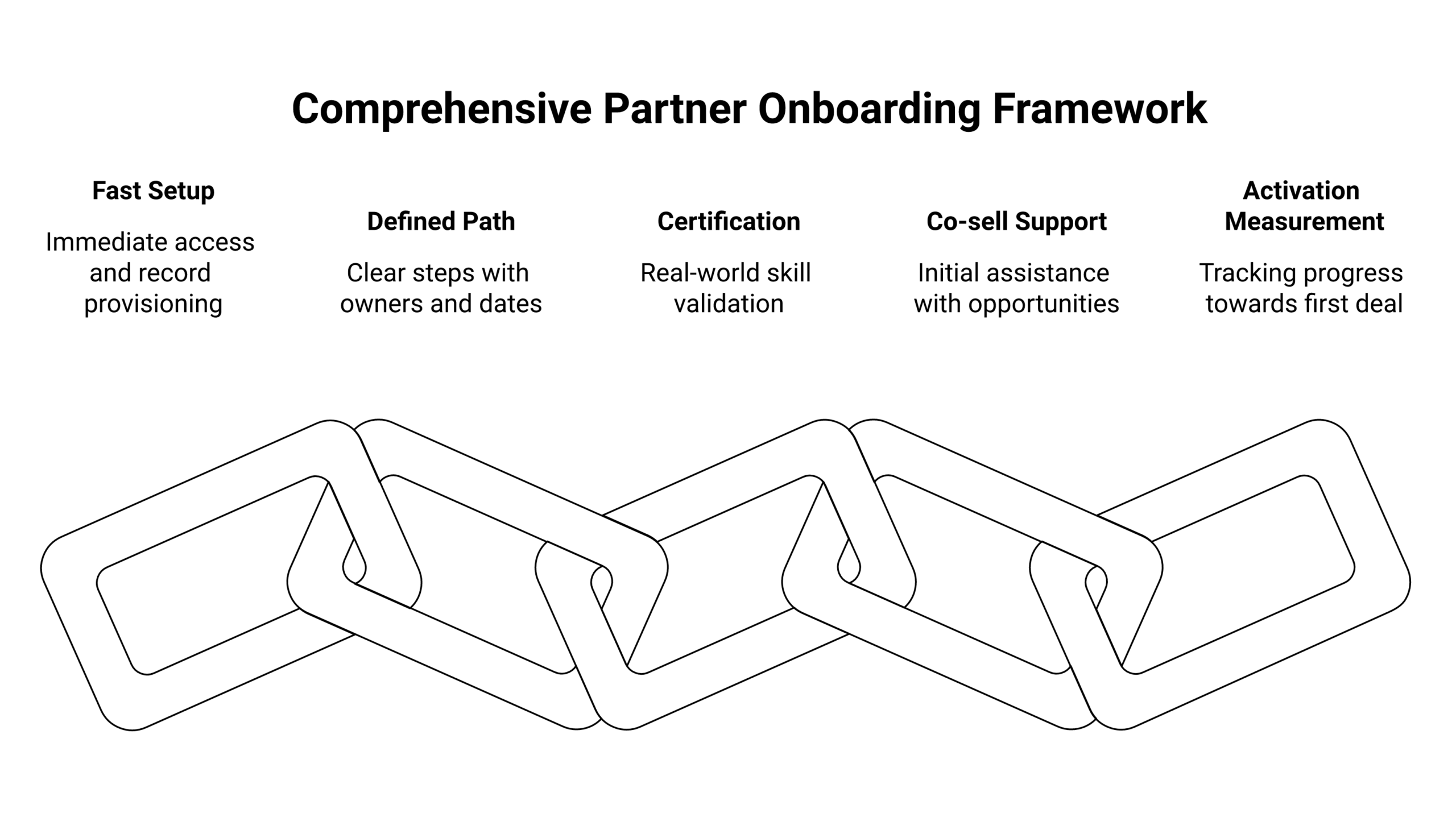
- Fast, complete setup: Provision access, records, and contacts immediately after signing, so the partner never waits on administration to get started.
- A defined path with owners: A clear sequence of steps, each with a named owner and a date, so onboarding runs the same way every time rather than depending on improvisation.
- Certification tied to capability: Training that ends in a real check the partner can pitch and qualify, not a slide they clicked, so enablement produces sellers rather than attendees.
- Early co-sell support: A first target account, deal registration access, and a named vendor contact for the first opportunity, so the partner is not left alone at the hardest moment.
- Activation measured to a first deal: A defined activation goal, time from signature to first registered deal, that the program tracks and reviews, so onboarding is judged by outcomes not completion.
Common pitfalls in partner onboarding
- Defining onboarding as done at signature: The most common failure. A signed partner is not an onboarded partner; the finish line is a first deal, and stopping at setup leaves the hardest work undone.
- Improvising every time: Onboarding that depends on which manager a partner gets produces wildly different starts. Without a repeatable path, quality is a coin flip.
- Enablement with no proof: A certification a partner clicks through certifies nothing. Best practice ties it to a real check of whether the partner can actually sell.
- Abandoning partners at the first hard deal: Training a partner and then leaving them alone when a live opportunity gets difficult teaches them to stop bringing you deals. Early co-sell support has to be real.
- Measuring completion instead of activation: Tracking how many partners finished onboarding tells you nothing about whether they sell. The number that matters is time to first deal and the share who reach one.
What this looks like in practice
A worked example: a vendor signed partners steadily but saw most go quiet within a quarter. It rebuilt onboarding around best practices: same-day provisioning, a defined path with owners and dates, a certification tied to a real pitch check, a first target account and named co-sell contact for every new partner, and an activation goal of a first registered deal within 60 days. It reviewed every partner against that goal at 30 days. Within two quarters, the share of new partners who reached a first deal roughly doubled, and time to first deal dropped sharply. Nothing about recruitment changed; the onboarding discipline behind it did, and that is what converted signatures into revenue.
Forecastable’s POV on partner onboarding
Our position is that onboarding is the highest-leverage point in a partner program and the most commonly wasted. Every program spends effort recruiting partners, but the return on that effort is decided in the first 60 days, and most programs run those days on improvisation. Getting onboarding right is cheaper than recruiting more partners and produces far more revenue per signature.
We also think best practice means measuring onboarding against a first deal, not checklist completion. It is comfortable to report that partners finished orientation and certification; it is uncomfortable and far more useful to report how many of them actually closed something and how long it took. Programs that avoid that second number are usually avoiding what it would reveal. Time to first deal is the honest measure of whether onboarding works.
Forecastable is a partnerships operating platform focused on connecting partner activity to CRM pipeline and revenue. That lens makes onboarding accountable: a team can see which newly onboarded partners register and close deals, how long activation takes, and where partners stall, so best practices are tuned against reality instead of assumed. Onboarding stops being a welcome sequence and becomes a measured driver of the forecast.
Forecastable is a partnerships operating platform. Any tools or approaches named here are independent third-party products, and naming them is not an endorsement. Adapt these partner onboarding best practices to your own product, partner types, and program.
Frequently asked questions
What are partner onboarding best practices?
They are the proven methods that take a new partner from signature to first deal quickly and consistently, including a defined path with owners, certification tied to capability, early co-sell support, and activation measured to a first deal.
What is the most important partner onboarding best practice?
Measuring onboarding to a first deal rather than to checklist completion. Defining the finish line as activation, not setup, is what turns onboarding into a revenue driver.
How long should partner onboarding take?
Short enough to reach a first-deal motion before the partner’s initial motivation fades, often a 30 to 60 day activation window, adjusted for product complexity and partner type.
How do you measure partner onboarding?
By time from signature to first registered deal and the share of new partners who reach one, rather than how many completed orientation or certification.
Why do so many signed partners never sell?
Usually because onboarding ended at setup and never carried them to a first deal. The gap between signed and selling is where most programs leak, and best practices exist to close it.
Who owns partner onboarding best practices?
Usually the partner manager or partner operations function, supported by enablement and product teams, with each step and the activation goal clearly owned and tracked.
Next step
If most of your signed partners go quiet before a first deal, the problem is onboarding discipline, not the supply of new logos. The fix is a repeatable path measured to activation and a way to see where partners stall. Forecastable helps partnerships teams connect partner activity to CRM pipeline, so onboarding is judged by first deals, not completed checklists. Start your growth journey now to make partner onboarding something you can measure. The partner program hub frames how partner onboarding best practices fit enablement and co-sell.
Uncover Your Growth Potential
Schedule a Discovery Call