AEs vs CSMs: Who Owns Partner Referrals?

What is the difference between AEs and CSMs on partner referrals?
Short answer: AEs vs CSMs on partner referrals comes down to motion: an AE owns a referral when it is a net-new sales opportunity that needs to be qualified and closed, while a CSM owns it when it is an expansion or relationship play inside an existing customer. They are not competing for the same referral; they are right for different ones.
The mistake is treating it as a turf question. It is a routing question. The referral itself tells you who should own it, if you know what to look for.
Why AEs vs CSMs matters for referrals in 2026
AEs vs CSMs ownership matters because a misrouted referral converts worse than no referral at all. Hand a net-new sales opportunity to a CSM with no quota or close motion and it stalls; hand an expansion-inside-an-account referral to an AE who does not know the customer and you create friction with the success team. The partner who made the introduction watches the referral go nowhere and learns not to bother again.
In 2026, with partner-sourced revenue under real scrutiny, a referral that dies in the wrong queue is a measurable loss. Partners are choosing where to send their best introductions based on what converts, so a routing process that reliably wastes referrals quietly redirects the whole ecosystem’s effort to your competitors. Getting the AE-versus-CSM call right is not an org-chart nicety; it is conversion.
How AEs and CSMs handle partner referrals differently
The right owner depends on the nature of the referral. The components below are the factors that decide whether an AE or a CSM should take it.
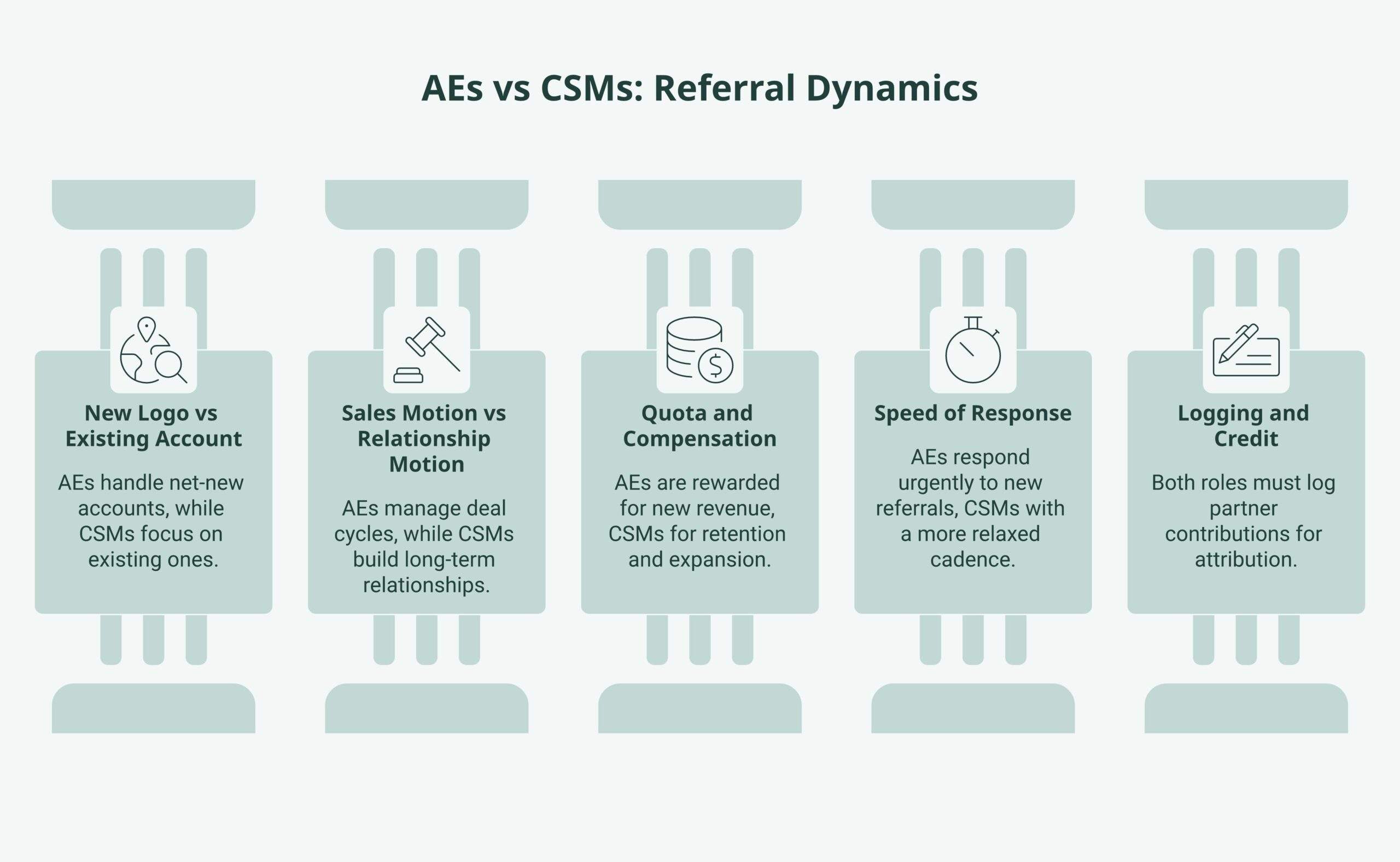
- New logo vs existing account: A referral into a net-new account is AE territory, because it needs qualification and a close motion. A referral inside a current customer is usually CSM territory, because it rides an existing relationship.
- Sales motion vs relationship motion: If the referral requires running a deal cycle, the AE owns it. If it requires deepening trust and expanding usage, the CSM is better placed.
- Quota and compensation: AEs are paid to close new revenue and CSMs to retain and expand it. Route the referral to whoever is actually compensated for the outcome it represents.
- Speed of response: Net-new referrals decay fast and need an AE’s urgency; expansion referrals can run on the CSM’s longer relationship cadence. Match the response speed to the referral type.
- Logging and credit: Whoever owns it must record the partner’s role so attribution survives the handoff. The owner changes; the obligation to credit the partner does not.
Common pitfalls in routing AE vs CSM referrals
- Defaulting every referral to the AE: Treating all partner referrals as sales leads pushes expansion plays to people who are not set up to run them, and the existing-customer relationship suffers.
- Letting the CSM hold a net-new deal: A CSM with no close motion sitting on a sales opportunity is how a hot referral goes cold. Match the motion to the owner.
- No routing rule at all: When ownership is decided ad hoc, referrals land wherever the loudest person grabs them, and conversion becomes random.
- Dropping partner credit on handoff: When a referral moves between AE and CSM, the partner’s role often gets lost in the transfer, and attribution disappears.
- Fighting over ownership in front of the partner: Internal turf disputes visible to the partner teach them their introductions cause friction, and they stop sending them.
What this looks like in practice
A team routed every partner referral to AEs by default. Net-new opportunities did fine, but referrals that were really expansions inside existing customers stalled, because the AE did not know the account and the CSM who did was never looped in. Partners noticed that half their introductions went nowhere and slowed down. The problem was not the partners or the reps; it was a routing rule that ignored what each referral actually was.
The fix was a simple routing test applied when each referral arrived: new logo to an AE, existing customer to a CSM, with the partner’s role logged in CRM regardless of owner so attribution held through the handoff. Where referrals flowed through a partner platform such as Introw or Euler, the routing tag traveled with the record. Conversion rose on both paths because each referral reached someone compensated and equipped to act on it, and partners sent more once their introductions started landing.
Forecastable’s POV on AEs vs CSMs and referrals
Our position is that ownership of a partner referral is a property of the referral, not a standing org decision. The referral tells you who should own it, new logo or existing account, sales motion or relationship motion, and a good routing rule just reads that signal. Teams that argue about AE-versus-CSM in the abstract are solving the wrong problem; the answer changes with each referral.
We also think the real risk is not who owns it but what happens to the partner’s credit when it moves. Referrals get handed off, and every handoff is a chance to lose the partner’s role in the record. The teams that keep their ecosystem healthy make partner attribution survive the transfer, because the partner is watching whether their introduction is honored, not which internal title runs it.
Finally, route for conversion, not comfort. The point of getting AE-versus-CSM right is that a referral reaches someone equipped and compensated to convert it, which is what makes partners send their next one. Connect the routing to your CRM so the owner, the motion, and the partner credit all travel together, and the referral becomes forecastable instead of a coin flip.
Forecastable is a partnerships operating platform. Any third-party tools named here are independent third-party products, and naming them is not an endorsement of one over another. Decide how AE and CSM referral ownership should work for your own team, partners, and motion.
Frequently asked questions
Who should own a partner referral, an AE or a CSM?
It depends on the referral. A net-new sales opportunity belongs with an AE who can qualify and close it; an expansion inside an existing customer belongs with a CSM who holds the relationship.
How do you decide AE vs CSM ownership of a referral?
Read the referral: new logo versus existing account, sales motion versus relationship motion, and who is compensated for the outcome. Route to whoever is equipped and paid to convert that specific type.
What happens when a referral is routed to the wrong owner?
It converts worse than no referral at all. A net-new deal stalls with a CSM who has no close motion, and an expansion creates friction when an AE works around the success team.
How do you protect partner credit when a referral changes hands?
Log the partner’s role in CRM at intake and keep that tag attached through any handoff. Attribution should survive a transfer between AE and CSM.
Should every partner referral go to sales first?
No. Defaulting all referrals to AEs pushes expansion plays to people not set up to run them. A simple routing test at intake outperforms a blanket sales-first rule.
Why do partners stop sending referrals?
Usually because their introductions stall in the wrong queue or their credit gets lost on handoff. Partners send more when referrals reliably reach someone who acts on them and honors their role.
Next step
If partner referrals keep stalling because they land with the wrong owner, a simple routing test will lift conversion on both the AE and CSM paths. Forecastable helps partnerships teams route referrals by type and keep partner credit attached through CRM, so introductions convert and partners keep sending them. Start your growth journey now to make referral routing a conversion engine. The partner program hub frames how referral ownership fits the wider motion.
Uncover Your Growth Potential
Schedule a Discovery Call