Mutual Action Plan: What It Is and How to Build One

What is a mutual action plan?
Short answer: A mutual action plan is the joint, dated roadmap that a buyer and a seller agree to follow to move a deal from evaluation to a decision and beyond, listing the milestones, the owner on each side, and the dates, across the whole pursuit rather than only the final steps to signature. It is a shared agreement about how the evaluation and purchase will actually run, owned by both parties.
A mutual action plan is broader than a closing checklist. It covers the milestones from early evaluation, demos, technical validation, business case, through approval and signature and sometimes into onboarding, so both sides can see the full path and their commitments along it.
Why a mutual action plan matters in 2026
A mutual action plan matters because complex deals fail in the gaps between milestones that nobody owned, and the plan is what assigns and dates those milestones before they become slips. When a business case stalls because no one agreed who would build it, or a technical validation drifts because the date was never set, the mutual action plan would have caught it as an owned, dated step. The shared roadmap converts a vague evaluation into a sequence both sides are accountable to.
In 2026 it matters more because buying committees are larger and evaluations longer, so the path from first meeting to decision has more milestones and more owners. A deal run without a mutual action plan relies on the champion to carry the process internally, and champions are busy and sometimes leave. The plan distributes the process across named owners and dates, so the deal does not depend on one person remembering what comes next.
There is also a buyer-experience argument. A good mutual action plan is something buyers value, because it gives them a clear view of what the evaluation requires of them and when. A deal that arrives with a shared, realistic plan signals a seller who runs a disciplined process, which is itself a reason buyers trust the eventual recommendation.
How a mutual action plan actually works
A mutual action plan is built by agreeing the decision date and working backward through the milestones, assigning a committed owner and date to each, then run as a living document both sides update. The plan covers the full pursuit, so the milestones span evaluation through decision.
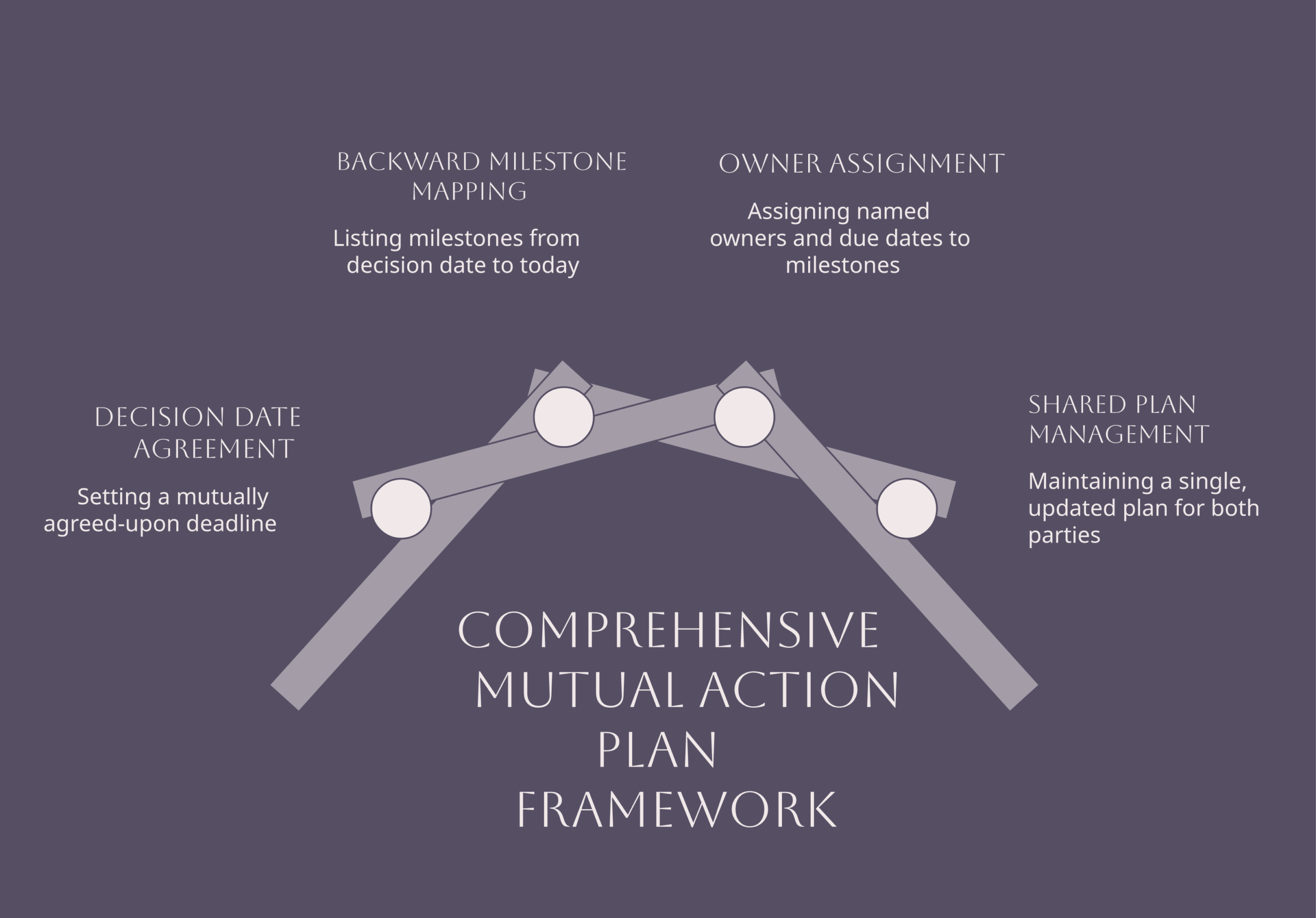
- Agree the decision date: Set the date the buyer intends to make a decision, agreed rather than imposed, so the whole plan is scheduled against a real internal deadline.
- Map the milestones backward: List the milestones from the decision date back to today, approval, business case, technical validation, demos, current step, so the plan shows the full path, not just the closing steps.
- Assign owners on both sides: Give each milestone a named owner on the buyer and seller side and a due date, so every milestone has someone accountable for moving it.
- Run one shared plan to the decision: Keep a single version both sides see and update, reschedule dependent milestones when one slips, and review it in the deal cadence so the decision date stays grounded.
A mutual action plan is working when both sides track the same milestones and dates and a slip in one visibly moves the rest, and failing when it is a seller-built document the buyer never agreed to and nobody updates.
What goes in a mutual action plan
The core of a mutual action plan is the milestone list, ordered from the decision date back to the present. The milestones should cover the buyer’s process, not just the seller’s, because the evaluation runs on the buyer’s internal steps: assembling the committee, building the business case, securing budget, completing security and legal review. A plan that lists only demos and proposals maps the seller’s activity and ignores the buyer’s, which is where the real timeline lives.
Each milestone needs an owner and a date. The owner has to be the person who actually controls the milestone, which for most buyer-side milestones is someone on the buyer’s team, not the champion acting as a proxy. The date should be agreed, not assigned, so it represents a commitment the owner has made rather than a deadline the seller hopes holds. Milestones without a committed owner and date are decoration; they make the plan look thorough without making the deal move.
The plan also benefits from a small set of explicit dependencies, the milestones that cannot start until an earlier one finishes. Marking that the security review cannot begin until the technical validation passes, for example, makes the consequences of a slip visible: when validation slips a week, the dependent milestones move with it and the decision date moves honestly rather than silently. Dependencies are what make the plan a schedule rather than a list.
The mutual action plan in a co-sell deal
In a co-sell motion the mutual action plan often has three sides, because the partner is part of the pursuit. The partner may own milestones the buyer-side process depends on, an executive introduction, a reference call, a workshop, that sit alongside the vendor’s and buyer’s milestones. A mutual action plan that names the partner’s milestones turns the co-sell relationship into scheduled contribution rather than goodwill that fades once the formal evaluation starts.
The plan also coordinates the vendor and partner so they do not duplicate or drop milestones. Without a shared plan, the vendor and partner each assume the other is driving certain steps, and milestones fall between them. The mutual action plan makes the division explicit, so the partner’s relationship strength and the vendor’s product and contract ownership are sequenced into one path rather than run as two overlapping efforts the buyer has to reconcile.
Common pitfalls with a mutual action plan
- Mapping only the seller’s milestones: A plan full of demos and proposals but light on the buyer’s internal steps misses where the timeline actually lives. Map the buyer’s process milestones explicitly.
- The champion as proxy owner: Assigning buyer-side milestones to the champion because they are easiest to reach overloads one person and hides who really controls each step. Owners should be the people who actually move the milestones.
- Dates assigned, not agreed: A plan full of dates the seller set alone is a wish list. Each date should be a commitment the owner has agreed to.
- No dependencies marked: Without explicit dependencies, a slip in one milestone does not visibly move the others, so the decision date drifts silently. Mark what depends on what.
- Never updated: A mutual action plan built once and left static stops reflecting the deal within weeks. The value is in keeping it current as milestones complete and slip.
What this looks like in practice
A seller ran a complex evaluation entirely through the champion, who promised a decision by quarter end. The champion got pulled onto another project, the business case stalled because no one else owned it, and the decision slipped two quarters. On the next deal the seller built a mutual action plan with the buying team: decision date agreed, milestones mapped backward across the full evaluation, owners named on the buyer side for the business case, security, and budget, with dates each owner agreed to. When the champion was again pulled away, the plan kept moving because other owners carried their milestones. The deal reached a decision on schedule. The evaluation was no simpler; distributing it across owned, dated milestones is what kept it from depending on one person.
Forecastable’s POV on the mutual action plan
Our position is that a mutual action plan earns its keep by mapping the buyer’s process, not the seller’s. Sellers naturally fill a plan with their own activities, demos, proposals, follow-ups, because those are the steps they control, but the deal’s real timeline runs on the buyer’s internal milestones: committee, business case, budget, security, legal. A plan that maps the seller’s half thoroughly and the buyer’s half vaguely is detailed about the part that was never going to slip and silent about the part that will. The discipline is to map the buyer’s process in their language and get their owners to commit to it.
The second conviction is that a mutual action plan is insurance against champion dependence. Most stalled deals were running through a single champion who carried the process internally until they could not, and the plan is what distributes that process across named owners so the deal survives the champion being busy or gone. In co-sell this extends to the partner, whose milestones, named and dated, mean the relationship contributes on a schedule rather than as a favor that fades. A plan that names every owner is a plan that does not collapse when any one of them steps away.
The third conviction is that the mutual action plan and the close plan are the same instinct at different scopes, and a program benefits from running both. The mutual action plan covers the whole pursuit from evaluation to decision; the closing steps to signature are the final segment of it, sharp enough to run as their own checklist. Treating them as one undifferentiated document makes the closing steps too diffuse to drive and the early milestones too detailed to maintain. Keep the scopes distinct and each does its job.
Forecastable is a partnerships operating platform; any third-party tools or methods referenced here are independent and naming them is not an endorsement of one approach over another. Build the mutual action plan around your own deal, partner, and buying committee.
Frequently asked questions
What is a mutual action plan?
The joint, dated roadmap a buyer and seller agree to follow to move a deal from evaluation to a decision, listing milestones, owners on both sides, and dates across the whole pursuit.
What goes in a mutual action plan?
A decision date, the milestones from evaluation through decision mapped backward, an agreed owner and date on each, the buyer’s internal process steps, and marked dependencies between milestones.
How is a mutual action plan different from a close plan?
A mutual action plan covers the full pursuit from evaluation to decision; a close plan focuses on the final steps to signature. The closing steps are the last segment of the broader plan.
Who owns the milestones in a mutual action plan?
The people who actually control each milestone, which for most buyer-side steps is someone on the buyer’s team rather than the champion acting as a proxy for all of them.
Where does the partner fit in a co-sell mutual action plan?
As a third owner of milestones the buyer process depends on, an executive introduction, a reference, a workshop, named and dated alongside the vendor’s and buyer’s milestones.
Why do buyers value a mutual action plan?
Because it gives them a clear, realistic view of what the evaluation requires of them and when, which signals a disciplined seller and makes the eventual recommendation easier to trust.
Next step
If your deals depend on one champion carrying the process, a mutual action plan is how you distribute it across owned, dated milestones. Forecastable helps partnerships and revenue teams keep the joint path to a decision visible and owned, so deals do not stall in the gaps. Start your growth journey now to run your pursuits on a shared plan. The co-sell hub frames how joint deals progress, and the related mutual action plan template gives you a structure to start from.
Uncover Your Growth Potential
Schedule a Discovery Call