Skip to content
Logo — It’s All AboutThe Team
  • Home
  • Who We Serve
    • By Category
      • SaaS
      • Professional Services
      • Platforms (Large Ecosystems)
      • Private Equity
    • By Role
      • Chief Revenue Officers (CRO)
      • Chief Financial Officers (CFO)
      • Chief Marketing Officers (CMO)
      • Chief Executive Officers (CEO)
      • Sales Leaders
      • Partnership Professionals
  • Solutions
    • By Partner Program Maturity
      • Partnerships Foundation
      • Partnerships Acceleration
      • Ecosystem-Wide Orchestration
    • Specialized Solutions
      • Net-New Named Account Development
      • Large Ecosystems
      • M&A: Post-Acquisition Internal Cross-Selling
  • Education
  • Company
    • Our History
    • Security
  • Login
Logo — It’s All AboutThe Team
  • Home
  • Who We Serve
    • By Category
      • SaaS
      • Professional Services
      • Platforms (Large Ecosystems)
      • Private Equity
    • By Role
      • Chief Revenue Officers (CRO)
      • Chief Financial Officers (CFO)
      • Chief Marketing Officers (CMO)
      • Chief Executive Officers (CEO)
      • Sales Leaders
      • Partnership Professionals
  • Solutions
    • By Partner Program Maturity
      • Partnerships Foundation
      • Partnerships Acceleration
      • Ecosystem-Wide Orchestration
    • Specialized Solutions
      • Net-New Named Account Development
      • Large Ecosystems
      • M&A: Post-Acquisition Internal Cross-Selling
  • Education
  • Company
    • Our History
    • Security
  • Login
  • Home
  • Who We Serve
    • By Category
      • SaaS
      • Professional Services
      • Platforms (Large Ecosystems)
      • Private Equity
    • By Role
      • Chief Revenue Officers (CRO)
      • Chief Financial Officers (CFO)
      • Chief Marketing Officers (CMO)
      • Chief Executive Officers (CEO)
      • Sales Leaders
      • Partnership Professionals
  • Solutions
    • By Partner Program Maturity
      • Partnerships Foundation
      • Partnerships Acceleration
      • Ecosystem-Wide Orchestration
    • Specialized Solutions
      • Net-New Named Account Development
      • Large Ecosystems
      • M&A: Post-Acquisition Internal Cross-Selling
  • Education
  • Company
    • Our History
    • Security
  • Login
Back to all blogs
  • Partnerships Forecasting
Alex Buckles

Forecast Collaboration Feature: What to Look For

A partnerships lead and a partner rep at a wall monitor working a forecast collaboration feature, both editing the same joint deal list with stage and close-date fields visible, a finance partner checking the committed number on a printout, deep navy and warm amber palette

What is a forecast collaboration feature?

Short answer: A forecast collaboration feature is the capability in a revenue or partnerships system that lets two sides who influence the same deals, internal sellers and the partners co-selling with them, build and adjust one forecast together instead of maintaining separate, private estimates. It exists so the joint pipeline is forecast from a shared view rather than from two numbers that only meet at quarter end.

The capability is narrow and specific. It is not a dashboard that shows two pipelines side by side; it is the mechanism that lets both parties act on the same opportunities, agree on stage and timing, and produce a number both will stand behind.

Why a forecast collaboration feature matters in 2026

A forecast collaboration feature matters because partner-influenced revenue is now a real share of pipeline, and a forecast that cannot incorporate what partners know is structurally incomplete. When the partner working a deal sees a budget freeze the internal rep has not heard about, the capability is what gets that signal into the committed number before the quarter closes on a surprise.

In 2026 it matters more because revenue leaders increasingly hold partner pipeline to the same forecasting standard as direct. A program whose tooling cannot collaborate on the forecast produces a partner number that swings, and a number that swings gets discounted to zero in planning. The capability is what makes partner pipeline credible enough to commit.

There is also an efficiency argument. Reconciling forecasts over email and spreadsheets is slow and lossy, and the loss usually lands on the partner number because it is the one nobody owns end to end. A purpose-built capability removes the manual reconciliation and replaces it with a shared, current view.

How a forecast collaboration feature actually works

A working forecast collaboration feature runs as a short loop that turns two private estimates into one agreed number, where each step depends on the one before it. The loop is the mechanism; a screen that only displays both pipelines without letting either side change the shared number is reporting, not collaboration.
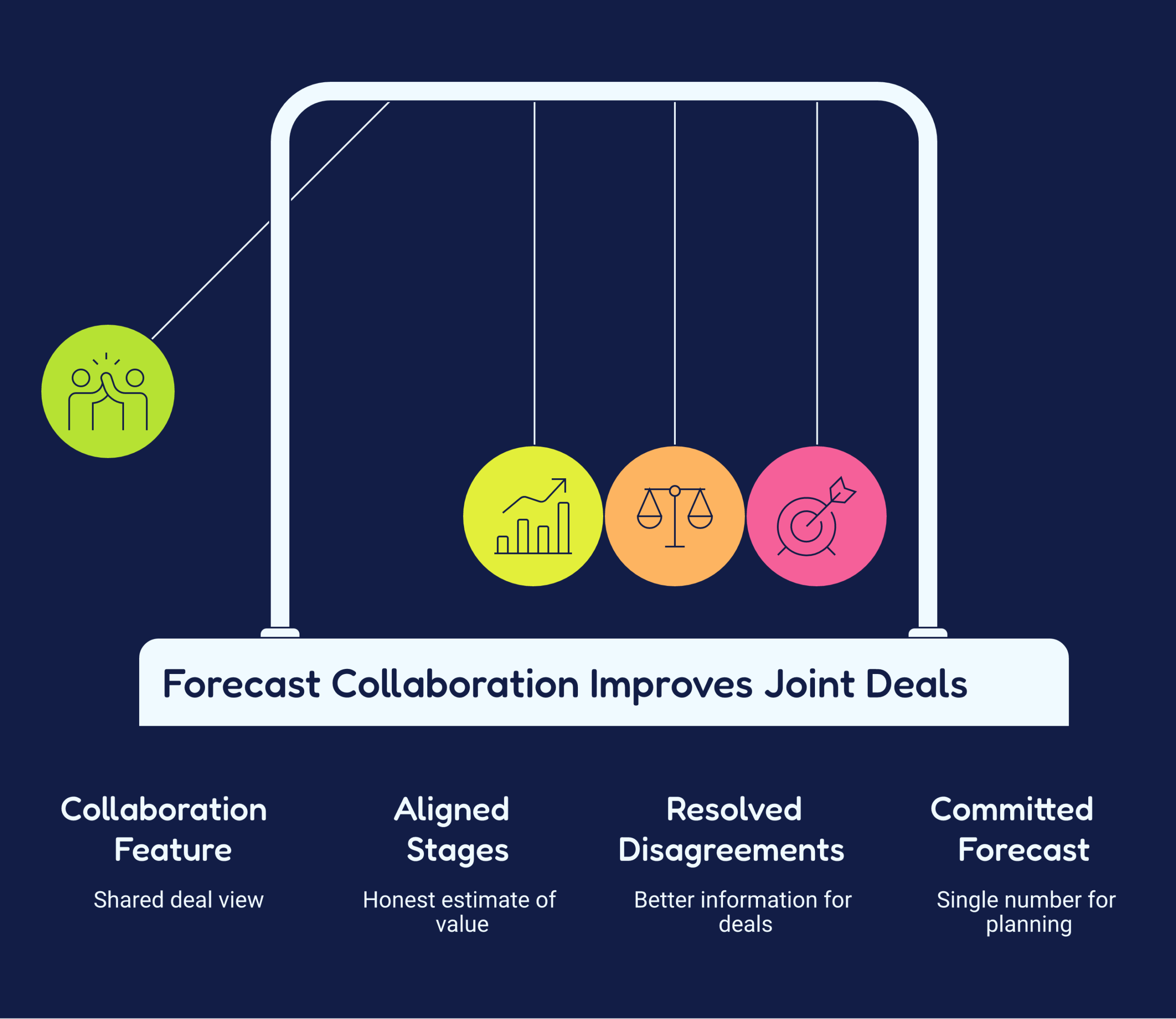
Diagram of how a forecast collaboration feature works as a loop, sharing one joint deal view, aligning on stage and timing, reconciling disagreements, and committing one number into planning

  1. Share one joint deal view: The capability puts the opportunities both sides are working into a single list both can see and edit, so every conversation starts from the same deals rather than two private pipelines.
  2. Align on stage and timing: Both sides set where each deal actually sits and when it is likely to close, reconciling the optimistic and cautious reads into one honest estimate of stage and value.
  3. Reconcile the disagreements: The capability surfaces where the partner and the internal team differ, a deal one side still counts and the other has written off, and routes it to be resolved with the better information.
  4. Commit one number into planning: It produces a single forecast for the joint pipeline that both sides stand behind and pushes that number into the company forecast, so collaboration ends in a committed line rather than a private agreement.

The capability is working when the partner and the internal team describe the same deals the same way and the joint number reaches the plan, and failing when each still carries a private estimate that only meets reality at the end of the quarter.

What the capability includes in detail

The most important part of a forecast collaboration feature is the shared deal view, because every other part depends on it. Without one trusted list of the jointly worked opportunities, the rest of the capability has nothing to operate on, and the two sides spend their time arguing about which list is right instead of improving the forecast. The shared view should carry the fields that matter for forecasting, stage, expected close, and value, and keep them current for both sides.

The second part is permissioned editing. Collaboration means both sides can change the shared estimate, not that one side publishes a number the other can only read. The capability has to let the partner contribute what they know and let the internal team incorporate it, with a clear record of who changed what, so the reconciliation is real rather than one-directional.

The third part is the reconciliation surface, the place where disagreements are made visible and resolved. A capability that quietly averages two numbers hides the exact information that makes collaboration valuable. The disagreement is the signal; the capability should expose it, not smooth it over, so the better-informed side can correct the estimate.

The fourth part is the path to planning. A forecast that lives only inside the collaboration screen is a private agreement that improves nobody’s plan. The capability has to route the committed joint number into the company forecast and the planning model, because that handoff is the entire reason to do the work.

Common pitfalls with a forecast collaboration feature

  • Mistaking side-by-side display for collaboration: A screen that shows two pipelines next to each other lets you compare numbers, not reconcile them. The capability has to let both sides change one shared estimate, or it is just a fancier report.
  • No shared data underneath: A collaboration surface sitting on top of two disconnected systems inherits their disagreement. Align the deal data first, then the forecast capability has something real to work on.
  • Read-only for the partner: If the partner can see the forecast but not contribute to it, the capability captures none of the information advantage that made the partner worth forecasting. Collaboration requires permissioned editing on both sides.
  • No route to planning: A committed joint number that stays inside the tool produces no benefit. The capability is incomplete until that number reaches the finance planning model.
  • Treating it as a quarterly event: A capability used once a quarter drifts immediately. The forecast collaboration feature earns its value on a recurring cadence, not at a single alignment meeting.

What this looks like in practice

A software company with a growing co-sell motion kept arriving at quarterly reviews with a partner-influenced number that finance discounted because it swung quarter to quarter. The partnerships team moved the joint pipeline into a shared view both they and their partners could edit, ran a short biweekly pass to align stage and timing, and made disagreements explicit rather than averaging them away. The committed joint number then flowed into the company forecast on the same cadence as direct pipeline. Within two quarters the partner-influenced line was stable enough that finance included it at full value. The deals did not change; the capability to forecast them together is what made the number usable.

Forecastable’s POV on the forecast collaboration feature

Our position is that the value of the capability is entirely in the shared, editable view of the joint pipeline, not in the screen on top of it. The appealing parts of forecast collaboration, the reconciliation, the partner’s information reaching the number, the committed joint line, are all impossible without one current view both sides can act on. Teams that buy a collaboration screen without first aligning the underlying deal data get the screen and none of the benefit, because the capability is only as good as the data it operates on.

The second conviction is that the capability has to expose disagreement rather than hide it. A forecast collaboration feature that quietly averages two estimates is discarding the exact thing that made collaboration worth doing. The partner’s dissent, a deal they have written off that the internal rep still counts, is information; the capability should surface it and route it to resolution, because that is where the partner’s knowledge becomes the company’s forecast. Smoothing it over produces a number that looks agreed and is not.

Forecastable is a partnerships operating platform; any third-party tools or methods referenced here are independent and naming them is not an endorsement of one approach over another. Evaluate any forecast collaboration feature against your own pipeline, partners, and planning model.

Frequently asked questions

What is a forecast collaboration feature?
The capability in a revenue or partnerships system that lets internal sellers and their partners build and adjust one forecast of the deals they work together, from a shared view, instead of keeping two separate estimates.

How is it different from a forecasting dashboard?
A dashboard displays pipeline; a forecast collaboration feature lets both sides change one shared estimate and reconcile their differences. Display is one-directional; collaboration is two-directional.

Who uses a forecast collaboration feature?
The internal account team and the partner reps who hold deal information, plus partnerships and finance who consume the committed number and route it into the plan.

What should a forecast collaboration feature include?
A shared joint deal view, permissioned editing for both sides, a surface that exposes and resolves disagreements, and a path that routes the committed number into the planning model.

Does a forecast collaboration feature require shared data?
Yes. The capability is only as reliable as the joint deal view underneath it; without aligned, current data, the reconciliation degrades into an argument about whose list is correct.

How often should the capability be used?
Often enough that the forecast stays current, frequently biweekly during active quarters, with a disciplined pass that changes estimates based on new information rather than just restating them.

Next step

If your partner pipeline and your partners’ pipeline are two different numbers, a forecast collaboration feature is how they become one. Forecastable helps partnerships and revenue teams forecast the joint pipeline from a shared view, so partner pipeline is credible enough to commit. Start your growth journey now to make the joint forecast a collaborative number. The forecastability hub frames how a reliable partner forecast fits the wider revenue picture, and the forecast collaboration process shows how to run the loop the capability supports.

Uncover Your Growth Potential

Whether starting with a single sales team or a single partner, any co-sell motion can be live within 30 days.

Schedule a Discovery Call
Latest Insights
A revenue operations lead and a partner manager evaluating a forecast collaboration solution on a shared screen, the display showing reconciled partner and internal deals in one pipeline view, a finance lead nodding at the committed number, deep navy and warm amber palette
  • Partnerships Forecasting
Alex Buckles

Forecast Collaboration Solution: What to Look For

What is a forecast collaboration solution? Short answer: A forecast collaboration solution is the combination of shared data, agreed process, and the capability to reconcile estimates that lets a company and its partners produce one revenue forecast instead of two conflicting ones. It is less a single product than a set of capabilities, a shared […]

Read Article
Two professionals discuss a whiteboard diagram titled 'Partner Forecast Strategy' in a bright office as a colleague reads a document at the table.
  • Partnerships Forecasting
Alex Buckles

Forecast Collaboration Strategy: A Practical Guide

What is a forecast collaboration strategy? Short answer: A forecast collaboration strategy is the deliberate plan for how a company and its partners build one revenue forecast together, defining who is involved, what data they share, how often they reconcile, and how the joint number reaches the planning model. It turns ad hoc forecast conversations […]

Read Article
A partnerships lead and a partner rep building a shared forecast on a wall monitor, both pointing at the same deal list with overlapping accounts highlighted, a finance partner taking notes beside them, deep navy and warm amber palette
  • Partnerships Forecasting
Alex Buckles

What Is Forecast Collaboration? A Clear Definition

What is forecast collaboration? Short answer: Forecast collaboration is the practice of building a single revenue forecast jointly across the parties who influence it, internal sales, finance, and the partners co-selling the deals, working from shared data instead of separate, conflicting guesses. It replaces the situation where a company forecasts its own pipeline and its […]

Read Article
A partner manager and a finance lead listing the elements for forecast collaboration on a glass board, a shared joint deal view open on a laptop beside them, an internal AE adding a close date to the same list, deep navy and warm amber palette
  • Partnerships Forecasting
Alex Buckles

Elements for Forecast Collaboration: The Core 5

What are the elements for forecast collaboration? Short answer: The elements for forecast collaboration are the five parts that have to be present for a company and its partners to build one revenue forecast together: a shared view of the joint deals, a defined set of participants, aligned definitions of stage and timing, a recurring […]

Read Article
Logo — It’s All AboutThe Team

Quick Links

  • Who We Serve
  • Solutions
  • Resources
  • Pricing
  • Our History

Social Media

  • Linkedin

Legal

  • Privacy Policy
  • Terms of Service
Quick Links
  • Who We Serve
  • Solutions
  • Resources
  • Pricing
  • Our History
Social Media
  • Linkedin
Legal
  • Privacy Policy
  • Terms of Service

Stay ahead on ecosystem-led growth

Logo — It’s All AboutThe Team
© 2025 Forecastable. All rights reserved.
Book Your Strategy Call
Request Enrollment Details

[contact-form-7 id=”dfbeed3″ title=”Request Enrollment Details”]

Mollie Bodensteiner

Revops Advisory
  Mollie Bodensteiner is an experienced operations professional with a demonstrated track record of utilizing technology to support operational processes that drive performance and innovation. She currently is the Vice President of Operations at Sound and owns go-to-market agency, MB Solutions. Mollie has previously held operations leadership roles at Deel, Syncari, Corteva and Marketo. She has over 14 years of experience in both B2C and B2B operations and technology. When she is not working, Mollie enjoys spending time with her husband, three small children, and two large dogs. Childhood Career/Dream: Growing up in the age of Disney and Nick@Nite I always wanted to be a child actor (good thing that never was actually pursued 🙂 Favorite Win: I am not sure I have a specific “win” but I think I get the most joy and excitement from coaching others and watching them hit major milestones in their career. The first time you get to promote someone on your team or watch them lead a major project – are always career highlights! Personal Fun Facts: Favorite Song: If it’s love, Train Favorite Movie: Good Will Hunting Favorite Meme: Disaster Girl
Forecastable resources: Co-Sell Orchestration Platform · All Use Cases · Live in 30 Days · Co-Sell Playbook

Kelsey Buckles

Director of Operations


My journey from Education to Operations has equipped me with a unique perspective and skill set that perfectly aligns with Forecastable’s mission to help businesses improve sales collaboration through partner co-selling strategies.

At Forecastable, I am passionate about empowering teams and organizations to unlock the full potential of strategic partnerships. By leveraging my expertise in communication, leadership, and operational efficiency, I contribute to creating seamless co-selling processes that align with business goals and deliver exceptional results.

The intersection of my educational foundation and operational experience fuels my dedication to fostering alignment, building trust, and enhancing collaboration between partners. I am driven by the opportunity to contribute to a platform that not only optimizes sales strategies but also strengthens relationships that lead to long-term growth.

Paul Jonhson

Chief Technology Officer (Co-founder)


Paul Johnson has 20+ years of software development and consulting experience for a variety of organizations, ranging from startups to large-enterprise organization with highly-complex needs.

Mr. Johnson has a long track record of successful technology deployments.
This, combined with his deep passion for machine learning and exceptional user experience design, allows him to lead our technical direction from the front with confidence.

Alex Buckles

Product, Partnerships, and Value Engineering (Co-founder)


After serving in The United States Marine Corps, Alex Buckles spent the next two decades as a student of revenue production and an advocate for innovation.

Along the way, he has helped numerous companies achieve double and triple-digit growth by crafting and executing high-performing go-to-market strategies, with co-selling at the center of each.

As a once-advanced technical marketer, an expert sales & partner professional, and a strong customer success advocate, Mr. Buckles understands the impact of these functions aligning not only on revenue production, but on the day-to-day execution of the go-to-market strategy. This concept of revenue-team alignment is what quickly became the foundation of Forecastable back in January of 2018.

In his free time, you’ll find him spending quality time with his children, one of whom is on the autism spectrum. 1 in 36 children in the U.S. are on the spectrum and boys are four times more likely to be diagnosed than girls.

With that in mind, Mr. Buckles plans on dedicating the rest of his life serving those living with autism, through his organization Pathways for Autism. From his perspective, there must be a scalable and financially self-sustaining infrastructure established to put as many individuals with autism as possible on a path towards complete independence as adults.