Forecast Collaboration Strategy: A Practical Guide

What is a forecast collaboration strategy?
Short answer: A forecast collaboration strategy is the deliberate plan for how a company and its partners build one revenue forecast together, defining who is involved, what data they share, how often they reconcile, and how the joint number reaches the planning model. It turns ad hoc forecast conversations into a repeatable system that makes partner pipeline credible enough to commit.
The strategy exists because collaboration does not happen by goodwill. Two organizations forecasting the same deals will drift into two different numbers unless there is a designed way to align them, and the strategy is that design.
Why a forecast collaboration strategy matters in 2026
The strategy matters because partner-influenced revenue is now expected on the forecast, and an unstrategized collaboration produces a partner number nobody trusts. When partners and the internal team align only occasionally and informally, the joint forecast swings, finance discounts it, and the program loses the credibility it needs to be funded. A strategy stabilizes the number by making alignment routine instead of occasional.
In 2026 the stakes are higher because revenue leaders are applying the same forecasting rigor to partner pipeline that they apply to direct. A company that can present a reconciled, partner-informed forecast earns a real line in the plan; one that presents a directional guess gets it discounted to zero. The forecast collaboration strategy is what moves partner pipeline from “interesting” to “committable.”
There is also an information argument. Partners often see things in a deal the internal rep does not, a competing evaluation, a budget shift, a champion leaving, and a strategy for collaboration is how that knowledge reaches the forecast systematically rather than by accident. Without a strategy, the information advantage of having partners in the deal is left on the table.
How a forecast collaboration strategy actually works
A working strategy is built from five components that operate together, where each one makes the next possible. Assemble them in order and collaboration becomes a system rather than a series of meetings.
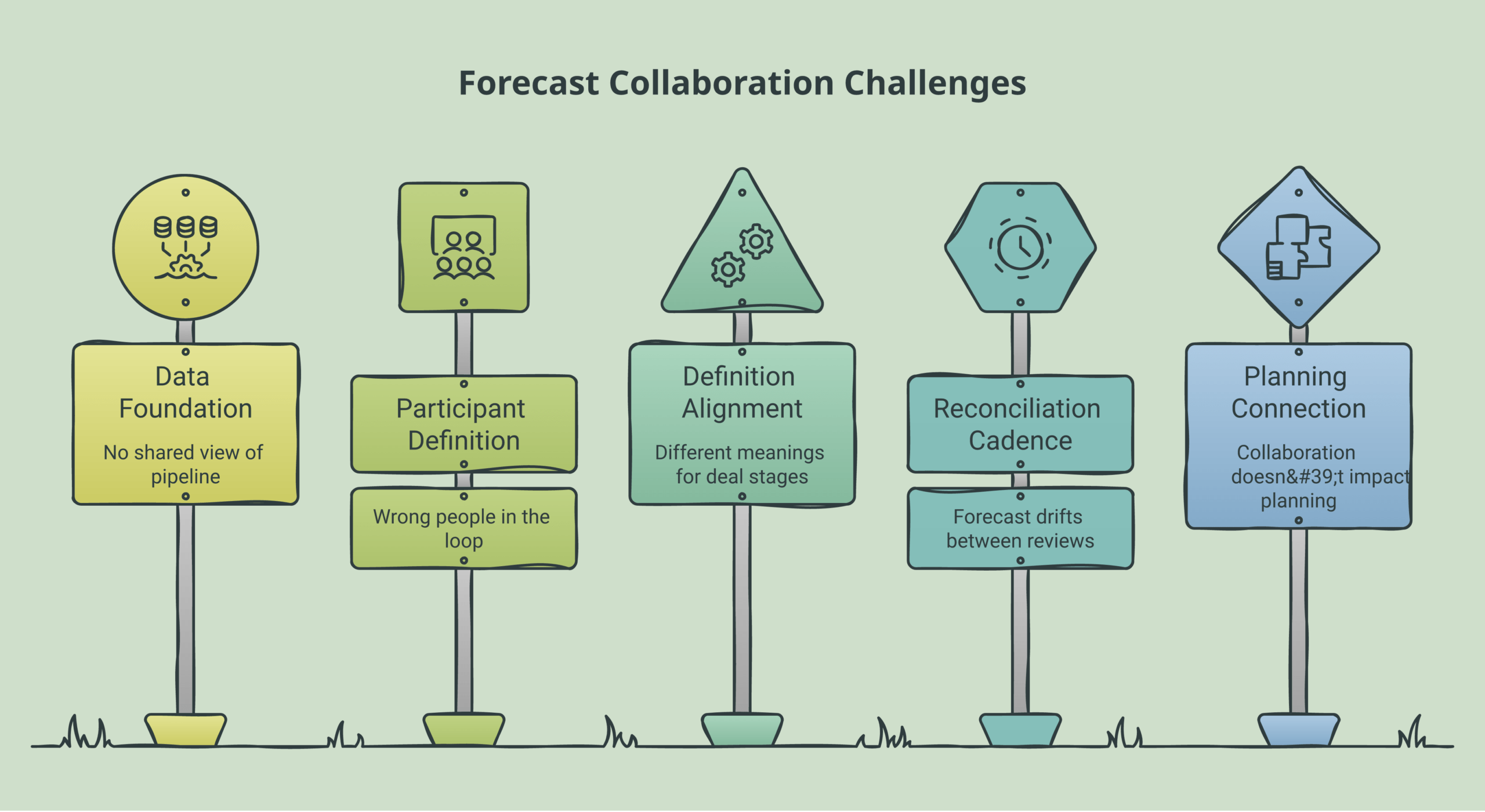
- Build the shared data foundation: Establish one view of the jointly worked pipeline that both the company and the partner can see, so every conversation starts from the same deals rather than two private lists.
- Define the participants: Name who collaborates, the partner reps, the internal account team, partnerships, and finance, so the right knowledge and the eventual consumer of the forecast are both in the loop.
- Align the definitions: Agree on what each deal stage means and how timing and value are estimated, so the two sides are measuring the same thing before they try to reconcile.
- Set the reconciliation cadence: Schedule a recurring, short pass to align stage, timing, and value and to surface disagreements, so the forecast stays current instead of drifting between quarterly reviews.
- Connect to planning: Route the reconciled joint number into the company forecast and the planning model, so collaboration produces a committed line rather than a private agreement.
The strategy is working when the company and the partner consistently forecast the same deals the same way and the joint number lands in the plan, and failing when alignment happens only at quarter end and the partner pipeline is discounted because nobody trusts it.
The data foundation in detail
The first and most important component is shared data, because every other part of the strategy depends on it. Without one view of the joint pipeline, collaboration degrades into two parties reading separate spreadsheets at each other, which can restate numbers but cannot reconcile them. The data foundation does not have to be elaborate; it has to be shared, current, and trusted by both sides.
A practical data foundation identifies the deals both parties are working, attaches the fields that matter for forecasting, stage, expected close, and value, and keeps them visible to both the partner and the internal team. The investment here is what makes the rest of the strategy real. Teams that try to collaborate on the forecast without first aligning the data spend their meetings arguing about which list is right instead of improving the number.
The participants and definitions in detail
The second and third components decide who is in the room and whether they are speaking the same language. The participant set should include the people who hold information, the partner reps and internal account team, and the people who consume the forecast, partnerships leadership and finance. Leaving finance out is a common error, because the most carefully reconciled number is useless if it never reaches the planning model.
Aligned definitions prevent the subtler failure, where two parties reconcile diligently but mean different things by the same words. If the partner’s “commit” stage is the vendor’s “best case,” the reconciliation produces a number that looks agreed but is not. The strategy fixes this by agreeing on stage definitions, timing conventions, and value treatment up front, so the collaboration reconciles real differences rather than vocabulary mismatches.
The cadence and planning connection in detail
The final two components turn alignment into a habit and a habit into a committed number. The reconciliation cadence is the recurring, short pass where the two sides align stage and timing and surface disagreements. It should be frequent enough that the forecast stays current, often biweekly during active quarters, and disciplined enough that it changes estimates rather than just restating them. A cadence that produces no changed numbers is a status meeting, not a reconciliation.
The planning connection is what makes the whole strategy pay off. A reconciled joint forecast that lives only between the partner and the partnerships team is a private agreement; one that flows into the company forecast and the planning model is a committed line that the program can be funded against. The strategy is not complete until the collaborative number has a path into the plan, because that path is the reason to do the work.
Common pitfalls in a forecast collaboration strategy
- Skipping the data foundation: Collaborating without one shared deal view turns reconciliation into an argument about whose list is right. Align the data before the forecast.
- Excluding finance: A reconciled number that never reaches the planning model produces no benefit. Include the team that consumes the forecast from the start.
- Misaligned definitions: Reconciling without agreeing on stage and timing meanings produces a number that looks agreed but is not. Align the language first.
- Cadence without change: A recurring meeting where no estimate moves is a status update, not collaboration. The cadence has to reconcile, not just report.
- No path to planning: A joint forecast that stays between partnerships and the partner is a private agreement. Connect it to the plan or the strategy produces nothing committable.
What this looks like in practice
A software company with a growing co-sell motion kept presenting a partner-influenced forecast that swung by large margins quarter to quarter, so finance stopped counting it. The partnerships leader built a forecast collaboration strategy from the components: first a shared view of the jointly worked deals, then a named participant set that included a finance partner, then agreed stage definitions, then a biweekly reconciliation, and finally a path that routed the joint number into the company forecast. Two quarters later the partner-influenced number was stable enough that finance included it in the plan at full value rather than discounting it. The strategy did not create new pipeline; it made the existing partner pipeline reliable enough to commit, which is what the program had been missing.
Forecastable’s POV on forecast collaboration strategy
Our position is that the strategy lives or dies on the data foundation. Everything appealing about forecast collaboration, the reconciliation, the shared commit, the partner information reaching the number, is impossible without one shared view of the joint pipeline underneath it. Teams that try to skip straight to collaborative meetings without aligning the data get the meetings and none of the benefit. Invest in the shared view first, and the rest of the strategy has something real to stand on.
The second conviction is that the strategy is incomplete until the number reaches planning. A reconciled forecast that stays between the partner and the partnerships team is a private agreement that improves nobody’s plan. The reason to run the collaboration is to produce a partner number credible enough to commit, and credibility only matters if the number is actually consumed by finance in the planning model. Design the path to planning into the strategy from the start, because without it the collaboration is effort that produces a document, not a forecast.
The third conviction is that reconciliation has to change estimates to count. The recurring cadence is the engine of the strategy, but a cadence where no number ever moves is just a status meeting in disguise. The discipline that makes collaboration worth the time is surfacing real disagreements, a deal one side counts and the other has written off, and resolving them with the better information. That is where the partner’s knowledge becomes the company’s forecast.
Forecastable is a partnerships operating platform; any third-party tools or methods referenced here are independent and naming them is not an endorsement of one approach over another. Build the strategy around your own pipeline, partners, and planning model.
Frequently asked questions
What is a forecast collaboration strategy? A deliberate plan for how a company and its partners build one revenue forecast together, covering shared data, participants, aligned definitions, a reconciliation cadence, and a path into planning.
What are the components of a forecast collaboration strategy? A shared data foundation, a defined participant set, aligned stage and timing definitions, a recurring reconciliation cadence, and a connection that routes the joint number into the planning model.
Why do companies need a strategy for this instead of just collaborating? Because collaboration drifts without design. Two organizations forecasting the same deals will reach different numbers unless there is a planned way to align them, which is what the strategy provides.
Who should be involved in forecast collaboration? The partner reps and internal account team who hold deal information, plus partnerships leadership and finance who consume the forecast and route it into the plan.
How often should partners and the company reconcile the forecast? Often enough to stay current, frequently biweekly during active quarters, with a disciplined pass that changes estimates based on new information rather than just restating them.
What is the hardest part of a forecast collaboration strategy? Usually the shared data foundation. Without one trusted view of the joint pipeline, every later step degrades into arguing about which list is correct.
How does the strategy make partner pipeline credible? By producing a reconciled, partner-informed number on a reliable cadence and routing it into planning, so finance can include it at full value instead of discounting an unstable guess.
Next step
If your partner forecast swings too much to be trusted, a forecast collaboration strategy is how you stabilize it. Forecastable helps partnerships and revenue teams build the shared data foundation and cadence that make partner pipeline credible enough to commit. Start your growth journey now to design the strategy around your motion. The forecastability hub frames how a reliable partner forecast fits the wider revenue picture, and the related what is forecast collaboration defines the practice the strategy operationalizes.
Uncover Your Growth Potential
Schedule a Discovery Call