Forecast Collaboration Solution: What to Look For

What is a forecast collaboration solution?
Short answer: A forecast collaboration solution is the combination of shared data, agreed process, and the capability to reconcile estimates that lets a company and its partners produce one revenue forecast instead of two conflicting ones. It is less a single product than a set of capabilities, a shared deal view, aligned definitions, a reconciliation workflow, and a path into planning, that together make partner pipeline reliable enough to commit.
The word “solution” matters here because the problem is not lack of effort, it is lack of a shared mechanism. Companies and partners already talk about deals; what they lack is a structured way to see the same pipeline and reconcile it, which is what a forecast collaboration solution provides.
Why a forecast collaboration solution matters in 2026
A solution matters because manual, meeting-based collaboration does not scale and does not hold. When alignment depends on two teams remembering to compare spreadsheets, the forecast drifts the moment attention moves elsewhere, and the partner number loses the stability that makes it trustworthy. A solution makes the shared view and the reconciliation routine instead of dependent on goodwill.
In 2026 it matters more because revenue leaders expect partner-influenced pipeline to be forecast with the same discipline as direct, and that discipline is hard to sustain by hand across organizational boundaries. A forecast collaboration solution gives partner pipeline the same kind of operating support that the direct forecast already has, which is what lets it earn a committed line in the plan rather than a discount.
The need also grows with the ecosystem. A company co-selling with many partners cannot run a reliable joint forecast through a patchwork of side conversations. A solution that holds one shared view across partners is what keeps the partner forecast coherent as the program scales beyond a handful of relationships.
How a forecast collaboration solution actually works
A solution works by delivering five capabilities that operate as a system, where each capability makes the next usable. Evaluate any solution against this set, however it is assembled.
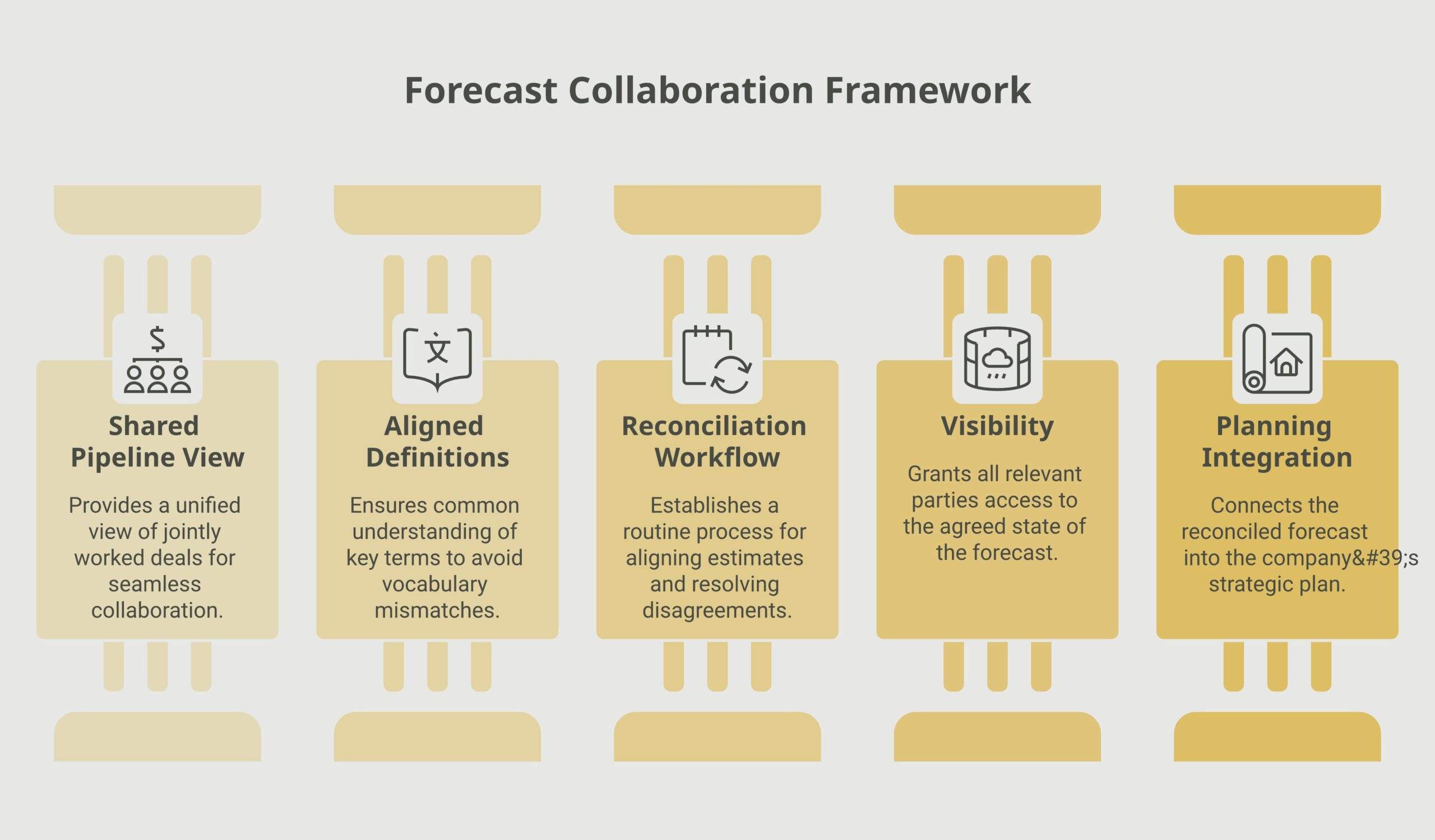
- Provide a shared pipeline view: Give the company and its partners one view of the jointly worked deals, so collaboration starts from the same data rather than two private lists.
- Enforce aligned definitions: Hold a common understanding of stage, timing, and value, so the two sides reconcile real differences rather than vocabulary mismatches.
- Support a reconciliation workflow: Make it routine to align estimates and surface disagreements on a cadence, so the forecast stays current instead of drifting between reviews.
- Give every party visibility: Let partners, the internal team, partnerships, and finance see the agreed state, so the number is transparent rather than held privately by one side.
- Connect into planning: Route the reconciled joint forecast into the company plan, so collaboration produces a committed line rather than a side agreement.
The solution is working when partners and the internal team consistently forecast the same deals the same way and the joint number reaches the plan, and falling short when any capability is missing, because a gap in one breaks the chain.
What capabilities to look for
When evaluating a forecast collaboration solution, the first capability to scrutinize is the shared pipeline view, because it is the foundation everything else rests on. The view should let both the company and its partners see the same jointly worked deals with the fields that drive the forecast, and it should stay current without heavy manual upkeep. A solution that cannot deliver a trusted shared view will not deliver reliable collaboration, regardless of its other features.
The second capability is the reconciliation workflow. Look for a way to align stage, timing, and value on a cadence and to surface where the two sides disagree, since reconciliation is where collaboration actually changes a number. A solution that only displays two pipelines side by side without supporting the act of reconciling them leaves the hardest part to chance.
How the solution connects to planning
The capability that most often gets overlooked in evaluation is the connection to planning, and it is the one that determines whether the solution pays off. A reconciled joint forecast that lives only inside the collaboration tool is a private agreement; one that flows into the company forecast and the planning model is a committed line the program can be funded against. When evaluating, trace the path the joint number takes after reconciliation, and confirm it reaches the place where revenue gets committed.
This connection is also what aligns the solution with finance, the eventual consumer of the forecast. A solution that produces a reconciled number finance can ingest at full value earns the program a real place in the plan. One that produces a number stranded in a separate system leaves finance to discount it, which defeats the purpose of collaborating in the first place.
How to evaluate a forecast collaboration approach
Evaluating an approach is less about feature checklists and more about whether the five capabilities hold together as a system. A solution strong on the shared view but weak on the path to planning produces a clean forecast nobody commits to; one strong on workflow but weak on the shared data foundation produces disciplined reconciliation of the wrong deals. The right evaluation tests the chain end to end: can the same deals be seen, defined, reconciled, made visible to all parties, and routed into the plan.
It also helps to evaluate against your own motion rather than a generic ideal. A program with a few high-value co-sell partners has different collaboration needs than one with many smaller partners, and the right solution fits the shape of the pipeline you actually run. The test that matters is whether the approach makes your partner forecast reliable enough that finance will commit it, not whether it has the longest feature list.
Common pitfalls in choosing a solution
- Buying tooling before defining the process: A forecast collaboration solution runs whatever process you give it. Without agreed definitions and a cadence, the tool automates two private guesses rather than one shared number.
- Prioritizing display over reconciliation: A solution that shows two pipelines side by side is not collaboration. Look for support for the act of reconciling estimates, not just viewing them.
- Ignoring the planning connection: A reconciled number stranded in a separate system gets discounted by finance. Confirm the path into the plan before committing.
- Overlooking the data foundation: A workflow built on an untrusted shared view reconciles the wrong deals. The shared pipeline view has to be current and trusted first.
- Choosing against a generic ideal: A solution that fits a textbook program may not fit yours. Evaluate against the shape and scale of the partner pipeline you actually run.
What this looks like in practice
A revenue operations team evaluating how to fix their partner forecast started by listing the symptoms: partners and reps carried different numbers, finance discounted the partner line, and alignment happened only at quarter end. Rather than shopping features, they mapped the five capabilities and tested any approach against them. The approach they adopted, built on a shared view of joint deals, a biweekly reconciliation, transparency for finance, and a path that routed the agreed number into the plan, made the partner forecast stable within two quarters. The lesson was that the solution was defined by the capabilities it delivered as a system, not by the tool’s brand or its feature count.
Forecastable’s POV on a forecast collaboration solution
Our position is that a forecast collaboration solution is a set of capabilities first and a product second. The problem teams are solving is that they and their partners see the same deals differently and reconcile too rarely, and the fix is a shared view, aligned definitions, a reconciliation workflow, visibility for all parties, and a path into planning. Whether those capabilities come from one platform or several, the test is whether they hold together as a system. Shopping for a tool before defining the capabilities you need is how programs end up automating the same two private guesses.
The second conviction is that the shared data foundation and the planning connection are the two capabilities that decide everything. Without the shared view, reconciliation has nothing trustworthy to work from; without the planning connection, the reconciled number never gets committed and the effort produces a document instead of a forecast. The middle capabilities matter, but a solution that nails the data foundation and the planning path delivers most of the value, while one that misses either fails no matter how polished the workflow looks.
The third conviction is that the right solution fits your motion, not a generic ideal. The shape of your partner pipeline, a few large co-sell relationships or many smaller ones, should drive what you adopt. Evaluate against whether the approach makes your partner forecast reliable enough for finance to commit, because that outcome, not the feature list, is the entire point of solving forecast collaboration.
Forecastable is a partnerships operating platform; any third-party tools or methods referenced here are independent and naming them is not an endorsement of one deployment over another. Evaluate any solution against your own pipeline and planning model.
Frequently asked questions
What is a forecast collaboration solution? The combination of shared data, agreed process, and reconciliation capability that lets a company and its partners produce one revenue forecast instead of two conflicting ones, and route it into planning.
Is a forecast collaboration solution a single product? Not necessarily. It is a set of capabilities, a shared deal view, aligned definitions, a reconciliation workflow, visibility, and a planning connection, that may come from one platform or several assembled together.
What capabilities matter most in a solution? The shared pipeline view and the connection into planning. Without a trusted shared view, reconciliation works from the wrong data; without a planning path, the reconciled number never gets committed.
How do I evaluate a forecast collaboration solution? Test the five capabilities end to end against your own motion: can the same deals be seen, defined, reconciled, made visible to all parties, and routed into the plan at full value.
Do I need software to collaborate on a forecast? A shared view of the joint pipeline makes collaboration far more reliable and scalable, but the essential ingredient is the capability set, not any single tool. Define the capabilities before shopping for a product.
Why does the planning connection matter so much? Because a reconciled number that never reaches the planning model is a private agreement, not a forecast. The connection is what turns collaboration into a committed line the program can be funded against.
How is this different from a forecast collaboration strategy? The strategy is the plan for how you collaborate; the solution is the set of capabilities that delivers it. The strategy decides what to do, and the solution provides the means to do it reliably.
Next step
If your partner forecast is unreliable because collaboration depends on memory and meetings, a forecast collaboration solution gives it a shared view and a routine. Forecastable helps partnerships and revenue teams assemble the capabilities that make partner pipeline credible enough to commit. Start your growth journey now to evaluate the approach against your motion. The forecastability hub frames how a reliable partner forecast fits the wider revenue picture, and the related forecast collaboration strategy covers the plan a solution operationalizes.
Uncover Your Growth Potential
Schedule a Discovery Call