HubSpot Deal Stages Co-Sell: How to Set Them Up

What is a HubSpot deal stages co-sell setup?
Short answer: A HubSpot deal stages co-sell setup is the way you configure your pipeline so a deal worked with a partner is tracked as one, from the stage where the partner enters to the credit captured at close. It uses your existing pipeline plus a few partner fields and stage rules so the joint motion is visible instead of buried in a generic deal record.
It is not a separate pipeline for every partner. The point is to make the deals you already run jointly legible inside the pipeline your reps already live in, so partner involvement is captured as the deal moves rather than reconstructed afterward.
The honest test of the setup is whether anyone can open the pipeline and see which deals a partner is on, what the partner did, and whether the deal is credited to them. If that takes a spreadsheet and a meeting to answer, the setup is not done.
Why HubSpot deal stages co-sell tracking matters in 2026
A HubSpot deal stages co-sell tracking setup matters in 2026 because partner-influenced revenue is a number leadership now reports, and the CRM is where that number has to be provable. A co-sell motion that lives in conversations and slides but not in the deal record produces a figure nobody can audit, and an unauditable partner number gets cut the first time the board pushes on it.
The second reason is rep behavior. Reps work the pipeline in front of them, and if the partner has no place in the deal stages, the partner falls out of the deal in practice. When the stages and fields make partner involvement part of how a deal advances, the co-sell motion survives contact with a busy quarter instead of being the first thing dropped.
The third reason is that the data compounds. Once partner involvement is captured deal by deal inside HubSpot, you can finally answer which partners actually move deals, which stages they help at, and where joint deals stall. That is the input to a real co-sell strategy, and you only get it if the tracking was built in from the start rather than bolted on after the quarter closed.
How a HubSpot deal stages co-sell process actually works
A HubSpot deal stages co-sell process works by adding a small amount of structure to the pipeline you already run, so a joint deal is captured as it moves rather than reconstructed at the end of the quarter.
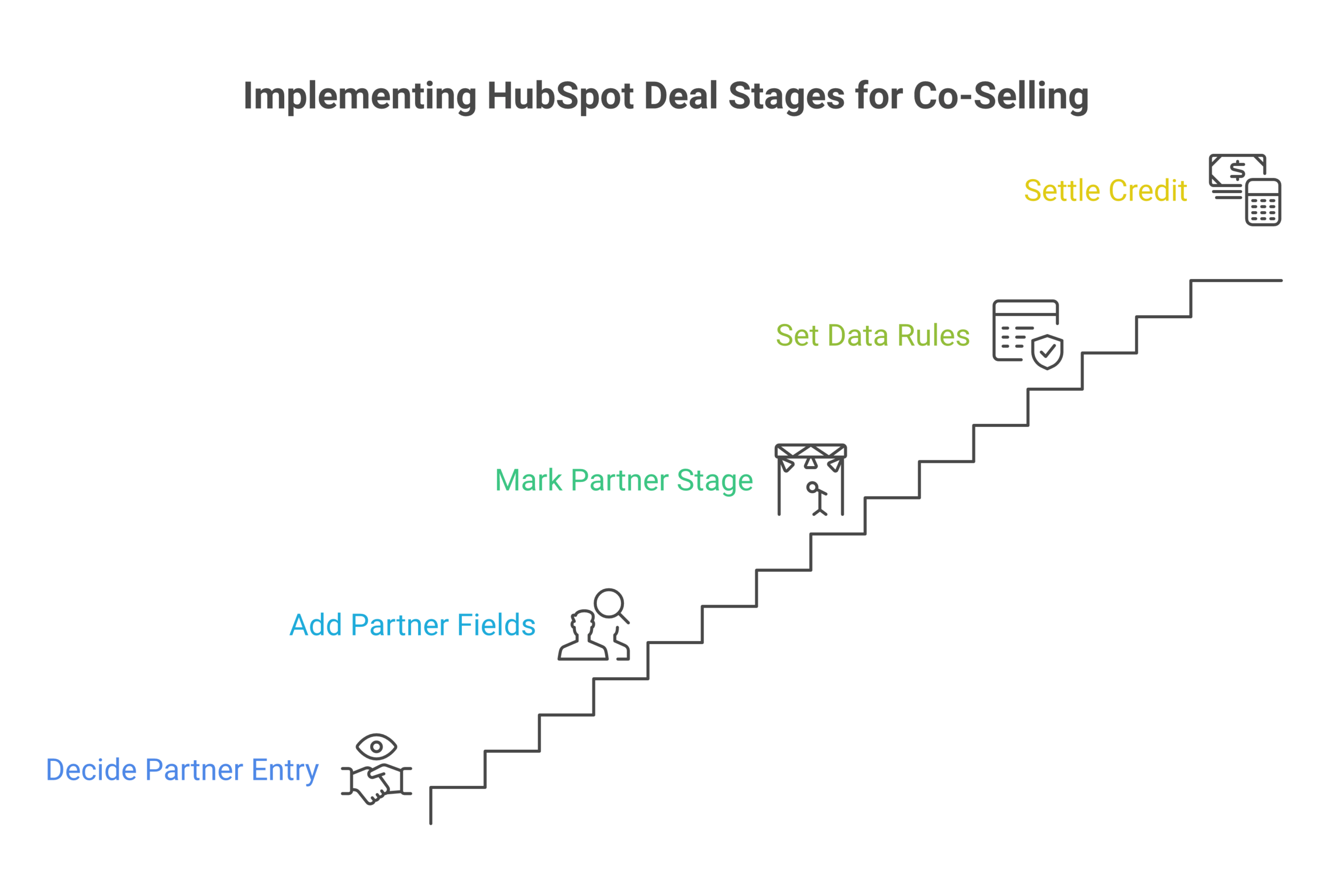
- Decide where the partner enters the pipeline: Identify the stage at which a partner becomes part of a deal, whether that is at sourcing, at qualification, or later when a partner is pulled into an active opportunity. Naming the entry point is what lets you separate partner-sourced deals from partner-influenced ones instead of lumping them together.
- Add the partner fields the deal needs: Create the deal properties that capture which partner is involved, what role they play, and whether the deal is partner-sourced or partner-influenced. These few fields are what turn a normal deal record into a co-sell record without building a parallel system.
- Add or mark the partner-involved stage: Either add a stage that reflects the joint motion, such as a partner-validated or joint-evaluation step, or mark the existing stage with a partner flag so the pipeline shows where the partner is acting. The goal is for the board view to reveal partner involvement at a glance.
- Set the rules that keep the data honest: Decide what is required before a deal can advance, such as the partner field being filled when a partner is flagged, so the data is captured at the moment of work rather than backfilled. Rules at the stage gates are what keep the setup from decaying into half-filled records.
- Settle credit before the close stage: Define how a won deal is attributed, sourced or influenced and to which partner, and capture it in the deal before it reaches closed-won. Credit settled in the record before close is what makes the partner number provable and keeps the partnership intact after the win.
A HubSpot deal stages co-sell process is working when a manager can filter the pipeline to partner deals and trust what they see, and it is failing when the partner fields are mostly empty and the real co-sell activity lives in someone’s notes.
Common pitfalls in a HubSpot deal stages co-sell setup
- Building a separate pipeline per partner: Spinning up a new pipeline for every partner fragments the data and pulls reps out of the pipeline they actually work. Keep one pipeline and use partner fields and stage flags to mark the joint deals.
- Capturing partner data only at close: Asking reps to fill in who the partner was after the deal is won guarantees thin, unreliable data. The fields have to be required as the deal advances, not reconstructed at the end.
- No distinction between sourced and influenced: Treating every partner-touched deal the same way hides the difference between a partner who brought the deal and one who helped on it. Separate the two, because they mean very different things to a partner and to the number.
- Too many partner fields: Adding a dozen partner properties nobody fills is as useless as having none. Capture the few that matter, partner, role, and sourced-or-influenced, and resist the urge to instrument everything.
- Stages that do not match the real motion: Adding a partner stage that does not reflect how a joint deal actually moves makes reps skip it. The stage has to map to a real step in the motion, or it becomes a field reps click past.
What this looks like in practice
A mid-market software company had a co-sell motion on paper and nothing to show for it in the system. Deals were closing with partner help, but every partner-sourced figure in the quarterly review was assembled by hand from a partnerships manager’s memory and a few Slack threads, and leadership had stopped trusting it. The pipeline in HubSpot showed deals, but nothing showed which ones a partner was on.
The fix was deliberately small. The team added three deal properties, partner involved, partner role, and a sourced-or-influenced flag, and added one partner-validated stage to the existing pipeline rather than building a new one. They made the partner field required the moment the partner flag was set, so the data was captured as reps worked the deal. They defined that credit was settled in the record before a deal could move to closed-won, so attribution was never an after-the-fact argument.
Two quarters later the quarterly review changed character. Instead of a hand-built slide, the partner-sourced and partner-influenced numbers came straight from a saved pipeline view that anyone could open and audit. The team could see that two partners drove most of the joint pipeline and that joint deals stalled most often at the technical-validation step, which told them exactly where to spend enablement next. None of that insight required new software. It came from a few fields, one stage, and the discipline to capture the data as the deal moved.
Forecastable’s POV on HubSpot deal stages co-sell
The position we hold is that the CRM is where a co-sell motion either becomes real or quietly dies. A HubSpot deal stages co-sell setup is not an administrative chore, it is the difference between a partner number you can defend and one you assemble from memory. Teams that treat the pipeline configuration as the foundation of the motion get a provable number, and teams that treat it as paperwork to do later get a figure the board eventually discounts to zero.
The second conviction is that less instrumentation, captured reliably, beats more instrumentation captured sometimes. The temptation is to add a dozen partner fields and a custom pipeline, and the result is a system reps route around. A few required fields and one honest partner stage, enforced at the gates, produce cleaner data than an elaborate setup nobody maintains. Build the minimum that makes partner involvement legible, and make that minimum non-optional.
The third position is that sourced and influenced are different motions and should never share a single flag. A partner who brings you a deal and a partner who helps you win one you already had are doing different work and deserve different credit, and collapsing them flatters the numbers while hiding the truth. The setup that distinguishes them is the one that lets you reward the right behavior and aim your co-sell strategy at the partners who actually move deals.
The honest caveat is that no CRM configuration makes reps co-sell. The stages and fields make the motion visible and the data provable, but a setup on top of a co-sell motion reps are not actually running just produces clean records of nothing. The configuration is necessary and not sufficient, it captures a real motion and cannot manufacture one.
Forecastable is a partnerships operating platform; any third-party tools or platforms referenced here, including HubSpot, are independent third-party products, and naming them is not an endorsement of one deployment over another. Evaluate each against your own motion.
Frequently asked questions
Should I build a separate HubSpot pipeline for co-sell deals?
Usually not. A separate pipeline fragments the data and pulls reps out of the pipeline they work daily. Keep one pipeline and use partner fields plus a partner-involved stage to mark the joint deals.
Which deal stage should mark partner involvement?
The stage where the partner actually starts acting on the deal, whether that is at sourcing or when a partner is pulled into an active opportunity. The stage has to reflect a real step in the motion, or reps will skip past it.
What partner fields are worth adding to a deal?
A small set: which partner is involved, what role they play, and whether the deal is partner-sourced or partner-influenced. These few capture the co-sell motion without building a parallel system reps will not maintain.
How do I tell partner-sourced from partner-influenced deals?
Use a deal property that flags one or the other, set as the deal is worked. Sourced means the partner brought the deal, influenced means they helped on a deal you already had, and the two should never share a single field.
When should credit be captured in the deal record?
Before the deal reaches closed-won. Settling attribution in the record ahead of close is what makes the partner number provable and keeps the win from turning into a credit dispute with the partner.
How does this connect to a co-sell strategy?
Once partner involvement is captured deal by deal, you can see which partners move deals and where joint deals stall, which is the evidence a real co-sell strategy is built on. The tracking is the input, the strategy is what you do with it.
Next step
If your partner-sourced number is assembled by hand each quarter and leadership has stopped trusting it, the highest-leverage move is to add a few partner fields and one partner stage to your existing pipeline and require them as the deal moves, so the number comes straight from the system.
Start your growth journey now to build a co-sell motion your CRM can actually prove, or see the orientation on co-sell for how the tracking fits the wider motion.
Uncover Your Growth Potential
Schedule a Discovery Call