Partner Attribution Model: A Working Build for 2026

What is a partner attribution model?
Short answer: A partner attribution model is the signed definition for how partner-touched opportunities count toward sourced, influenced, and assisted pipeline and revenue, with named rules for which partner role at which stage produces which credit. It exists because finance will not fund a partner pipeline forecast without a definition that holds across deals and quarters, and the partnerships team cannot operate without knowing what the field gets credit for.
The shortcut is to write a one-page attribution definition, get a CRO, CFO, and head of partnerships signature, and stop arguing the model in deal reviews. Until that page exists, every quarter’s partner pipeline number is up for renegotiation.
Why a partner attribution model matters in 2026
Three forces have moved the partner attribution model from “nice to have” to “required to run a forecast.” First, partner-sourced and partner-influenced pipeline now produces a meaningful share of forecast at programs that have matured past recruiting, and finance will not accept a forecast without a definition. Second, partner-side compensation has stratified (partner-sourced commission, partner-influenced bonus, co-sell SPIFs), and reps will not work the motion if they cannot tell what gets paid. Third, the buying committees on co-sell deals have grown, and the simple “first-touch wins” or “last-touch wins” models have stopped reflecting the operating reality.
A working partner attribution model is signed, narrow, and operating-ready. It does not try to capture every nuance; it defines the small number of cases that produce credit and treats the rest as gray-area exceptions to be handled in the deal review.
The shortcut is to build a deal-level partner role table, not a system-wide attribution algorithm. The role table is what AEs, partners, and finance can all read.
How a partner attribution model actually works
A working model runs on five components. Each component is built by named owners (head of partnerships, CRO, CFO) and signed before the model goes live.
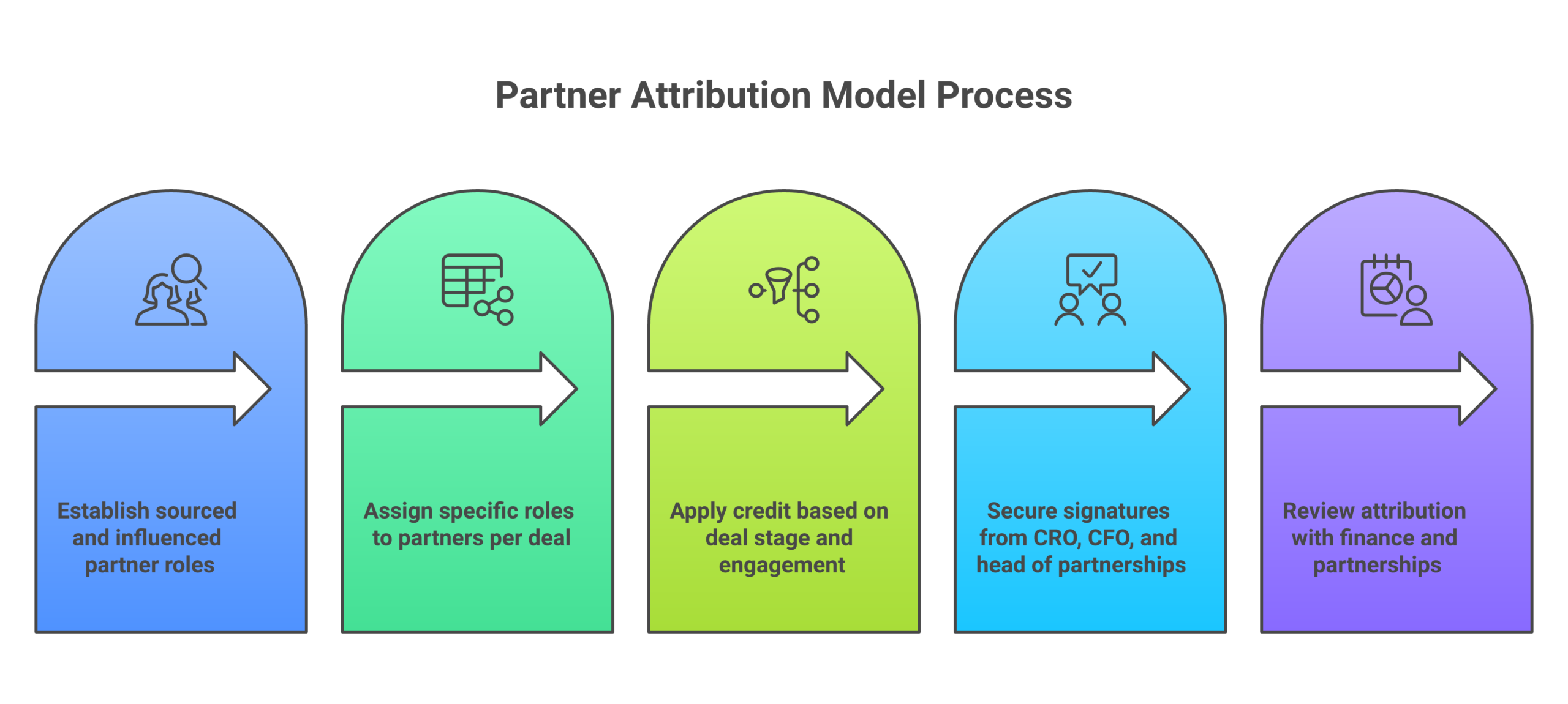
- Two-bucket definition: sourced and influenced: Sourced is partner-side as the first contact with the buyer or first material movement on the opportunity. Influenced is partner-side meaningfully engaged on a deal sourced by another channel. Assisted (small credit) is optional; most working models stop at two buckets.
- Deal-level partner role table: For each deal, the AE names the partner-side role (Sourcer, Co-seller, Influencer, Referral source) and the stage at which the partner touched the deal. The role table is a structured field in the CRM and the PRM.
- Stage-gated credit rules: Sourced credit applies if the partner touched the deal at or before stage one; otherwise it is influenced. Influenced credit applies if the partner ran a named motion (joint discovery, joint pitch, executive intro, technical pre-brief, MDF event) at any stage before stage four. Below that bar, no credit.
- Signed scope memo with finance: A one-page memo that names the two buckets, the deal-level role table, the stage rules, and the edge cases (multi-partner deals, partner-of-partner deals, marketplace co-sell). CRO, CFO, head of partnerships sign.
- Quarterly attribution review: Once per quarter, finance and partnerships review the closed deals against the model and flag the gray-area exceptions. The model is amended at most once per year; quarterly drift is contained in the exceptions log.
The model is not a system; it is a written agreement that operates the field.
Common pitfalls in building a partner attribution model
- Trying to model every edge case: A nine-rule attribution model with thirty-seven exceptions does not get signed. Build the model for the eighty percent of deals; handle the gray cases in the quarterly review.
- Treating sourced and influenced as the same bucket: The partner-sourced motion and the partner-influenced motion are different work, and the field will treat them the same if the model treats them the same. Two buckets, two named compensation lines, two field motions.
- No CRO and CFO signature: An attribution model written by the partnerships team and not signed by finance is a draft, not a model. The model has to clear the executive bar before it operates.
- Letting deal review re-litigate the model every week: Once the model is signed, deal reviews enforce the model; they do not renegotiate it. Gray cases go to the quarterly exceptions log; the weekly deal review applies the rule.
- Stage-gating the credit too tightly: A model that only credits partners at stage zero misses the influenced work that produces close. The stage-gate has to reflect where partners actually move deals, which for most programs is between stage one and stage three.
What this looks like in practice
A mid-market B2B SaaS team had been arguing partner attribution in every QBR for six quarters. The head of partnerships, the CRO, and the CFO sat down for a half-day workshop with a draft attribution memo: two buckets (sourced and influenced), a deal-level role table (Sourcer, Co-seller, Influencer, Referral), stage rules (sourced at stage one or earlier, influenced through stage three with a named motion), and an exceptions log for multi-partner deals and marketplace co-sell. The memo was signed at the end of the workshop. The CRM and the PRM (Introw) were updated within two weeks with the role table fields. The next QBR ran clean: every deal had a partner role, every role had a bucket, and the gray cases were five percent of the deals and routed to the exceptions log. The partner-sourced pipeline number on the next forecast was signed by finance for the first time.
Forecastable’s POV on partner attribution models
The partner attribution model is not a measurement problem; it is an agreement problem. The teams that solve it write a one-page memo, get the three executive signatures, and stop arguing the model. The teams that do not solve it spend ten percent of every QBR re-litigating the rule, and the field never trusts the partner pipeline number on the forecast.
The deeper read is that the attribution model is the highest-leverage artifact a partnerships function can ship in its first year. It unlocks the forecast, the compensation, the field motion, and the executive conversation. Until it is signed, every other partnership investment is harder to defend.
The candor on the bucket count is that two is enough. Sourced and influenced. The team can add an assisted bucket later if the operating reality demands it, but starting with three buckets invites argument; starting with two forces the field to make a decision on every deal.
The candor on the multi-partner edge case is that it is the most common gray-area pattern, and it has to be handled by rule, not by debate. The working rule is: split credit equally between named partners on the same deal, unless the role table assigns different roles (Sourcer vs Influencer) to each, in which case the role table governs. The rule has to be written into the signed memo.
Forecastable is a partnerships operating platform; the tools above (Crossbeam, Pocus, Common Room, Tackle, Labra, Suger, Clazar, Introw, Euler, Impartner, PartnerStack, Channelscaler) are independent third-party platforms, and naming them is not an endorsement of any specific deployment over another. Evaluate each on your own motion.
Frequently asked questions
What is the difference between sourced and influenced in a partner attribution model?
Sourced is partner-side as the first contact with the buyer or the first material movement on the opportunity. Influenced is partner-side meaningfully engaged on a deal sourced by another channel, with a named motion (joint discovery, joint pitch, executive intro, technical pre-brief).
Who signs the partner attribution model?
CRO, CFO, and head of partnerships. The three signatures are required; a model signed only by partnerships is a draft.
How often should the partner attribution model change?
At most once a year. Quarterly drift is contained in the exceptions log; annual amendments incorporate the learnings from the prior four quarters.
Should we credit deals where the partner touched the buyer post-stage three?
Most working models do not. The stage gate for influenced credit usually sits at stage three or earlier; below that bar, the partner role is recorded but no credit applies. The exact gate is a design choice the three signatories agree on.
How do partner attribution models handle multi-partner deals?
The working rule is to split credit equally unless the role table assigns different roles to each partner, in which case the role table governs. The rule has to be written into the signed memo.
Where does the partner role table live?
In the CRM and the PRM (Introw, Euler, Impartner, PartnerStack, or Channelscaler). The AE updates the role table at deal registration and at material partner-side motion; finance reads it at quarterly attribution review.
How does the model affect partner compensation?
Compensation policies are downstream of the attribution model. Sourced credit drives one compensation line; influenced credit drives another (typically a smaller bonus or SPIF). The compensation policy is signed after the attribution model, not in parallel.
Next step
If a partner attribution model is open this quarter, the move this week is to draft the one-page memo with the two buckets, the role table, and the stage rules, and get the CRO, CFO, and head of partnerships into a half-day workshop to sign.
Start your growth journey now to install a working partner attribution model in your specific environment, or read the orientation on account mapping for the broader data layer that feeds it.
Uncover Your Growth Potential
Schedule a Discovery Call