Co-Sell Without Warm Relationships: Does It Work?

What is co-selling without warm relationships?
Short answer: Co-sell without warm relationships is possible, and the teams that lean on personal chemistry alone tend to stall first. It works when the joint motion runs on shared mechanics, account overlap, a joint pitch, and a deal-review cadence, rather than on whether two partner managers happen to like each other.
A warm relationship is a head start, not a system. Two people who trust each other will return calls faster and share accounts sooner. That advantage is real, and it is also fragile. People change jobs, get reorganized, or get busy, and a motion built on rapport collapses the moment the relationship moves.
What survives a personnel change is the mechanics: a documented account overlap, an agreed joint pitch, named deal owners on both sides, and a standing review. Those artifacts do not care whether the two companies are friendly. They make the next deal run the same way the last one did.
This post lays out how co-sell works when rapport is thin, the four parts that carry it, and where warm relationships still matter most.
Why co-sell without warm relationships matters in 2026
Most co-sell happens between companies that barely know each other. Ecosystem-led growth has pushed teams to co-sell across dozens of partners at once, and there is no version of that where every partner manager has a warm relationship with every counterpart. The motion has to work cold or it does not scale.
The case for a mechanics-first motion has three layers. At the coverage layer, a company co-selling with thirty partners cannot staff thirty friendships, so the motion must carry deals on process. At the continuity layer, sellers and partner managers turn over every eighteen months on average, and a motion that survives that turnover is one documented in artifacts, not in someone’s contacts. At the forecast layer, finance will only fund partner revenue it can predict, and predictability comes from a repeatable motion, not from rapport that varies partner to partner.
The reality most teams live is the opposite. They have two or three warm partnerships that produce and twenty cold ones that do nothing, and they conclude co-sell needs relationships. The more accurate read is that the warm partnerships had mechanics by accident, because the friendly people built them, and the cold ones never got the mechanics at all.
How co-sell without warm relationships actually works
A cold co-sell motion runs on four parts. Each one replaces something a warm relationship would otherwise supply informally.
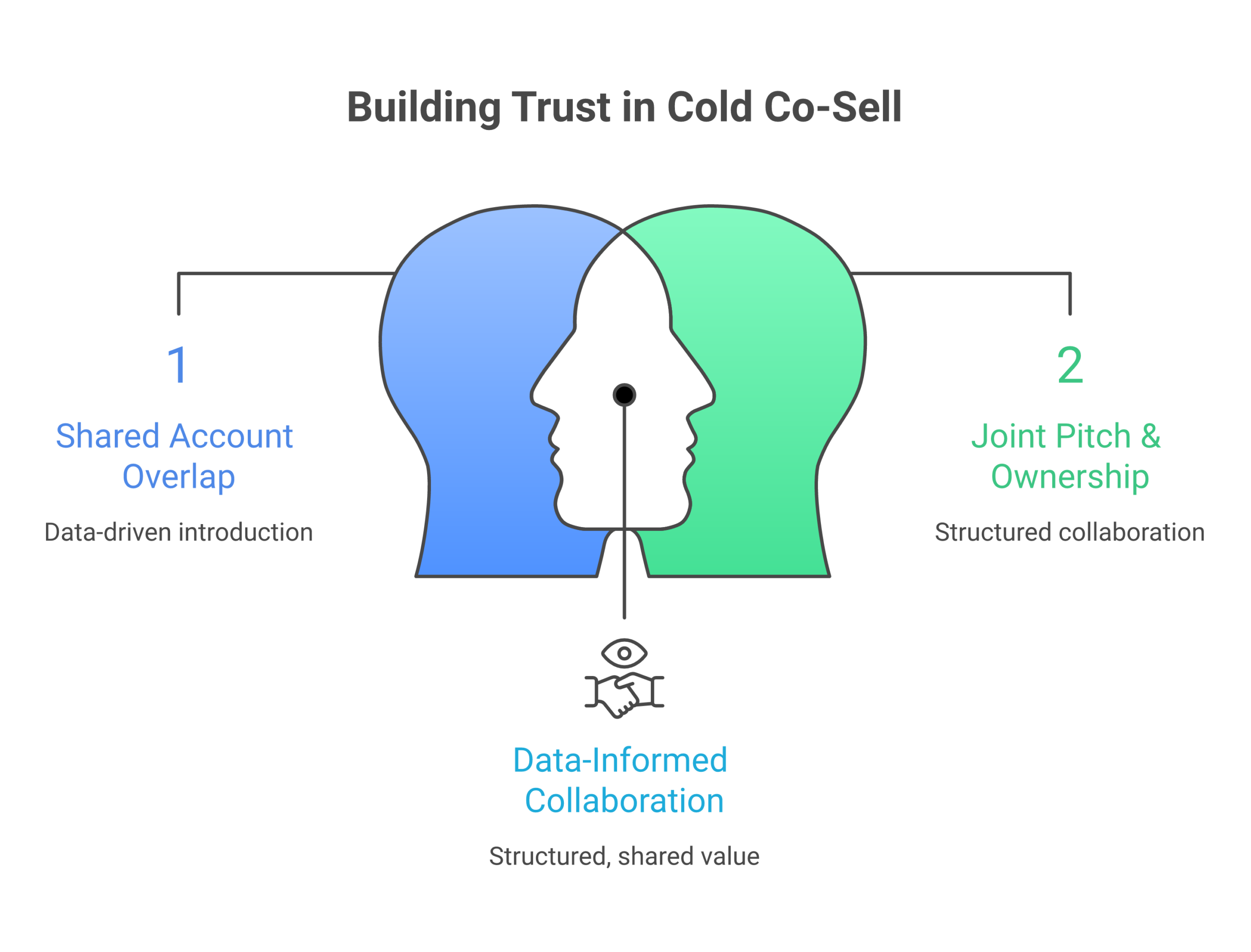
- Account overlap as the opening move: A warm relationship opens with “who do you know.” A cold motion opens with an overlap report. Shared customers and shared open opportunities give two companies a concrete reason to talk before any trust exists, and the data does the introduction the relationship would have done.
- A joint pitch both sides can deliver: Rapport lets two sellers improvise in front of a customer. Without it, the motion needs a written joint value proposition and a short pursuit guide, so either seller can position the combined solution without rehearsing with the other first.
- Named owners and a deal-registration step: A warm relationship knows who to call. A cold motion writes it down: a named partner manager and a named AE on each side per deal, and a registration step that records the deal so neither company is surprised. Ownership on paper replaces ownership by familiarity.
- A standing deal review: Friendly partners check in naturally. Cold partners need a calendar invite. A short recurring review of joint pipeline forces the contact that rapport would have produced on its own, and it is where a cold partnership slowly becomes a warm one.
The point is that warm relationships are not the input to co-sell. They are usually the output. Run the mechanics with a cold partner for two quarters and the relationship warms because the deals worked, not the other way around.
Common pitfalls
Co-sell built on rapport alone fails in predictable ways, and so does co-sell that swings too far the other direction.
- Treating chemistry as a strategy: The motion produces only with the two or three partners someone happens to like. It is not a program; it is a few friendships, and it ends when those people leave.
- No overlap data to open cold: Without a shared account view, a cold partnership has nothing concrete to discuss, so the first meeting is generic, goes nowhere, and the partnership is written off as a poor fit.
- Skipping the joint pitch: Two sellers who do not know each other walk into a customer meeting and contradict each other, because nobody wrote down the combined story.
- No standing review: A cold partnership with no recurring touchpoint never warms, because the only contact is transactional and rare.
- Confusing politeness with progress: Friendly calls feel productive and produce nothing. Warmth without registered deals and a pipeline number is not co-sell; it is networking.
What this looks like in practice
A mechanics-first motion runs on a small stack. The tools supply the structure a warm relationship would otherwise improvise.
A data company signs a partnership with a firm it has no history with. There is no warm relationship and no shared contacts. The two teams run an overlap report, find nineteen shared accounts and four shared open opportunities, and pick the four to pursue. They write one joint pitch, name an AE and a partner manager per deal, register each deal, and hold a fifteen-minute review every two weeks. Two of the four deals close inside a quarter. By then the partner managers do have a relationship, built on deals that worked rather than on a lunch.
The contrast is a partnership that opened warm and never got mechanics. The two partner managers were friendly, traded a few leads, closed nothing repeatable, and when one of them changed roles the partnership went silent. The rapport was real and it produced nothing durable.
Forecastable’s POV
The belief that co-sell needs warm relationships is the single most expensive idea in partnerships, because it caps the motion at the number of friendships a team can maintain. A partnerships org that can only co-sell where it has chemistry will always be small, always be fragile, and always be one reorg away from a bad quarter.
Across our client base, the partnerships that scale are the ones that treat the relationship as a result, not a prerequisite. They open cold partnerships on overlap data, run the same four-part motion regardless of who is on the other side, and let the relationship warm as deals close. The friendly partnerships in their portfolio got friendly because the mechanics worked, not because someone networked well.
The contrarian point is that warm relationships can actively hide a broken motion. A friendly partnership that produces a little feels fine, so nobody examines it, and the lack of registered deals, a joint pitch, or a review goes unnoticed. A cold partnership has no warmth to coast on, which forces the mechanics into the open. Teams often learn more from a cold partnership run well than from a warm one run loosely.
Warm relationships still matter for one thing: speed at the executive level. A senior sponsor on each side who trusts the other will clear blockers faster and commit resources sooner. That is worth cultivating. It is not, however, what closes the deals. The mechanics close the deals.
Forecastable is an independent third-party professional services company. Our evaluations of co-sell motions and tooling are based on publicly-available information as of May 2026 and our own client experience.
Frequently asked questions
Can you co-sell without warm relationships?
Yes. A co-sell motion built on account overlap, a joint pitch, named owners, and a standing review will produce with partners you have no history with.
Do warm relationships help co-sell at all?
They help most at the executive level, where a trusted sponsor clears blockers faster. They are a head start, not the system that closes deals.
How do you start a cold co-sell partnership?
Open with an account overlap report. Shared customers and shared open opportunities give two companies a concrete reason to talk before any trust exists.
Why do warm partnerships still fail?
Usually because they coasted on rapport and never got mechanics. When the friendly people move on, a partnership with no documented motion goes silent.
What replaces chemistry in a cold co-sell motion?
Documented artifacts: an overlap report, a written joint pitch, named deal owners on both sides, and a recurring review on the calendar.
How long until a cold partnership warms up?
Usually two quarters of running the motion. The relationship warms because deals closed, which is the reverse of the order most teams assume.
Next step
If your co-sell only produces with the partners you happen to like, you do not have a co-sell program. You have a few friendships, and they will not survive the next reorg. Open your cold partnerships on overlap data, run one documented motion regardless of rapport, and let the relationships warm as deals close.
Talk to our team about building a co-sell motion that runs cold →
The co-sell hub holds the broader operating context, and the co-sell programs write-up covers how to run this motion across a whole partner portfolio.
Uncover Your Growth Potential
Schedule a Discovery Call