OEM vs Reseller: A 2026 Comparison for Programs

What is the difference between OEM and reseller?
Short answer: OEM vs reseller is the decision between embedding your product inside a partner’s offering (OEM) versus letting a partner sell your product as-is alongside theirs (reseller). The two motions look adjacent and produce opposite operating models. The economics, the legal posture, the support model, and the partner motion differ in every meaningful way, and the decision is structural, not just a discount-rate negotiation.
The partner program hub holds the broader operating context. The decision usually surfaces inside a single contract negotiation, which is the wrong place to make it. By the time a partner is asking for OEM terms, the program has often already committed to a motion that does not match its operating model. This piece breaks down the structural differences and the conditions that decide between them.
Why the OEM vs reseller decision matters in 2026
Three forces sharpened the question. First, OEM and reseller deals carry different revenue-recognition profiles, and finance leadership now scrutinizes the difference earlier in the cycle than they did three years ago. Second, partner-side product teams increasingly ask for embedded relationships rather than reseller relationships, and saying yes to OEM without the operational capability erodes margin durably. Third, customers increasingly buy combined offerings rather than discrete products, which means the motion choice affects how the customer experiences the brand.
The honest framing: getting OEM vs reseller wrong is more expensive than getting the discount rate wrong. The wrong motion creates structural friction that compounds quarter over quarter. The wrong rate is a one-time correction at renewal.
At-a-glance comparison
| Dimension | OEM | Reseller |
|---|---|---|
| Product packaging | Embedded inside partner’s product or service | Sold as-is alongside partner’s product |
| Brand visibility | Partner brand dominant, vendor brand often hidden | Vendor brand visible, sometimes co-branded |
| Pricing | Discounted at higher tier (often 40-60% off list), flat unit or per-seat | Reseller margin (15-35%), list-based with deal registration |
| Support ownership | Partner owns Tier 1, vendor owns Tier 2-3 | Vendor often owns all tiers, partner triages |
| Sales motion | Joint engineering, joint product roadmap | Joint sales, lighter product alignment |
| Contracting | Multi-year, long-tail commitment, often with minimums | Annual or per-deal, lower commitment |
| Customer relationship | Customer is the partner’s customer | Customer is often the vendor’s customer (registered) |
The two motions look adjacent because both involve a partner who pays a discounted price and resells. They are operationally opposite on the dimensions that matter, brand, support, customer ownership, and roadmap influence.
When to choose OEM
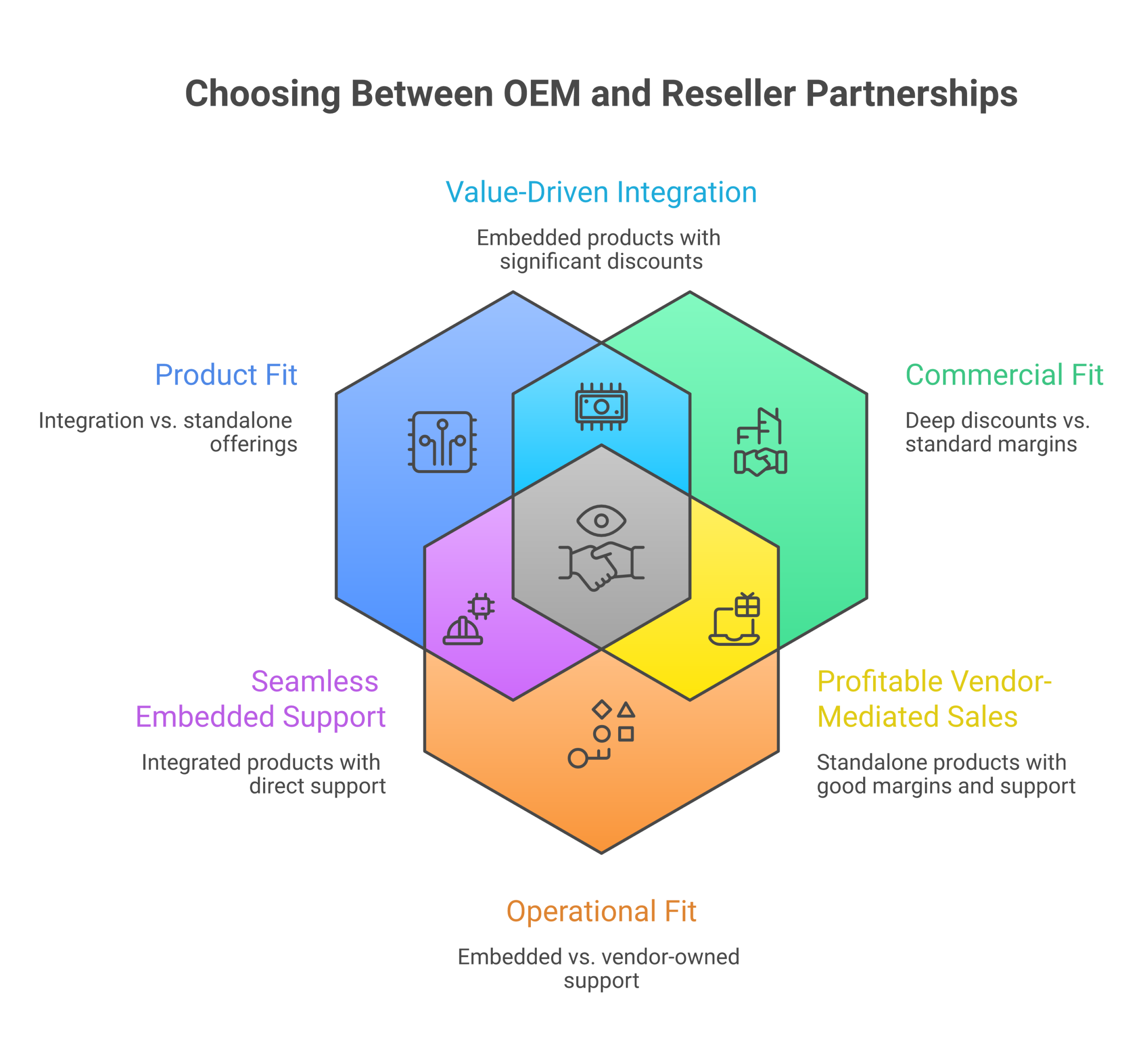
Choose an OEM motion when the product is a component the partner needs inside a larger offering, when the business can support a multi-year minimum commitment, and when the team is willing to accept lower brand visibility in exchange for deeper unit economics and roadmap influence from a strategic partner. Three conditions need to be present.
- Product fit: the product slots cleanly into the partner’s stack as a component rather than a standalone product. If the partner could replace the vendor with a competitor without re-architecting their offering, the OEM economics rarely make sense for either side.
- Commercial fit: the partner can commit to a multi-year minimum (units, seats, or revenue) and the business can absorb the steep discount (often 40-60% off list) in exchange for the predictability. A one-year, no-minimum OEM is usually a reseller motion mislabeled.
- Operational fit: the team can run a multi-year partner-side product roadmap, an embedded support relationship (vendor owning Tier 2-3), and a customer relationship that is mediated by the partner. Many product teams underestimate the operational weight of running OEM correctly.
The classic OEM example in B2B software is a forecasting or signal layer embedded inside a vendor’s CRM or marketing platform: the customer experiences the embedded feature as part of the platform, the partner’s brand carries the product, and the vendor influences the partner’s roadmap directly.
When to choose reseller
Choose a reseller motion when the product is standalone, when the team wants to scale a channel without giving up brand visibility or customer ownership, when the partner is bringing distribution and local presence rather than product integration, and when the business wants a flexible commercial model (annual or per-deal) without multi-year minimums.
- Product fit: the product is sold to the partner’s customers as a recognizable product, with the vendor brand on it, alongside whatever else the partner sells. The partner is bringing distribution, relationships, and services, not product integration.
- Commercial fit: the discount band (typically 15-35%) is enough to fund the partner’s sales and services motion without forcing the partner to white-label or embed. Minimum-driven reseller programs usually disguise an OEM motion under reseller paperwork.
- Operational fit: the team can run deal registration, defend partner pricing through margin-protection rules (see partner pricing), and support the customer through a relationship the partner mediates but does not own.
The classic reseller example is a SaaS vendor selling through regional partners or system integrators who add services around the product: the customer engages the partner for delivery and services, the vendor’s brand stays on the product, the customer relationship is shared, and the commercial model is annual or per-deal.
Edge cases worth flagging
Four edge cases come up often enough to surface. Each one changes the answer between OEM and reseller and is worth explicit decision-making before the contract phase.
- Hybrid motions are common and usually mislabeled: a partner who embeds the product in part of their stack and resells it standalone elsewhere is running a hybrid. The pragmatic fix is two contracts (one OEM, one reseller) rather than one contract trying to cover both. Single-contract hybrids produce attribution chaos and exception culture inside both motions.
- “OEM-light” is rarely real: usually a reseller relationship with a heavier discount and looser brand rules. The result is a partner who behaves like a reseller but pays OEM economics, which compounds badly. If the team cannot commit to embedded product and multi-year minimums, the motion is reseller, and pricing it like OEM erodes margin without buying commitment.
- White-label is a third category: white-label has elements of OEM (vendor brand hidden) but typically lacks the product embedding and roadmap commitment. Treat white-label as its own category with its own rules.
- Marketplace co-sell changes the answer for cloud transactions: selling through AWS, Azure, or GCP marketplaces with hyperscalers as the transaction layer is a distinct motion that the OEM-versus-reseller framing does not capture cleanly.
Forecastable’s POV
The honest test for an OEM versus reseller decision is whether the three structural conditions (product fit, commercial fit, operational fit) line up on the same side. When all three line up on OEM, OEM produces a strategic relationship that compounds. When all three line up on reseller, reseller produces a scalable channel that funds the program. When the conditions split, the motion is going to underperform regardless of which contract gets signed, and the fix is to redesign the partnership before signing, not after.
The most common failure I see is single-contract OEM masquerading as a reseller arrangement, or single-contract reseller masquerading as OEM. The partner gets language that sounds like one motion and economics that fit the other. The result is a partnership that operates in friction for the full contract term, and at renewal both sides are exhausted and neither side wants to invest further.
The fix is to make the motion explicit before the discount. Decide which of the two motions the program is actually running, write the operating model accordingly, then negotiate the rate. Programs that negotiate rate first end up retrofitting the operating model to match whatever discount the partner accepted, which is the wrong sequence and produces predictable downstream pain.
The second move is to accept that some partnerships do not fit either motion cleanly and need a third arrangement. White-label, marketplace co-sell, joint-venture, and equity-tied partnerships all exist for a reason, the OEM-vs-reseller frame does not cover every case. Forcing a partnership into one of the two frames when it actually needs a third is a common cause of contract friction. Build the right vehicle for the partnership; do not over-fit the partnership to the two most common vehicles.
Forecastable is an independent third-party professional services company. Our evaluations of OEM and reseller partnership design are based on publicly-available information as of May 2026 and our own client experience.
Frequently asked questions
What is the main difference between OEM and reseller in B2B software? The main difference is product packaging and brand. OEM partners embed the product inside theirs under their brand; reseller partners sell the product as-is under the vendor’s brand alongside their offerings.
Can a partner be both OEM and reseller? Yes, and it is common, but the arrangement should be two contracts with two distinct sets of rules. Single-contract hybrid motions produce attribution and exception problems inside both.
Is OEM always more profitable than reseller? No. OEM economics are usually higher per-unit but require multi-year minimums and heavier operational support. Reseller economics are lower per-unit but scale to more partners with less operational weight. Total margin depends on program design.
Who owns the customer in an OEM deal? The partner. The customer experiences the product as part of the partner’s offering, and the partner mediates the relationship. In a reseller deal, the customer relationship is usually shared and often more directly with the vendor.
What is a typical OEM discount? OEM discounts typically range 40-60% off list, with the higher end tied to deeper minimums and longer commitments. The number varies widely by category and partner.
Should we start with reseller and graduate to OEM? Sometimes. A clean reseller motion can produce the operational maturity needed to run OEM with a specific strategic partner later. The inverse, running OEM economics with reseller-level commitment, usually erodes margin without producing the strategic relationship.
Next step
Map the three structural conditions (product fit, commercial fit, operational fit) for the partnership in question before drafting partner-agreement language. If all three align on OEM, design the operating model for OEM before negotiating the rate. If all three align on reseller, design for reseller. If they split, the partnership probably needs a third vehicle (white-label, marketplace co-sell, joint venture) rather than a forced fit into either OEM or reseller.
Talk to our team about structuring the right partnership vehicle for your motion →
The partner program hub holds the broader context on where OEM and reseller motions fit inside program design.
Uncover Your Growth Potential
Schedule a Discovery Call