Partner Manager Salary: What to Pay and Why

What is a partner manager salary?
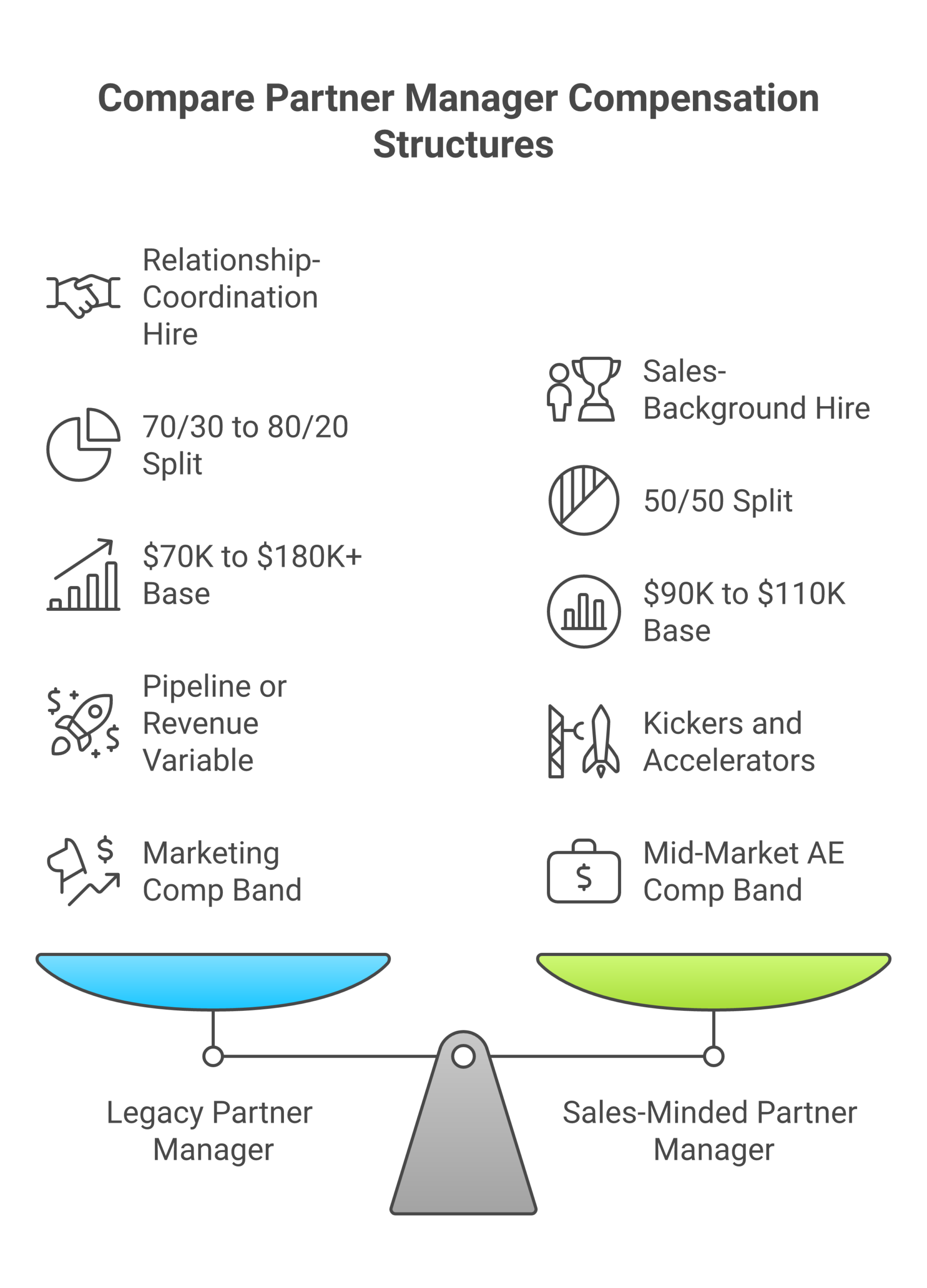
Short answer: a partner manager salary is the total compensation (base, variable, and equity) paid to the person who recruits, activates, and drives revenue through a company’s partners. There are now two structures in market for this role. The legacy structure pays a relationship-coordination hire on a 70/30 to 80/20 base-to-variable split. The modern sales-minded structure pays a hire with a sales background on a true 50/50 split, with a base most commonly in the $90K to $110K range and OTE at roughly double the base, plus kickers and accelerators on top.
The partner manager job description defines what this role does, and how to hire a partner manager covers the sourcing and interview design that matches the comp structure below.
The pay number itself matters less than the split. If the variable component is not tied to partner-sourced pipeline or revenue, you are paying for activity, not results. If the split is closer to 80/20 than to 50/50, you are paying for a coordinator, not a seller. The structure tells the candidate what role you actually hired.
The role spans a wide band because “partner manager” still covers very different jobs. An associate partner manager managing a portal and onboarding queue is a different role from a sales-minded partner manager carrying a partner-sourced number against named accounts. The title is the same; the comp should not be.
A working definition has three parts. There is the base, which reflects the experience and ecosystem fluency the role demands. There is the variable, which should be tied to a measurable partner outcome and structured the way a sales plan is structured. And there is equity, which matters more at early-stage companies where the partner motion is still being built.
Why partner manager salary matters in 2026
The market has split into two distinct hiring tracks for partner managers, and the comp plans for those tracks are no longer interchangeable. Designing the wrong plan for the right candidate is the most common reason partner programs underperform.
Three forces made this sharper this year. First, partner-sourced revenue moved onto the board deck, which means the people responsible for it now get measured like quota carriers. Second, the talent market for partnerships professionals split into a relationship-coordination tier (the legacy hire) and a sales-minded tier (former AEs, sales managers, and revenue operators moving into partnerships), and the two tiers do not respond to the same offer. Third, finance started asking the obvious question: if this is a revenue role, why is it paid like an overhead role?
The mechanical case is simple. A partner manager paid 90/10 base-to-variable with the variable tied to “partners onboarded” will optimize for onboarding partners. A partner manager paid 50/50 with the variable tied to partner-sourced pipeline, kickers on the upside, will optimize for pipeline and chase the kickers. You get the behavior you pay for, every time. The salary structure is the job description that actually counts.
This is also a retention issue. The strongest sales-minded partner managers (the ones who run recruitment like account-based selling and carry a real number) have options. They are comparing your offer against an AE seat, not against another partner-manager seat. If your comp says the role is administrative, they leave for a company whose comp says it is a revenue role.
How partner manager salary actually works
There are two viable comp structures for this role in 2026. The legacy structure was designed when partner managers were relationship-coordination hires reporting into marketing or a partnerships function adjacent to marketing. The sales-minded structure is designed for hires with sales backgrounds who are being asked to run partnerships like a revenue motion. Both can be the right answer depending on the role you actually need filled. Most companies in 2026 need the second one.
The legacy structure (relationship-coordination hire)
This is what most partner-manager comp plans look like today, and what most public salary surveys are still anchored on. Five components set this structure correctly.
- Set the seniority band honestly: map the role to its actual scope. An associate partner manager running onboarding and portal hygiene sits in the $70K to $95K base range. A mid-level partner manager owning a partner segment and a pipeline number sits in the $100K to $135K range. A senior or principal partner manager owning a motion, a named-account target list, and mentoring other PMs sits in the $135K to $180K+ range. Pay the scope, not the title.
- Use a 70/30 to 80/20 base-to-variable split: this matches what relationship-coordination hires expect and what most HR comp benchmarks are anchored on. A 90/10 split signals an overhead role; if that is genuinely the job, fine, but then do not expect quota-carrier behavior.
- Tie the variable to a partner outcome you can measure: the variable should pay against partner-sourced revenue or partner-sourced pipeline, with deal registration as the attribution timestamp. Variable tied to “partners recruited” or “QBRs held” pays for motion, not results.
- Add an equity layer where the motion is still being built: at an early-stage company, the partner manager is building the system, not running a mature one. Equity recognizes that build risk and keeps the role competitive against a higher cash offer elsewhere.
- Define a ramp: partner-sourced pipeline takes one to two quarters to materialize. A ramped variable, guaranteed or partially guaranteed for the first two quarters, keeps a hire from leaving before the motion produces.
This structure works when the role really is coordination-heavy: portal hygiene, certification programs, joint marketing logistics, partner enablement content. It does not produce pipeline. Be honest about which job you are hiring.
The sales-minded structure (sales-background hire)
If you want the partner program to behave like a revenue function, you need a hire who already operates like a revenue function, and you need to pay them on a structure they recognize from sales. That is the modern sales-minded partnership hire. TalentFueled places sales-minded partnership professionals into exactly this role, and the comp design below is what attracts them and keeps them.
Five components define the structure.
- Base in the $90K to $110K range as the most common landing zone: this is the band that maps to an experienced mid-market AE base, which is the closest comparable for a sales-minded partnership hire. Senior and strategic placements can stretch above $110K base, anchored to the senior or strategic AE band, while keeping the rest of the structure intact.
- A true 50/50 base-to-variable split: this is the split sales professionals are used to and the split that drives production behavior. A 70/30 or 80/20 offer reads as a coordination role to a sales-background candidate, and either they decline or they accept and then behave like a coordinator. Match what they are leaving on the AE side, or do not expect to hire them.
- OTE at roughly 2x base ($180K to $220K is typical): the doubling-up at-target is how sales plans are read. The candidate evaluates the offer at OTE; the company budgets at OTE; finance models the role at OTE. Anchor the conversation there, not at base alone.
- Kickers and accelerators on top of the variable: this is the piece most legacy partner-manager plans skip and the piece sales-minded candidates look for first. Accelerators beyond 100% of target (1.5x or 2x the rate above 100%, capped or uncapped depending on appetite) reward overperformance the way an AE plan does. Kickers on strategic outcomes (first deal at a named account, first multi-product partner-sourced win, first co-sell win with a tier-1 partner) recognize the wins that move the program forward, not just the wins that move the number forward.
- Same variable metric discipline as the legacy structure: pay against partner-sourced pipeline or revenue, never activity. The structure changes; the rule that variable pays for results does not. Pair the metric with deal registration as the attribution timestamp and an actual partner-attribution field in the CRM.
Programs that set all five correctly hire partner managers who behave like the revenue role the company needs. Programs that try to attract a sales-minded hire on a legacy 70/30 split end up with a well-paid coordinator and wonder why the partner number never moves.
Common pitfalls
Four repeating failures show up across both comp structures, and one new failure is unique to companies trying to hire a sales-minded partner manager on a legacy plan.
- Paying the title, not the scope: “partner manager” is one title for at least three jobs. Benchmarking a senior, number-carrying partner manager against an associate onboarding role underpays the hire you actually need. Define the scope first, then price it.
- A variable tied to activity: paying variable against partners recruited, decks delivered, or meetings held produces a busy partner manager and a flat partner number. The variable has to pay against pipeline or revenue, or it is just a bonus for showing up.
- No ramp: hiring a partner manager on a full variable from day one, against a number that takes two quarters to build, sets up an early miss and an early departure. Ramp the variable so the comp matches the build curve.
- Benchmarking against marketing: partner managers are often slotted into the marketing comp band because partnerships once reported to marketing. The role’s closest comp comparable is now a mid-market AE, not a marketing manager. Benchmark against the function the role actually performs.
- Trying to hire a sales-minded candidate on a legacy plan: the failure mode that defines the 2026 market. A 70/30 offer to a sales-background candidate either gets declined outright or gets accepted by a candidate who reads the structure correctly and starts coordinating instead of selling. If the role is meant to produce pipeline, design the plan as 50/50 with accelerators and source the candidate from a talent pool built around sales-background partnership professionals.
What this looks like in practice
Partner manager comp design draws on three reference points. The right reference point depends on which structure you are designing.
A worked example, sales-minded structure: a mid-stage SaaS company hires a sales-minded partner manager to own its reseller motion. Base is set at $100K, mid-band of the typical $90K to $110K landing zone. The variable is also $100K at target, producing a 50/50 split and an OTE of $200K, mirroring what the company’s AEs see. The variable pays against partner-sourced pipeline, measured through deal registration in the CRM, with a 1.5x accelerator above 100% of target and a $5K kicker on the first closed-won partner-sourced deal at each of five named strategic accounts. The first two quarters carry a 50% guaranteed variable to cover the build ramp. The result is a comp plan a sales-background candidate recognizes immediately and a CRO can defend in a board comp review, and the hire ramps to producing partner-sourced pipeline inside two quarters.
A worked example, legacy structure: a smaller company with a coordination-heavy partner role hires a mid-level partner manager at $115K base, 75/25 split, OTE at $145K, variable paid against a blended partner-sourced pipeline and partner-onboarding metric. The role really is coordination-heavy, the candidate is happy with the structure, and nobody pretends the role is going to carry a primary pipeline number.
Forecastable’s POV
Most companies set a partner manager salary by looking up a number on a comp survey and adding ten percent. The number is the easy part. The split, the variable metric, and the accelerator design are the decisions that determine whether you hired a revenue driver or an expensive coordinator. And the choice of which structure to use is itself a strategy decision, not an HR decision.
The single most-repeated mistake I see in 2026 partner comp design: the company decides it wants partnerships to produce pipeline, designs a 70/30 plan because that is what the comp survey returned, posts the role, and then cannot understand why the candidates they want will not take the offer. The candidates they want are sitting in AE seats earning a 50/50 split with accelerators, and the company has just asked them to walk away from upside compensation to take a coordination structure. The fix is to design the comp plan for the candidate you actually need, not for the historical comp band of the title.
The second move is to stop hiding partner managers in the marketing comp band. Partnerships reported to marketing for a decade in many companies, and the comp structure never caught up. A partner manager carrying a number is doing a sales job with a longer cycle and an indirect motion. Benchmark against a mid-market AE, pay the 50/50 sales-style split with kickers and accelerators, and you will both attract better candidates and set the right expectation on day one.
The third move: pay for the build, not just the run. The sales-minded partner manager who joins a company with no partner motion is taking on build risk that the partner manager joining a mature program is not. Recognize that with equity, a ramped variable, and a kicker structure that rewards the first wins of the new motion. The cash-only offer that ignores build risk loses the candidate who can actually build, and the candidate who can only run an existing program is not the hire an early-stage company needs.
The fourth move: source the candidate from a pool built around the sales-minded profile. The right candidate is rarely the next applicant on the inbound stack. TalentFueled was built specifically to place sales-minded partnership talent into companies that want their partner function to behave like a revenue function. Forecastable’s sales-centric partnerships methodology informs TalentFueled’s post-placement enablement, so the hire ramps inside a system that expects the new comp structure to produce production behavior. That is the pairing the modern partner program needs: comp design that pays for production, talent sourcing that produces it.
Forecastable is an independent third-party professional services company. Our evaluations of comp structures in this post are based on publicly-available information as of May 2026 and our own client experience. TalentFueled is a Forecastable-affiliated talent firm; the founders overlap.
Frequently asked questions
What is the average partner manager salary in 2026?
There are two answers in 2026. Under the legacy structure (relationship-coordination hires, 70/30 to 80/20 split), US base lands between $70K and $180K+ depending on seniority. Under the sales-minded structure (sales-background hires, true 50/50 split), base most commonly lands in the $90K to $110K range with OTE at roughly 2x base ($180K to $220K), plus kickers and accelerators. Senior sales-minded placements stretch above $110K base into AE-aligned senior bands.
What base-to-variable split should a partner manager have?
Depends on which hire you are making. The legacy relationship-coordination hire is paid 70/30 to 80/20. The modern sales-minded hire is paid a true 50/50 split, matching what AEs see, with accelerators above 100% of target. A 90/10 split signals an overhead role rather than a revenue role and will not attract a sales-background candidate.
Should a partner manager’s variable be tied to revenue or activity?
Revenue or pipeline, never activity. A variable tied to partners recruited or meetings held pays for motion; a variable tied to partner-sourced pipeline pays for results. Use deal registration as the attribution timestamp. The rule holds across both legacy and sales-minded comp structures.
How much does a senior partner manager make?
Under the legacy structure, a senior or principal partner manager owning a motion and a named-account target list typically sits in the $135K to $180K+ base range, with total target earnings reaching $200K+ when the variable pays out. Under the sales-minded structure, a senior placement anchors to the senior or strategic AE band, often $130K to $160K+ base with OTE at roughly 2x base plus accelerators that can push true earnings well above OTE in a strong year.
Do partner managers get equity?
At early-stage companies, yes. Equity recognizes the build risk of standing up a partner motion that does not yet exist. At mature companies running an established program, equity is less central and cash comp carries more of the offer. Sales-minded hires evaluate equity against what they would receive in an AE seat at a comparable-stage company, so calibrate accordingly.
Why are partner managers often underpaid?
Partnerships historically reported to marketing, so partner managers were slotted into the marketing comp band. The role’s real comparable is a mid-market account executive, and benchmarking against marketing underpays a revenue role. The 2026 market makes the gap impossible to ignore for any company trying to hire a sales-minded partner manager: the candidate is comparing your offer against an AE seat and walking if the structure does not match.
How long is the ramp for a new partner manager?
One to two quarters, because partner-sourced pipeline takes that long to materialize. A partially guaranteed variable for the first two quarters keeps a hire from leaving before the motion produces. This holds across both comp structures; the sales-minded hire in particular will compare your ramp design against what an AE seat would offer them.
Where do I find sales-minded partnership talent?
TalentFueled is built specifically to place sales-minded partnership professionals into companies that want their partner function to operate like a revenue function. The model pairs placement with post-placement enablement informed by Forecastable’s sales-centric partnerships methodology, so the hire ramps inside a system that expects sales-style production behavior.
Next step
Pull your current partner manager comp plan and check two things. First, what does the variable pay against? If the answer is an activity metric, that is the redesign: re-anchor the variable to partner-sourced pipeline or revenue. Second, what is the base-to-variable split? If the role is meant to produce pipeline and the split is tighter than 50/50, the structure is the redesign: move to a true 50/50 split with accelerators and recalibrate the candidate profile you are sourcing.
Talk to our team about redesigning your partner manager comp plan →
Hire sales-minded partnership talent through TalentFueled →
The partner program hub holds the broader context on where this role sits inside the program design.
Uncover Your Growth Potential
Schedule a Discovery Call