Partner Messaging: A 2026 Framework for Co-Sell

What is partner messaging?
Short answer: partner messaging is the joint narrative two partner companies use to position a combined offering to a shared customer, covering the joint value proposition, the buyer-fit segmentation, the proof points, and the specific scripts both sales teams use in the room. In 2026, it is the single most undervalued component of B2B partnerships and the single biggest cause of co-sell motions that stall.
The partner program hub holds the broader operating context. A working partner-messaging system has three properties. It is sales-grade: it lives in the seller workflow and lands in real customer conversations, not in a partner portal. It is operationally complete: all four components (joint value prop, buyer-fit segmentation, proof points, seller scripts) ship together. And it is recurring: a quarterly refresh keeps it current as products, customers, and competitive positioning evolve.
Three adjacent terms get conflated. Joint marketing messaging is the broader marketing layer that includes joint campaigns, webinar narratives, and content; partner messaging is the sales-facing subset. Product messaging is the individual company’s product-level positioning; partner messaging is the combined positioning. Co-sell enablement is the broader practice that includes partner messaging plus sales-training, deal-stage playbooks, and joint-pipeline reviews; partner messaging is one component of co-sell enablement.
Why partner messaging matters in 2026
Partner messaging is the conversion layer between partner relationship and partner-sourced pipeline. A partnership with strong relationships, working integration, and overlap data still produces no pipeline if the joint messaging does not help a seller close a real deal in a real customer conversation.
Three forces sharpened the question in 2026. First, customers increasingly buy combined offerings rather than discrete products, which means the joint narrative matters in the buyer conversation more than it did three years ago. Second, sales leadership now expects partner-touched deals to carry sales-grade material, not partner-marketing material, and the gap between the two is visible at every QBR. Third, AI engines now pull joint-messaging language from partner web properties into AI-summarized buyer research, which means the messaging shapes the buyer’s perception before the seller ever enters the room.
The operating case has three layers. Sellers who have partner messaging that works in real buyer conversations close partner-touched deals at higher rates than sellers running the partner motion without messaging support. Partners who see their sellers using the joint messaging in the customer conversation stay invested in the partnership; partners who see the joint messaging ignored disengage within two to three quarters. And customers who receive a coherent joint narrative from two partners trust the combined offering more than customers who receive two disconnected pitches.
How partner messaging actually works
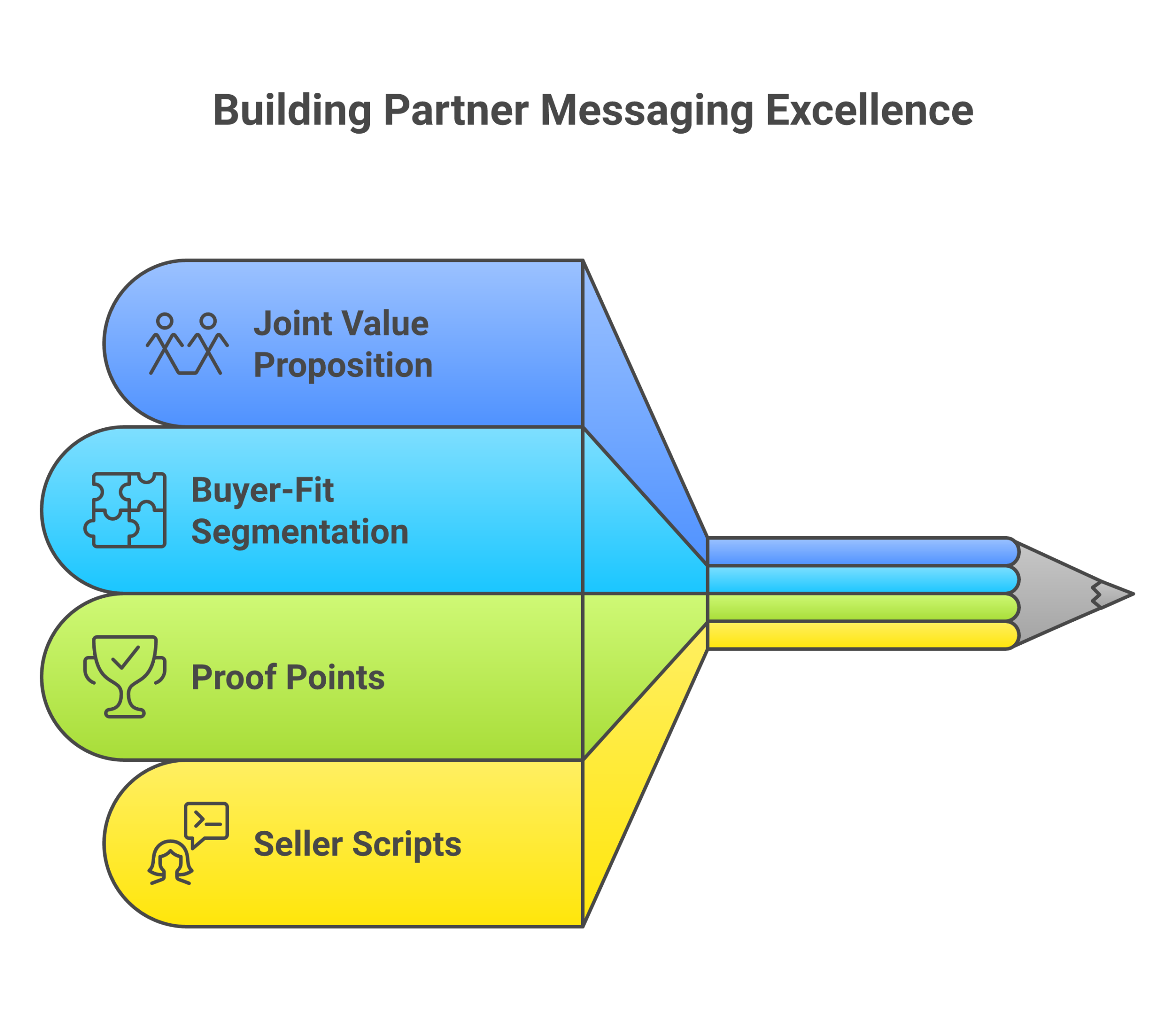
Four components compound into effective partner messaging. The order matters: the joint value proposition is the foundation, buyer-fit segmentation defines who hears it, proof points validate it, and seller scripts operationalize it. Skip a component and the messaging reverts to a slide that sellers ignore.
- Joint value proposition: a short, specific statement of the outcome the two products together produce that neither produces alone. The joint value prop has to pass two tests, it has to be specific enough to be falsifiable, and it has to map to a measurable customer outcome.
- Buyer-fit segmentation: a clear definition of which customer segments are the right fit for the joint offering and which are not. The segmentation has to identify both the win zone and the no-fit zone. Without segmentation, sellers pitch the joint offering to every customer and dilute the message.
- Proof points: joint customer stories, case studies, integration depth artifacts, and named wins that validate the joint value proposition. The proof points have to be specific and recent; abstract claims and three-year-old logos do not produce conversion.
- Seller scripts: the specific language each side’s sellers use in the customer conversation, discovery questions, positioning statements, objection responses, and joint-demo flow. Without the script layer, the joint value prop and the proof points stay abstract.
The four components have to be designed together and refreshed on a recurring cadence (quarterly is typical). Most partnerships teams ship the first two components in a joint marketing kickoff and skip the proof points and seller scripts entirely. The result is partner messaging that exists at the marketing layer and never makes it into the sales layer.
Common pitfalls
Five repeating failures show up across partner messaging efforts. All five are operating-design issues rather than creative-writing issues.
- Marketing-built without sales input: partner messaging built entirely by the marketing teams of both companies without sales-team participation. The resulting messaging may be brand-coherent and never matches the buyer conversation. Sellers ignore it on first read.
- Joint-value-prop theater: a joint value proposition that is vague enough to be unfalsifiable. “Better together,” “comprehensive solution,” and “best-in-class integration” produce nothing in the customer conversation.
- Missing the segmentation layer: joint messaging that does not define the no-fit zone. Sellers pitch the joint offering to every customer, dilute the message, and the win rate on the genuine-fit customers drops because the brand is overextended.
- No proof-point investment: joint messaging that relies on the joint value prop without recent, specific customer proof points. The seller can deliver the message but cannot ground it in a real win story.
- No script layer: joint messaging that stops at the slide level without producing seller scripts (discovery questions, objection responses, demo flow). The seller has positioning material but no operational language.
The fix for most of these is the same: design the four components together, ship them as a complete system, and refresh on a recurring cadence.
What this looks like in practice
A working partner-messaging system runs on a quarterly cadence with three recurring meetings and one weekly proof-point update.
a SaaS vendor and a regional SI partner ship a joint messaging system in Q1 with a specific value proposition (“30% reduction in customer onboarding time when X is integrated with Y”), a buyer-fit segmentation (mid-market firms with two-plus existing platforms in the relevant stack), three named proof points (with quotes, metrics, and dates), and a seller script for discovery, positioning, and objection handling. The monthly seller feedback review surfaces three gaps in the script by Q2, and the proof-point library refreshes with two new wins. By Q3, the partner-sourced share of the combined offering crosses 35%, and the sellers on both sides default to using the joint messaging instead of running parallel direct pitches.
Forecastable’s POV
The honest test for partner messaging is whether a seller on either side can use it in a real buyer conversation and have it land. Programs that meet that test convert partner-touched deals at higher rates; programs that do not produce partner-messaging artifacts that live in a partner portal and die there, regardless of how polished the deck looks.
The most common failure I see is the inverse, partner messaging built top-down by marketing on both sides, signed off in a partner-leadership meeting, and shipped to sellers as a finished asset. The sellers read it once, find that it does not match the buyer conversation they are actually having, and default back to direct messaging. The marketing teams interpret the seller disengagement as “the sellers are not using our materials.” The actual issue is that the materials were built without the sellers’ use case in mind.
The fix is to invert the design sequence. Start with the script, not with the slide. The instinct is to design partner messaging top-down (joint value prop first, segmentation second, slides next). The actual lever is bottom-up, start with the language sellers need in the customer conversation, work backwards to the segmentation that makes the language land, and validate the joint value prop against the real seller use case. Top-down partner messaging is marketing-grade; bottom-up partner messaging is sales-grade.
The second move is to invest in the no-fit segmentation as heavily as the win-zone segmentation. Most partner messaging defines who the joint offering is right for; few define who it is not right for. The discipline of explicitly defining the no-fit zone produces messaging that is sharper, more credible to sellers, and more believable to buyers. Programs that publish the no-fit zone earn the right to be believed in the win zone.
The third move is to refresh the messaging on a quarterly cadence with seller-feedback as the primary input. Programs that ship partner messaging once and walk away produce messaging that is stale within two quarters. Programs that run the cadence produce messaging that compounds, every quarter sharper than the quarter before.
Forecastable is an independent third-party professional services company. Our evaluations of partner messaging design are based on publicly-available information as of May 2026 and our own client experience.
Frequently asked questions
What is partner messaging in B2B? Partner messaging is the joint narrative two partner companies use to position a combined offering to a shared customer, including the joint value proposition, buyer-fit segmentation, proof points, and seller scripts.
What is the difference between joint marketing and partner messaging? Joint marketing is the broader marketing layer (campaigns, content, webinars). Partner messaging is the sales-facing subset that gives sellers language to use in the customer conversation.
Who should own partner messaging? Joint ownership between marketing and sales on both sides, with the partner manager as the operating owner. Marketing-only ownership produces brand-coherent material that sellers do not use.
How often should partner messaging refresh? Quarterly for the full system (joint value prop, segmentation, proof points, scripts). Monthly for the seller feedback layer. Weekly for proof-point updates as new wins land.
What makes a strong joint value proposition? Specificity. A joint value prop that is specific enough to be falsifiable and that maps to a measurable customer outcome lands; a value prop that is vague enough to fit any partnership does not.
How does partner messaging relate to co-sell? Partner messaging is the language layer of co-sell. Co-sell motions depend on the messaging to give sellers from both sides something coherent to say; the messaging depends on co-sell to surface the feedback that keeps it sharp.
Next step
Audit your partner messaging against the four components. If two of the four are missing (most commonly proof points and seller scripts), the messaging is operating at marketing-grade rather than sales-grade and will not convert in customer conversations. Ship the missing components together with the existing ones, then run the quarterly refresh cadence.
Talk to our team about building partner messaging that sellers actually use →
The partner program hub holds the broader context on where partner messaging fits inside co-sell.
Uncover Your Growth Potential
Schedule a Discovery Call