Skip to content
Logo — It’s All AboutThe Team
  • Home
  • Who We Serve
    • By Category
      • SaaS
      • Professional Services
      • Platforms (Large Ecosystems)
      • Private Equity
    • By Role
      • Chief Revenue Officers (CRO)
      • Chief Financial Officers (CFO)
      • Chief Marketing Officers (CMO)
      • Chief Executive Officers (CEO)
      • Sales Leaders
      • Partnership Professionals
  • Solutions
    • By Partner Program Maturity
      • Partnerships Foundation
      • Partnerships Acceleration
      • Ecosystem-Wide Orchestration
    • Specialized Solutions
      • Net-New Named Account Development
      • Large Ecosystems
      • M&A: Post-Acquisition Internal Cross-Selling
  • Pricing
  • Education
  • Company
    • Our History
    • Security
  • Login
Logo — It’s All AboutThe Team
  • Home
  • Who We Serve
    • By Category
      • SaaS
      • Professional Services
      • Platforms (Large Ecosystems)
      • Private Equity
    • By Role
      • Chief Revenue Officers (CRO)
      • Chief Financial Officers (CFO)
      • Chief Marketing Officers (CMO)
      • Chief Executive Officers (CEO)
      • Sales Leaders
      • Partnership Professionals
  • Solutions
    • By Partner Program Maturity
      • Partnerships Foundation
      • Partnerships Acceleration
      • Ecosystem-Wide Orchestration
    • Specialized Solutions
      • Net-New Named Account Development
      • Large Ecosystems
      • M&A: Post-Acquisition Internal Cross-Selling
  • Pricing
  • Education
  • Company
    • Our History
    • Security
  • Login
  • Home
  • Who We Serve
    • By Category
      • SaaS
      • Professional Services
      • Platforms (Large Ecosystems)
      • Private Equity
    • By Role
      • Chief Revenue Officers (CRO)
      • Chief Financial Officers (CFO)
      • Chief Marketing Officers (CMO)
      • Chief Executive Officers (CEO)
      • Sales Leaders
      • Partnership Professionals
  • Solutions
    • By Partner Program Maturity
      • Partnerships Foundation
      • Partnerships Acceleration
      • Ecosystem-Wide Orchestration
    • Specialized Solutions
      • Net-New Named Account Development
      • Large Ecosystems
      • M&A: Post-Acquisition Internal Cross-Selling
  • Pricing
  • Education
  • Company
    • Our History
    • Security
  • Login
Back to all blogs
  • Partnerships Roles & Hiring
Alex Buckles

B2B SaaS Partnerships: A Practical Operating Guide

Two B2B SaaS revenue leaders walking through a modern office with a glass meeting room visible, deep navy and amber palette, right third clean for headline overlay

What is b2b saas partnerships?

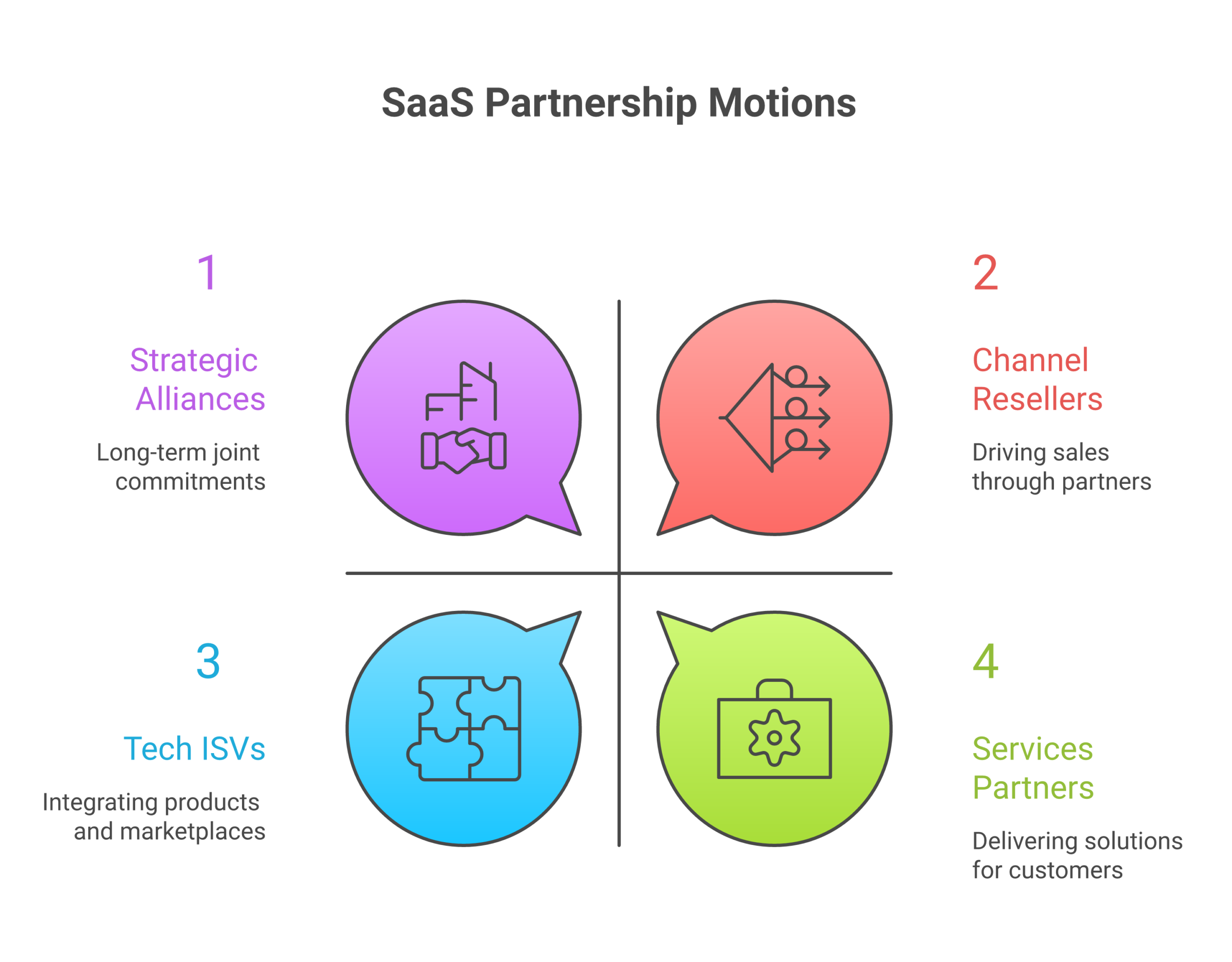
B2B SaaS Partnerships: The four motion types

Short answer: b2b saas partnerships is the practice of building and operating partner relationships that produce co-sell pipeline, integration revenue, or marketplace presence for a B2B SaaS company. In 2026, the SaaS partnerships that work as a revenue motion share three traits: an ideal partner profile, attribution discipline, and AE comp aligned to partner deals. The ones that do not work share the opposite traits.

The partner program hub holds the broader operating context, and the ideal partner profile work is the upstream filter for which SaaS partnerships will produce. Partnerships is the function; the partner program is the operating system; the profile is the recruitment filter.

A working SaaS-partnerships motion has three properties. It is typed: tech ISV, reseller, SI, and referral are distinct motions that need distinct designs. It is attributed: partner-sourced versus partner-influenced revenue is auditable, not negotiated. And it is integrated: partner deals run through the same CRM and forecast as direct, with AEs co-selling on aligned comp.

Why b2b saas partnerships matter in 2026

B2B SaaS spent the easy-money years recruiting partners broadly and operating partnerships lightly. The reckoning has arrived: capital efficiency is now a board metric, partner-sourced revenue is on the board deck, and partnerships that cannot defend a number are losing budget.

Three forces sharpened this. First, the SaaS buying committee got larger and more cross-vendor, which makes co-sell motions valuable when they work and expensive when they don’t. Second, AE/sales-team time tightened across most SaaS revenue orgs, so AEs only invest in partner deals that show stage progress. Third, ecosystem and PRM tooling matured enough that attribution and execution can be instrumented at the deal level, there is no longer a tooling excuse for soft partner numbers.

The mechanical case is simple. A SaaS company running partnerships as a real revenue motion reports partner-sourced revenue with the same conviction as direct, defends the number in the board review, and gets funded. A SaaS company running partnerships as a side function reports a fuzzy “partner-attributed” number, gets discounted by finance, and watches budget shift to direct outbound the following year.

This is also a competitive issue. The SaaS companies that win the strongest tech ISV partners and the best implementation SIs are the ones whose programs operate professionally. Strong partners can tell which programs are real, and they invest accordingly.

How b2b saas partnerships actually work

Five mechanics build a SaaS partnerships motion that produces. The order matters: design the program by partner type, recruit to the profile, instrument attribution, align comp, and run the forecast discipline.

  1. Design the program by partner type, not as a generic “partnerships” function: tech ISV, reseller, SI, and referral are distinct motions. Each needs its own profile, comp design, and operating cadence. A generic program that tries to serve all four poorly produces nothing.
  2. Recruit to the ideal partner profile for each type: profile drift is the most common cause of underperforming SaaS partnerships. A 12-partner roster that all match the profile outperforms a 60-partner roster that doesn’t.
  3. Instrument attribution at the CRM-opportunity level: see partner attribution. Every opportunity carries a sourced/influenced/direct tag. Partner-sourced deals carry a deal-registration timestamp. Without auditable attribution, the SaaS partnerships number stays soft and the CFO discounts it.
  4. Align AE comp on partner deals to direct: see partner manager salary. If AEs are paid less on partner deals than direct, they will prioritize direct every quarter. Equalize the comp treatment or accept that the AEs will not co-sell.
  5. Roll partner pipeline into the same forecast review as direct: math-led, same exit criteria, same inspection questions. A separate partner forecast review under-scrutinizes partner deals and undercuts the partner number’s credibility with the CFO.

SaaS companies that run all five build partnerships that the board funds. Companies that skip the profile work or the attribution discipline end up with partnerships that look real in the deck and produce inconsistently in reality.

Common pitfalls

Four repeating failures show up across B2B SaaS partnerships programs. All four are recognizable in the operating model, not just in the results.

  • Treating partnerships as a single function: tech ISV, reseller, SI, and referral are different jobs. A “head of partnerships” managing all four is usually managing one well and the rest poorly. Pick the dominant motion and design around it.
  • Recruitment without a profile: a SaaS company that recruits any willing partner ends up with a roster mismatched to the production opportunity. The profile is the cheapest filter and the most under-built artifact.
  • Soft attribution: a SaaS partnership number debated at quarter-end is a negotiation, not a number. Build attribution before deals exist; apply the same rules to wins and losses.
  • AE comp that penalizes partner deals: any comp differential against partner deals trains AEs to prioritize direct. The damage is invisible in any single quarter and structural over a year.

Tools and examples

B2B SaaS partnerships operate across three layers, each of which is well-established in the SaaS stack.

LayerWhat it does for SaaS partnershipsExamples
Ecosystem / account mappingSurfaces customer and prospect overlap with partners’ booksCrossbeam, PartnerTap
PRMProvides partner-facing portal, deal registration, enablement asset deliveryPartnerStack, Impartner, Allbound
CRM with attribution disciplineHolds opportunities with sourced/influenced tags, math-led forecastSalesforce, HubSpot

A worked example: a mid-stage SaaS company designs its partnerships motion around its tech ISV partners, the segment with the strongest overlap on its target ICP. It writes a focused ideal partner profile for tech ISVs, sources a 30-name target list, recruits 12 partners that match. RevOps wires partner attribution into the CRM with explicit sourced/influenced/direct states. The CRO equalizes AE comp on partner deals. Partner pipeline rolls into the weekly forecast review with the same math as direct. Within three quarters, partner-sourced revenue lands at 28% of new revenue with a tight commit-to-close ratio. The board funds the program.

Forecastable’s POV

The single most-repeated mistake in B2B SaaS partnerships is treating partnerships as a generic function instead of a set of distinct motions. The team gets hired to “build partnerships,” recruits a mix of tech ISVs, resellers, SIs, and referral partners, builds a program that tries to serve all four, and produces inconsistent results across the board. The fix is to pick the dominant motion for the company’s go-to-market and design the program around it. The other motions can run as supplements, not as parallel primary motions.

The most common second mistake is under-instrumenting attribution. SaaS companies that report partner numbers in language like “$5M in partner-attributed revenue” without explicit sourced/influenced separation are reporting a number the CFO discounts by default. The fix is mechanical: a CRM field with explicit states, a deal-registration timestamp before the deal advances, and a monthly reconciliation co-owned by RevOps. The number that emerges is smaller and worth far more, believability beats size in every board review.

The third move is to fix the AE comp alignment before recruiting more partners. A partnerships team that recruits aggressively while AEs are paid less on partner deals is building a recruitment funnel that the field will not consume. Equalize the comp first. Then watch which AEs actually co-sell, which is a useful signal for how to size the broader motion. A SaaS partnerships function that does this comp work upstream avoids the most common adoption failure in the field.

Forecastable is an independent third-party professional services company. Our evaluations of SaaS partnership and ecosystem platforms are based on publicly-available information as of May 2026 and our own client experience.

Frequently asked questions

What are B2B SaaS partnerships? The set of partner relationships a B2B SaaS company builds to produce co-sell pipeline, integration revenue, marketplace presence, or implementation reach, across tech ISVs, resellers, SIs, and referral partners.

Which partner type matters most in B2B SaaS? It depends on the company’s GTM. Tech ISVs matter most for product-led SaaS with integration leverage; SIs matter most for enterprise SaaS with complex implementation; resellers matter most for breadth across mid-market. Pick the dominant motion and design around it.

How do you measure the success of B2B SaaS partnerships? Partner-sourced revenue as a share of new revenue, partner-sourced commit accuracy at quarter-end, share of AEs actively co-selling, and time-to-first-registered-deal for new partners. Activity metrics tell you the team is busy, not that the program is producing.

Should a B2B SaaS company invest in a PRM and an ecosystem platform? For most programs above a small partner roster, yes. The ecosystem platform surfaces overlap; the PRM captures deal registration and provides the partner-facing portal. They are different tools for different jobs.

How is B2B SaaS partnerships different from a partner marketing function? Partner marketing produces co-marketing campaigns and demand generation through partners. Partnerships covers the broader relationship, recruitment, enablement, co-sell, attribution. Partner marketing is a slice of the broader partnerships function.

When should a SaaS company hire its first dedicated partnerships role? When the company has a clear ICP, a working direct sales motion, and product-led signals that partners (tech ISVs especially) are present in deals already. Hiring partnerships before any of those is in place produces a function with nothing to build on.

What is the most common reason B2B SaaS partnerships fail to produce? Treating partnerships as a generic function and skipping the attribution and comp-alignment work. Both failures show up as flat partner-sourced revenue while the team looks busy.

Next step

Pull your last quarter’s partner-attributed revenue number and check two things: is it cleanly split into sourced versus influenced, and were the AEs paid the same on partner deals as on direct deals? If either answer is no, those are the first two fixes.

Talk to our team about building a B2B SaaS partnerships motion that produces a number the board funds →

The partner program hub holds the broader context on where SaaS partnerships sit inside revenue strategy.

Uncover Your Growth Potential

Whether starting with a single sales team or a single partner, any co-sell motion can be live within 30 days.

Schedule a Discovery Call
Latest Insights
Alex Buckles in a sleeve-rolled-up dress shirt at a whiteboard sketching a partner-readiness score model with a CRO standing nearby, partner-portfolio chart visible, deep navy and amber palette.
  • Partnerships Roles & Hiring
Alex Buckles

Alex Buckles Partnerships POV: 5 Operating Rules

For broader industry context, see Partnership Leaders’ practitioner community. What Does Alex Buckles Think About Partnerships? Short answer: Alex Buckles’ partnerships work is grounded in one operating belief, partnerships is a measurable system, not a relationship motion. I run Forecastable, an independent third-party professional services firm that designs partner-led GTM systems for B2B SaaS companies, […]

Read Article
Partner manager at a laptop drafting a 1:1 bi-weekly partner check-in email with a tier-1 cadence calendar visible on a second monitor, deep navy and amber palette
  • Partnerships Roles & Hiring
Alex Buckles

Always-On Comms: The Partner Cadence That Keeps Mindshare

What are always-on comms? Short answer: Always-on comms is the structured, recurring cadence of brief, value-add 1:1 communications from a vendor’s partner team to named contacts at partner firms. They are not newsletters, not marketing blasts, and not pitch sequences. They run quietly in the background of a partnership and keep mindshare from decaying between […]

Read Article
A revenue leader and a partnerships leader at a conference-room whiteboard sketching a partner-program operating model with archetypes, attribution lanes, and a measurement scoreboard, partner-portfolio chart visible on the wall monitor, deep navy and amber palette.
  • Partnerships Roles & Hiring
Alex Buckles

Building a Partner Program: The 2026 Operating Blueprint

What is building a partner program? Short answer: Building a partner program is the end-to-end exercise of designing and launching a partner-led growth system from zero, with a defined thesis, archetypes, operating model, partner journey, and measurement scoreboard. It is a system-design effort, not a hiring decision. A working partner program has three properties. It […]

Read Article
Revenue leader and partnerships ops reviewing a target-partner list at a calm modern conference table, deep navy and amber palette, right third clean for headline overlay
  • Partnerships Roles & Hiring
Alex Buckles

Partner Sourcing: How to Find the Partners You Need

What is partner sourcing? Short answer: partner sourcing is the deliberate process of identifying, prioritizing, and engaging prospective partners against an ideal partner profile, run like account-based selling rather than inbound waiting. In 2026, the programs that recruit the partners they actually need do partner sourcing as a discipline; the ones that recruit whoever applies […]

Read Article
Logo — It’s All AboutThe Team

Quick Links

  • Who We Serve
  • Solutions
  • Resources
  • Pricing
  • Our History

Social Media

  • Linkedin

Legal

  • Privacy Policy
  • Terms of Service
Quick Links
  • Who We Serve
  • Solutions
  • Resources
  • Pricing
  • Our History
Social Media
  • Linkedin
Legal
  • Privacy Policy
  • Terms of Service

Stay ahead on ecosystem-led growth

Logo — It’s All AboutThe Team
© 2025 Forecastable. All rights reserved.
Book Your Strategy Call
Request Enrollment Details

[contact-form-7 id=”dfbeed3″ title=”Request Enrollment Details”]

Mollie Bodensteiner

Revops Advisory
  Mollie Bodensteiner is an experienced operations professional with a demonstrated track record of utilizing technology to support operational processes that drive performance and innovation. She currently is the Vice President of Operations at Sound and owns go-to-market agency, MB Solutions. Mollie has previously held operations leadership roles at Deel, Syncari, Corteva and Marketo. She has over 14 years of experience in both B2C and B2B operations and technology. When she is not working, Mollie enjoys spending time with her husband, three small children, and two large dogs. Childhood Career/Dream: Growing up in the age of Disney and Nick@Nite I always wanted to be a child actor (good thing that never was actually pursued 🙂 Favorite Win: I am not sure I have a specific “win” but I think I get the most joy and excitement from coaching others and watching them hit major milestones in their career. The first time you get to promote someone on your team or watch them lead a major project – are always career highlights! Personal Fun Facts: Favorite Song: If it’s love, Train Favorite Movie: Good Will Hunting Favorite Meme: Disaster Girl
Forecastable resources: Co-Sell Orchestration Platform · All Use Cases · Live in 30 Days · Co-Sell Playbook

Kelsey Buckles

Director of Operations


My journey from Education to Operations has equipped me with a unique perspective and skill set that perfectly aligns with Forecastable’s mission to help businesses improve sales collaboration through partner co-selling strategies.

At Forecastable, I am passionate about empowering teams and organizations to unlock the full potential of strategic partnerships. By leveraging my expertise in communication, leadership, and operational efficiency, I contribute to creating seamless co-selling processes that align with business goals and deliver exceptional results.

The intersection of my educational foundation and operational experience fuels my dedication to fostering alignment, building trust, and enhancing collaboration between partners. I am driven by the opportunity to contribute to a platform that not only optimizes sales strategies but also strengthens relationships that lead to long-term growth.

Paul Jonhson

Chief Technology Officer (Co-founder)


Paul Johnson has 20+ years of software development and consulting experience for a variety of organizations, ranging from startups to large-enterprise organization with highly-complex needs.

Mr. Johnson has a long track record of successful technology deployments.
This, combined with his deep passion for machine learning and exceptional user experience design, allows him to lead our technical direction from the front with confidence.

Alex Buckles

Product, Partnerships, and Value Engineering (Co-founder)


After serving in The United States Marine Corps, Alex Buckles spent the next two decades as a student of revenue production and an advocate for innovation.

Along the way, he has helped numerous companies achieve double and triple-digit growth by crafting and executing high-performing go-to-market strategies, with co-selling at the center of each.

As a once-advanced technical marketer, an expert sales & partner professional, and a strong customer success advocate, Mr. Buckles understands the impact of these functions aligning not only on revenue production, but on the day-to-day execution of the go-to-market strategy. This concept of revenue-team alignment is what quickly became the foundation of Forecastable back in January of 2018.

In his free time, you’ll find him spending quality time with his children, one of whom is on the autism spectrum. 1 in 36 children in the U.S. are on the spectrum and boys are four times more likely to be diagnosed than girls.

With that in mind, Mr. Buckles plans on dedicating the rest of his life serving those living with autism, through his organization Pathways for Autism. From his perspective, there must be a scalable and financially self-sustaining infrastructure established to put as many individuals with autism as possible on a path towards complete independence as adults.