How to Build a Predictable B2B Selling System

What is a predictable selling system?
Short answer: a predictable selling system is the operating combination of forecast math, deal inspection, and partner attribution that lets a revenue org call its number with the same confidence every quarter. In 2026, it is what separates revenue orgs that get funded from revenue orgs that get scrutinized. “Let’s build a predictable selling system” is the phrase we use because predictability is the design goal, not a side effect of selling harder.
The forecastability pillar holds the broader framing for why this matters, and the frontline sales managers layer is where the system actually gets run. The system is the design; the frontline manager is the operator.
A working system has three components. There is forecast math: a stage-by-stage conversion model anchored in historical close rates. There is deal inspection: a structured way to look at every commit deal that does not collapse into vibes. And there is attribution discipline, including partner attribution, so the pipeline number is auditable.
Why a predictable selling system matters in 2026
Revenue orgs are being asked to do more with less, and “more with less” is impossible without predictability. The companies that hit their numbers in a tighter market are not the ones with the best reps; they are the ones with the most boring, most consistent operating cadence.
Three forces sharpened this. First, capital efficiency is now a board metric, and capital efficiency is downstream of forecast accuracy. Second, partner-driven revenue moved onto the board deck, and partner-driven revenue is forecast-able only when it sits inside the same system as direct. Third, AI tools changed the leverage point: reps need less data-entry help and more deal-judgment help, which means the system that produces judgment becomes the constraint.
The mechanical case is simple. A revenue org with a real system reports the number once and the number holds. A revenue org without one re-forecasts the quarter three times, each time downward, and the CFO learns to discount the team’s calls by 20% by default. The difference compounds: the team with the system gets the funding to scale, the team without it gets a hiring freeze.
This is also a retention issue. The strongest sales managers and operators want to work inside a system. Without one, the role is reactive, and reactive roles burn out the best people first.
How a predictable selling system actually works
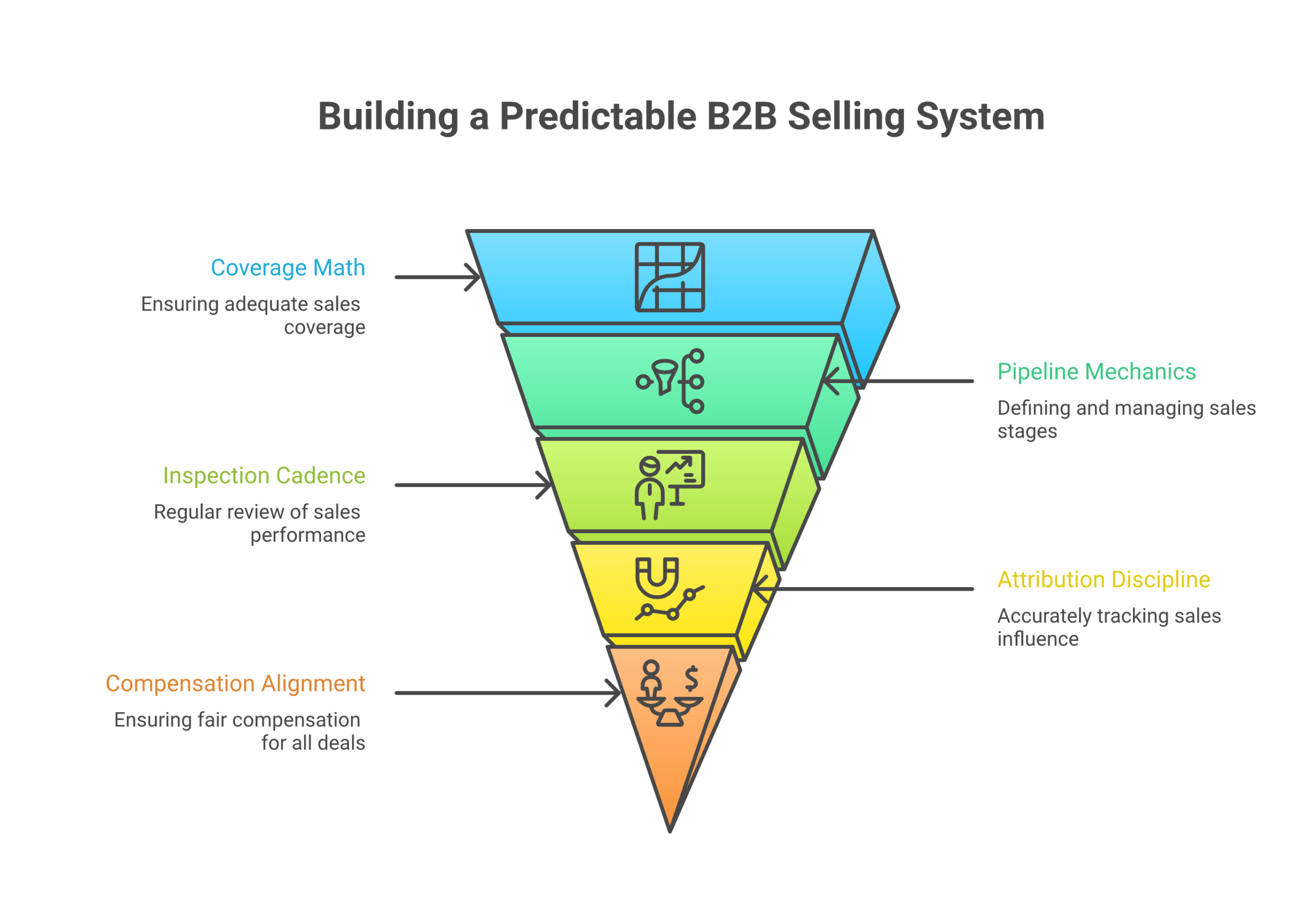
Five mechanics build a predictable selling system. The order matters: the math is the foundation, the inspection is the practice, the attribution is the audit, the cadence is the heartbeat, and the leadership is the multiplier.
- Build the forecast math first: stage-by-stage conversion rates anchored in the last four quarters of history, applied to current pipeline by stage. Math first; story second. Without the math, every forecast becomes a debate about feeling.
- Add structured deal inspection: a small set of questions applied to every commit deal every week (champion strength, economic-buyer access, decision criteria, paper process, close plan). The questions are the same across reps; the answers expose where the deal really stands.
- Make attribution auditable: every opportunity carries a sourced/influenced/direct tag, and partner-sourced deals carry a deal-registration timestamp. Without auditable attribution, the partner number stays a claim and the forecast stays soft.
- Run the cadence weekly, not when the quarter is in trouble: a weekly forecast review, a weekly one-on-one per rep, a weekly partner pipeline sweep. The cadence is the system’s heartbeat; without it, the system is a slide.
- Lead by raising the floor, not the ceiling: most revenue orgs over-invest in star performers and under-invest in median performers. A predictable system moves the median, which is where the company’s revenue actually lives. The frontline sales manager development work is where the median moves.
Companies that run all five report numbers that hold. Companies that skip the math or the cadence end up with a forecast that re-forecasts itself every two weeks.
Common pitfalls
Four repeating failures show up across attempts to build a predictable selling system. All four are recognizable in the first quarter.
- Forecast by feel, not by math: if the team’s forecast comes from “what reps think will close” without explicit conversion math, the system has no predictability layer. Anchor every commit number to a stage-by-stage conversion rate against the last four quarters.
- Inspection without coaching, or coaching without inspection: inspection finds the gap; coaching closes it. A team that inspects but never coaches finds the same gaps quarter after quarter. A team that coaches without inspecting builds reps who feel good and miss deals.
- Attribution argued at quarter-end: a partner-sourced number debated in the last week of the quarter is not attribution; it is lobbying. Build the partner-sourced revenue rules before the quarter starts and apply them the same way to wins and losses.
- Cadence that only runs when the quarter is shaky: a forecast review that materializes mid-quarter when the number looks bad is reactive, not predictable. The cadence has to be the same in good quarters and bad quarters, or it does not work in either.
Tools and examples
A predictable selling system runs on three operating layers, not on a single tool purchase.
| Layer | What it provides | Examples |
|---|---|---|
| CRM with stage discipline | The source of truth for pipeline, stages, and forecast math | Salesforce, HubSpot |
| Recorded calls + deal review | Evidence for inspection that does not depend on rep memory | Gong, Chorus, Fathom |
| Ecosystem / partner attribution | Auditable partner-sourced and partner-influenced data | Crossbeam, PartnerTap on overlap; PartnerStack, Impartner, Allbound on deal registration |
A worked example: a mid-stage SaaS company builds the system in three steps over two quarters. Quarter one, RevOps wires up stage-by-stage conversion math from historical data, and the forecast review becomes math-first. Quarter two, every manager runs a five-question inspection on every commit deal, every week, and the partner pipeline gets the same attribution treatment as direct. By the end of quarter two, the company calls its number on the third week and the number holds. The CFO stops discounting the sales team’s commits.
Forecastable’s POV
The phrase “let’s build a predictable selling system” is the work, not a slogan. Most revenue orgs treat predictability as a side effect of trying harder. It is not. It is a design choice that lives in the math, the inspection cadence, and the attribution discipline. Companies that pick the design choice get predictable revenue; companies that wait for predictability to emerge from effort get inconsistent quarters and a CFO who learns to discount their calls.
The most common failure pattern is the same in every revenue org I see: the team has each of the components in a partial form, but they have never been assembled into a system. There is some forecast math (in a spreadsheet RevOps maintains). There is some deal inspection (when a deal goes sideways). There is some attribution (debated quarterly). None of it runs on a cadence. The fix is rarely buying a new tool; the fix is connecting the existing components into one weekly operating rhythm and holding the rhythm even when the quarter is going fine.
The second move is to lead the system from the second-line layer, not from the CRO’s office. The CRO is the customer of the system, but the operator is the second-line sales leader and the frontline managers underneath them. A predictable system designed at the CRO level and never adopted by the line layer is a slide deck. A system the frontline managers run every week is the actual product.
The third move is to accept that predictability is partly about saying no. A predictable system means the team commits a lower number with high confidence rather than a higher number with low confidence. Salespeople trained on aspirational forecasts hate this initially; CFOs love it immediately; CROs come around once the calls hold. The trade is real and worth making, a number you hit is worth far more than a number you almost hit.
Forecastable is an independent third-party professional services company. Our evaluations of selling-system platforms are based on publicly-available information as of May 2026 and our own client experience.
Frequently asked questions
What is a predictable selling system? The combination of forecast math, structured deal inspection, attribution discipline (including partner attribution), and a weekly operating cadence that lets a revenue org call its number with consistent confidence.
Why is it called “let’s build a predictable selling system”? Because predictability is the explicit design goal, not a side effect. The phrase frames the work as something a team chooses to build, not something that emerges from effort alone.
Do you need a specific tool to build a predictable selling system? No. The system runs on a CRM with stage discipline, a recorded-call platform for inspection, and ecosystem/PRM tooling for partner attribution. The tools are commodities; the cadence is the differentiator.
How long does it take to build a predictable selling system? Two to three quarters to a working v1. Forecast math first, then inspection cadence, then attribution discipline. Compounding benefits show up in quarter three and beyond.
Who should own building a predictable selling system? The CRO sponsors it; the second-line sales leader operates it; frontline managers run it every week. A system that lives only at the CRO level never lands; a system run by the frontline managers compounds.
What is the relationship between this system and partner-driven revenue? Partner-driven revenue is only forecastable when it sits inside the same system as direct revenue, same attribution rules, same stages, same forecast review. A predictable selling system treats the partner number as a peer to the direct number.
How is this different from a normal sales process? A sales process describes how a deal moves through stages. A predictable selling system describes how the org runs the math, inspection, attribution, and cadence around all the deals. Process is per-deal; system is org-wide.
Next step
Audit your last forecast review with one question: was the commit number defended with math, or with story? If story, the math layer is the first build. Wire up stage-by-stage conversion math from the last four quarters of history and run the next forecast review against it.
Talk to our team about building a predictable selling system from the math layer up →
The forecastability pillar holds the broader context on where this system fits in a forecast-disciplined revenue org.
Uncover Your Growth Potential
Schedule a Discovery Call