Frontline Sales Manager Development: A Practical Guide

What is frontline sales manager development?
Short answer: frontline sales manager development is the deliberate training, coaching, and operational system used to turn first-line sales managers into forecast-disciplined, deal-coaching leaders rather than senior reps with a bigger spreadsheet. In 2026, it is the highest-leverage investment any revenue org can make, and the most consistently underbuilt.
The frontline sales managers role definition covers what these managers own, and the forecastability pillar holds the broader operating context. Development is the layer that connects role design to actual behavior change in the field.
A working definition has three parts. There is inspection: the manager learns to look at deals with structured questions, not vibes. There is coaching: the manager learns to develop reps rather than do reps’ work. And there is forecast discipline: the manager learns to call commit, best case, and pipeline with the same rigor as the CRO.
Why frontline sales manager development matters in 2026
The frontline manager layer is the leverage point in every revenue org, and most companies under-train it. A strong frontline manager raises the productivity of every rep on the team. A weak one caps the team at whatever the manager can carry personally.
Three forces make this urgent. First, the cost of a missed quarter is higher in a tighter environment, and missed quarters are usually frontline-management problems, not rep problems. Second, the senior-rep-promoted-to-manager pattern produces individual contributors with extra direct reports, not actual managers. Third, AI tools changed what reps need from their manager: less data wrangling, more deal judgment.
The mechanical case is simple. A frontline manager who runs an inspection-led one-on-one and a forecast review with structured math will compound their team’s results across every quarter. A manager who runs status meetings and best-case roll-ups will not. The difference between the two managers is training, not talent.
This is also a retention issue. Strong reps leave for managers who develop them. Weak managers lose the best reps first, and the loss is invisible in the pipeline number until the next ramp cycle exposes it.
How frontline sales manager development actually works
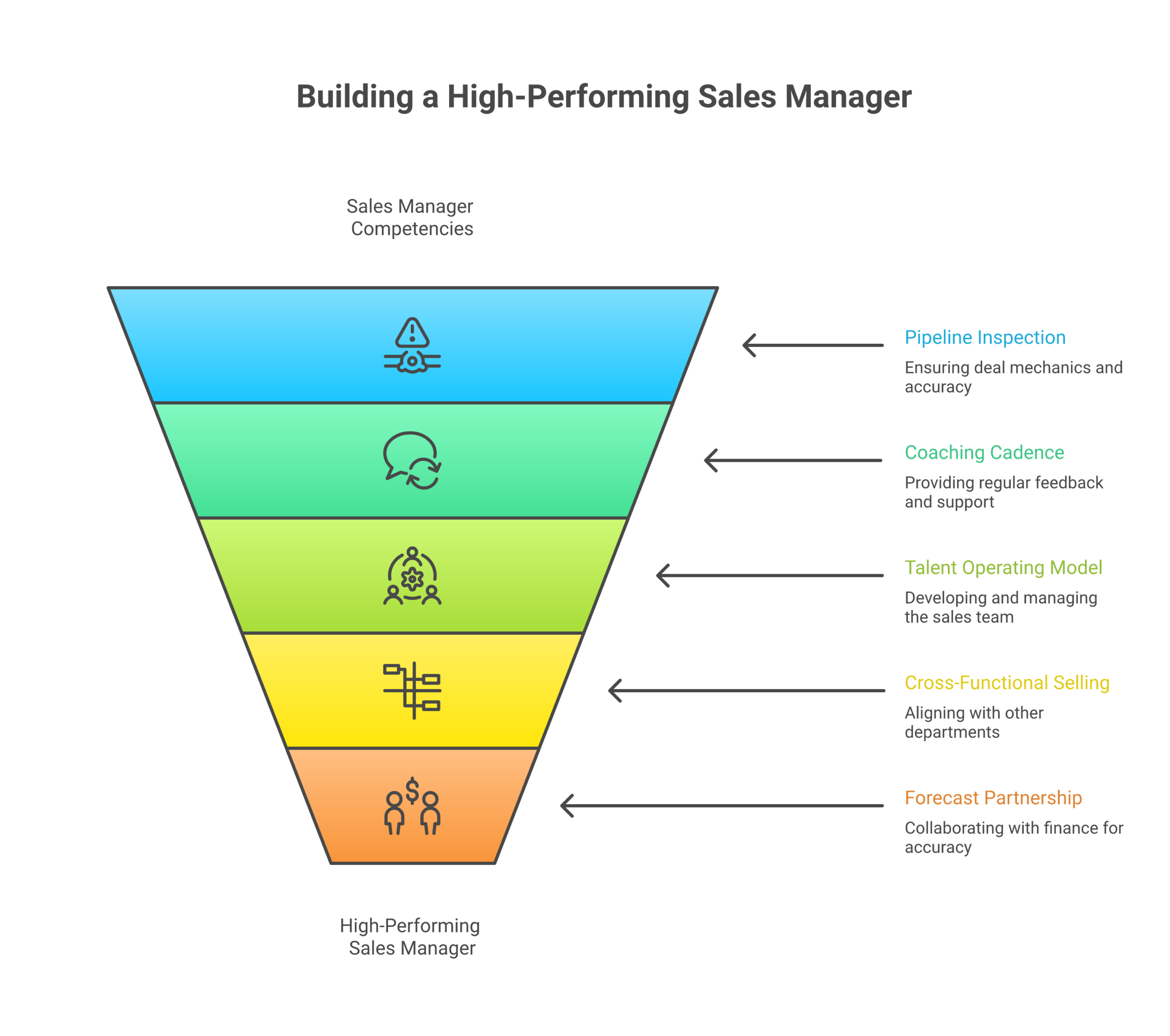
Five components produce a frontline manager who runs the team like a system, not a reactive role. The order matters: inspection before coaching, coaching before forecast discipline, all of it before scaled team-building.
- Inspection skills come first: teach the manager to look at deals with a structured set of questions (champion, economic buyer, decision criteria, paper process, close plan). Inspection is the prerequisite for every other manager skill; you cannot coach a deal you cannot see clearly.
- Coaching as a separate skill, not a softer version of inspection: the manager learns to ask the rep questions that develop the rep’s judgment, rather than tell the rep what to do. Inspection finds the gap; coaching closes the gap by building the rep’s capability.
- Forecast discipline anchored in math, not feel: the manager learns to call commit, best case, and pipeline with explicit conversion math against history, and to defend the number in the CRO’s review. This is the layer that connects the team’s work to the company’s number.
- Operating cadence the manager owns: a weekly one-on-one with each rep, a weekly team forecast review, a monthly deep dive on a stuck deal or two. The cadence is the manager’s product; without it, the role degrades into reactive deal help.
- Separation of inspection and coaching from quota carrying: if the manager personally carries quota, the role pulls back toward selling. The strongest frontline manager development programs progressively remove individual quota and replace it with team metrics, so the manager has the capacity to actually manage.
Programs that run all five produce managers who scale teams. Programs that skip the separation step end up with senior reps wearing manager titles, which caps the team and burns out the best individual contributor.
Common pitfalls
Four repeating failures account for most frontline manager development that does not stick. All four are upstream of the manager, in how the program is designed.
- Promoting the top rep and calling it development: the top rep promotion is a hiring decision, not a development plan. Without explicit training in inspection, coaching, and forecast math, the new manager defaults to doing rep work with a team attached.
- Training without operating cadence: a development workshop without a weekly one-on-one and forecast review attached does not change manager behavior. The cadence is where the new skills get rehearsed and reinforced.
- Keeping the manager on quota indefinitely: a manager carrying personal quota will protect the personal number first, the team number second. The role caps at the manager’s bandwidth. Move the quota off, even gradually.
- Measuring activity instead of judgment: tracking call volume, demo count, or pipeline activity tells you the team is busy. It does not tell you the manager is developing reps. Measure the development outcome: rep ramp time, win-rate change across the team, forecast accuracy over rolling quarters.
Tools and examples
Frontline manager development draws on three operating layers, none of which are tools in the SaaS sense, they are practices anchored in the team’s existing systems.
| Layer | What it provides | Where it lives |
|---|---|---|
| Structured deal inspection | A shared vocabulary for what is true about a deal, applied consistently across reps | CRM opportunity records and MEDDIC/MEDDPICC or similar deal framework |
| Coaching cadence | The weekly one-on-one and call-review routine that converts inspection into rep development | Manager calendar; recorded-call platform |
| Forecast discipline | The team forecast review with explicit conversion math and historical comparison | Weekly team forecast meeting; CRO review |
A worked example: a mid-stage SaaS company runs a frontline-manager development program over two quarters. Quarter one, every manager learns and practices a five-question deal inspection on every commit deal, every week. Quarter two, every manager runs a structured weekly one-on-one with each rep, with a clear separation between inspection (what is true) and coaching (what should this rep develop next). The forecast review becomes math-led, not story-led. By end of quarter two, the company’s forecast accuracy improves measurably and the strongest reps stop quietly leaving.
Forecastable’s POV
Frontline sales manager development is the most consistently undervalued investment in revenue leadership, and the highest-return one. Every company says it cares about manager development. Almost no company has a real program. The gap between the talk and the practice is where the next quarter is won or lost.
The most common pattern I see is that the company runs a one-time manager onboarding workshop, ships the manager a copy of a sales-management book, and expects behavior change. It does not work. Behavior change at the manager layer requires three things: explicit teaching of separate skills (inspection, coaching, forecast math), an operating cadence that forces those skills into the weekly schedule, and a measurement framework that watches for team-level outcomes over multiple quarters. Without all three, the workshop is theater, and the manager defaults back to doing rep work because that is the only behavior the company actually rewards.
The second move is to take the personal quota away, even if the manager protests. As long as the manager is on a personal number, the team is implicitly a side project. Strong managers earn their compensation by raising the productivity of the team, not by closing deals themselves. Pay them on the team’s number and the role’s center of gravity moves where it belongs.
The third move is to separate inspection from coaching in how you train and measure. They are different skills. Inspection asks: what is true about this deal? Coaching asks: what does this rep need to develop next, and how do I help them get there? A manager who confuses the two ends up either telling reps what to do (no development) or running supportive conversations that never expose deal weakness (no inspection). Teach them separately, measure them separately, expect both.
Forecastable is an independent third-party professional services company. Our evaluations of sales-manager development practices are based on publicly-available information as of May 2026 and our own client experience.
Frequently asked questions
What does frontline sales manager development include? At minimum, explicit training in deal inspection, rep coaching, and forecast math, plus an operating cadence (weekly one-on-ones and team forecast review) that turns the training into weekly practice.
How long does it take to develop a frontline sales manager? Two to three quarters to a working v1, longer to compound. Inspection skills land first; coaching takes a full quarter of practice; forecast discipline solidifies across multiple forecast cycles.
Should a frontline manager carry personal quota? Not indefinitely. A manager on a personal number protects the personal number first; the team caps at the manager’s bandwidth. Move the quota off as the team scales, even gradually.
What is the difference between inspection and coaching? Inspection asks what is true about a deal. Coaching asks what the rep needs to develop next. They are different skills and should be taught and measured separately.
How do you measure whether a manager is improving? Team-level outcomes over multiple quarters: rep ramp time, win-rate change across the team, forecast accuracy on rolling quarters. Activity metrics tell you the team is busy, not that the manager is developing reps.
Why do top reps make weak managers? The skills that produce a great rep (personal selling judgment, deal execution) are different from the skills that produce a great manager (inspection at scale, coaching, forecast math). Without explicit development, the top rep promoted to manager defaults to doing rep work with a team attached.
Who should own frontline manager development? The second-line sales leader (VP Sales or equivalent) owns it, with enablement supporting. Outsourcing it entirely to enablement removes the line-leader accountability and the program drifts.
Next step
Pick one frontline manager on your team and audit the weekly cadence: are there real one-on-ones, a math-led forecast review, and structured deal inspection? If any of those is missing, that is the first build. Add the missing piece for one quarter and watch the team metrics.
Talk to our team about building a frontline sales manager development program that compounds →
The forecastability pillar holds the broader context on where frontline manager development fits inside a forecast-disciplined revenue org.
Uncover Your Growth Potential
Schedule a Discovery Call