Partner Program Examples: Structural Patterns Behind Programs That Scale

Partner program examples are most useful when you read past the logo gallery and study the structural mechanics: tier requirements, deal-registration rules, MDF gates, certification thresholds, co-sell expectations, and attribution policy. The same five or six structural patterns repeat across every successful program, regardless of category or scale. The patterns are what’s portable; the brand details rarely are.
Most articles on partner program examples list ten programs and describe their tiers. That’s surface-level. The more useful exercise is to read across the major programs (AWS, Salesforce, HubSpot, ServiceNow, Microsoft, Atlassian) and notice the structural moves they all make: tier-based gating tied to revenue and competency, deal-registration with margin protection, certification as a requirement for tier progression, MDF as a co-investment lever, and a designation system that overlays the tier system. Once you see the patterns, the question shifts from “which program should I copy” to “which patterns fit my motion.”
This piece covers what a partner program example is, six structural patterns that repeat across high-functioning programs, six representative programs and what they do well, the failure modes I see most often, and how program structure ties to the broader partner program.
What is a partner program example?
A partner program example is a documented partner program from a vendor that’s reached scale, used as a reference for designing or refreshing your own program. Useful examples are studied for structure (what mechanics the program uses) rather than for branding (what the tier names are). The structural patterns generalize; the brand details usually don’t.
The major examples in 2026 fall into four categories. Hyperscaler programs (AWS Partner Network, Microsoft Cloud Partner Program, Google Cloud Partner Advantage) are the most operationally mature; the structural patterns invented or refined here have flowed downstream to most other programs. Enterprise software programs (Salesforce Partner Program, ServiceNow Partner Program, SAP PartnerEdge, Oracle Partner Network) layer industry and product specialization on top of the hyperscaler patterns. SaaS platform programs (HubSpot Solutions Partner Program, Atlassian Solution Partner Program, Shopify Partner Program) emphasize accessibility and self-serve tooling. Niche vertical programs follow the patterns at smaller scale.
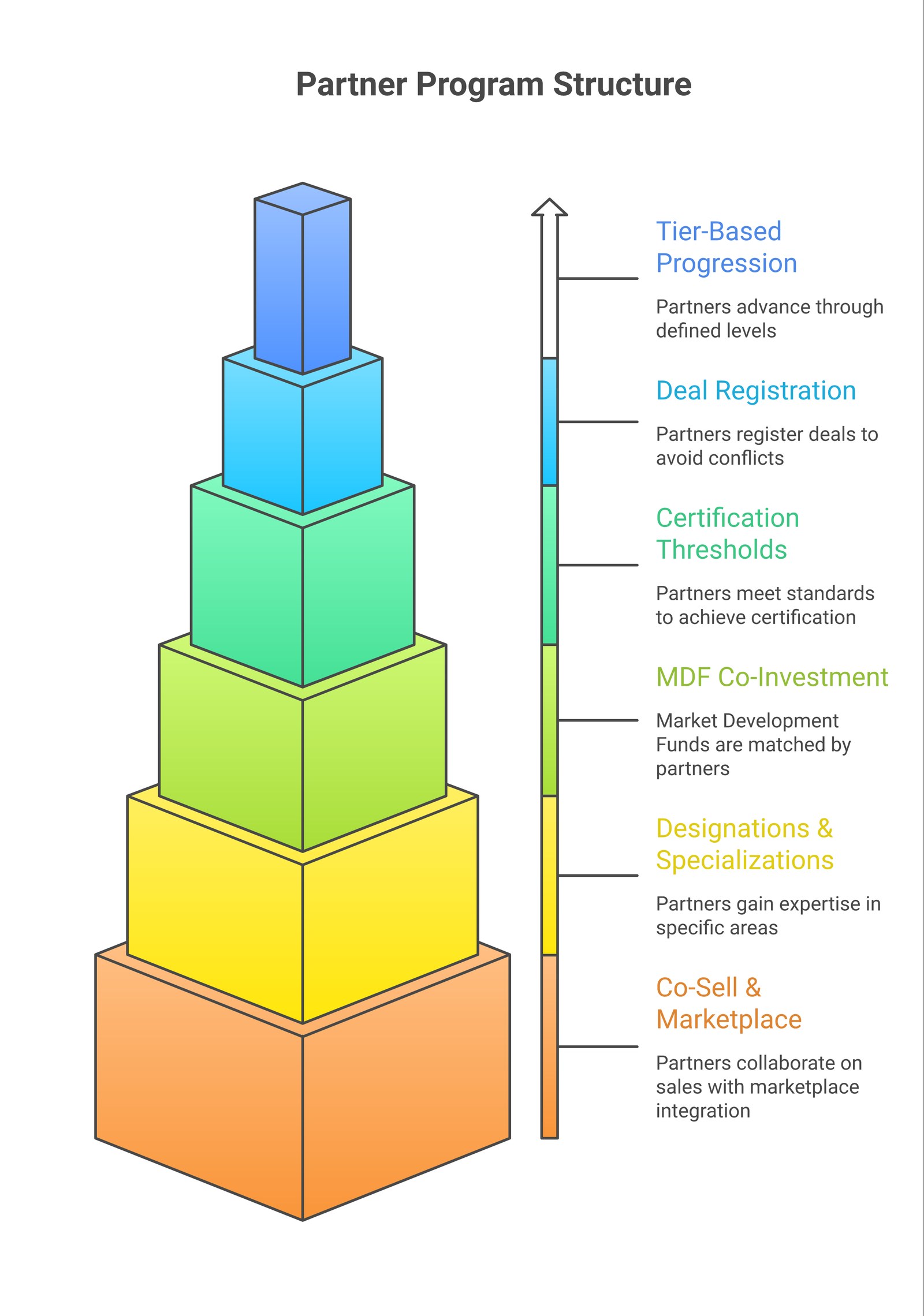
The structural elements are remarkably consistent across the four categories. Tier-based progression with revenue and competency requirements; deal registration with margin or co-sell protection; certification as a tier-gating mechanism; MDF as a co-investment lever; designations or specializations that overlay the tier system; co-sell motion with marketplace integration. The presence or absence of any of these is the structural signal worth studying.
Why partner program examples matter
Studying examples is the fastest way to compress two years of program-design learning into two weeks of analysis. The patterns that work have been validated at scale by hyperscaler and enterprise software programs; the patterns that don’t have been quietly retired. Reading across the major programs is the structural literacy required to design a program that will hold up.
The specific value is pattern recognition. After studying six or eight major programs, the structural decisions become much clearer: which tier mechanics work at which scale, when to add a designation system, when MDF helps and when it gets gamed, what deal-registration friction is appropriate at your stage. The decisions are still your decisions; the literacy makes the decision space smaller and more navigable.
The risk in studying examples is over-borrowing. A program that works at AWS scale doesn’t work at SMB SaaS scale; a program that works for enterprise software doesn’t work for a 50-person platform startup. The right exercise is to identify which structural patterns scale down, which scale up, and which are scale-specific. Most of the patterns scale down with simplification; a few don’t.
Six structural patterns common across major programs
Six patterns repeat across high-functioning partner programs at scale. Reading these as a system clarifies which moves you’ll make at your own program and in what order.
- Tier-based progression. Most major programs run three to five tiers. Tier requirements combine revenue thresholds, certification thresholds, and customer outcome thresholds. Tier benefits scale: better margins, more MDF, executive cadence, marketplace co-sell priority. AWS APN runs Select / Advanced / Premier tiers; Salesforce runs Base / Ridge / Crest / Summit; HubSpot runs Solutions Partner / Gold / Platinum / Diamond / Elite.
- Deal registration. Every mature program runs deal registration with some form of margin protection or co-sell protection. The mechanic gives the partner who invested in the deal first-mover protection against other partners and against the vendor’s direct sales.
- Certification thresholds. Certifications gate tier progression and partner profile placement. AWS, Salesforce, ServiceNow, Microsoft, and SAP all require named certifications.
- MDF as co-investment. Marketing Development Funds (MDF) are co-investment dollars the vendor provides to fund partner-led marketing programs. Strong programs tie MDF to specific revenue or pipeline outcomes; weak programs let MDF fund general partner marketing without accountability.
- Designations and specializations. A designation system overlays the tier system, naming partner expertise in specific products, industries, or motions. AWS uses competencies; Salesforce uses Industry and Product Cloud designations; ServiceNow uses Build and Service Partner designations; Microsoft uses Solutions Designations.
- Co-sell motion with marketplace integration. The hyperscaler programs (AWS, Azure, GCP) and Salesforce AppExchange have made marketplace co-sell a structural element. Programs that integrate marketplace co-sell at scale produce coordinated demand; programs that treat marketplace as a separate motion don’t.
Six representative programs
| Program | Tiers | Deal-reg | MDF | Designation system | Marketplace co-sell |
|---|---|---|---|---|---|
| AWS Partner Network | Select / Advanced / Premier | Yes; APN Customer Engagements (ACE) | Yes; tied to MDF guidelines | Competencies (10+) | AWS Marketplace |
| Salesforce Partner Program | Base / Ridge / Crest / Summit | Yes; via Partner Community | Yes; sales-led MDF | Industry & Product Cloud designations | AppExchange |
| HubSpot Solutions Partner Program | Solutions Partner / Gold / Platinum / Diamond / Elite | Yes; HubSpot deal-reg portal | Yes; co-marketing emphasis | App Partner / Solutions Partner / Provider designations | HubSpot Marketplace |
| ServiceNow Partner Program | Registered / Specialist / Premier / Elite | Yes | Yes | Build Partner / Service Partner designations on top of tiers | ServiceNow Store |
| Microsoft Cloud Partner Program | Solution Partner designations across six categories | Via PartnerCenter | Yes | Solutions Designations + Specializations | Microsoft Marketplace |
| Atlassian Solution Partner Program | Atlassian Solution Partner / Gold / Platinum | Yes | Yes; co-marketing | Marketplace App Partner / Solution Partner | Atlassian Marketplace |
The hyperscaler programs (AWS, Microsoft, Google) are the operationally most sophisticated; the structural patterns they refined are now standard in most enterprise software programs. Salesforce and ServiceNow have the most mature designation systems on top of tiers. HubSpot is the most accessible large program for SMB-mid market platform vendors.
Common pitfalls in copying examples
The pitfalls in studying examples are about over-borrowing, under-adapting, and misjudging scale. Three patterns repeat.
The first pitfall is copying tier names without copying tier mechanics. Tier names are the visible surface; the mechanics underneath (revenue thresholds, certification thresholds, benefit deltas across tiers) are what makes the tier system work. Copying “Gold / Platinum / Diamond” without designing the underlying thresholds produces tiers that don’t gate behavior.
The second pitfall is borrowing MDF mechanics from a program that has 10x the resources. AWS or Microsoft can run MDF as a major co-investment lever because the absolute dollars are large enough to fund partner motion at scale. A 50-person platform vendor copying that mechanic produces an MDF program that is too small to fund real motion and too big to ignore.
The third pitfall is treating examples as templates instead of as references. The right use of an example is to identify which structural patterns fit your motion, not to import the program wholesale.
The fourth pitfall is studying only the top of the funnel (program announcement, tier names, partner directory) and not the operating layer (deal-reg adjudication, MDF accountability, certification renewal cadence, conflict resolution).
Forecastable’s POV
Partner program examples are most useful as a structural reference and least useful as a template. The patterns generalize; the specifics rarely do. Read four to six major programs, identify the three or four structural moves you’ll borrow, and design the rest from your motion.
Two specific calls Forecastable makes consistently. First: study the operating layer, not the announcement layer. The tier names and partner directory are the marketing surface; the deal-reg rules, MDF accountability, certification cadence, and conflict-resolution process are where the program actually runs. Second: pick the structural patterns that fit your scale, not the ones that look most ambitious. A program designed for AWS scale will collapse under a 50-person platform vendor’s resources.
The benchmark resources worth studying directly are the published program documents from the six examples above. AWS APN’s annual reports and program documentation are the most operationally detailed; Salesforce’s Partner Community documentation is the most accessible; HubSpot’s Solutions Partner Program portal is the best example of accessible-for-SMB-platform design.
Frequently asked questions
What are the most-studied partner program examples in 2026?
AWS Partner Network, Salesforce Partner Program, HubSpot Solutions Partner Program, ServiceNow Partner Program, Microsoft Cloud Partner Program, and Atlassian Solution Partner Program are the most-cited at scale.
Should I copy a partner program from a peer?
No. Copying wholesale produces a program misaligned with your motion. Borrow specific structural patterns and adapt them to your motion.
What structural patterns repeat across major partner programs?
Tier-based progression with revenue and competency requirements; deal registration with margin or co-sell protection; certification thresholds; MDF as co-investment; designations or specializations overlaying the tier system; co-sell motion with marketplace integration.
How many tiers should my partner program have?
Three to five. Fewer than three doesn’t differentiate partner economics enough to drive behavior; more than five produces administrative complexity.
Do I need MDF in my partner program?
Only if you have the resources to fund it at a level that produces real motion and the operating discipline to tie MDF to specific outcomes.
What’s the difference between a tier and a designation?
Tier names where a partner sits on the broad progression ladder (entry, mid, top); designation names what the partner is good at (industry, product, motion).
How often should a partner program be refreshed?
Annually for tier requirements and economic mechanics; quarterly for designations and certifications.
Next step
If you’re designing or refreshing a partner program, start by reading four to six major programs and identifying which structural patterns fit your motion. Write a one-page structural-pattern summary before you write the program document.
Talk to our team about designing a partner program that fits your motion →
By Alex Buckles
Uncover Your Growth Potential
Schedule a Discovery Call