Channel Sales Strategy: A Framework Anchored in Partner Economics

A channel sales strategy is the operating plan that defines how a vendor sells through partners: which partners, in which segments, with which economics, on which cadence, against which pipeline target. Most published channel strategies are partner-count plans. The right strategy is anchored in partner economics: the producer-consumer ratio, the partner-attached pipeline target, the operating cadence, and the attribution model, in that order.
The pattern across channel strategies that compound is consistent. The strategy starts with a quantified partner-attached pipeline target tied to the company’s revenue plan, names the producer-consumer ratio that hits the target, derives the partner profile from that ratio, and only then names the partners. Strategies that start with named partners and back into a target almost always over-promise on coverage and under-deliver on revenue.
This piece covers what a channel sales strategy is, the four layers of a strategy that ties to revenue, the operating decisions that determine whether partners actually produce, the failure modes I see most often, and how channel strategy connects to the broader partner program.
What is a channel sales strategy?
A channel sales strategy is the operating plan for selling through partners. It names the partners, the segments, the economics, the operating cadence, and the pipeline target. The strategy answers four questions: how much revenue will partners produce, which partners will produce it, what economics make the partner motion work for both sides, and what operating cadence turns the strategy into closed deals?
A channel sales strategy is not the same as a partner program. The program is the structural rules (tiers, requirements, deal registration, MDF, certification); the strategy is the commercial plan that uses the program to produce revenue. Programs without strategies tend to be portal-and-tier exercises that don’t move pipeline; strategies without programs tend to be one-off relationships that don’t scale. Both layers are required.
The strategy spans direct, indirect, and hybrid motions. Direct sales are the vendor’s own AEs selling to end customers; indirect sales are partners selling to end customers and the vendor compensating the partner through margin or commission; hybrid is a co-sell motion where both the vendor’s AE and the partner’s seller are paid on the deal. Most modern channel strategies blend the three.
Why channel sales strategy matters
A documented strategy is what separates a channel program from a collection of partnerships. Without the strategy, channel decisions get made tactically, the program drifts, and the channel team spends each quarter defending its budget. With the strategy, the channel program ties to revenue and survives finance review.
The economic case is that channel sales scales the company beyond what direct sales alone can produce. A direct AE costs $200K-$300K in fully-loaded comp and produces a finite number of deals per quarter; a productive partner can produce that pipeline at marginal cost to the vendor. The math works when the partner is genuinely productive, which depends on the strategy and the operating motion.
The strategic case is that channel partners produce coverage in segments and geographies the vendor can’t reach economically. A vendor with a direct US enterprise motion typically can’t cover SMB in EMEA economically; a regional reseller covering EMEA SMB at scale can, with margin economics that work for both sides. The strategy is the document that captures which segments are partner-led, which are direct-led, and which are hybrid.
The four layers of a channel sales strategy
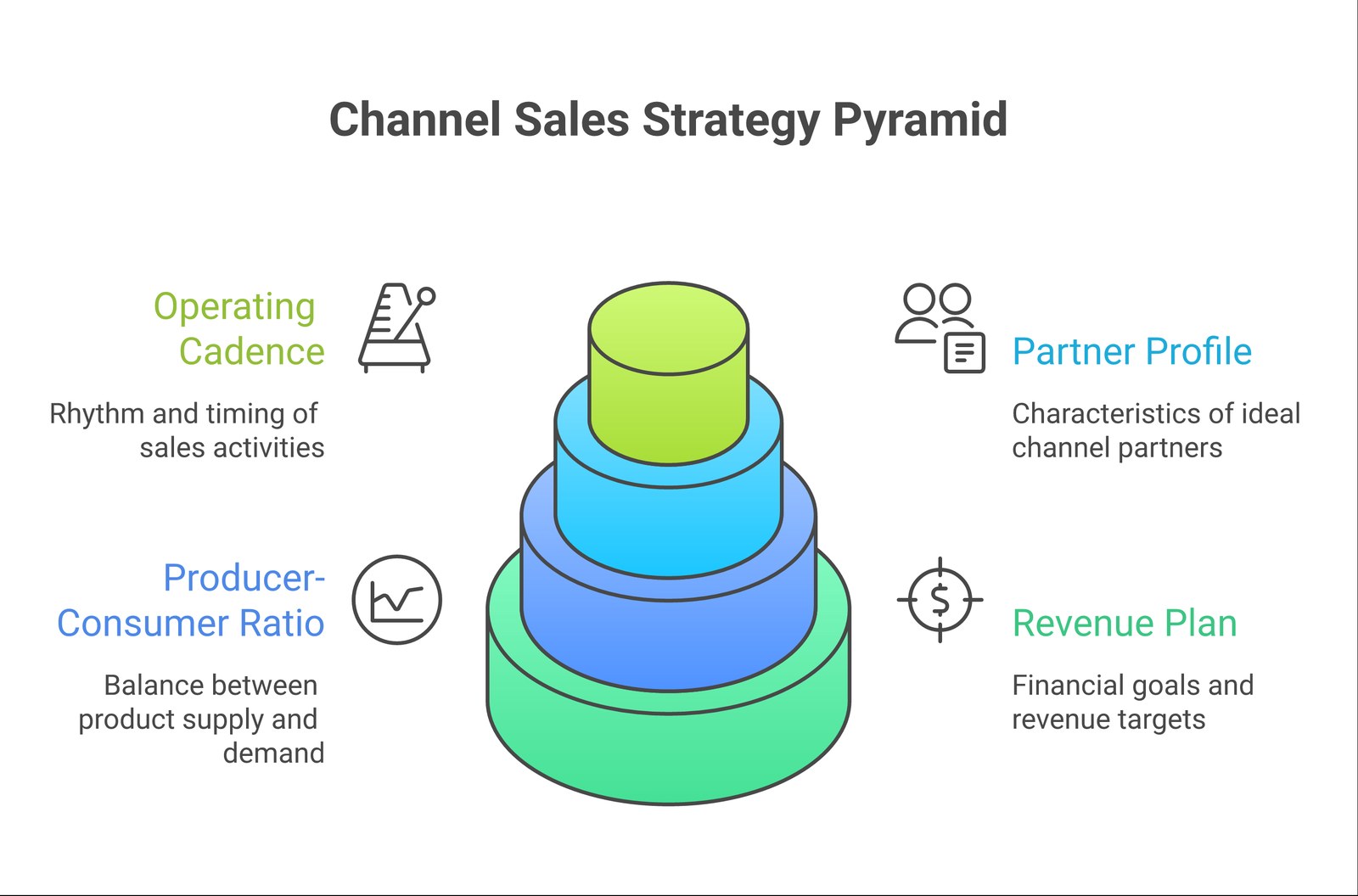
A channel sales strategy that holds up to finance review has four layers, each derived from the prior layer. Skipping a layer or building it out of order produces a strategy that doesn’t tie to revenue.
- Revenue plan. The starting input is the company’s revenue plan, broken down by segment, geography, and product line. The strategy names the partner-attached portion of that plan, the percentage of revenue that will run through partners, and gets sign-off from finance and sales leadership before any partner work happens.
- Producer-consumer ratio. Given the partner-attached revenue target, the strategy names the ratio of producing partners (partners closing deals) to consuming partners (partners signed but not yet producing). Mature channels run a 1:3 to 1:5 ratio; pilot channels often start at 1:10.
- Partner profile. Given the ratio and the target, the strategy derives the ideal partner profile: segment focus, geography, product fit, customer overlap, commercial model. The profile is the recruitment filter; partners who don’t fit the profile are deferred or declined.
- Operating cadence. Given the profile, the strategy names the operating cadence the channel team will run: pipeline reviews, QBRs, exec cadences, deal-reg processes. The cadence is what turns the strategy into closed deals.
How channel sales strategy works inside the broader program
The channel strategy sits between the revenue plan and the partner program. Three operating decisions determine whether the strategy actually works: the segment-coverage decision, the economic-mechanics decision, and the cadence decision.
The segment-coverage decision answers which segments are direct-led, which are partner-led, and which are hybrid. The decision has to be made explicitly and committed to; ambiguity at this layer produces channel conflict that consumes the channel team’s capacity. Strong vendors document the segment map and refresh it annually.
The economic-mechanics decision answers how partners get paid. Margin (resale margin, sometimes 20-40%), referral fees (typically 10-25% of first-year ARR), implementation services (partner-led professional services), shared revenue (joint-deal economics on co-sold opportunities), and MDF (marketing development funds) are the standard mechanics.
The cadence decision answers how the strategy gets operationalized. Monthly partner pipeline review, quarterly business review, annual program reset is the canonical cadence; it scales by adding deal-stage coordination at the AE level for active partners and exec sponsorship at the leadership level for strategic partners.
Common pitfalls
The pitfalls in channel strategy are mostly about sequence and specificity. Strategies fail when they get the order wrong, the specificity wrong, or the operating cadence wrong.
The first pitfall is starting with named partners instead of the revenue plan. A strategy that starts with “we’re going to partner with Salesforce, ServiceNow, and AWS” doesn’t have a target, doesn’t have a ratio, and doesn’t have a coverage map.
The second pitfall is partner-count goals instead of revenue goals. “Add 50 partners this year” is a recruitment target, not a strategy. The right metric is partner-attached revenue with a defined producer-consumer ratio.
The third pitfall is no segment-coverage map. Without an explicit map of which segments are partner-led versus direct-led, channel conflict consumes the channel team’s capacity.
The fourth pitfall is treating channel strategy as a one-time exercise. The strategy needs an annual reset against the company’s revenue plan and the changing partner landscape.
Tools and operating cadence
| Operating stage | Strategy artifact | Partner data | Workflow / PRM |
|---|---|---|---|
| Pilot (1-3 partners) | One-page strategy doc | Shared spreadsheet | None |
| Early (3-10 partners) | Strategy doc + segment map | Crossbeam, PartnerTap | Light PRM (Channelscaler, Mindmatrix, PartnerStack) |
| Operating (10-30 partners) | Strategy doc + tier map + economic model | Crossbeam at scale | Mature PRM (Impartner, Intro, Euler) |
| Mature (30+ partners) | Strategy + tier + economic + segment + cadence | Crossbeam plus enriched data | Enterprise PRM plus partner-side workflow |
The strategy artifact should be one to three pages, refreshed annually, and signed off by the CRO and the CFO. Strategies that run longer than three pages tend to be slide decks dressed as strategies; the discipline of keeping the document short forces clarity on the four layers.
Forecastable’s POV
Channel sales strategy is the most under-documented commercial plan in modern B2B. The category has decades of vocabulary, the tooling is sophisticated, and the playbooks are public; what’s missing at most companies is the discipline to write the four-layer strategy and refresh it annually.
Two specific calls Forecastable makes consistently. First: the strategy should start with a partner-attached revenue target, not with named partners. Strategies that lead with named partners typically have a producer-consumer ratio that doesn’t tie to the target and a segment map that doesn’t tie to the revenue plan. Second: the strategy should be signed off by finance, not just by sales. Channel programs without finance sign-off lose the budget battle in year-two when partner-attached revenue gets attributed differently.
The benchmark resources worth borrowing from are AchieveUnite’s “Partner Excellence Framework,” the PartnershipLeaders community’s strategy templates, ChannelNomics’ research on channel program structure, and 360Insights’ work on channel incentives. Crossbeam’s content on ELG and ecosystem strategy is also useful.
Frequently asked questions
What’s the difference between channel sales strategy and a partner program?
The strategy is the commercial plan; the program is the structural rules. The strategy answers how much revenue partners will produce; the program answers what tiers, requirements, deal-reg rules, and MDF gates structure the partner experience.
Who owns channel sales strategy?
The head of partnerships or VP of partnerships, with sign-off from the CRO and CFO.
How long should a channel strategy document be?
One to three pages. Shorter than that misses one of the four layers; longer than that tends to be a slide deck dressed as a strategy.
How often should a channel strategy be refreshed?
Annually, against the company’s revenue plan. Mid-year refreshes are appropriate when the revenue plan changes materially or when the partner landscape changes.
What’s the right partner-attached revenue percentage?
It depends on company stage and segment focus. SMB-led SaaS companies often run 30-50% partner-attached; enterprise-led platforms can run 60-80%; product-led growth companies typically run 10-25%.
Should I run direct, indirect, or hybrid?
Most modern channel strategies run all three, tuned to the segment. Direct in segments where partners can’t cover economically, indirect where partners produce coverage the vendor can’t reach, hybrid where joint motion produces faster cycles or larger deals.
How do I know if my channel strategy is working?
The leading indicator is partner-attached pipeline against the planned target; the outcome metric is partner-attached revenue against the planned target.
Next step
If you’re writing a channel sales strategy, start with the revenue plan and work down through the four layers. Write the producer-consumer ratio before you write the partner profile, and write the partner profile before you name partners.
Forecastable is an independent third-party professional services company. Our evaluations of other vendors are based on publicly-available information as of May 2026 and our own client experience.
Talk to our team about building a channel sales strategy that produces pipeline →
By Alex Buckles
Uncover Your Growth Potential
Schedule a Discovery Call