AWS ACE: How the APN Customer Engagement Program Actually Works

AWS ACE (the APN Customer Engagement program) is the operating mechanism that lets AWS partners track and co-sell deals with AWS field sellers. Partners that run ACE well produce co-sell revenue that compounds; partners that treat ACE as a back-office reporting task produce ACE pipelines that look full and don’t close. The thing that separates the two is whether the ACE process is integrated into the partner’s CRM and operating cadence, not whether the partner has a high partner tier.
This is the program I get asked about most often by AWS partners trying to figure out why their AWS co-sell motion isn’t producing the revenue the partner-tier promises. ACE is a sophisticated program, but it lives or dies on the partner’s operating discipline rather than on AWS’s program design. The partners that compound on AWS treat ACE as a forecast input; the partners that don’t treat it as a partner-portal data-entry task.
This piece covers what AWS ACE is, how the program works structurally, the four operating habits that determine whether ACE produces co-sell revenue, the failure modes I see most often, and how AWS ACE fits inside the broader partner program.
What is AWS ACE?
AWS ACE (APN Customer Engagement) is the AWS Partner Network program that lets AWS partners share opportunities with AWS, receive AWS field engagement, track co-sell revenue, and qualify for AWS partner program benefits like funding, MDF, and tier advancement. The program runs through Partner Central, integrates with Salesforce via the AWS Partner Central API, and is the operational backbone of every serious AWS partner motion.
The program has been the standard co-sell mechanism for AWS partners for several years and continues to evolve as AWS pushes more revenue through the partner channel. ACE opportunities feed into AWS’s own seller pipeline visibility, which is why ACE qualification matters: an opportunity in ACE is visible to AWS field sellers, factors into AWS partner-tier advancement, and unlocks AWS support resources that are not available outside the program.
ACE differs from generic deal registration programs in three structural ways. The validation is two-sided. AWS reviews and validates each ACE opportunity. The benefits are multi-dimensional. ACE qualification contributes to AWS partner tier (Select, Advanced, Premier), unlocks specific MDF and funding programs, and produces formal AWS field engagement on the deal. The reporting is structural. ACE-validated revenue feeds into AWS-public partner metrics and into the partner’s tier-advancement calculation.
How AWS ACE works structurally
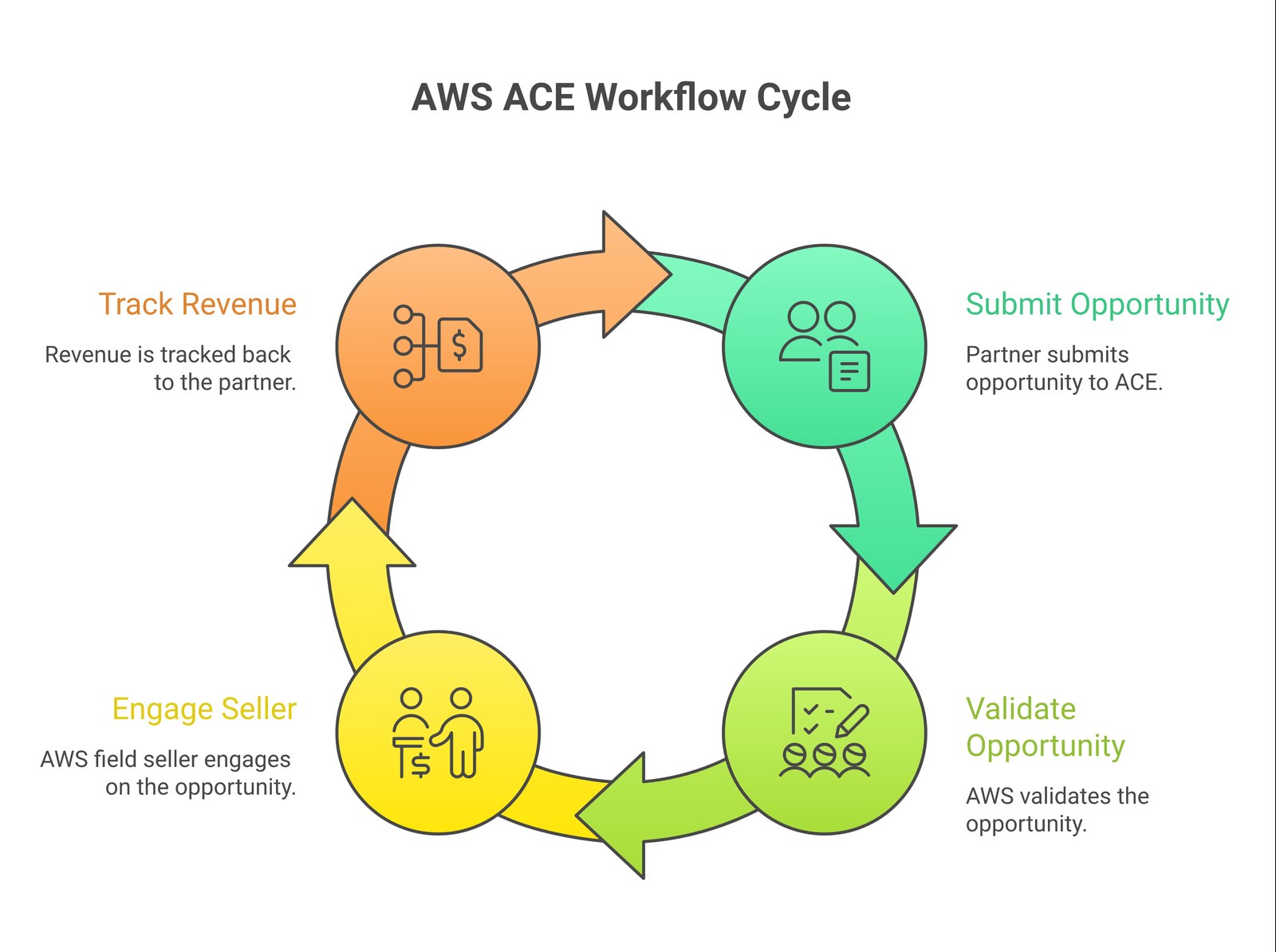
ACE runs as a four-stage workflow: partner submits the opportunity to ACE, AWS validates the opportunity, AWS field seller engages on validated opportunities, and revenue is tracked back to the partner for credit. Each stage has named SLAs, named acceptance criteria, and named failure modes that partners need to operate against.
Stage 1: Partner submission
The partner submits an opportunity to ACE through Partner Central or via the API. Required fields include customer name, opportunity value, expected close date, AWS services in scope, partner-side contact, and a free-text description of the joint motion. Strong submissions include named AWS services (not generic categories), a specific use case, and an expected AWS revenue calculation. Weak submissions are rejected at validation or sit unvalidated for weeks.
Stage 2: AWS validation
AWS reviews the submission for fit, completeness, and customer-side validity. The validation typically takes 5-10 business days. Validated opportunities receive an ACE ID, become visible to the AWS field, and start counting toward partner-tier metrics. Rejected submissions get a rejection reason and can be resubmitted with additional information.
Stage 3: AWS field engagement
Validated opportunities surface in the AWS field seller’s view of the account. The AWS seller can engage to varying depths: provide technical assistance, join customer meetings, contribute to the customer’s business case, fund customer pilots through dedicated programs, or assist in commercial negotiation.
Stage 4: Revenue tracking
Once the deal closes, the partner submits revenue data back to ACE. The closed-revenue data feeds into the partner’s tier-advancement calculation, into AWS-public partner metrics, and into the partner’s eligibility for tier-specific benefits. The reporting is the audit layer: the partner’s claimed AWS revenue must reconcile to the closed-revenue data in ACE.
The four operating habits of strong AWS ACE partners
Strong ACE partners run four operating habits that average ACE partners do not: integrate ACE submission into the CRM workflow, name the AWS field contact on every ACE opportunity, run a recurring AWS field cadence, and tie ACE metrics to internal partner-team compensation. These are operating habits, not partner-program features.
Integrate ACE submission into the CRM workflow
Strong partners auto-submit opportunities to ACE from the CRM. As soon as an opportunity hits a defined stage (typically “discovered” or “qualified”), the CRM workflow pushes the data to ACE via the API. Average partners require manual ACE submission, which creates lag between the opportunity entering the CRM and the opportunity entering ACE.
Name the AWS field contact on every ACE opportunity
The single most predictive practice for ACE-driven co-sell revenue is naming the AWS field seller contact on the opportunity at submission time. Partners that name the contact get faster validation, more substantive AWS engagement, and a higher close rate.
Run a recurring AWS field cadence
Strong partners run a recurring (typically monthly) cadence with their AWS partner development manager (PDM) and the regional AWS field leadership. The cadence covers ACE pipeline review, joint-account strategy, MDF deployment, and tier-advancement progress.
Tie ACE metrics to internal compensation
Strong partners include ACE metrics in the partner team’s internal compensation. ACE-validated pipeline, ACE-influenced revenue, and ACE-driven tier progress all show up in the partner team’s variable compensation.
Common pitfalls in AWS ACE operating design
Five recurring failure modes account for most of the ACE underperformance I see at customer organizations. All five are operating-discipline issues at the partner side.
- Manual ACE submission with lag. Opportunities sit in the CRM for weeks before being submitted to ACE.
- Ambiguous opportunity descriptions. Submissions with generic services and vague use cases get rejected or sit in validation purgatory.
- No named AWS field contact. Submissions without a named AWS field contact get less engagement and lower close rates.
- No recurring AWS PDM cadence. Partners that don’t run a monthly cadence with their PDM produce a transactional ACE relationship rather than an operational alliance.
- ACE treated as compliance, not strategy. Partner teams that view ACE as a back-office reporting task produce ACE pipelines that don’t translate to revenue.
Tools and operating cadence stack
| Operating stage | ACE submission | Field cadence | Reporting |
|---|---|---|---|
| Pilot (early ACE adoption) | Manual through Partner Central | Quarterly with PDM | Manual revenue reconciliation |
| Operating (Select / Advanced) | API integration with CRM | Monthly with PDM + quarterly regional review | Automated revenue tracking |
| Mature (Premier) | Full bi-directional CRM-ACE integration | Monthly PDM + monthly regional + quarterly executive | Real-time tier-advancement dashboard |
Forecastable’s POV
My take is that AWS ACE is the most strategically important and most operationally underinvested partner program element for AWS partners. The program’s design rewards the partners that operate against it with discipline; it produces flat revenue for the partners that don’t. The investment that compounds is operating-discipline investment, not partner-tier investment.
The pattern that compounds
The AWS ACE motions I see compound across multi-year horizons share four traits. ACE submission is auto-pushed from the CRM at a defined stage. The AWS field contact is named on every opportunity at submission time. The PDM cadence is monthly and protected. ACE metrics are tied to the partner team’s internal compensation.
The contrarian position
The contrarian position is that the partner tier matters less than the operating discipline for ACE-driven co-sell revenue. Most AWS partners over-invest in tier advancement (which is hard, slow, and visible) and under-invest in operating discipline (which is faster, lower-visibility, and structurally higher-leverage).
Frequently asked questions
What is AWS ACE?
The APN Customer Engagement program that lets AWS partners share opportunities with AWS, receive AWS field engagement, track co-sell revenue, and qualify for AWS partner program benefits.
How does AWS ACE work?
Four stages: partner submits the opportunity to ACE, AWS validates the opportunity, AWS field seller engages on validated opportunities, and revenue is tracked back to the partner for credit.
How long does AWS ACE validation take?
5-10 business days typically. Faster for well-formed submissions with named AWS field contacts and specific use cases.
What are the four operating habits of strong AWS ACE partners?
Integrate ACE submission into the CRM workflow, name the AWS field contact on every opportunity, run a recurring AWS PDM cadence, and tie ACE metrics to internal compensation.
What is the most predictive ACE practice for co-sell revenue?
Naming the AWS field seller contact on the opportunity at submission time.
How is AWS ACE different from generic deal registration?
ACE has two-sided validation, multi-dimensional benefits (tier advancement, MDF, field engagement), and structural reporting that feeds AWS-public partner metrics.
Does the AWS partner tier matter more than ACE operating discipline?
Operating discipline matters more for co-sell revenue. A Select-tier partner with strong ACE discipline produces more co-sell revenue than a Premier-tier partner with weak discipline.
Next step
If your AWS co-sell pipeline looks full and isn’t producing closed revenue, the answer is more likely an operating-discipline issue than an AWS-program issue.
Talk to our team about turning your AWS ACE pipeline into closed co-sell revenue →
By Alex Buckles
Uncover Your Growth Potential
Schedule a Discovery Call