Account-Planning Template: A 2026 Framework Partners Will Actually Use

An account planning template is the structured document that captures the named contacts, decision drivers, partner mix, deal mechanics, and operating cadence for a strategic account. The template is only useful if it’s short enough that an AE will keep it updated and rich enough that a frontline sales manager can read it without the AE in the room. Most templates fail one or both tests; the ones that compound earn their place by being a working artifact, not a planning theater output.
The reason most account planning programs underperform is that the template was designed by sales operations as a reporting artifact and not by the field as a working document. The result is a 12-tab spreadsheet that nobody updates after the kickoff session. Strong templates flip the priority: the field’s working experience comes first, the reporting view is downstream, and the template earns its keep by being the document the AE actually pulls up before every prospect call.
This piece covers what an account planning template is, the four building blocks that determine whether it will get used, the partner-attached layer most templates skip, the failure modes I see most often, and how the template ties to the broader partner program.
What is an account-planning template?
An account planning template is the structured document that an AE or account team uses to capture the strategic plan for a named enterprise account. The template typically covers named buyers and influencers, the buying committee mapping, decision drivers and risks, partner overlay, deal mechanics, competitive landscape, and the operating cadence. The template is updated continuously by the AE and read by the AE’s manager, the partnership team, and the executive sponsor.
Account planning templates differ from opportunity plans (which are deal-level) and territory plans (which are quota-level). The account plan sits between them: scoped to a single named account, multi-deal in time horizon, and meant to span the customer’s procurement cycles. The template is the operating artifact that lets a multi-quarter pursuit produce a coherent close-plan rather than a string of disconnected outreach attempts.
The category includes several common variants. Strategic account plans are deeper templates for top-tier enterprise accounts (typically the top 20-50 named accounts in a territory). Named account plans are lighter templates for the broader named-account list. Joint account plans are partner-attached templates where the vendor and partner share the document. Renewal account plans are templates focused on year-two-and-beyond renewals.
The four building blocks of an account planning template that gets used
Strong account planning templates run on four building blocks: named contacts and buying committee mapping, decision drivers and risks, partner overlay (including overlap and joint mechanics), and operating cadence with explicit dispositions. Templates missing any of the four become reporting theater that nobody updates after the kickoff.
Named contacts and buying committee mapping
The first block is the buying committee map. The template should capture every named contact at the account: name, title, role on the buying committee (champion, influencer, blocker, economic buyer, technical buyer), engagement history, and the AE’s read on the contact’s leaning. Strong templates also capture the committee’s gaps so the AE has a working list of contacts to develop.
Decision drivers and risks
The second block is the named decision drivers and risks. Decision drivers are the things the customer cares about that determine the buying decision (cost reduction, regulatory compliance, operational efficiency, vendor consolidation). Risks are the things that could derail the deal. Both lists should be specific to the account, not generic.
Partner overlay
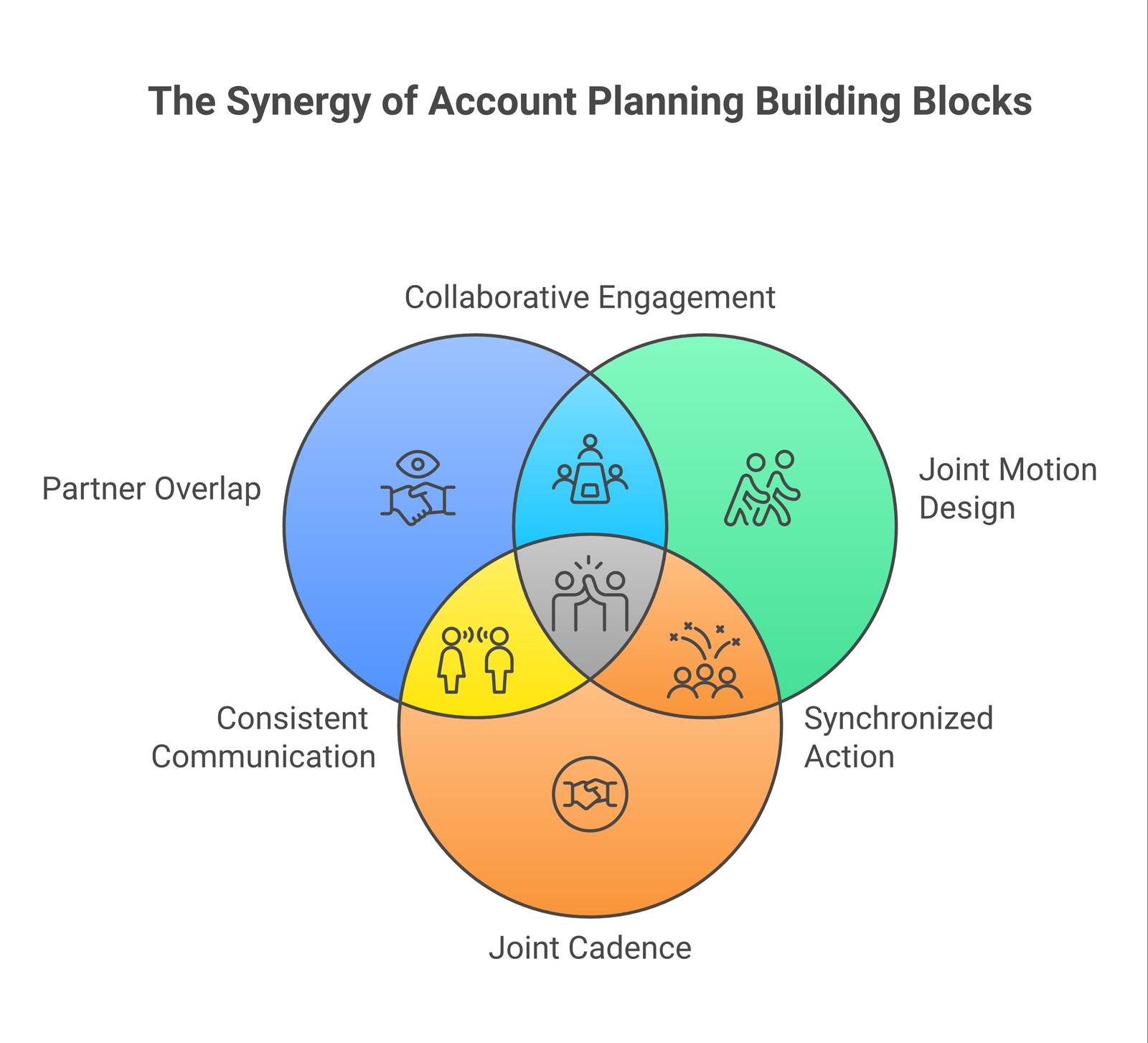
The third block is the partner overlay, and it’s the block most templates skip. The overlay captures which partners have a relationship at the account, what the relationship is, what the partner sells, and what the joint motion is. The overlay is fed by the account mapping data layer; the AE reads the overlay on the same page as the buying committee map.
Operating cadence with explicit dispositions
The fourth block is the operating cadence: when the AE updates the template, when the FSM reviews it, when the partner is brought in, when the executive sponsor is engaged. Strong cadences include explicit dispositions on each open item (progressing on plan, blocked, slipped, closed). Without the cadence, the template ages and becomes wallpaper.
The partner-attached layer most templates skip
Most account planning templates were designed before partner motions were a structural part of B2B sales. Strong modern templates add the partner-attached layer as a first-class section, not an appendix.
- Partner overlap. Which partners have a customer relationship at this account, fed from account mapping. Each partner gets a named contact, an engagement history, and a current status.
- Joint motion design. What the joint motion is for this account (partner intro, joint discovery, co-presentation, partner-led implementation), who’s leading, what the protection terms are if a deal registration applies.
- Joint cadence. When the AE syncs with the partner, what the standing meetings are, what the named partner-side outcomes are.
- Joint attribution. What the agreed partner attribution treatment is for this account, so the post-close revenue split is settled before close.
Common pitfalls in account planning template design
Five recurring failure modes account for most of the underuse I see at customer organizations.
- Too long. A 12-tab spreadsheet that takes 90 minutes to update. AEs avoid templates that take more time to maintain than they save.
- Designed by ops, not field. Sales operations designs a reporting artifact and the field treats it as a tax.
- No partner overlay. Modern templates without a partner overlay are missing the structural slice that determines pipeline source for an increasing share of B2B revenue.
- Static, not live. A template updated once at kickoff and never touched again.
- No FSM review. The template is filled out by the AE and never reviewed by the frontline sales manager. Without the review, the template becomes an artifact for the AE and not an operating document for the team.
Tools and operating cadence stack
| Operating stage | Template tooling | Partner overlay source | FSM review |
|---|---|---|---|
| Pilot | Google Doc or Notion | Manual / spreadsheet | Monthly |
| Early | CRM-native fields plus shared doc | Crossbeam, PartnerTap | Biweekly |
| Operating | CRM extension (Plan, Demandbase, Lattice) | Crossbeam at scale | Weekly |
| Mature | Full account-planning platform | Crossbeam plus partner-side workflow | Weekly + quarterly QBR |
Forecastable’s POV
My take is that account planning templates are the most under-loved operating layer in enterprise sales. The category was designed before partner motions, before account-mapping platforms, and before AI-assisted CRM workflows; most templates in use today reflect the design priorities of 2010, not 2026. Updating the template to include the partner overlay and the joint cadence is the single biggest pickup in account planning quality available to most enterprise sales teams.
The pattern that compounds
The account planning templates I see compound across multi-year horizons share four traits. They fit on one to three screens with depth available on click-through. They have a first-class partner overlay section, not an appendix. They run on a biweekly update cadence with FSM review. They pull live partner data from the account-mapping layer rather than running on stale snapshots.
The contrarian position
The contrarian position is that the template’s primary user is the AE, not the executive team. Most templates are designed for the executive read-out and produce a document the executive enjoys and the AE avoids. Designing for the AE’s working experience first produces a template the AE actually maintains.
Frequently asked questions
What is an account planning template?
The structured document that an AE or account team uses to capture the strategic plan for a named enterprise account.
How does an account plan differ from an opportunity plan?
The account plan is scoped to a single named account, multi-deal in time horizon, and spans the customer’s procurement cycles. The opportunity plan is deal-level and short-cycle.
What are the four building blocks of a working account planning template?
Named contacts and buying committee mapping, decision drivers and risks, partner overlay, and operating cadence with explicit dispositions.
Why do most account planning templates fail to get used?
They are too long, designed by ops not field, missing the partner overlay, static rather than live, and not reviewed in FSM pipeline review.
What is the partner overlay in an account plan?
A first-class section that captures partner overlap, joint motion design, joint cadence, and joint attribution treatment.
How often should an account plan be updated?
Biweekly is the standard cadence, plus after every meaningful customer interaction.
What tool should I use for account planning?
Pilot stage runs on a shared doc; early stage adds CRM-native fields; operating stage adds a CRM extension; mature stage runs a full account-planning platform with live partner-data integration.
Next step
Forecastable is an independent third-party professional services company. Our evaluations of other vendors are based on publicly-available information as of May 2026 and our own client experience.
Talk to our team about building account plans your partner team will actually use →
By Alex Buckles
Uncover Your Growth Potential
Schedule a Discovery Call