Nearbound: Definition, Operating Model, and 2026 Playbook

Nearbound is a sales motion in which a vendor uses its partner ecosystem as the primary signal and channel to enter a buying account, rather than relying on inbound or outbound. The motion runs on overlap data, partner-led trust, and joint deal mechanics. Done well, it produces materially higher win rates than direct outbound.
Most companies that try nearbound treat it as a synonym for “ask my partners for intros.” That is the entry point, not the motion. Nearbound as a discipline is a layered operating model: a clean overlap data layer, a partner-mapped target account list, a joint outreach cadence, and a measurement framework that survives finance review. The companies that confuse nearbound with intro-asking get a quarter of partner intros and stall; the companies that build the system see compounding pipeline.
This piece covers what nearbound actually is, how it differs from inbound, outbound, and broader ecosystem-led growth, the operating cadence that makes it repeatable, the failure modes that explain why most nearbound programs underperform, and the connection to forecastability. For the broader category, see the ELG overview and ecosystem partnerships.
What is nearbound?
Nearbound is a go-to-market motion in which a vendor uses its partner ecosystem as the primary path into a target account: overlap data identifies the accounts where a partner has a meaningful relationship, the partner becomes the trusted introduction or co-presenter, and the deal proceeds with the partner involved through some or all of the cycle. The unit of nearbound is the partner-touched account, not the individual intro.
The category is best understood by contrast. Inbound runs on the buyer raising a hand (search, content, demo request); the seller’s job is to convert. Outbound runs on the seller initiating into a cold account; the seller’s job is to create demand. Nearbound runs on the partner ecosystem providing the warm signal and the trust layer; the seller’s job is to operationalize the partner’s relationship into deal flow.
Nearbound is sometimes used interchangeably with ecosystem-led growth (ELG); the two are closely related but not identical. ELG, as defined by Crossbeam and Bob Moore, is the broader strategy treating the ecosystem as a structural growth lever across the entire GTM stack. Nearbound is one of the motions inside ELG, specifically the sales motion that uses the ecosystem to enter accounts. A company can do nearbound without fully embracing ELG; a company that fully embraces ELG will run nearbound as one of its core motions.
The unit of nearbound is the partner-touched account. Every account where a partner has a meaningful relationship and is willing to engage on the deal is a nearbound opportunity. Every account without a partner relationship is, by definition, not nearbound; it might be inbound or outbound, but the nearbound motion doesn’t apply.
Why nearbound matters
Nearbound deals close at higher win rates and shorter cycles than direct outbound at the same account list, because the partner’s existing relationship shortcuts the trust-building phase that consumes the early stages of a typical sales cycle. The lift compounds when the partner stays engaged through the cycle rather than just providing the intro.
In practice, the economic case has three layers. Win rate: nearbound deals win at materially higher rates than cold outbound deals at the same account, often 1.5 to 2.5x, because the partner’s relationship reduces objections, accelerates buying-committee discovery, and provides a trusted reference. Velocity: nearbound deals close 20 to 40% faster on average because the trust phase is compressed and the buying committee already trusts at least one of the two vendors. Deal size: nearbound deals are often 20 to 50% larger because the partner-led conversation tends to surface a broader use case than the direct conversation would have.
The strategic case is more durable. Nearbound builds a pipeline source that competitors can’t replicate by outspending. Cold outbound and paid acquisition are matchable by any well-funded competitor; nearbound depends on the partner relationships, the overlap data, and the operating cadence that compounded over years. That moat is the reason ELG and nearbound have become the dominant growth thesis at the late-stage SaaS layer, not because they’re the easiest motions, but because they’re the hardest to copy.
The downside, real and common, is that nearbound run badly is worse than cold outbound. If the partner motion is theater, asking for intros without earning them, treating partners as a free lead source, the partners stop responding within two quarters and the motion collapses. Nearbound has to be operationally mature on both sides; the lift is conditional.
How nearbound works: the four-stage operating cadence
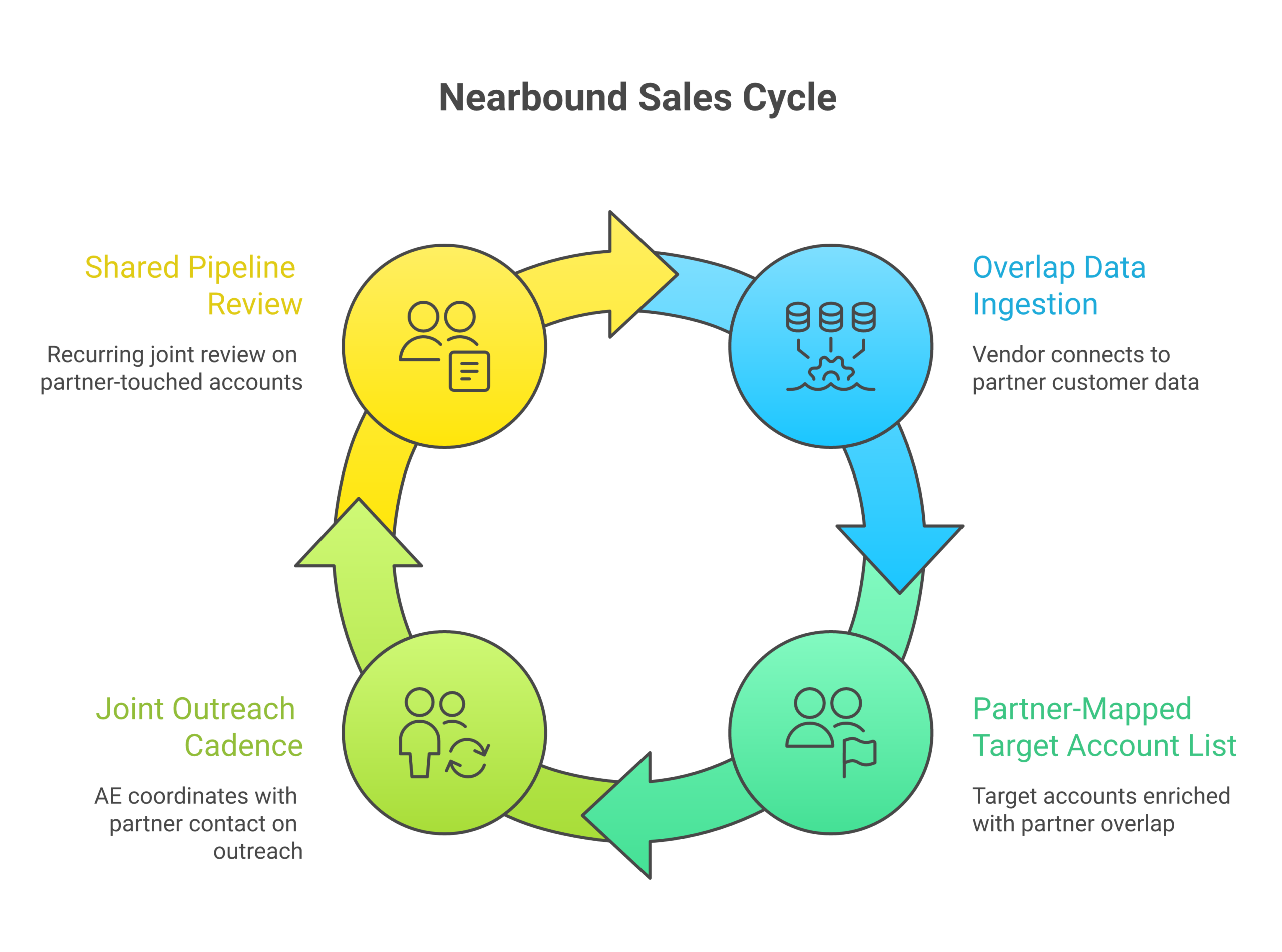
Repeatable nearbound runs on a four-stage cadence: overlap-data ingestion to surface where partners have presence, partner-mapped target account list, joint outreach cadence with the partner involved, and shared pipeline review with the partner. Skip a stage and the motion reverts to ad-hoc intro-asking that doesn’t compound.
The stages
The four stages, in order:
Why the cadence is the system
The cadence is the system. Most nearbound programs that underdeliver are missing stage 4. Without a recurring joint pipeline review, the partner-mapped account list goes stale within a quarter and the motion reverts to opportunistic intro-asking. The cadence is what turns nearbound from a tactic into a program.
Common pitfalls in pursuing nearbound
Nearbound programs fail at predictable points. The five recurring failure modes account for most of the underperformance, and most are operating-model issues, not technology or partner-quality issues.
The recurring failure modes
The recurring failure modes:
The fix
The fix for most of these is the same: treat nearbound as a system, not a tactic. Companies that get this right see materially higher win rates and shorter cycles on partner-touched accounts. Companies that don’t run an intro-asking practice that produces a quarter of pipeline and then breaks.
Tools and platforms for nearbound
Nearbound tooling spans four categories: overlap and account mapping (Crossbeam, PartnerTap), partner workflow and co-sell orchestration (Forecastable’s Ecosystem Orchestration layer, plus PRM platforms like Introw and Euler that run the partner-program structure underneath), AE field activation (CRM with partner-tagged accounts, partner-mapped territory views), and reporting and attribution (CRM dashboards, finance-aligned attribution model). The right stack matches the program’s operating maturity.
A pragmatic snapshot of the stack progression:
| Nearbound stage | Overlap & mapping | Workflow | AE enablement | Reporting |
|---|---|---|---|---|
| Pilot (1-3 partners) | Manual exchange | Shared doc | Partner-tagged CRM | CRM with partner-touched flag |
| Early (3-10 partners) | Crossbeam | Shared doc + standing call | CRM partner-touched dashboard | CRM-influenced revenue report |
| Operating (10-30 partners) | Crossbeam, PartnerTap | PRM (Introw, Euler) plus joint plan | Account-mapped territory views | Closed-loop attribution model |
| Mature (30+ partners) | Crossbeam at scale | Forecastable Ecosystem Orchestration plus PRM | AE-level partner scorecard | Executive attribution model |
The mistake most companies make is buying mature-stage tooling at pilot stage. A Crossbeam license at three partners is fine; a multi-partner co-sell platform at three partners is overhead theater that delays real motion by 4 to 6 months. Match the tooling to the stage. (See the PRM platform guide for the broader tool landscape.)
Forecastable’s POV
My take is that nearbound is the most operationally mature motion inside ecosystem-led growth and the most often confused with intro-asking. The companies I see compound treat nearbound as a programmable sales motion with overlap data, joint mechanics, and shared pipeline review; the companies that don’t treat it as a soft request to partners and burn the partner trust they spent years building.
The pattern that compounds
The pattern I watch compound is nearbound run as system-design first, relationship management second. The system produces the partner-mapped account list, the joint outreach cadence, and the shared pipeline review. The relationships produce the deal-level execution. Companies that invert the order, build the relationships first, then try to retrofit a system, get a quarter of intros and watch the motion plateau when the partners get tired of being asked.
What I push customers on
Here’s what I push our customers on: stop treating nearbound as a marketing campaign or as a partnerships project. It is a sales motion. Run it like one. Define the named accounts. Run the joint pipeline review. Hold both sides accountable for the forecast number. Lock the attribution model. Build the operating cadence into the calendar before the kickoff call ends. Companies I’ve watched do this build nearbound programs that produce 25 to 45% of net new ARR within 24 months. Companies that don’t keep relaunching nearbound every 18 months and wonder why the partners aren’t engaged.
The other position
The other position I take at Forecastable: nearbound is more compatible with forecastability than direct outbound, when run cleanly. Partner-touched deals carry richer signal (more buying-committee context, more product validation, more shared accountability) and tend to be more forecastable than cold-outbound deals at the same size. The condition is the operating maturity: a nearbound motion run as theater adds noise; a nearbound motion run as system adds signal. (See the forecastability overview for the connection.)
Frequently asked questions
What is the difference between nearbound and ecosystem-led growth (ELG)?
ELG is the broader GTM strategy, treating the partner ecosystem as a structural growth lever across the entire stack. Nearbound is one of the motions inside ELG, specifically the sales motion that uses the ecosystem to enter accounts. A company can practice nearbound without committing fully to ELG; a company committed to ELG runs nearbound as one of its core motions.
Is nearbound the same as warm outbound?
Closely related, not identical. Warm outbound describes any outreach that uses some signal to warm the prospect (event attendance, content engagement, mutual connection). Nearbound is more specific: the warming signal comes from a partner ecosystem and typically involves the partner staying engaged in the deal, not just providing the trust signal at the start.
How does nearbound compare to inbound?
Inbound runs on the buyer raising a hand. Nearbound runs on the partner ecosystem indicating where a hand is likely to be raised and providing the trusted entry point. Inbound is buyer-initiated; nearbound is seller-initiated but ecosystem-warmed. Both can produce high-quality pipeline; nearbound tends to produce larger deals on average because the ecosystem signal correlates with enterprise-grade buying motion.
What tools does a nearbound program need?
At minimum, an overlap data source (Crossbeam or PartnerTap, or a manual exchange), a CRM where partner-touched accounts can be flagged, and a recurring joint pipeline review process. Mature programs add a co-sell orchestration layer (Forecastable’s services-plus-platform), a PRM (Introw, Euler, or Impartner depending on motion), an attribution model with finance, and AE-level partner-touched dashboards.
Can a small SaaS company do nearbound?
Yes, often more cleanly than larger companies. A 5-partner program with disciplined overlap data, a partner-mapped account list, and a recurring joint pipeline review can produce 20 to 30% of net new ARR within 18 months. The motion scales down better than it scales up, because the operating cadence is what matters, not the partner count.
How long does it take a nearbound program to produce pipeline?
Most programs see initial partner-touched pipeline within 60 to 90 days of launching the motion, but durable, compounding nearbound takes 2 to 4 quarters of operating discipline to lock in. Programs that judge nearbound on the first quarter typically declare it broken; programs that judge it on the fourth quarter typically declare it core.
Who owns nearbound inside a company?
The head of partnerships typically owns the operating cadence; the CRO owns the AE-level adoption; the CFO owns the attribution model. Programs that assign nearbound to a single role usually underperform because the operating layers don’t align. Joint ownership across CRO, CFO, and head of partnerships produces the best operating outcomes.
Is nearbound a fad or a structural shift?
Structural. The underlying conditions, mature ecosystem-data tooling, more crowded inbound channels, higher buyer skepticism of cold outbound, more sophisticated partner programs, are all secular trends that favor partner-led motion. Whether the term “nearbound” survives is less important than whether the motion does, and the motion is durable.
Next step
Nearbound is the highest-leverage sales motion most B2B software companies aren’t running cleanly. If you have an account-mapping layer in place but pipeline isn’t compounding, the gap is usually in stages 3 and 4, the joint outreach cadence and the shared pipeline review.
For the broader strategy that wraps nearbound, see the ELG overview and ecosystem partnerships. For the underlying data layer, see account mapping.
For the connection to forecastability, see the forecastability overview and the co-sell guide. Forecastable is an independent third-party professional services company. Our evaluations of other vendors are based on publicly-available information as of May 2026 and our own client experience.
Talk to our team about installing the nearbound operating cadence →
By Alex Buckles
Uncover Your Growth Potential
Schedule a Discovery Call