Partner Ecosystem Strategy: How to Build One

What is a partner ecosystem strategy?
Short answer: A partner ecosystem strategy is a plan for using the network of technology, services, and channel partners around your customers to source, influence, and close more revenue. It treats the ecosystem as a go-to-market surface, not a logo wall. The idea is that the companies your buyers already trust can bring you into deals you would never reach cold.
The strategy differs from managing a single partner type. An ecosystem strategy coordinates many partners across roles so the whole network moves pipeline toward you.
Why a partner ecosystem strategy matters in 2026
A partner ecosystem strategy matters because buyers now surround themselves with vendors and advisors they trust, and the fastest path into an account runs through one of them. Cold outbound keeps getting harder while a warm introduction from a trusted partner keeps working. The ecosystem is where those introductions come from, and a strategy is how you make them repeatable rather than lucky.
In 2026, with ecosystem-led growth an established motion, the companies that map account overlap and act on it are entering deals earlier and winning more of them. A partner ecosystem strategy is how you find where your partners and your prospects intersect, then turn that overlap into a real motion. Without it, the overlap sits unused in spreadsheets.
The strategy also compounds. Each partner relationship makes the next introduction easier, and a well-run ecosystem becomes a durable source of pipeline that competitors cannot easily copy. That compounding is why ecosystem strategy is a leadership priority, not a partnerships side project.
How a partner ecosystem strategy actually works
A partner ecosystem strategy works by mapping the ecosystem, finding overlap, and building motions that turn shared accounts into pipeline. The components below are what the strategy contains.
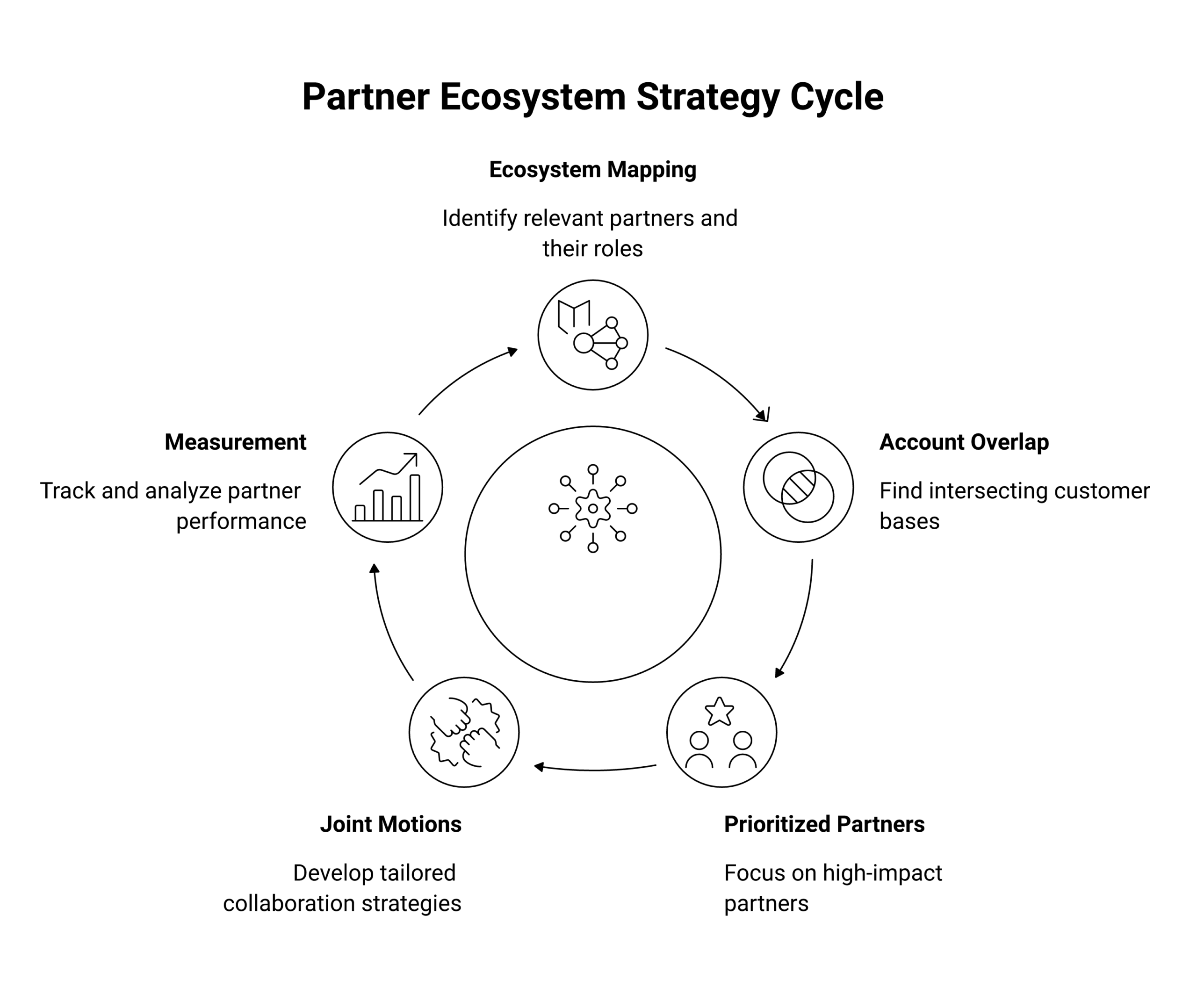
- Ecosystem mapping: Identifying the technology, services, and channel partners whose customers and credibility matter to your buyers, and understanding the role each plays.
- Account overlap: Finding where your partners’ customers and your target accounts intersect, so effort goes to the accounts a partner can actually help you reach.
- Prioritized partners: Concentrating on the few partners whose overlap and willingness make them real pipeline sources, rather than treating all partners equally.
- Joint motions: Building the introduction, co-sell, and co-marketing plays that convert overlap into meetings and deals, tailored to each partner’s role.
- Measurement: Tracking partner-sourced and partner-influenced pipeline from the ecosystem, so you know which partners and motions produce and can double down.
Common pitfalls in a partner ecosystem strategy
- Collecting logos, not overlap: Signing many partners without mapping where their customers meet your targets produces a big ecosystem that generates no pipeline. Overlap is the point.
- Treating all partners equally: Spreading ecosystem effort across every partner ignores that a few hold most of the useful overlap. Concentrate where the intersection is real.
- Mapping without a motion: Producing overlap reports that nobody acts on is common. The strategy only pays off when overlap turns into introductions and co-sell.
- No sales involvement: Running the ecosystem inside partnerships without embedding it in the sales motion means the overlap never reaches the reps who could use it.
- Measuring introductions, not revenue: Counting warm intros while ignoring what they produce hides whether the ecosystem is actually moving the number.
What this looks like in practice
A worked example: a company had dozens of ecosystem partners and an impressive slide, but sales saw no benefit from any of them. The partnerships team was collecting logos, not overlap. It changed approach: it mapped account overlap between its top partners and its target account list, found that four partners shared a large set of its priority accounts, and built a simple motion where reps requested warm introductions into those specific accounts through those partners. Sales suddenly had a reason to care, because the ecosystem was producing meetings in accounts they wanted. Partner-influenced pipeline became measurable and grew. The lesson was that a partner ecosystem strategy lives or dies on overlap and motion, because an ecosystem that is not mapped to accounts and wired into sales is a directory, not a strategy.
Forecastable’s POV on a partner ecosystem strategy
Our position is that ecosystem strategy is about overlap and motion, not partner count, and most struggling ecosystems have the count and none of the rest. The impressive-looking mistake is recruiting broadly and reporting how many partners you have. The version that produces maps where partners and prospects intersect and builds a repeatable way to act on it. Depth on real overlap beats breadth every time.
We also believe the ecosystem has to be wired into the sales motion or it stays a partnerships artifact. Overlap data that lives in the partnerships team and never reaches a rep produces nothing. The strategies that work give sellers a simple, in-workflow reason to use the ecosystem, so requesting a warm introduction through a partner becomes a normal sales play rather than a special project. That is what turns nearbound from a concept into pipeline.
Forecastable is a partnerships operating platform focused on connecting partner conversations and actions to CRM pipeline and revenue. We do not replace your overlap tooling; we make ecosystem-sourced and ecosystem-influenced pipeline visible in the forecast, so you can see which partners and motions actually produce. An ecosystem strategy points you at the overlap; visibility proves which overlap turned into revenue.
Forecastable is a partnerships operating platform and a category authority, not a PRM vendor. Any third-party tools or firms referenced in this space are independent third-party products, and mentioning them is not an endorsement. Evaluate any ecosystem approach against your own partner mix, motion, and CRM.
Frequently asked questions
What is a partner ecosystem strategy?
It is a plan for using the network of technology, services, and channel partners around your customers to source, influence, and close revenue, by mapping overlap and building motions that act on it.
How is an ecosystem strategy different from a channel strategy?
A channel strategy usually focuses on resale and one partner type; an ecosystem strategy coordinates many partner types around shared accounts to influence and source deals, not only resell.
What is account overlap?
Account overlap is where a partner’s customers intersect with your target accounts. It shows which accounts a partner can help you reach with a warm introduction or co-sell.
How do you prioritize ecosystem partners?
By the size and quality of their overlap with your target accounts and their willingness to act, concentrating effort on the few partners who can actually produce pipeline.
How do you measure a partner ecosystem strategy?
By partner-sourced and partner-influenced pipeline and revenue from the ecosystem, not by partner count or the number of introductions requested.
Why do ecosystem strategies fail?
Usually because they collect partners without mapping overlap or building a motion, or because the overlap never reaches the sales reps who could act on it.
Next step
If your ecosystem is a logo wall that sales ignores, the fix is overlap and motion: map where your partners’ customers meet your target accounts, and give reps a simple way to request warm introductions there. Start your growth journey now to make ecosystem-influenced pipeline visible in the forecast. The ecosystem-led growth hub frames how a partner ecosystem strategy connects to nearbound motions and attribution.
Uncover Your Growth Potential
Schedule a Discovery Call