Mindmatrix Alternatives: 6 PRM Options for 2026

Mindmatrix is a long-tenured Through-Channel Marketing Automation (TCMA) and PRM platform best fit for vendors with deep channel-marketing needs and a sizable indirect motion. Buyers often shop alternatives when they want a lighter PRM, a more modern UI, a Salesforce-native architecture, or a co-sell-first ecosystem stack. This guide compares six alternatives by program shape, the gaps they each have, and where Mindmatrix is still the right answer.
This is an independent analyst review. Forecastable is a partnerships consultancy and category authority. We don’t sell PRM software, so we are not in the comparison table. Pricing and feature claims reflect publicly available information as of May 2026. For the broader category context, see our PRM pillar.
At a glance: 6 Mindmatrix alternatives
Buyers considering Mindmatrix alternatives typically want one of three things: a lighter PRM, a Salesforce-native PRM, or an account-mapping-first ecosystem stack. The right alternative depends on which of those three motivates the search.
| Tool | Best fit | Top 3 features | Top 3 limits | Pricing (public) | Review snapshot |
|---|---|---|---|---|---|
| Introw | Modern PRM and ecosystem-orchestration teams that want fast time-to-value | Modern UX; integrations layer designed for partner orchestration; clean partner-side workflows | Newer entrant; market footprint still building | Tiered SaaS pricing | Early reviews praise UX and modern stack; consistently called out for setup speed |
| Euler | Ecosystem-led teams that want PRM functionality with deep ecosystem-data DNA | Partner-data-first design; configurable workflows; strong reporting layer | Smaller market footprint than Impartner or Zinfi today | Tiered SaaS pricing | Reviewers cite modern architecture; strong fit for tech-alliance-heavy programs |
| Impartner | Enterprise channel programs (1000+ partners) | Deep MDF and channel-marketing workflows; mature partner-portal experience; configurable tiering | Heavyweight implementation; enterprise-priced; UI dated relative to newer entrants | Enterprise (custom quote) | Strong G2 ratings on feature depth; common note: lengthy rollout |
| Zinfi | Mid-market and enterprise channel programs | Modular feature set; strong TCMA module; deep affiliate and reseller workflows | UI feels older to teams used to modern SaaS; setup complexity scales fast | Modular pricing; tier-based | G2 reviewers cite breadth; some cite usability as a tradeoff |
| PartnerStack | SMB and mid-market reseller, affiliate, and ambassador programs | Fast time-to-value; built-in marketplace network; native payment automation | Lighter on enterprise governance; reporting depth shallower than Impartner/Zinfi | Tiered SaaS plans (public starting tiers) | High G2 marks for ease of use; common note: enterprise teams outgrow it |
| Channelscaler | Mid-market partner programs and tech-alliance teams | Solid PRM core; clean partner-side UX; serviceable enablement features | Mid-tier reporting depth; less TCMA than Mindmatrix or Zinfi | Tiered SaaS pricing; mid-market range | G2 reviewers praise UX; some flag reporting limits |
A note on category. Mindmatrix sits at the PRM-plus-TCMA intersection. Introw, Euler, Impartner, Zinfi, PartnerStack, and Channelscaler are PRM alternatives covering different program shapes. Account mapping (Crossbeam, PartnerTap) sits one layer above this list and is often the right first investment before any PRM.
Methodology
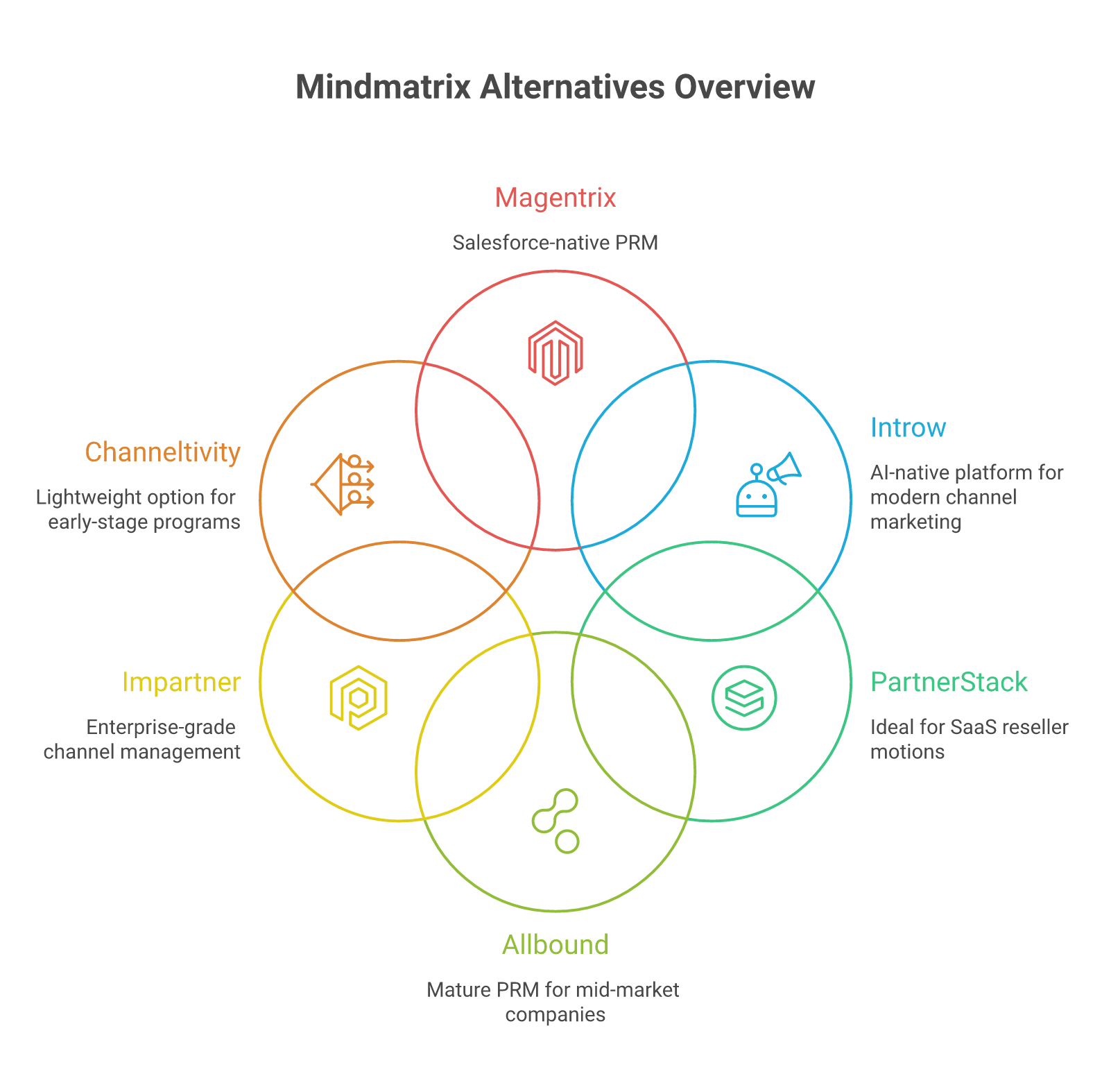
This list reflects what buyers actually shortlist when considering Mindmatrix alternatives, ranked against the use cases Mindmatrix is best at, not feature-checklist parity.
The evaluation criteria, in order:
- Program fit. Whether the tool serves channel-heavy, tech-alliance-heavy, or affiliate/reseller motions. Mindmatrix’s strength is channel-marketing automation, so alternatives are evaluated against how they support a similar program shape.
- Implementation lift. Time-to-first-value for a typical buyer in the same segment. Heavyweight tools earn higher feature scores but lose on time-to-value.
- Partner-side UX. Whether partners can register a deal in under 90 seconds on a phone. Most PRMs fail this test silently; the ones that pass tend to have higher partner adoption.
- CRM integration depth. Whether deal-reg and partner attribution flow into the CRM with attribution intact, or whether attribution gets lost in the sync.
- Reporting and attribution. Whether the reporting layer is good enough to defend partner-sourced pipeline at a CFO meeting.
- Total cost of ownership. License plus implementation plus the partnerships team headcount the tool requires to operate well.
Sources: vendor product documentation, G2 and Capterra review aggregates, conversations with partnerships leaders running these tools, and our own implementation work alongside customers. Dates: pricing and feature claims as of May 2026; verify directly with vendors before purchase.
When Mindmatrix is still the right answer
Don’t switch off Mindmatrix if your program is heavily through-channel-marketing-led, your reseller channel is large and content-hungry, and your partner motion runs on co-marketing more than co-selling. Mindmatrix is built for that program shape.
Mindmatrix is mature, deep on TCMA, and well-instrumented for through-channel campaigns. Vendors with hundreds of resellers running co-branded campaigns get real value from the platform. The alternatives in the table above tend to be lighter on the TCMA dimension. They are strong PRMs with marketing modules bolted on, rather than purpose-built channel-marketing automation.
If your program is the opposite shape, meaning tech-alliance-heavy, co-sell-first, low TCMA need, then Mindmatrix is overbuilt. That’s the most common reason buyers shop alternatives.
Edge cases
A few use cases sit between the obvious choices and need careful evaluation. Salesforce-native shops, tech-alliance-heavy programs, and ELG-first companies each have a non-obvious right answer.
Salesforce-native shops. Magentrix is the strongest fit because it lives natively inside Salesforce. The data model is the data model. Integrations don’t break because there is no integration layer to break. The tradeoff is portability. Leaving Salesforce gets harder.
Tech-alliance-heavy programs. A standalone PRM is overkill if the program runs primarily on co-sell with tech alliances and not on reseller deal-reg. The right stack is account mapping (Crossbeam, PartnerTap) plus a CRM customization for partner attribution. Add Introw or Euler later if program shape justifies it.
ELG-first programs. Buyers building an ecosystem-led growth motion tend to start with account mapping and a modern PRM (Introw, Euler) rather than a heavyweight legacy PRM. The substrate is partner data; the workflow layer is the PRM.
Lean SMB programs. A 10-partner program doesn’t need any of these tools. A clean CRM customization, a shared Notion or Google Drive, and a single partnerships hire cover the first 18 months. Don’t buy a PRM at partner number five.
Frequently asked questions
What does Mindmatrix do? Mindmatrix is a Through-Channel Marketing Automation (TCMA) and PRM platform. It manages partner enablement, runs deal registration, and distributes co-branded marketing assets to a vendor’s reseller and channel-partner ecosystem.
Why do buyers consider Mindmatrix alternatives? The most common reasons are wanting a lighter implementation, a more modern partner-side UI, a Salesforce-native architecture, or an account-mapping-first stack for a co-sell-led motion rather than a TCMA-led one.
Is Mindmatrix a PRM or a marketing automation tool? Both. Mindmatrix sits at the intersection. It has full PRM functionality (deal-reg, tiering, content gating) plus deep TCMA features (campaign distribution, co-branded assets, through-channel marketing reporting).
What is the closest direct alternative to Mindmatrix? Zinfi is the closest like-for-like, because both span PRM and TCMA. Impartner is the closest enterprise alternative on PRM depth. For modern, ecosystem-data-first shops, Introw and Euler are the strongest fits.
How much does Mindmatrix cost? Mindmatrix lists tier-based pricing publicly; specific quotes vary by partner count, modules, and contract length. Most enterprise buyers report mid-five-figure-to-six-figure annual contracts. Verify with the vendor.
Can a smaller company switch from Mindmatrix to a lighter PRM? Yes, but plan for content migration. The biggest implementation cost when switching off any PRM is moving partner directory data, deal-reg history, and content libraries into the new system without breaking partner workflows.
Should I use account mapping instead of a PRM? If your program is tech-alliance-heavy and co-sell-first, often yes, at least to start. Account mapping plus CRM attribution covers more of the value than a PRM does for that program shape. Add a PRM (Introw, Euler, or Impartner) when reseller volume justifies it.
How long does a Mindmatrix replacement implementation take? Typically 8 to 16 weeks for mid-market programs, longer for enterprise. The biggest variable is CRM-integration scope and the volume of partner data being migrated.
Next step
Before you seek MindMatrix alternatives, answer two questions. Is your program TCMA-led or co-sell-led, and how mature is your CRM partner-attribution data? The first question separates Zinfi/Impartner from Introw/Euler/PartnerStack/Channelscaler. The second decides whether a PRM is the right next investment, or whether account mapping and partner attribution come first.
Need an independent read on your PRM shortlist? That’s what we do. Talk to Forecastable for a partnerships-engineering view of your stack.
By Alex Buckles
Forecastable is an independent third-party professional services company. Our evaluations of other vendors are based on publicly-available information as of May 2026 and our own client experience.
Uncover Your Growth Potential
Schedule a Discovery Call