Alex Buckles
Partner Activation: The Work That Turns Enablement Into Pipeline

Partner activation is the work of getting partner sellers, technical teams, and customer success people to actually run deals alongside the vendor. The industry calls this enablement; the work that produces revenue is activation. Most B2B SaaS partner programs invest heavily in enablement content (training portals, certification badges, recorded courses) and underinvest in activation (motion playbooks, joint discovery rituals, ongoing reinforcement). The result is certified partners who don’t sell. Done correctly, partner activation produces partner-sourced and partner-influenced pipeline within 90 days of a partner’s first joint motion. Done wrong, it produces a content library nobody opens.
I’ve audited dozens of partner programs across SaaS companies of every size. The pattern is depressingly consistent. The vendor invests in a partner training portal, runs a launch event, certifies a cohort of partners, and then watches partner pipeline stay flat for the next eighteen months. The reason is structural. The work was framed as enablement (content delivery) when the work that actually moves pipeline is activation (behavior change at the deal level).
Activation vs enablement: the distinction that matters
| Frame | What it measures | What it produces |
|---|---|---|
| Enablement (the industry term) | Course completion rates, certification counts, portal logins. | A library of trained partners who may or may not sell. |
| Activation (the work that produces revenue) | Time to first partner-sourced opportunity, joint motion adoption rate, partner-influenced velocity lift. | Partner sellers actually running deals with the vendor. |
The two frames are not opposites. Enablement content is necessary input for activation. The mistake is treating enablement as the outcome. Outcomes are measured in pipeline, not completion rates.
The four layers of partner activation
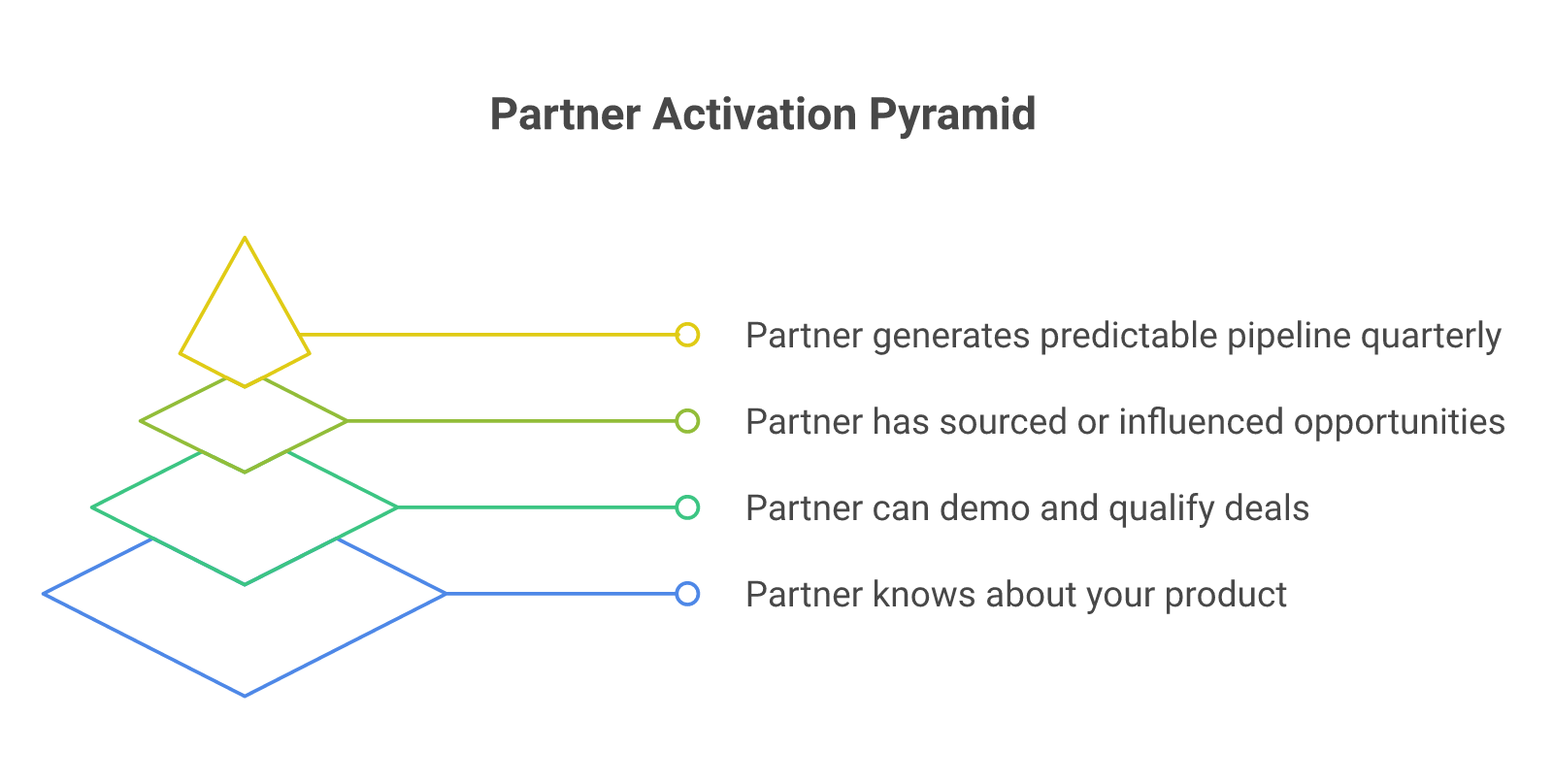
Activation has four distinct layers. Most programs invest heavily in the first two and almost nothing in the last two. Pipeline impact lives in the last two.
Layer 1: Knowledge foundation. Product fundamentals, positioning, competitive context, ICP definition. Necessary but not sufficient. Without it, partner sellers can’t have credible conversations with customers.
Layer 2: Technical foundation. Architecture deep dives, integration patterns, demo environments, certification. Necessary but not sufficient. Without it, technical buyers reject the joint solution at evaluation.
Layer 3: Motion activation. Co-sell playbooks tied to specific deal motions, joint discovery scripts, pricing and packaging guidance, deal registration workflow. This is where most programs underinvest. Without it, partner sellers don’t know how to actually run a deal with the vendor.
Layer 4: Reinforcement activation. Weekly partner manager office hours, joint deal review rituals, quarterly refresh sessions. Without it, layers 1 through 3 decay within 90 days. Reinforcement is what separates programs that compound from programs that plateau.
Why most partner activation programs fail
Five failure modes show up consistently.
Treated as a one-time event. The vendor runs a launch training, certifies a cohort, and assumes the work is done. Within 90 days, the partner sellers have forgotten most of what they learned. Within 180 days, half the certified sellers have rotated to other accounts.
Designed by marketing, not sales. Activation content gets built by the marketing team and reads like marketing collateral. Partner sellers ignore it because it doesn’t help them close deals.
No motion-level activation. The vendor provides product training but not motion training. Partner sellers know what the product does but don’t know how to run a joint discovery call, when to bring in the vendor’s technical team, or how to handle pricing objections.
Certification without recertification. Partners get certified once and the badge stays valid forever. Product evolves, positioning shifts, competitive landscape changes, and the certified partners are operating on stale knowledge.
No measurement loop. The team measures completion rates (how many partners completed the course) instead of pipeline outcomes (how many certified partners produced pipeline within 90 days). Without the outcome loop, the program optimizes for the wrong thing.
The reinforcement layer most teams skip
Reinforcement is what separates partner activation programs that compound from programs that decay. Three reinforcement mechanisms produce the most ROI.
Weekly partner manager office hours. Standing time when any partner seller can drop in with deal-specific questions. Low overhead, high signal. Reinforces that the vendor is actively supporting the partner motion.
Joint deal review rituals. Bi-weekly 30-minute review with the partner counterpart on the top 5 partner-influenced deals. Forces the partner manager and partner seller to stay aligned on motion execution.
Quarterly refresh sessions. Short (45 to 60 minute) sessions on what’s new, what’s changed, and what’s working. Keeps certified partners current without requiring full recertification.
Forrester research on channel programs consistently shows reinforcement-heavy programs produce 2 to 4x the partner-sourced pipeline of one-time-event programs at similar investment levels.
The five highest-ROI activation assets
Different activation assets have very different ROI profiles. From data across mid-market and enterprise SaaS:
Co-sell playbooks tied to specific motions. Highest ROI. Documents that walk a partner seller through exactly how to run a specific motion: who to contact, what to say, when to bring in the vendor, how to handle common objections. Used weekly by partners who actually sell.
Partner-specific demo environments. High ROI. Sandbox accounts that partners can use to demo the joint solution to their own customers. Eliminates the friction of having to coordinate vendor demo support for every prospect.
Recorded discovery call examples. High ROI. Fifteen to thirty minute recordings of strong joint discovery calls, annotated with what worked and why. Partner sellers learn faster from real examples than from training decks.
Competitive battle cards. Mid to high ROI when kept current. Specific positioning against the competitors partners actually encounter. Stale battle cards do more harm than good.
Pricing and packaging guidance. Mid ROI. Concrete guidance on how to price the joint solution, when discounting is appropriate, and how to position value vs cost. Partner sellers freeze without this guidance.
How to measure partner activation effectiveness
Stop measuring completion rates. Start measuring four pipeline outcomes.
Time from certification to first partner-sourced opportunity. If certified partners take more than 90 days to source their first opportunity, the activation program is underweight on motion layer 3.
Win rate on partner-influenced deals where the partner used the playbook vs not. Compare deals where partner sellers used the co-sell playbook against deals where they didn’t. Win rate delta is one of the cleanest activation effectiveness signals.
Partner-sourced pipeline volume per certified partner. Total partner-sourced pipeline divided by certified partner count. Track quarterly. The trend matters more than the absolute number.
Partner seller retention in the program. What percentage of certified partner sellers are still actively producing pipeline 12 months later. Below 30 percent and the reinforcement layer is missing. BCG research on channel programs shows partner seller retention is the strongest leading indicator of long-term partner-sourced revenue growth.
How Forecastable handles partner activation
Forecastable’s services includes the operational layer that makes partner activation actually drive pipeline. Co-sell playbooks tied to specific deal motions. Joint discovery call recording with AI annotation. Reinforcement workflows that fire automatically when a partner deal hits friction. Pipeline outcome tracking by certified partner cohort.
The output is a partner activation program that produces measurable partner-sourced pipeline within the first 90 days of a partner’s certification, not eighteen months later.
The bigger picture for partnerships leaders
Partner activation is not a content delivery exercise. It’s an operating system that has to run continuously. Build the four layers (knowledge, technical, motion, reinforcement). Invest disproportionately in motion and reinforcement because those are where most programs underinvest. Measure pipeline outcomes, not completion rates. Recertify quarterly. Do this consistently for two to three years and your partner-sourced pipeline compounds. Skip the reinforcement layer and you’ll certify a lot of partners who never produce revenue.
Frequently Asked Questions
What is partner activation?
Partner activation is the work of getting partner sellers, technical teams, and customer success people to actually run deals alongside the vendor. It spans four layers: knowledge foundation, technical foundation, motion activation, and reinforcement activation. The industry term for this category is “partner enablement,” but the unit of measurement that matters is partner sellers actually running deals, not partner sellers completing courses.
What’s the difference between partner activation and partner enablement?
Enablement is content delivery (courses, certification, portals). Activation is the behavior change at the deal level that turns enabled partners into selling partners. Enablement measures completion rates. Activation measures pipeline outcomes. Most failing programs invest in enablement and call it activation; most succeeding programs build activation rituals on top of enablement content.
Why do most partner activation programs fail?
Five failure modes. Treated as a one-time event. Designed by marketing instead of sales. No motion-level activation (only product training). Certification without recertification. Measurement focused on completion rates instead of pipeline outcomes.
How do you measure partner activation effectiveness?
Four pipeline outcomes. Time from certification to first partner-sourced opportunity. Win rate on partner-influenced deals where the partner used the playbook vs not. Partner-sourced pipeline volume per certified partner. Partner seller retention in the program at 12 months.
What activation assets have the highest ROI?
Co-sell playbooks tied to specific motions (highest ROI). Partner-specific demo environments. Recorded discovery call examples with annotation. Competitive battle cards (when kept current). Pricing and packaging guidance.
How often should partners be recertified?
Quarterly refresh sessions of 45 to 60 minutes covering what’s new and what’s changed. Full recertification annually. Without periodic refresh, certified partners operate on stale knowledge as the product evolves and competitive landscape shifts.
How does Forecastable support partner activation?
Forecastable’s services include the operational layer that makes activation drive pipeline: co-sell playbooks tied to deal motions, joint discovery call recording with AI annotation, reinforcement workflows triggered by deal friction, pipeline outcome tracking by certified partner cohort.
Forecastable turns scattered partner relationships into predictable, forecastable pipeline. See the platform or start your growth journey.
Uncover Your Growth Potential
Schedule a Discovery Call