Skip to content
Logo โ€” Itโ€™s All AboutThe Team
  • Home
  • Who We Serve
    • By Category
      • SaaS
      • Professional Services
      • Platforms (Large Ecosystems)
      • Private Equity
    • By Role
      • Chief Revenue Officers (CRO)
      • Chief Financial Officers (CFO)
      • Chief Marketing Officers (CMO)
      • Chief Executive Officers (CEO)
      • Sales Leaders
      • Partnership Professionals
  • Solutions
    • By Partner Program Maturity
      • Partnerships Foundation
      • Partnerships Acceleration
      • Ecosystem-Wide Orchestration
    • Specialized Solutions
      • Net-New Named Account Development
      • Large Ecosystems
      • M&A: Post-Acquisition Internal Cross-Selling
  • Pricing
  • Education
  • Company
    • Our History
    • Security
  • Login
Logo โ€” Itโ€™s All AboutThe Team
  • Home
  • Who We Serve
    • By Category
      • SaaS
      • Professional Services
      • Platforms (Large Ecosystems)
      • Private Equity
    • By Role
      • Chief Revenue Officers (CRO)
      • Chief Financial Officers (CFO)
      • Chief Marketing Officers (CMO)
      • Chief Executive Officers (CEO)
      • Sales Leaders
      • Partnership Professionals
  • Solutions
    • By Partner Program Maturity
      • Partnerships Foundation
      • Partnerships Acceleration
      • Ecosystem-Wide Orchestration
    • Specialized Solutions
      • Net-New Named Account Development
      • Large Ecosystems
      • M&A: Post-Acquisition Internal Cross-Selling
  • Pricing
  • Education
  • Company
    • Our History
    • Security
  • Login
  • Home
  • Who We Serve
    • By Category
      • SaaS
      • Professional Services
      • Platforms (Large Ecosystems)
      • Private Equity
    • By Role
      • Chief Revenue Officers (CRO)
      • Chief Financial Officers (CFO)
      • Chief Marketing Officers (CMO)
      • Chief Executive Officers (CEO)
      • Sales Leaders
      • Partnership Professionals
  • Solutions
    • By Partner Program Maturity
      • Partnerships Foundation
      • Partnerships Acceleration
      • Ecosystem-Wide Orchestration
    • Specialized Solutions
      • Net-New Named Account Development
      • Large Ecosystems
      • M&A: Post-Acquisition Internal Cross-Selling
  • Pricing
  • Education
  • Company
    • Our History
    • Security
  • Login
Back to all blogs
  • Co-Selling
Alex Buckles

Why Co-Sell Fails: The Structural Reasons It Stalls

A partnerships leader and a sales director diagnosing a stalled co-sell program at a wall monitor showing a flat partner-pipeline chart, a printed motion map on the table, deep navy and warm amber palette

What is meant by why co-sell fails?

Short answer: Why co-sell fails is a question about structure more than effort, because most co-sell programs stall on design flaws, no defined motion, no clear ownership, no attribution, rather than on people not trying hard enough. It points to the systemic reasons a joint-selling program produces meetings and goodwill but not revenue.

Teams tend to blame co-sell failure on the partner, the reps, or bad luck. Those explanations feel satisfying and are usually wrong. A program built on a broken structure fails no matter how committed everyone is.

Understanding why co-sell fails means looking at the program’s architecture: whether the motion is defined, whether anyone owns the number, whether the revenue is attributable, and whether the incentives point the right way. Fix the structure and the effort starts producing.

Why understanding why co-sell fails matters in 2026

Co-sell has become a core growth motion, and in 2026 the cost of a failing co-sell program is no longer a missed experiment, it is a missed number that leadership was counting on. Knowing why co-sell fails matters because the failure modes are predictable and preventable, and a program designed against them produces where an undesigned one stalls.

The second reason is resource defense. A co-sell program that fails quietly loses its budget and its credibility, and the partnerships function spends the next planning cycle explaining the flat number. Diagnosing the structural causes lets you fix them before the program is written off.

The third reason is that the same flaws recur across companies. Why co-sell fails is rarely a novel problem; it is the same handful of design gaps showing up again. A team that knows the pattern can build around it from the start rather than rediscovering it the expensive way.

How co-sell fails actually works

Co-sell fails through a small set of structural gaps, each of which produces activity without revenue, and each of which is fixable by design.
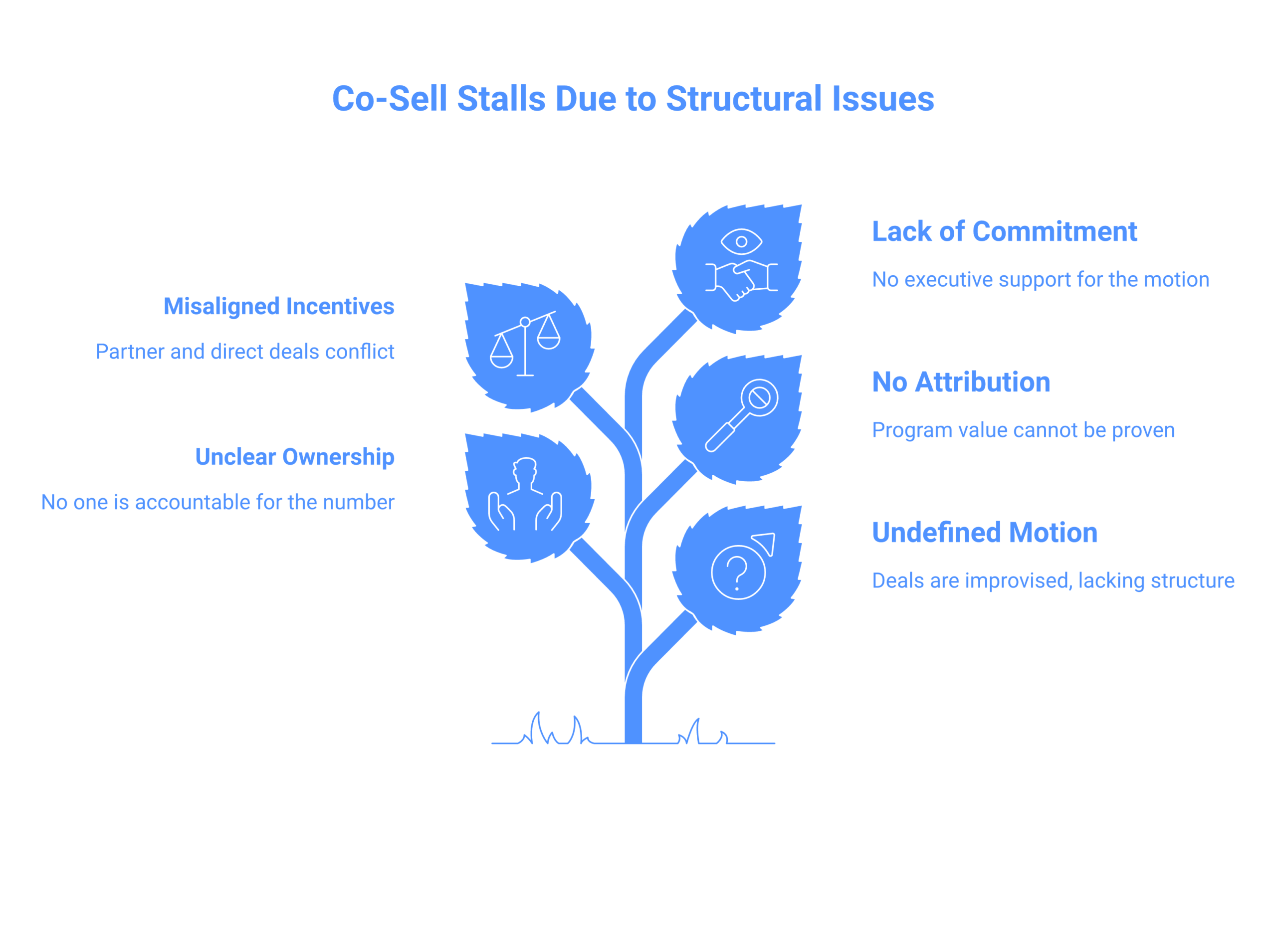
why co-sell fails framework: No defined motion, so every deal is improvised, No clear ownership of the number, No attribution, so the program cannot prove value, Misaligned incentives between partner and direct deals, No executive...

  1. No defined motion, so every deal is improvised: When there is no documented play for how partners and reps sell together, each co-sell deal is a one-off, and improvisation does not scale. The fix is a defined motion, who fronts the customer, how the deal runs, that any rep can execute.
  2. No clear ownership of the number: When co-sell revenue is everyone’s job and no one’s quota, it gets the attention an unowned goal always gets, which is none under pressure. The fix is a named owner accountable for partner-sourced revenue.
  3. No attribution, so the program cannot prove value: When partner involvement is not captured, the program cannot show what it produced, and an unprovable program loses its resources. The fix is capturing partner-sourced and influenced revenue where the rest of the funnel is tracked.
  4. Misaligned incentives between partner and direct deals: When co-sell deals contest credit with direct deals, reps avoid the friction and the program starves. The fix is settling credit rules before the quarter so co-sell is not a fight reps would rather skip.
  5. No executive commitment behind the motion: When leadership likes co-sell in principle but commits no resources, the program cannot secure the sales attention or budget it needs. The fix is a resourced executive commitment, not just enthusiasm.

Co-sell is failing structurally when the program is busy, meetings, enablement, decks, but partner revenue stays flat, and it recovers when each structural gap is closed so effort finally lands on a working architecture.

Common reasons why co-sell fails

  • The motion was never defined: A program that never wrote down how partners and reps actually sell together leaves every deal to improvisation. Improvised co-sell works occasionally and scales never, so the program produces sporadic wins and no reliable revenue.
  • No one owns the co-sell number: When partner revenue belongs to everyone, it belongs to no one when priorities compete. Without a named owner accountable for the outcome, co-sell loses every contest for attention against quota-carrying direct work.
  • The program cannot prove what it produced: A co-sell program with no attribution cannot show its contribution, and an invisible contribution gets cut. Many co-sell programs fail not because they produced nothing but because they could not prove they produced anything.
  • Credit rules pit co-sell against direct deals: When involving a partner means fighting a direct rep for the same credit, reps quietly avoid co-sell. Unsettled attribution turns a growth motion into an internal dispute that sellers route around.
  • Executives endorsed but never committed: Leadership enthusiasm with no resources behind it leaves the program unable to secure sales time or budget. Co-sell that has a sponsor in name but not in committed resources stalls the first time it needs something.

What this looks like in practice

A company ran a co-sell program for a year and had almost nothing to show for it, and the leadership’s instinct was that the partners were weak. A short diagnosis told a different story. The partners were fine; the structure was broken in three places. There was no defined motion, so reps improvised every partner deal and most fizzled. No one owned the co-sell number, so it lost every priority contest to direct quota. And nothing was attributed, so even the deals that closed could not be credited to the program. None of that was an effort problem. The team fixed the architecture rather than replacing the partners. They documented the motion, named an owner accountable for partner revenue, and instrumented attribution in the CRM. Within two quarters the same partners that had looked weak were producing forecastable pipeline, because the program finally had a structure for their effort to land on.

Forecastable’s POV on why co-sell fails

The position we hold is that co-sell almost never fails for lack of effort, and teams waste months treating a structural problem as a motivation problem. They push reps harder, swap partners, and run more enablement, when the real issue is that the program has no defined motion, no owner, or no attribution. Effort poured onto a broken structure produces exhaustion, not revenue.

The second conviction is that the failure modes are boringly predictable, which is good news. Why co-sell fails is rarely a mystery unique to your company; it is the same handful of design gaps that stall programs everywhere. That means you can design against them from the start instead of discovering them one painful quarter at a time.

The honest caveat is that not every co-sell failure is worth fixing in place. Sometimes the structural diagnosis reveals that the underlying partnership has no real overlap or mutual value, and no amount of motion design will save it. The discipline is to separate a structurally broken program around a good partnership, which is fixable, from a sound structure around a partnership that was never going to produce, which is not.

Forecastable is a partnerships operating platform; any third-party tools or platforms referenced here are independent third-party products, and naming them is not an endorsement of one deployment over another. Evaluate each against your own motion.

Frequently asked questions

What is the most common reason co-sell fails?
No defined motion. When there is no documented play for how partners and reps sell together, every deal is improvised, and improvisation does not scale. Most co-sell programs that stall do so because the motion was never actually designed.

Is co-sell failure usually a people problem or a structure problem?
Almost always structure. Teams blame partners or reps, but the recurring causes are design flaws, no motion, no ownership, no attribution. Effort cannot compensate for a broken architecture, which is why pushing harder rarely fixes a failing co-sell program.

Why does a co-sell program lose its budget even when deals close?
Because without attribution it cannot prove what it produced. A program that captures no partner involvement cannot credit the revenue it generated, and an unprovable contribution gets cut regardless of whether it was real.

How does misaligned credit cause co-sell to fail?
When co-sell deals contest the same credit as direct deals, reps avoid the friction and route around the partner motion. Unsettled attribution turns co-sell into an internal dispute, and sellers will not fight that battle when a cleaner direct deal is available.

Can executive support fix a failing co-sell program?
Only if the support is resourced. Enthusiasm with no committed people or budget cannot secure the sales attention the motion needs. Real executive commitment helps; symbolic endorsement does not, and many programs fail with a sponsor who never committed anything concrete.

How do I know whether to fix or abandon a failing co-sell program?
Diagnose the structure first. If the motion, ownership, and attribution are broken around a partnership with real overlap and mutual value, fix the structure. If the structure is sound but the partnership has no genuine overlap, the honest move is to stop rather than redesign.

Next step

If your co-sell program is busy but the partner number is flat, the move this quarter is to diagnose the structure rather than the people, check whether the motion is defined, the number is owned, and the revenue is attributed, then close whichever gap is starving the program.

Start your growth journey now to fix the structure that makes co-sell produce, or see the orientation on co-sell for how the pieces fit together.

Uncover Your Growth Potential

Whether starting with a single sales team or a single partner, any co-sell motion can be live within 30 days.

Schedule a Discovery Call
Latest Insights
A SaaS partnerships leader and a co-sell advisor evaluating options at a table, a printed checklist of co-sell solution criteria and a partner account list between them, deep navy and warm amber palette
  • Co-Selling
Alex Buckles

Co-Selling Solutions for SaaS Companies: How to Choose

What are co-selling solutions for SaaS companies? Short answer: Co-selling solutions for SaaS companies are the services, frameworks, and software that help a software business sell jointly with its partners, spanning advisory help that designs the motion, frameworks that make it repeatable, and tooling that makes partner deals visible in the CRM. They are not […]

Read Article
A RevOps admin and a partner manager configuring a co-sell pipeline in HubSpot on a shared monitor, a printed field map and deal-stage list on the desk, deep navy and warm amber palette
  • Co-Selling
Alex Buckles

Set Up HubSpot for Co-Sell: A Working Configuration

What does it take to set up HubSpot for co-sell? Short answer: To set up HubSpot for co-sell means configuring the CRM so partner involvement in a deal is captured, attributable, and actionable, through partner fields, a clear deal stage for co-sell, and routing that loops the right partner in. It is less about new […]

Read Article
An ecosystem team reviewing a printed co-sell framework on a whiteboard, mapping deal stages and partner roles, a shared account plan on the table, deep navy and warm amber palette
  • Co-Selling
Alex Buckles

Co-Sell Frameworks for Ecosystem Teams: What to Trust

What are co-sell frameworks for ecosystem teams? Short answer: Co-sell frameworks for ecosystem teams are documented, repeatable models that define how partners and a vendor sell together, covering who owns the customer, how deals are registered and tracked, and what each side does at every stage. A trustworthy one is judged not by how polished […]

Read Article
Two sellers from partnering companies in a tense moment over a shared deal, one checking a phone while a customer waits, an account list and an unread handoff note on the table, deep navy and warm amber palette
  • Co-Selling
Alex Buckles

Why Does Co-Selling Fail? The Human Reasons It Breaks

What does why does co-selling fail mean? Short answer: Why does co-selling fail is, at the level reps actually experience, a question about the human moments between two sellers, the slow handoff, the unbuilt trust, the credit that never gets shared, where joint deals quietly break even when the program looks well-designed on paper. It […]

Read Article
Logo โ€” Itโ€™s All AboutThe Team

Quick Links

  • Who We Serve
  • Solutions
  • Resources
  • Pricing
  • Our History

Social Media

  • Linkedin

Legal

  • Privacy Policy
  • Terms of Service
Quick Links
  • Who We Serve
  • Solutions
  • Resources
  • Pricing
  • Our History
Social Media
  • Linkedin
Legal
  • Privacy Policy
  • Terms of Service

Stay ahead on ecosystem-led growth

Logo โ€” Itโ€™s All AboutThe Team
ยฉ 2025 Forecastable. All rights reserved.
Book Your Strategy Call
Request Enrollment Details

[contact-form-7 id=”dfbeed3″ title=”Request Enrollment Details”]

Mollie Bodensteiner

Revops Advisory
  Mollie Bodensteiner is an experienced operations professional with a demonstrated track record of utilizing technology to support operational processes that drive performance and innovation. She currently is the Vice President of Operations at Sound and owns go-to-market agency, MB Solutions. Mollie has previously held operations leadership roles at Deel, Syncari, Corteva and Marketo. She has over 14 years of experience in both B2C and B2B operations and technology. When she is not working, Mollie enjoys spending time with her husband, three small children, and two large dogs. Childhood Career/Dream: Growing up in the age of Disney and Nick@Nite I always wanted to be a child actor (good thing that never was actually pursued ๐Ÿ™‚ Favorite Win: I am not sure I have a specific โ€œwinโ€ but I think I get the most joy and excitement from coaching others and watching them hit major milestones in their career. The first time you get to promote someone on your team or watch them lead a major project – are always career highlights! Personal Fun Facts: Favorite Song: If itโ€™s love, Train Favorite Movie: Good Will Hunting Favorite Meme: Disaster Girl
Forecastable resources: Co-Sell Orchestration Platform · All Use Cases · Live in 30 Days · Co-Sell Playbook

Kelsey Buckles

Director of Operations


My journey from Education to Operations has equipped me with a unique perspective and skill set that perfectly aligns with Forecastable’s mission to help businesses improve sales collaboration through partner co-selling strategies.

At Forecastable, I am passionate about empowering teams and organizations to unlock the full potential of strategic partnerships. By leveraging my expertise in communication, leadership, and operational efficiency, I contribute to creating seamless co-selling processes that align with business goals and deliver exceptional results.

The intersection of my educational foundation and operational experience fuels my dedication to fostering alignment, building trust, and enhancing collaboration between partners. I am driven by the opportunity to contribute to a platform that not only optimizes sales strategies but also strengthens relationships that lead to long-term growth.

Paul Jonhson

Chief Technology Officer (Co-founder)


Paul Johnson has 20+ years of software development and consulting experience for a variety of organizations, ranging from startups to large-enterprise organization with highly-complex needs.

Mr. Johnson has a long track record of successful technology deployments.
This, combined with his deep passion for machine learning and exceptional user experience design, allows him to lead our technical direction from the front with confidence.

Alex Buckles

Product, Partnerships, and Value Engineering (Co-founder)


After serving in The United States Marine Corps, Alex Buckles spent the next two decades as a student of revenue production and an advocate for innovation.

Along the way, he has helped numerous companies achieve double and triple-digit growth by crafting and executing high-performing go-to-market strategies, with co-selling at the center of each.

As a once-advanced technical marketer, an expert sales & partner professional, and a strong customer success advocate, Mr. Buckles understands the impact of these functions aligning not only on revenue production, but on the day-to-day execution of the go-to-market strategy. This concept of revenue-team alignment is what quickly became the foundation of Forecastable back in January of 2018.

In his free time, youโ€™ll find him spending quality time with his children, one of whom is on the autism spectrum. 1 in 36 children in the U.S. are on the spectrum and boys are four times more likely to be diagnosed than girls.

With that in mind, Mr. Buckles plans on dedicating the rest of his life serving those living with autism, through his organization Pathways for Autism. From his perspective, there must be a scalable and financially self-sustaining infrastructure established to put as many individuals with autism as possible on a path towards complete independence as adults.