Co-Selling Solutions for SaaS Companies: How to Choose

What are co-selling solutions for SaaS companies?
Short answer: Co-selling solutions for SaaS companies are the services, frameworks, and software that help a software business sell jointly with its partners, spanning advisory help that designs the motion, frameworks that make it repeatable, and tooling that makes partner deals visible in the CRM. They are not one product, and choosing well starts with knowing which kind your motion actually needs.
The question of who offers quality co-selling solutions assumes there is a single category to shop. There is not. A SaaS company struggling with co-sell usually has a motion problem, a tooling problem, or a skills problem, and the right solution depends entirely on which one is true.
That is why generic answers fail. A team buys software when the real gap is a motion no one has designed, or hires a consultant when the real gap is data that does not reach the reps. The quality of a solution is measured against the specific thing that is broken.
Why co-selling solutions for SaaS companies matter in 2026
SaaS growth increasingly runs through ecosystems rather than pure direct sales, and in 2026 the companies that capture that motion are the ones that treat co-sell as a deliberate capability instead of an occasional favor between partners. Co-selling solutions for SaaS companies matter because building that capability from scratch, alone, is slow and error-prone.
The second reason is that SaaS motions are specific. A product-led company co-sells differently than a sales-led one, and a solution built for a generic B2B seller often misses the realities of usage data, integrations, and self-serve funnels that define SaaS. Quality means fit to the SaaS motion, not just co-sell competence in the abstract.
The third reason is speed to revenue. A SaaS company that adopts a proven co-sell framework or tool reaches partner-sourced revenue faster than one reinventing the motion, and in a market where ecosystems are crowding fast, the time saved is the advantage.
How co-selling solutions for SaaS companies actually work
Quality co-selling solutions work by matching the kind of help to the kind of gap, and the three kinds are not interchangeable.
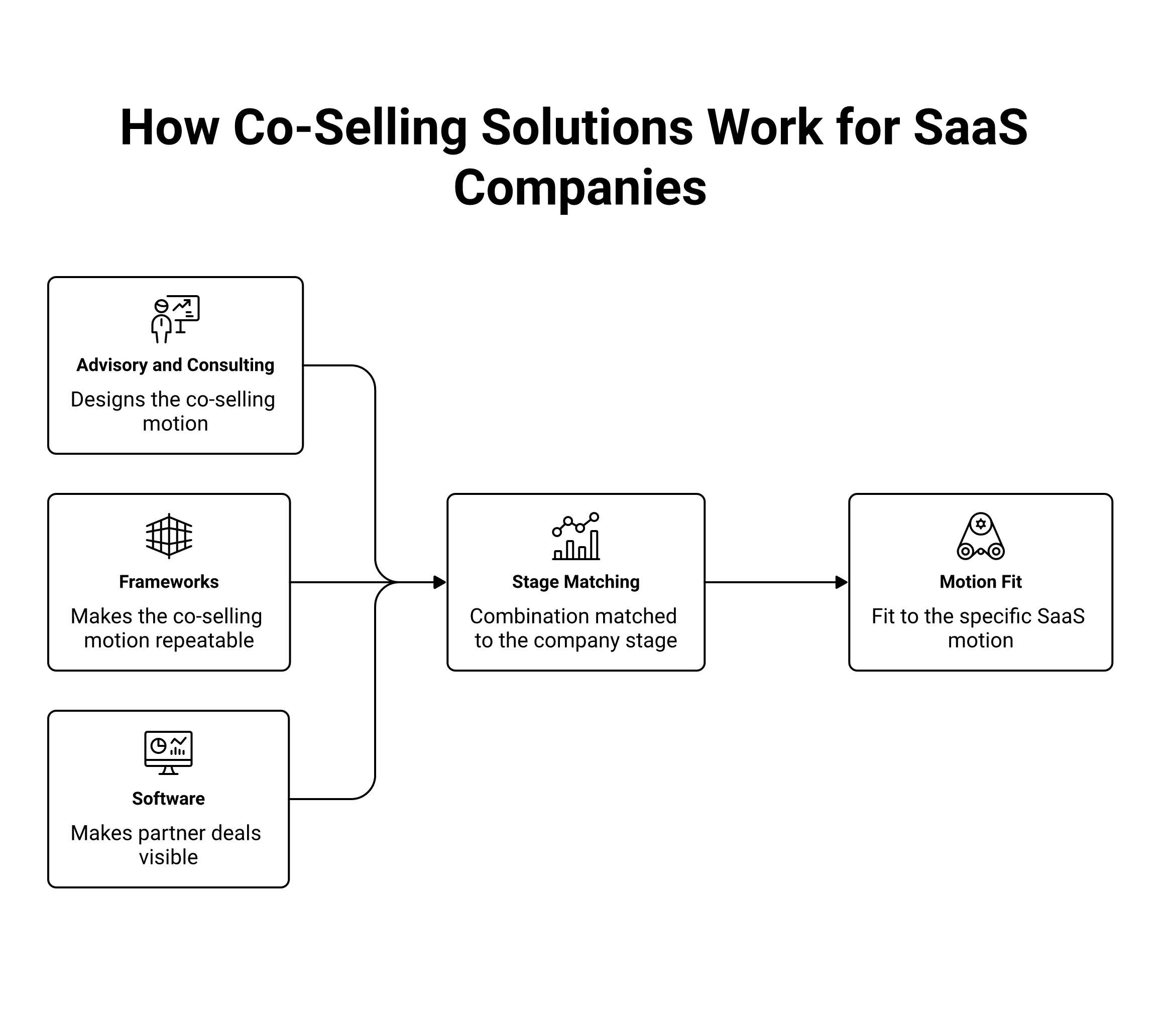
- Advisory and consulting that designs the motion: When the gap is that no repeatable co-sell motion exists, the solution is help designing one, who fronts the customer, how deals are registered, what the joint pitch is. This is the right solution when the problem is that co-sell happens by accident or not at all.
- Frameworks that make the motion repeatable: When a motion works occasionally but cannot be scaled, the solution is a framework that encodes the play so any rep can run it. This fits a SaaS company that has won with co-sell once and needs to make it a system rather than a one-off.
- Software that makes partner deals visible: When the motion exists but lives outside the CRM, the solution is tooling that captures partner involvement, surfaces account overlap, and reports partner revenue. This is the right solution when the gap is attribution and visibility, not motion design.
- A combination matched to the stage: Most SaaS companies need more than one over time, advisory to design, a framework to scale, tooling to measure, and the quality of a provider shows in whether they diagnose which you need now rather than selling all three at once.
- Fit to the specific SaaS motion: A quality solution accounts for how your company actually sells, product-led or sales-led, integration-driven or referral-driven, rather than applying a generic co-sell template. The motion fit is what separates a solution that produces from one that looks good in a deck.
A solution is working when the specific gap that was hurting your co-sell motion closes, and it is failing when you bought a category, software, consulting, a framework, that did not match the thing that was actually broken.
Common pitfalls when choosing co-selling solutions for SaaS companies
- Buying software for a motion problem: Tooling makes a working motion visible; it does not create a motion that does not exist. A SaaS company that buys co-sell software before designing the motion ends up with a precise view of partner deals that are not happening.
- Hiring advisory for a data problem: When reps cannot see account overlap, the gap is data reaching the CRM, not strategy. Paying for motion design when the real issue is visibility solves the wrong problem expensively.
- Treating co-sell solutions as one category: Asking who offers the best co-selling solution assumes a single market. The honest answer is that advisory, frameworks, and tooling solve different gaps, and the best provider is the one that fits the gap you actually have.
- Ignoring the SaaS specifics: A generic co-sell solution that does not account for usage data, integrations, or self-serve funnels misses what makes SaaS co-sell distinct. Fit to the SaaS motion matters more than general co-sell credentials.
- Buying all three at once: A provider that sells advisory, framework, and tooling as a single bundle before diagnosing your gap is selling a category, not a solution. Quality shows in the diagnosis first, the recommendation second.
What this looks like in practice
A SaaS company decided its co-sell was broken and went shopping for a solution. The first instinct was to buy co-sell software, and they nearly did, until a short diagnosis showed the software was not the gap. They had a real motion with one partner that closed deals, but no rep could repeat it because nothing was written down, and partner deals never made it into the CRM, so leadership could not see the revenue. The actual solution was two things, neither of which was a new platform. They adopted a framework that encoded the working motion so any rep could run it, then configured their existing CRM to capture partner involvement and report it. Six weeks later co-sell deals were repeatable and visible. Had they bought the software first, they would have had a precise dashboard of a motion still trapped in one person’s head. The quality of the outcome came from diagnosing the gap before choosing the category.
Forecastable’s POV on co-selling solutions for SaaS companies
The position we hold is that the question of who offers quality co-selling solutions is the wrong first question. The right first question is which gap is hurting your motion, because advisory, frameworks, and software solve different problems, and quality is meaningless until it is matched to a need. A great consulting engagement aimed at a data problem is a waste, and so is great software aimed at a motion that does not exist.
The second conviction is that SaaS co-sell deserves SaaS-specific solutions. The realities of usage data, integrations, and self-serve funnels change how co-sell works, and a solution designed for generic B2B selling often misses them. When you evaluate a provider, weigh fit to your actual SaaS motion over general co-sell polish.
The honest caveat is that most SaaS companies eventually need more than one kind of solution, and the right sequence is usually design the motion, make it repeatable, then make it visible. A provider worth trusting will tell you which you need now and which can wait, rather than selling you the whole stack before they understand what is broken.
Forecastable is a partnerships operating platform; any third-party tools or platforms referenced here are independent third-party products, and naming them is not an endorsement of one deployment over another. Evaluate each against your own motion.
Frequently asked questions
What kinds of co-selling solutions exist for SaaS companies?
Three main kinds: advisory and consulting that designs the motion, frameworks that make it repeatable, and software that makes partner deals visible and attributable. They solve different gaps, so the best one depends on what is actually broken in your co-sell.
How do I know which co-selling solution my SaaS company needs?
Diagnose the gap first. If no repeatable motion exists, you need advisory or a framework. If the motion works but is invisible to leadership, you need tooling. Buying the wrong category for your gap is the most common and most expensive mistake.
Is co-sell software enough on its own for a SaaS company?
Only if your gap is visibility. Software makes a working motion measurable, but it does not create a motion that does not exist. If reps have no repeatable way to co-sell, software gives you a precise view of deals that are not happening.
What makes a co-selling solution quality for SaaS specifically?
Fit to the SaaS motion. A quality solution accounts for usage data, integrations, and self-serve funnels rather than applying a generic B2B co-sell template. General co-sell competence matters less than whether the solution matches how your company actually sells.
Should I buy advisory, a framework, and software together?
Usually not all at once. Most SaaS companies need them in sequence, design the motion, make it repeatable, then make it visible. A provider that bundles all three before diagnosing your gap is selling a category rather than solving your problem.
How fast can a co-selling solution produce results for a SaaS company?
When matched to the right gap, often within a quarter. A framework can make a working motion repeatable in weeks, and CRM configuration can make partner revenue visible just as fast. The slow path is buying the wrong solution and then discovering the real gap.
Next step
If your SaaS company thinks its co-sell is broken, the move this quarter is to diagnose the gap before you shop, decide whether you need a motion designed, a motion made repeatable, or a motion made visible, then choose the solution that fits that gap rather than the loudest category.
Start your growth journey now to match the right co-sell solution to your SaaS motion, or see the orientation on co-sell for how the pieces fit together.
Uncover Your Growth Potential
Schedule a Discovery Call