What Is a Partner Ecosystem? Definition and How It Works

Short answer
Short answer: A partner ecosystem is the network of companies whose products, services, and customer bases surround your own, and whom you can sell with, build with, or sell through. It matters because buyers now assemble their own stacks, so the vendor whose ecosystem is richest and best activated wins more of the deal and keeps it longer.
The mistake I see most is treating the ecosystem as a logo wall. A directory of signed partners is not an ecosystem. A producing ecosystem is a set of relationships you actively map, work, and measure.
What is a partner ecosystem?
A partner ecosystem is the full set of external companies that touch the same customers you do: technology and integration partners who build alongside you, service partners and systems integrators who implement, and channel partners such as resellers, VARs, and MSPs who sell and deliver. Named from your side, the ecosystem is the surface area you can reach through other companies rather than through your own reps alone.
The word gets stretched until it means nothing. A list of companies with a signed agreement is a partner roster, not an ecosystem. What turns a roster into an ecosystem is overlap and motion: knowing which of your partners share which of your customers and prospects, and running an actual go-to-market play across that overlap. Without the overlap layer, you have a spreadsheet of relationships nobody works.
It helps to separate three things people blur together. A partner program is the structure you use to recruit and reward partners. A partner ecosystem is the living network of those relationships and the customers they surround. Ecosystem-led growth (ELG) is the practice of using ecosystem data, mainly account overlap, to source and accelerate revenue. The program is the container, the ecosystem is the network, and ELG is the motion.
Why a partner ecosystem matters in 2026
A partner ecosystem matters because almost no enterprise software deal happens in isolation anymore. Analyst Jay McBain has estimated that around 96% of technology deals are partner-surrounded, which means the companies already in and around your accounts shape whether you win. If you cannot see that surrounding network, you are selling half-blind.
The second reason is durability. An account reached through a partner integration or a joint implementation is harder to displace, because ripping you out means unwinding the partner too. Crossbeam has reported that partner-involved deals close at meaningfully higher win rates and larger sizes than solo deals. The ecosystem is not a branding exercise. It is where a growing share of pipeline and retention actually lives.
How a partner ecosystem actually works
A partner ecosystem produces revenue when four components are in place. Signing partners is only the first, and on its own it produces nothing.
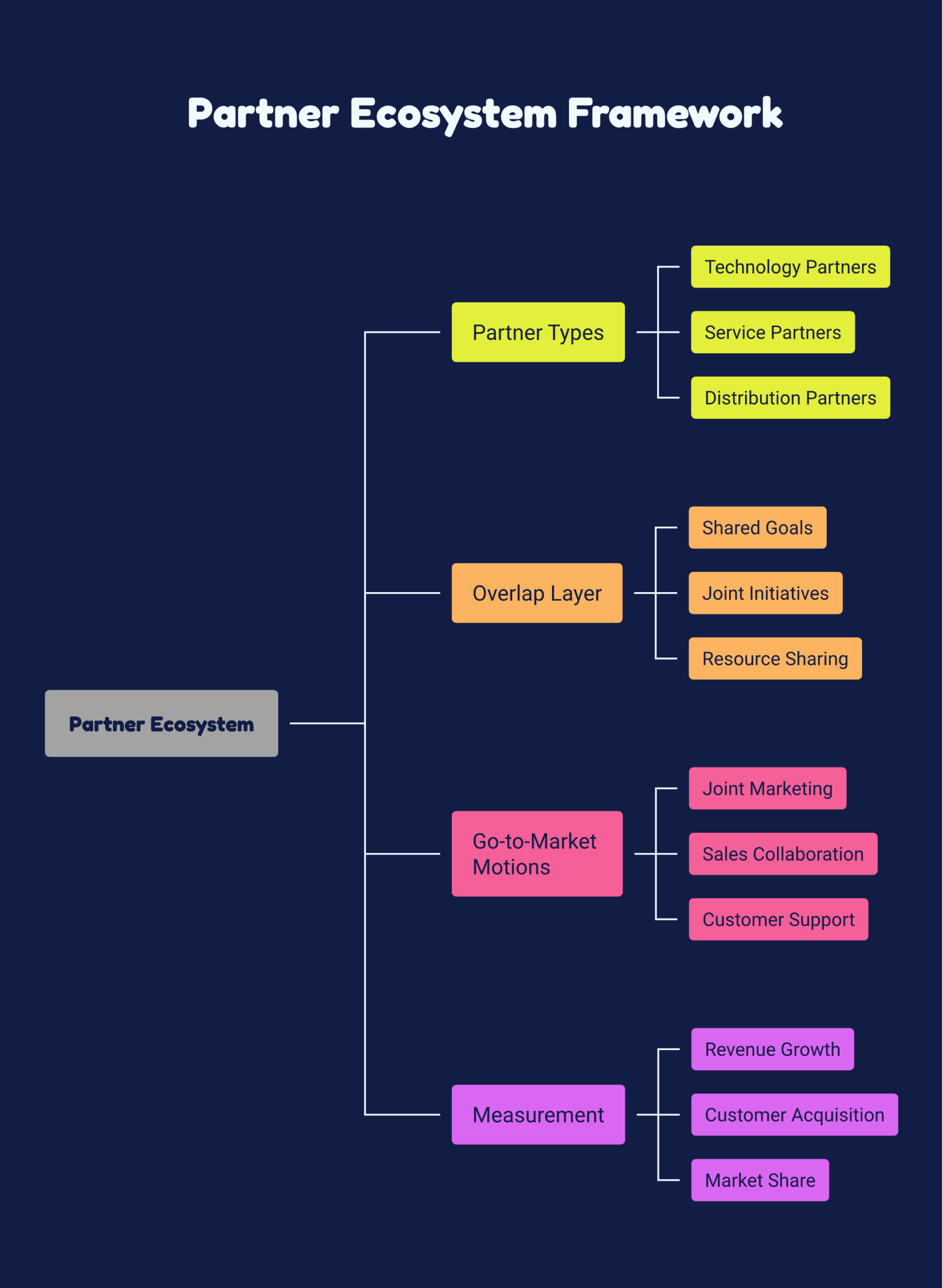
- The partner types: the mix of technology or build partners, service partners and SIs, and channel partners such as resellers and MSPs. Each type reaches your customers differently, so you segment the ecosystem by what each partner can actually do for a shared account.
- The overlap layer: the account-mapping data that shows which partners share which of your customers and prospects. This is the difference between a roster and an ecosystem, and it is usually where the work stops too early.
- The go-to-market motions: co-sell, referral, and marketplace plays run against that overlap. The overlap tells you where to act; the motion is the acting.
- The measurement: partner-sourced and partner-influenced pipeline tracked per partner, so you know which relationships produce and which are decoration.
The through-line is that the ecosystem is a network you operate, not an asset you own. Overlap without motion is a report nobody reads. Motion without measurement is activity you cannot defend in a board meeting.
Common pitfalls
- The logo-wall ecosystem: counting signed partners as ecosystem health while none of them source pipeline. A big roster and an empty ecosystem look identical on a slide.
- Overlap data with no motion: buying the account-mapping tool, loading the overlap, and never running the co-sell play. The data is a symptom-solver, not the motion.
- One-size partner treatment: running resellers, SIs, and integration partners through the same playbook when each reaches accounts differently.
- No per-partner measurement: reporting ecosystem size instead of sourced revenue, so the productive partners and the dormant ones are indistinguishable.
What this looks like in practice
The version that works starts narrow. A team I would model this on stopped trying to activate its whole roster at once, picked the handful of partners with the densest customer overlap, and ran one real co-sell motion with them: mapped shared accounts, agreed a monthly cadence in writing, and tracked sourced pipeline per partner. The ecosystem got smaller on the slide and larger in the forecast.
The contrast is the company that measures its ecosystem by partner count. It recruits, announces, and reports the number, while almost none of those partners share a customer anyone has looked at. Same logos, no overlap worked, no revenue moved. The lesson repeats across every program I have seen: an ecosystem is the overlap you activate, not the agreements you have signed.
Forecastable’s POV
A partner ecosystem is where leaders most often confuse breadth with production. The roster and the announcements answer “who are our partners.” They do not answer “which partners share our customers, and what are we doing about it this month.” That second question is the whole game, and it is an operating problem, not a recruiting one.
At Forecastable we build for that problem. We are a partnerships operating platform focused on connecting partner conversations and actions to CRM pipeline and revenue, the flywheel that runs from conversations to actions to pipeline to revenue. The work we deliver as part of the service is turning the overlap in an ecosystem into a run cadence and a number you can show a CRO.
My bet: the programs that win will report their ecosystem by sourced and influenced revenue per partner, and will treat the roster size as an input to that, not the result.
Forecastable is an independent third-party. Any tools or vendors named here are described from public information for the reader’s own evaluation, not as paid placements, and Forecastable does not resell them.
Frequently asked questions
What is a partner ecosystem? A partner ecosystem is the network of external companies whose products, services, and customers surround yours, including technology and integration partners, service partners and SIs, and channel partners such as resellers and MSPs. It is defined by the customers those partners share with you, not by the number of agreements you have signed.
What is the difference between a partner ecosystem and a partner program? A partner program is the structure you use to recruit, tier, and reward partners. A partner ecosystem is the living network of those relationships and the customers they surround. The program is the container; the ecosystem is what actually flows through it.
What is ecosystem-led growth? Ecosystem-led growth, or ELG, is the practice of using ecosystem data, mainly which accounts you and your partners share, to source new pipeline and accelerate existing deals. It is the motion you run on top of the ecosystem.
How do you measure a partner ecosystem? Measure it by partner-sourced and partner-influenced pipeline and revenue, tracked per partner, plus how much of your account overlap is actively worked. Partner count and marketplace listings are inputs, not health.
Why do partner ecosystems fail to produce? Usually because the roster is treated as the finish line. Companies sign partners, announce them, and never map the overlap or run a motion, so the ecosystem looks large and sources almost nothing.
Next step
Look at your own ecosystem and ask one question: for your top ten partners, which of your customers and prospects do they actually share, and who worked that overlap this month? If you cannot answer, you have a roster, not an ecosystem.
If you want your ecosystem mapped, activated, and measured on the revenue it sources, that is exactly what we do. Start your growth journey with Forecastable and we will turn the overlap into a producing motion. Our partner program guide covers how the ecosystem fits the wider program.
Uncover Your Growth Potential
Schedule a Discovery Call