What Does a Channel Manager Do? The Real Answer

What does a channel manager do?
Short answer: What a channel manager does is own a set of partners as a revenue channel, so a channel manager recruits the right partners, enables them to sell, runs co-sell with direct AEs, and drives partner-sourced pipeline and revenue. They are a quota-carrying seller whose deals happen through other companies rather than directly.
The role sits between your company and the partner, translating your product into something the partner can sell and the partner’s activity into something your revenue team can forecast. Done well, a channel manager produces pipeline. Done poorly, they manage relationships that never turn into deals.
Why the channel manager role matters in 2026
More revenue moves through partners every year, and a signed partner produces nothing on its own. The channel manager turns a logo on a slide into actual pipeline, and without one, most partner programs drift into a roster of names that never sell.
In 2026, partner-sourced revenue is a line the board asks about, and that line is the channel manager’s job. The good ones are measured on pipeline and closed revenue, not on partner headcount or activity.
How a channel manager actually works day to day
A channel manager’s week looks like a seller’s week, just run through partners instead of direct accounts. The work moves from recruiting the right partners, to a first deal, to co-sell, to forecasting what the channel will produce. The core responsibilities below are what the role includes when it is working.
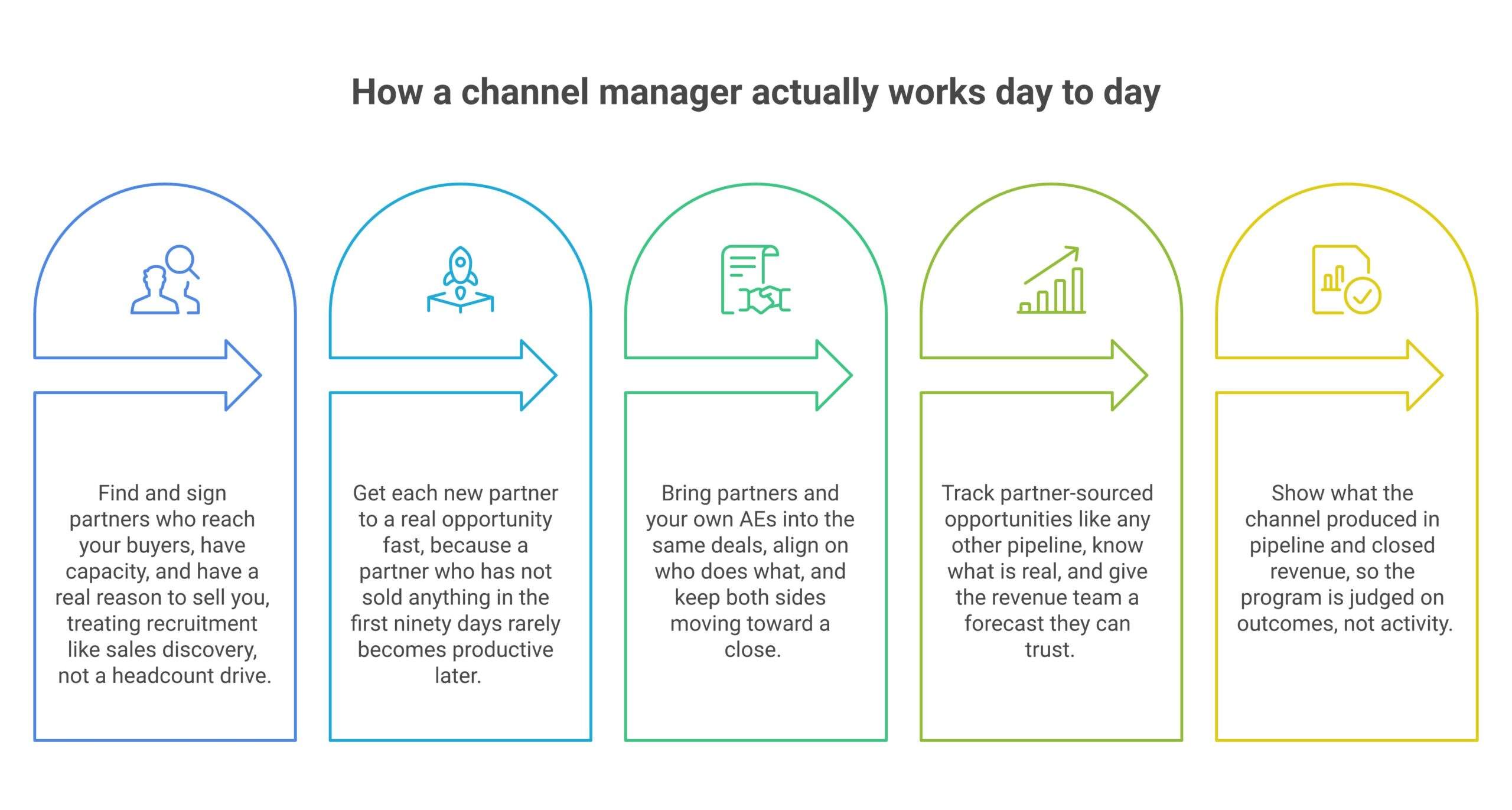
- Recruit and qualify partners: Find and sign partners who reach your buyers, have capacity, and have a real reason to sell you, treating recruitment like sales discovery, not a headcount drive.
- Enable partners to a first deal: Get each new partner to a real opportunity fast, because a partner who has not sold anything in the first ninety days rarely becomes productive later.
- Run co-sell with partners and direct AEs: Bring partners and your own AEs into the same deals, align on who does what, and keep both sides moving toward a close.
- Manage the partner’s pipeline and forecast: Track partner-sourced opportunities like any other pipeline, know what is real, and give the revenue team a forecast they can trust.
- Report partner-sourced revenue: Show what the channel produced in pipeline and closed revenue, so the program is judged on outcomes, not activity.
Common pitfalls in the channel manager role
- Managing relationships, not pipeline: A channel manager who measures success by meetings and goodwill produces a friendly roster and a flat forecast.
- Recruiting for headcount: Signing partners to hit a roster number fills the program with names that never sell and drains the attention real partners need.
- No first deal focus: Onboarding a partner without driving them to an early opportunity produces a signed partner who goes quiet.
- Weak internal selling: A channel manager who cannot get their own AEs to co-sell has partners on one side and a sales team ignoring them on the other.
What this looks like in practice
A channel manager inherits a roster of forty signed partners and a flat forecast. Instead of recruiting more, they rank the roster by reach and motivation, pick the eight partners who actually touch their buyers, and drive each to a first co-sell deal within a quarter. Two quarters later, those eight focused partners produce more pipeline than the prior forty combined, and the board finally has a channel number worth watching.
Forecastable’s POV on the channel manager role
Our position is that a channel manager is a seller, not a relationship manager, and the programs that treat the role as account management keep paying for it in a flat forecast. The best channel managers carry a number, run partners like a pipeline, and are as good at selling internally to their own AEs as they are at working the partner. Hire for that, measure for that, and the channel produces.
We also think the role should be judged on partner-sourced pipeline and revenue, not on partner count. A channel manager with a hundred partners and no pipeline is not doing the job, however busy the calendar looks.
Forecastable is a partnerships operating platform that connects partner conversations and actions to CRM pipeline and revenue, following the flow from Conversations to Actions to Pipeline to Revenue. We make it visible which partners a channel manager is actually moving, so the role is measured by production rather than headcount. We are complementary to a PRM, which administers the program, and we are the layer that ties partner work to the forecast.
Forecastable is a partnerships operating platform and a category authority, not a PRM vendor. Any third-party tools or firms referenced in this space are independent third-party products, and mentioning them is not an endorsement. Evaluate any approach to the channel manager role against your own partner mix, motion, and CRM.
Frequently asked questions
What does a channel manager do?
A channel manager owns a set of partners as a revenue channel, recruiting the right partners, enabling them to sell, running co-sell with direct AEs, and driving partner-sourced pipeline and revenue.
What is the difference between a channel manager and a partner manager?
The titles overlap and are often used interchangeably. Where they differ, a channel manager tends to own resellers and other partners who sell your product, while a partner manager may cover a broader set including tech and referral partners. Both should be measured on pipeline.
What skills does a channel manager need?
Sales skills first: discovery, qualification, deal management, and forecasting. Add the ability to sell internally to your own AEs, plus enough ecosystem fluency to know which partners are worth the time.
Is a channel manager a sales role?
Yes. A channel manager carries or influences a number and produces pipeline through partners. Treating it as a non-selling relationship role is the most common way it underperforms.
How is a channel manager measured?
On partner-sourced pipeline and closed revenue, plus leading indicators like partners driven to a first deal and active co-sell opportunities, not on headcount.
Next step
If your partner roster is growing but your forecast is flat, the fix is treating the channel manager as a seller and measuring the role by pipeline. Start your growth journey now to measure the channel manager role by pipeline, not headcount. The partner program hub frames how the channel manager role connects to recruitment, enablement, and co-selling.
Uncover Your Growth Potential
Schedule a Discovery Call