Head of Partnerships Job Responsibilities Explained

What does a head of partnerships do?
Short answer: The head of partnerships job responsibilities center on one outcome, partner-sourced and partner-influenced revenue, and everything else is in service of it. They own the program’s operating model, recruit and enable the right partners, run co-sell alongside direct sales, and report what the program produces in the forecast. It is a revenue role wearing a partnerships title.
The confusion in most companies is that the role gets treated as relationship management, a person who keeps partners happy and shows up at events. That framing produces a warm roster and a flat forecast.
A head of partnerships who is doing the job builds a motion, not a rolodex. The test is simple: can they point to pipeline in the CRM that would not exist without the program, and can they show how it got there.
Why the head of partnerships role matters in 2026
The role matters because more of the deal now happens outside your own sellers. Omdia and Jay McBain put it plainly: 96% of the $5.3T in tech deals are partner-surrounded. If your buyers are already talking to partners you do not control, someone senior has to own that surface, or you cede it.
In 2026, boards have stopped accepting partner headcount as a proxy for partner results. A signed roster is not a number that moves the forecast, and the head of partnerships is now the person expected to translate partner activity into pipeline the CRO can defend. That expectation raises the bar on the role and thins out the people who were coasting on goodwill.
The head of partnerships also sits at the seam between two orgs that do not naturally cooperate: direct sales and the partner ecosystem. Left unmanaged, that seam leaks deals, duplicates outreach, and breeds channel conflict. The role exists to make the seam productive rather than adversarial.
How the head of partnerships job responsibilities break down
The head of partnerships job responsibilities break down into a handful of areas that stack on each other: own the number, build the model, recruit and enable, run co-sell, and report the result. Skip one and the others get shakier. The list below is what the working version of the role actually covers.
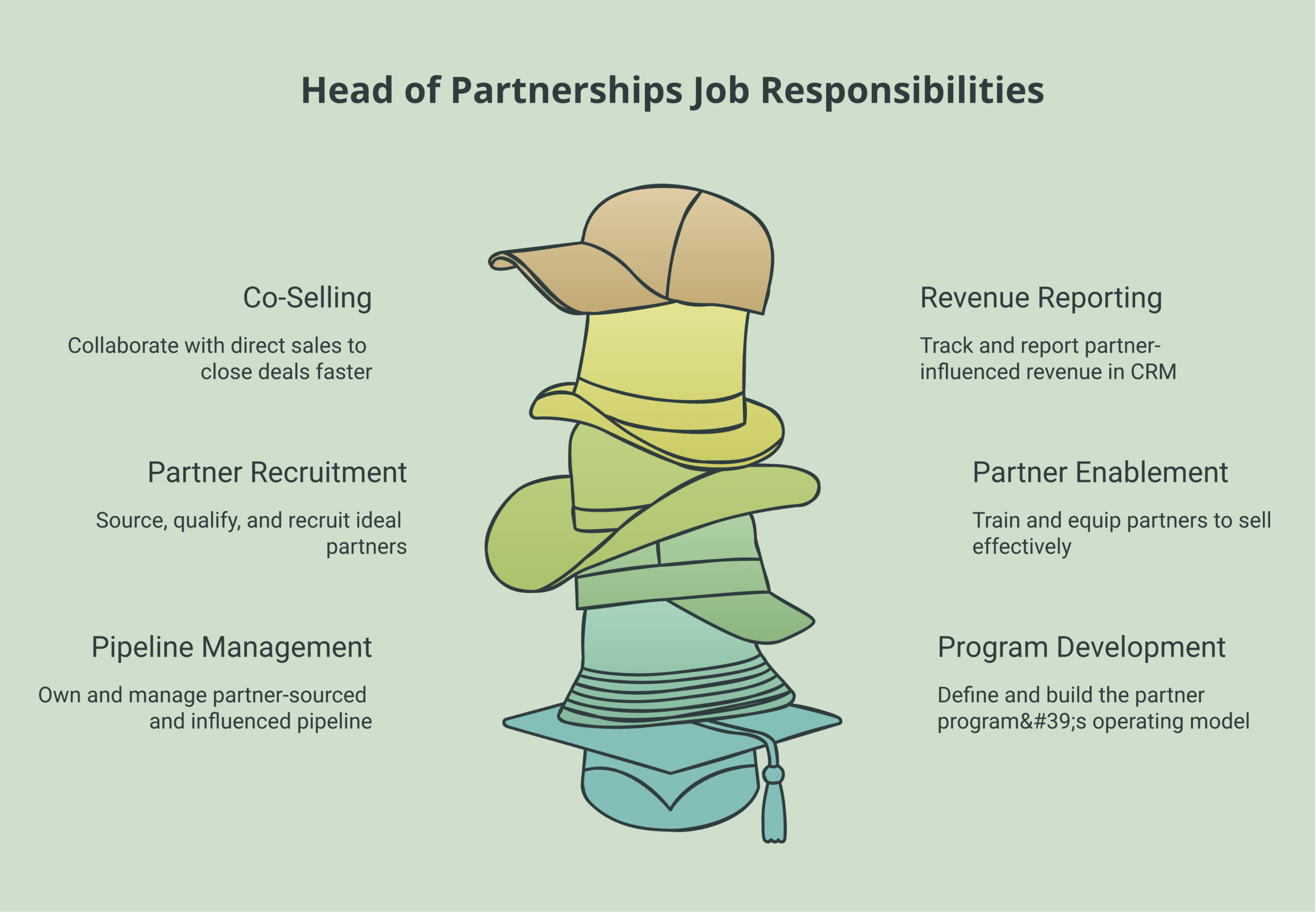
- Own partner-sourced and partner-influenced pipeline: Carry a number, the same way a sales leader does, and be measured against it. Partner-sourced is deals the program originated; partner-influenced is deals a partner touched on the way to close. Owning both is what makes this a revenue role rather than a support function.
- Build the program’s operating model: Define the partner types, the deal-registration and co-sell rules, the incentives, and the stages a partner moves through from recruited to producing. Without a written model, every partner relationship runs on improvisation and nothing is repeatable.
- Recruit and enable the right partners: Source against a defined ideal partner profile, qualify for reach and motivation, and enable the ones who sign so they can actually sell. Recruiting for logo count and skipping enablement is how programs fill up with partners who never produce.
- Run co-sell with direct sales: Get partners and your own AEs into the same deals with clear ownership, shared account plans, and a division of labor that closes deals faster instead of creating conflict. This is where partner-influenced revenue is won or lost.
- Report partner-influenced revenue in the CRM: Make the program’s contribution visible in the same system the rest of the company forecasts from. If partner impact lives in a slide deck and not in the pipeline report, the program cannot be defended when budgets tighten.
Common pitfalls in the role
- Managing relationships instead of a number: Treating the job as keeping partners happy produces a friendly roster and no forecast. The role is measured on pipeline, and the relationship work only counts when it moves deals.
- No operating model: Running the program on ad hoc deals and handshake rules means nothing scales and nothing is repeatable. When the head of partnerships leaves, an undocumented program leaves with them.
- Recruiting for headcount: Signing partners to grow the roster fills the program with names that never sell and drains the attention that should go to producing partners. Fewer and better beats more and silent.
- Ignoring the co-sell seam: Letting partners and direct sales work the same accounts without rules creates channel conflict, duplicated outreach, and deals that stall between two teams that each assumed the other had it.
- Attribution that lives outside the CRM: Reporting partner impact in a separate deck rather than in the pipeline the company forecasts from means the program’s value is invisible exactly when it needs to be obvious.
What this looks like in practice
A mid-market software company hired a head of partnerships and, for the first year, scoped the role as relationship management. The person was capable and well-liked, attended every partner event, and kept the roster warm, but the board deck showed partner-sourced pipeline flat and partner-influenced revenue untracked entirely. When a new CRO asked what the program produced, no one could answer from the CRM. The company redefined the role around a number: partner-sourced and partner-influenced pipeline, owned and forecast like any sales line. The head of partnerships wrote an operating model, cut the roster to the partners with real reach, built co-sell rules so partners and AEs shared accounts instead of colliding, and pushed partner influence into the CRM so every touched deal was visible. Two quarters later, partner-influenced revenue was a defensible line in the forecast, and the same headcount that had looked like overhead now read as a growth channel. The work did not change because the person changed. It changed because the responsibilities did.
Forecastable’s POV on the head of partnerships role
Our position is that the head of partnerships is a revenue leader who happens to run a channel, and the programs that treat the role as relationship management get relationship-management results: a warm roster and a flat number. The title should carry a quota-like expectation, and the person in it should be judged on partner-sourced and partner-influenced pipeline, not on activity. If the role cannot point to revenue in the CRM, it is not being run as the job it is.
We also think the hardest part of the role is not recruiting or enabling partners, it is making the program’s contribution legible to the rest of the company. Partner conversations and actions happen in a dozen places outside the CRM, and unless those turn into pipeline the CRO can see, the program stays a cost center in the eyes of finance no matter how much revenue it actually touches.
Forecastable is a partnerships operating platform focused on connecting partner conversations and actions to CRM pipeline and revenue, the flow from Conversations to Actions to Pipeline to Revenue. We do not administer your partner portal and we are not a PRM; we sit alongside PRM and make the program’s output visible in the system the company forecasts from, so a head of partnerships can defend the number with data instead of a story.
Any third-party tools or firms referenced in this space are independent third-party products, and mentioning them is not an endorsement. Evaluate any approach to the role against your own partner mix, motion, and CRM, and hold the head of partnerships job responsibilities to what shows up in pipeline.
Frequently asked questions
What are the core head of partnerships job responsibilities?
Owning partner-sourced and partner-influenced pipeline, building the program’s operating model, recruiting and enabling the right partners, running co-sell with direct sales, and reporting partner impact in the CRM.
What is the difference between a head of partnerships and a VP of partnerships?
Scope and seniority. A head of partnerships typically owns the program end to end and may still be hands-on; a VP of partnerships usually carries a larger org, more budget, a seat closer to the executive team, and accountability across multiple partner motions. In smaller companies the titles often describe the same job.
What seniority level is a head of partnerships?
It is a senior leadership role, usually reporting to a CRO or CEO, and often the most senior partnerships person in a company that does not yet have a VP or Chief Partner Officer. The exact level tracks company size, but the role is expected to own a number and a team.
Does a head of partnerships carry a quota?
In a well-run program, yes, in the form of partner-sourced and partner-influenced pipeline and revenue targets. Treating the role as unmeasured relationship work is the most common way it underperforms.
Who does a head of partnerships report to?
Most often the CRO, because the role is a revenue function. In partner-led companies it may report to the CEO. Reporting into marketing or business development tends to signal the role is not yet treated as revenue.
What background makes a good head of partnerships?
A mix of direct sales instinct and ecosystem fluency. The best hires can run a deal, sell internally to their own sales team, and build a repeatable motion, not just maintain partner relationships.
How do you measure a head of partnerships?
By partner-sourced and partner-influenced pipeline and revenue in the CRM, roster productivity, and co-sell win rate, not by roster size or event attendance.
Next step
If your head of partnerships is measured on relationships instead of pipeline, the role is being run below its potential, and the fix is to redefine it around a number and make that number visible in the CRM. Start your growth journey now to connect partner conversations and actions to the pipeline your company already forecasts from. A clear view of how the role fits recruiting, enablement, and co-sell starts with a well-defined partner program that treats partnerships as revenue.
Uncover Your Growth Potential
Schedule a Discovery Call