Channel Sales Manager: What the Role Really Does

What is a channel sales manager?
Short answer: A channel sales manager owns revenue produced through a set of partners, recruiting the right ones, enabling their sellers, and driving joint deals to close. It is a quota-carrying sales role where the sellers work at another company. The job is to make partners produce, not just to keep them happy.
The distinction matters because the role is often mistaken for relationship management. A channel sales manager who only maintains goodwill and never moves a number is a partner concierge, not a seller.
Why the channel sales manager role matters in 2026
The channel sales manager role matters because most B2B buying now runs through partners, and a vendor without someone accountable for partner-sourced revenue leaves that motion to chance. Partners will do business with the vendors who make selling easy and who show up in real deals. Someone has to be that presence, and that is the job.
In 2026, buyers expect the companies they already trust, their reseller, their services firm, their platform of record, to bring solutions to them. A channel that produces requires an owner who treats partner pipeline with the same discipline a direct rep treats their own. Without that owner, partners drift to whichever vendor gives their reps the least friction and the most support.
The role also protects a scarce resource. Partner attention is finite, and it flows to the vendors who earn it deal by deal. A good channel sales manager is the reason a partner’s rep thinks of your product first, and that recall is worth more than any co-marketing budget.
How the channel sales manager role actually works
The channel sales manager role works by running a small portfolio of partners like a territory: recruit, enable, co-sell, and measure. The components below are what the job actually contains on a normal week.
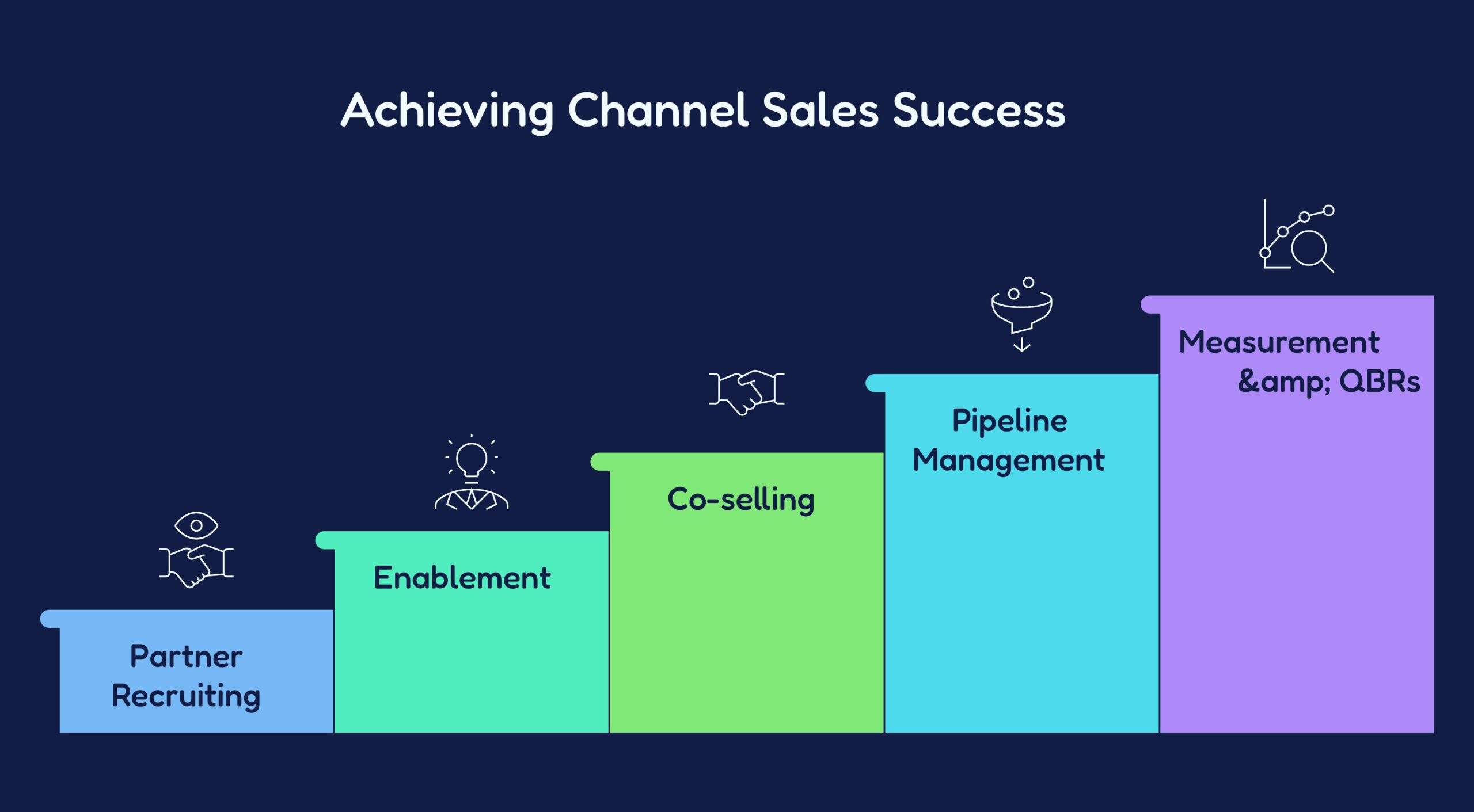
- Partner recruiting and selection: Choosing the few partners whose customers and motion fit your product, then signing them with a clear reason to sell. Fewer, better-fit partners beat a long roster that produces nothing.
- Enablement: Getting a partner’s sellers able to position and demo your product confidently, so they can carry it into their own deals without a specialist in every call.
- Co-selling: Working live opportunities alongside partner reps, bringing product depth and deal support where the partner brings the relationship and the account.
- Pipeline management: Treating partner-sourced and partner-influenced deals as a real forecast, with stages, dates, and next steps, not a list of hopeful logos.
- Measurement and QBRs: Reviewing what each partner actually produced against what it committed, and reallocating time toward the partners returning pipeline.
Common pitfalls in the channel sales manager role
- Managing relationships instead of revenue: A channel sales manager who measures success by meetings held and rapport built, not pipeline closed, becomes a cost center. The number is the job.
- Spreading across too many partners: Carrying fifty partners equally guarantees that none get the attention that produces. Depth on the few who can move a number beats thin coverage of everyone.
- Enabling on features, not the deal: Teaching partner reps your product specs instead of how to win a buyer’s problem leaves them informed but unable to sell. Enable the sale.
- No pipeline discipline: Running partner deals on gut feel and optimism, with no stages or forecast, means the channel is invisible to leadership until it misses. Treat partner pipeline like direct pipeline.
- Confusing signed with selling: Counting recruited partners as progress. A signed partner who never sells is a logo on a slide, not revenue. Activation, not signature, is the milestone.
What this looks like in practice
A worked example: a vendor hired a channel sales manager who inherited sixty partners and a mandate to grow the channel. The instinct was to touch all sixty, so the first quarter filled with introductory calls and produced almost no pipeline. The manager then ranked the roster by fit and recent activity, picked eight partners whose customers matched the product, and put real time into those eight. That meant enabling their reps on one crisp pitch, joining their live deals, and running a monthly review of what each produced. Within two quarters the eight partners generated more pipeline than the sixty had, and the manager retired the dead accounts. The lesson was that the channel sales manager role is a territory to work, not a roster to maintain, and depth on the right partners is what turns partner reach into revenue.
Forecastable’s POV on the channel sales manager role
Our position is that the channel sales manager is a sales role first and a relationship role second, and confusing the order is why so many channel programs underperform. The comfortable version of the job is building rapport and hosting partners. The version that produces is carrying a number through people you do not employ, which is harder and far more valuable. Hire and measure for the second version.
We also believe the role lives or dies on focus. The pressure to cover every partner equally feels fair and produces mediocrity everywhere. A channel sales manager who concentrates depth on the partners that can actually produce, and who is honest about which partners cannot, returns more than one who keeps a big roster warm. Fewer partners, more deeply worked, is the pattern that shows up in the pipeline.
Forecastable is a partnerships operating platform focused on connecting partner conversations and actions to CRM pipeline and revenue. We do not replace the channel sales manager; we make the manager’s work visible, so partner-sourced and partner-influenced deals show up in the forecast leadership already trusts. When the channel is measured like the direct team, the manager can point time at what produces and prove it.
Forecastable is a partnerships operating platform and a category authority, not a PRM vendor. Any third-party tools or firms referenced in this space are independent third-party products, and mentioning them is not an endorsement. Evaluate any channel approach against your own partner mix, motion, and CRM.
Frequently asked questions
What is a channel sales manager?
A channel sales manager owns revenue produced through a set of partners, recruiting the right ones, enabling their sellers, and driving joint deals to close. It is a quota-carrying sales role where the sellers work at another company.
What is the difference between a channel sales manager and a partner manager?
The titles overlap, but a channel sales manager usually carries a revenue number through resellers and partners, while a partner manager may focus more on the relationship and program. In practice both should be accountable for partner-sourced pipeline.
What does a channel sales manager do day to day?
Recruits and selects partners, enables their reps, co-sells live deals, manages partner pipeline in CRM, and runs reviews of what each partner produced.
How is a channel sales manager measured?
By partner-sourced and partner-influenced pipeline and revenue, plus partner activation, not by meetings held or partners signed.
What makes a good channel sales manager?
A hunter’s orientation applied to partners: focus on the few who can produce, discipline in the pipeline, and the ability to enable and co-sell rather than only maintain relationships.
How many partners should a channel sales manager own?
Few enough to work each one deeply. A focused portfolio of well-fit partners produces more than a large roster kept warm with light touches.
Next step
If your channel is a roster nobody is truly accountable for, the fix is to run it like a territory: concentrate a channel sales manager on the partners that can produce, enable their reps, co-sell the live deals, and measure partner pipeline in CRM. Start your growth journey now to make partner-sourced revenue visible in the forecast. The partner program hub frames how the channel sales manager role connects to enablement, onboarding, and attribution.
Uncover Your Growth Potential
Schedule a Discovery Call