Skip to content
Logo — It’s All AboutThe Team
  • Home
  • Who We Serve
    • By Category
      • SaaS
      • Professional Services
      • Platforms (Large Ecosystems)
      • Private Equity
    • By Role
      • Chief Revenue Officers (CRO)
      • Chief Financial Officers (CFO)
      • Chief Marketing Officers (CMO)
      • Chief Executive Officers (CEO)
      • Sales Leaders
      • Partnership Professionals
  • Solutions
    • By Partner Program Maturity
      • Partnerships Foundation
      • Partnerships Acceleration
      • Ecosystem-Wide Orchestration
    • Specialized Solutions
      • Net-New Named Account Development
      • Large Ecosystems
      • M&A: Post-Acquisition Internal Cross-Selling
  • Education
  • Company
    • Our History
    • Security
  • Login
Logo — It’s All AboutThe Team
  • Home
  • Who We Serve
    • By Category
      • SaaS
      • Professional Services
      • Platforms (Large Ecosystems)
      • Private Equity
    • By Role
      • Chief Revenue Officers (CRO)
      • Chief Financial Officers (CFO)
      • Chief Marketing Officers (CMO)
      • Chief Executive Officers (CEO)
      • Sales Leaders
      • Partnership Professionals
  • Solutions
    • By Partner Program Maturity
      • Partnerships Foundation
      • Partnerships Acceleration
      • Ecosystem-Wide Orchestration
    • Specialized Solutions
      • Net-New Named Account Development
      • Large Ecosystems
      • M&A: Post-Acquisition Internal Cross-Selling
  • Education
  • Company
    • Our History
    • Security
  • Login
  • Home
  • Who We Serve
    • By Category
      • SaaS
      • Professional Services
      • Platforms (Large Ecosystems)
      • Private Equity
    • By Role
      • Chief Revenue Officers (CRO)
      • Chief Financial Officers (CFO)
      • Chief Marketing Officers (CMO)
      • Chief Executive Officers (CEO)
      • Sales Leaders
      • Partnership Professionals
  • Solutions
    • By Partner Program Maturity
      • Partnerships Foundation
      • Partnerships Acceleration
      • Ecosystem-Wide Orchestration
    • Specialized Solutions
      • Net-New Named Account Development
      • Large Ecosystems
      • M&A: Post-Acquisition Internal Cross-Selling
  • Education
  • Company
    • Our History
    • Security
  • Login
Back to all blogs
  • B2B Sales Foundations
B2B Sales Rep
Alex Buckles

*Stakeholder Research* Best Practices in B2B Sales

Man dressed as a detective looks through a magnifying glass, holding a smoking pipe.

Stakeholder Research Best Practices in B2B Sales

While account research will help you prioritize which accounts to target and what pain points to focus on, accounts don’t make decisions; people do. And in B2B sales, decisions aren’t made individually either. You’ve got to generate group consensus, which is the name of the game. The good news is that because there are multiple people with skin in the game here, there are multiple points of entry for the salesperson. 

But what stakeholders should we start with and why? There are so many people in these accounts and it’s hard to figure out where to start. Should I go top down or bottom up or both? It all starts with identifying which functional roles, not always titles, your solution will impact. 


What’s the difference between a functional role and a job title?

A title is, just that, a label your company has placed on the job that you perform. A functional role is the role you fulfill based on what you actually (functionally) do within the organization. Your outbound messaging should always cater to the functional role, not the title. 


Examples of roles that don’t match to titles: 

Title: Marketing Operations Manager

Functional Role: Marketing Operations Practitioner


Logic for Role Categorization: Instead of categorizing them as “Marketing Leadership”, I chose “Marketing Practitioner” because this person is a team of 1, with no direct reports. My messaging and content is different for leadership roles than it is for marketers in the trenches turning wrenches. Very different value proposition. So, if I send this practitioner a bunch of content on managing a team, it would be a miss because that content isn’t relevant to this individual, even though she has a manager title.

Title: Regional Sales Director

Functional Role: Individual Sales Rep

Logic for Role Categorization: Same as the marketing scenario from above. This person is an individual contributor, but carries “Director” in the title. In most automated systems, this person would get the incorrect correspondence because the system might think this person is a sales leader.

Title: Senior Solutions Architect

Functional Role: Project Manager

Logic for Role Categorization: Maybe you’re selling a service of some sort and the project team on the prospect side has an architect that also plays the role of project manager. For the purpose of this one transaction, I’d categorize this person as a project manager because that’s their focus and job in this specific scenario.

The only time there’s really conflict is if someone is playing multiple functional roles in your deal. Like with the architect/project manager scenario above, what happens if there needs to be an architect and a project manager being filled by the same person? Spend more time with this stakeholder. Ensure they’re getting educated for all of their relevant roles.

HOW ARE YOUR PARTNER BDRs HANDLING THIS?

Learn More

How do I begin developing and defining my functional roles?

Hopefully, as the sales rep, you’re not starting from scratch and have either sales enablement or product marketing helping to define what roles you sell to and their corresponding pain points. If not, or if that collateral isn’t quite hitting the spot, it’s time for some deep thinking about your solution and the people that use it. Before you start digging too deep on your own, maybe speak with a top seller or customer success manager (even better) within your organization, share the first part of this article with them, then ask what functional roles your solution impacts and if there are any discrepancies between titles and roles.

If that’s unavailable, spend some time with customers you’ve built relationships with. They’ll always be brutally honest with you. Ask questions like:

  1. What roles do you see our technology impacting?
  2. Who do you think is most impacted by our technology/services on a daily basis?
  3. What would your team be doing manually if our technology/services disappeared?

In case it helps, here’s how we categorize our functional roles at Forecastable, each of whom derive very separate benefits from our platform and therefore receive different messaging from us throughout our engagement:

  1. Sales Development: Anyone in an SDR role, including leadership.
  2. Individual Sales Rep: Carries full cycle quota
  3. Frontline Sales Manager: While this person may be in a leadership position, their day-to-day interests are different than those of a senior sales leader, so we communicate with them differently.
  4. Senior Sales Leader: These folks are not in the weeds like a frontline sales manager, so that’s why they have their own unique role.
  5. Sales Enablement: They’ll be responsible for enabling change management during and after the deployment of our technology. 
  6. Sales Operations: This role is more of a technical evaluator for us. We would never outbound into this team, but during the cycle they’ll want to be involved to ensure the solution integrates well with the rest of their stack.
  7. C-Suite: Sometimes we’ll leverage senior sales leader messaging with the C-Suite, but most of the time these messages are very custom and not a part of any outbound sequence or cadence.

————————————————————————–

Now let’s get into the actual stakeholder research

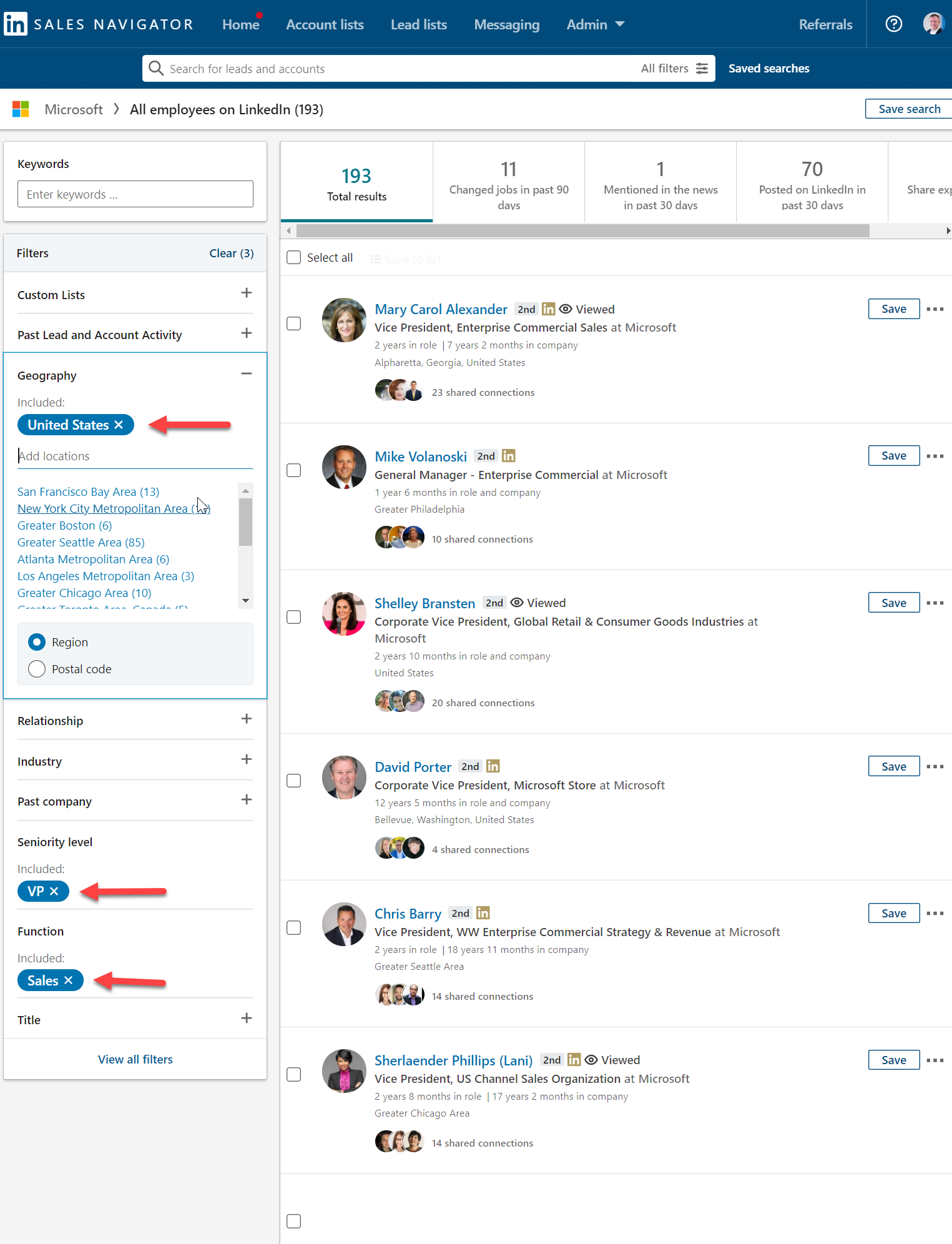
Step #1 – Use Filters to Find Relevant Stakeholders

LinkedIn provides some powerful searching capabilities in Sales Navigator if you know how to use them to the max (another post for another time). But, in general, simply filter down to the contacts you find interesting and open all of those stakeholders up in new tabs by holding down the CTRL (PC) or CMD (Mac) key while clicking their name. Once you’ve got that batch of stakeholders opened up in new tabs, then you can begin doing your individual research and note taking.
Relevant Stakeholders — Stakeholder Research Best Practices for B2B Sales

Step #2 – Log Stakeholders with Relevant Notes:

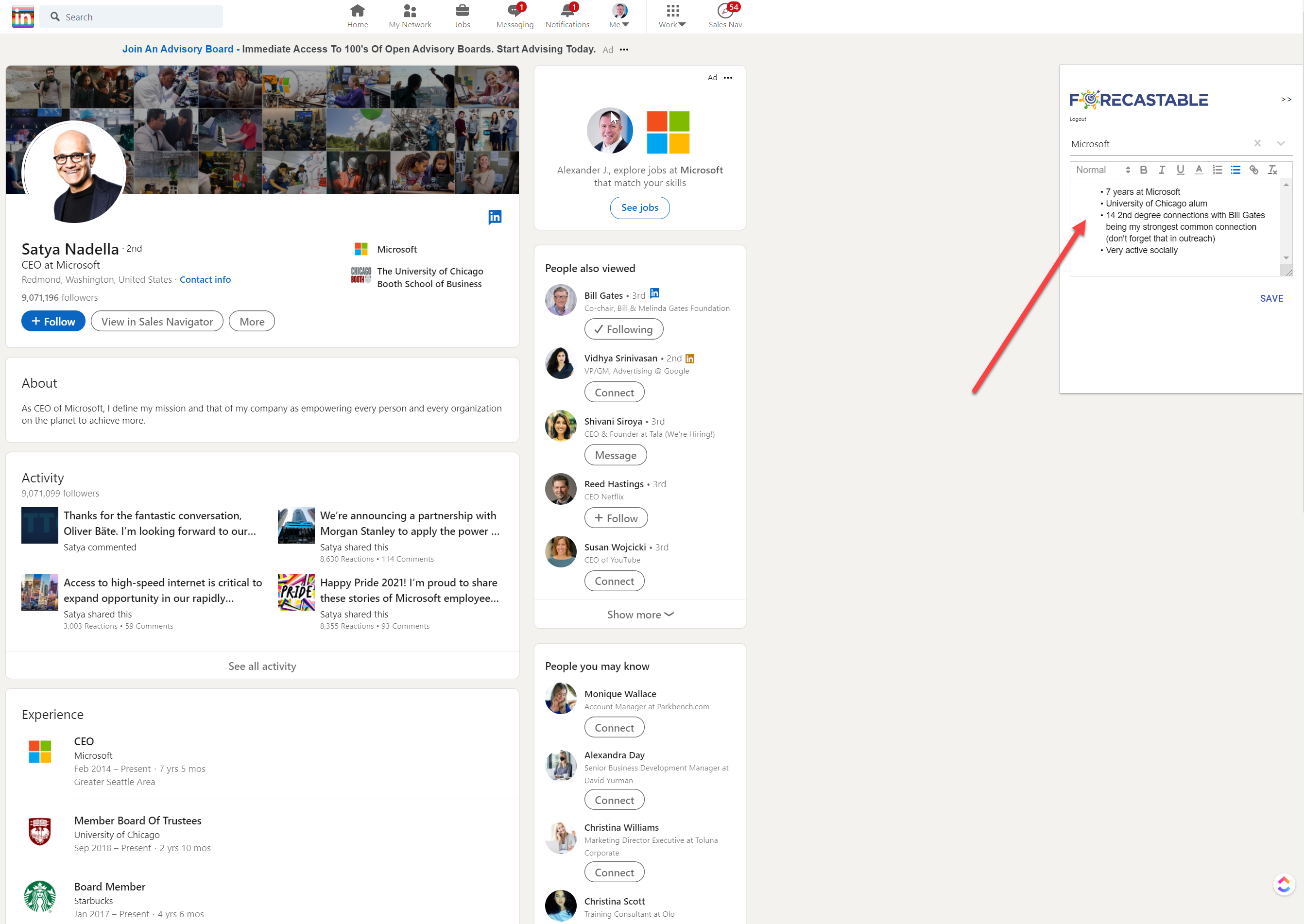
Once you’ve got all of your roles down, the real stakeholder research begins and it all starts with LinkedIn Sales Navigator. I tend to start logging people from the CEO down to the lowest level of stakeholders I feel will be involved in the deal, in that order. Whether you’re using our free spreadsheet or using Forecastable, taking notes along the way will help you from having to re-research that stakeholder down the road. Be sure to include name, title, and location in your list.
Stakeholder Notes — Stakeholder Research Best Practices for B2B Sales

Step #3 – Organize Stakeholders into Functional Role:

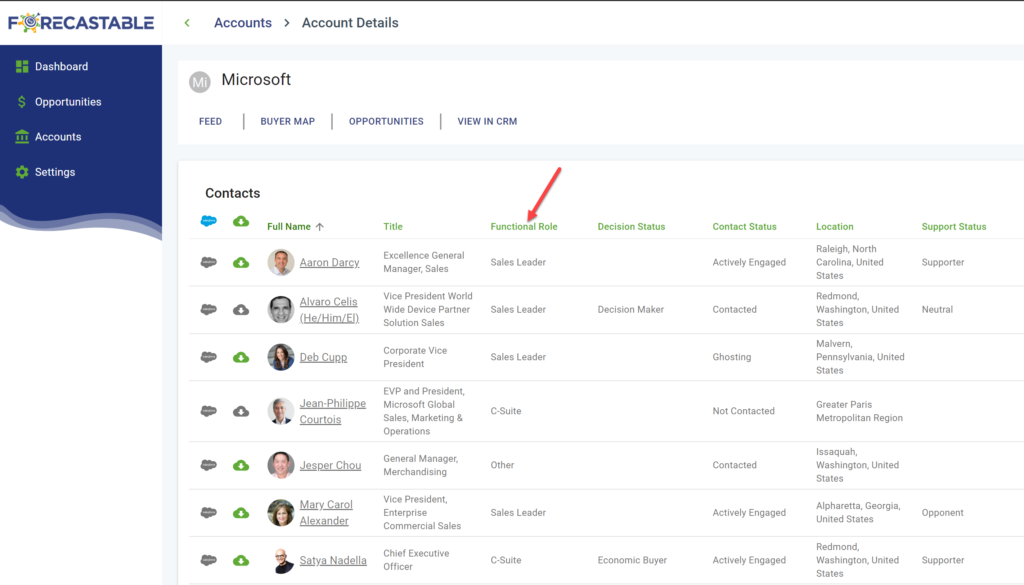
Again, whether you’re using Forecastable or our free Google sheet, you should be assigning functional role values to each stakeholder. If there’s no clear role for a stakeholder, don’t just fill one in. Stop and ask yourself why this is. Should there be another role added or is this a one-off situation?
Functional Role — Stakeholder Research Best Practices for B2B Sales

Step #4 – Enrich with Email & Direct Dial Information:

If you’re using Forecastable and are running ZoomInfo, you can enrich this entire list with email and direct dial information with a single click. If you’re not, and you’re using our spreadsheet, you can either guess the email addresses based on email format or you can hook our sheet up to Hunter.io and at least get accurate email addresses for these folks. 

Step #5 – Begin Outbound Cadences or Sequences

Whether you use Outreach.io, Salesloft, or one of the many other sales engagement platforms out there, you’ve now got a fully-prepped list ready to rock and roll. So, upload your list and get to work using all of those personalized data points you gathered during your research phase.

In summary, while we’ve detailed out a tried and true method for stakeholder research and getting these folks into outbound sequences or cadences, at the end of the day try to live a day in the life of your buyers. Get to know them. Understand each functional role. Know their pains inside and out and put yourself in their shoes. Operating from this perspective, and ruthlessly trying to solve their problems will most certainly lead you, and them, to success.

Uncover Your Growth Potential

Whether starting with a single sales team or a single partner, any co-sell motion can be live within 30 days.

Schedule a Discovery Call

Latest Insights
A channel sales manager and a reseller's account executive reviewing a joint deal pipeline on a laptop in a bright office, a printed partner tier sheet on the desk, deep navy and warm amber palette
  • B2B Sales Foundations
Alex Buckles

Channel Sales: What It Is and How It Works

What is channel sales? Short answer: Channel sales is the model where you sell through third-party partners, resellers, distributors, agencies, or technology firms, instead of relying only on your own direct sales team. The partner owns or influences the customer relationship, and you gain reach you could not build alone. It trades some margin and […]

Read Article
A channel manager explaining the partner sales motion on a glass whiteboard to a colleague in a bright office, a printed deal registration flow on the desk, deep navy and warm amber palette
  • B2B Sales Foundations
Alex Buckles

What Is Channel Sales? Definition and How It Works

What is channel sales? Short answer: Channel sales is a model where you sell through third-party partners, resellers, distributors, agencies, or technology firms, instead of relying only on your own direct sales team. The partner owns or influences the customer relationship, giving you reach and trust in exchange for some margin and control. It is […]

Read Article
Two professionals review charts in a modern conference room with a large screen displaying sales graphs and a city skyline outside the window.
  • B2B Sales Foundations
Alex Buckles

Sales Channel: What It Is and How to Choose One

What is a sales channel? Short answer: A sales channel is the route a company uses to reach and sell to its buyers, whether that is a direct sales team, a network of partners, a self-serve website, or a marketplace. Most companies use more than one, and the mix determines their reach, their margins, and […]

Read Article
A revenue leader and a sales operations manager mapping direct and partner sales channels on a glass whiteboard in a bright office, a printed channel mix chart on the desk, deep navy and warm amber palette
  • B2B Sales Foundations
Alex Buckles

What Is a Sales Channel? A Clear Definition

What is a sales channel? Short answer: A sales channel is the route a product takes to reach buyers, whether that is a direct sales team, a reseller, a marketplace, or a technology partner who brings you into deals. It describes who does the selling and how the product gets from vendor to customer. Every […]

Read Article
Logo — It’s All AboutThe Team

Quick Links

  • Who We Serve
  • Solutions
  • Resources
  • Pricing
  • Our History

Social Media

  • Linkedin

Legal

  • Privacy Policy
  • Terms of Service
Quick Links
  • Who We Serve
  • Solutions
  • Resources
  • Pricing
  • Our History
Social Media
  • Linkedin
Legal
  • Privacy Policy
  • Terms of Service

Stay ahead on ecosystem-led growth

Logo — It’s All AboutThe Team
© 2025 Forecastable. All rights reserved.
Book Your Strategy Call
Request Enrollment Details

[contact-form-7 id=”dfbeed3″ title=”Request Enrollment Details”]

Mollie Bodensteiner

Revops Advisory
  Mollie Bodensteiner is an experienced operations professional with a demonstrated track record of utilizing technology to support operational processes that drive performance and innovation. She currently is the Vice President of Operations at Sound and owns go-to-market agency, MB Solutions. Mollie has previously held operations leadership roles at Deel, Syncari, Corteva and Marketo. She has over 14 years of experience in both B2C and B2B operations and technology. When she is not working, Mollie enjoys spending time with her husband, three small children, and two large dogs. Childhood Career/Dream: Growing up in the age of Disney and Nick@Nite I always wanted to be a child actor (good thing that never was actually pursued 🙂 Favorite Win: I am not sure I have a specific “win” but I think I get the most joy and excitement from coaching others and watching them hit major milestones in their career. The first time you get to promote someone on your team or watch them lead a major project – are always career highlights! Personal Fun Facts: Favorite Song: If it’s love, Train Favorite Movie: Good Will Hunting Favorite Meme: Disaster Girl
Forecastable resources: Co-Sell Orchestration Platform · All Use Cases · Live in 30 Days · Co-Sell Playbook

Kelsey Buckles

Director of Operations


My journey from Education to Operations has equipped me with a unique perspective and skill set that perfectly aligns with Forecastable’s mission to help businesses improve sales collaboration through partner co-selling strategies.

At Forecastable, I am passionate about empowering teams and organizations to unlock the full potential of strategic partnerships. By leveraging my expertise in communication, leadership, and operational efficiency, I contribute to creating seamless co-selling processes that align with business goals and deliver exceptional results.

The intersection of my educational foundation and operational experience fuels my dedication to fostering alignment, building trust, and enhancing collaboration between partners. I am driven by the opportunity to contribute to a platform that not only optimizes sales strategies but also strengthens relationships that lead to long-term growth.

Paul Jonhson

Chief Technology Officer (Co-founder)


Paul Johnson has 20+ years of software development and consulting experience for a variety of organizations, ranging from startups to large-enterprise organization with highly-complex needs.

Mr. Johnson has a long track record of successful technology deployments.
This, combined with his deep passion for machine learning and exceptional user experience design, allows him to lead our technical direction from the front with confidence.

Alex Buckles

Product, Partnerships, and Value Engineering (Co-founder)


After serving in The United States Marine Corps, Alex Buckles spent the next two decades as a student of revenue production and an advocate for innovation.

Along the way, he has helped numerous companies achieve double and triple-digit growth by crafting and executing high-performing go-to-market strategies, with co-selling at the center of each.

As a once-advanced technical marketer, an expert sales & partner professional, and a strong customer success advocate, Mr. Buckles understands the impact of these functions aligning not only on revenue production, but on the day-to-day execution of the go-to-market strategy. This concept of revenue-team alignment is what quickly became the foundation of Forecastable back in January of 2018.

In his free time, you’ll find him spending quality time with his children, one of whom is on the autism spectrum. 1 in 36 children in the U.S. are on the spectrum and boys are four times more likely to be diagnosed than girls.

With that in mind, Mr. Buckles plans on dedicating the rest of his life serving those living with autism, through his organization Pathways for Autism. From his perspective, there must be a scalable and financially self-sustaining infrastructure established to put as many individuals with autism as possible on a path towards complete independence as adults.