Set Up HubSpot for Co-Sell: A Working Configuration

What does it take to set up HubSpot for co-sell?
Short answer: To set up HubSpot for co-sell means configuring the CRM so partner involvement in a deal is captured, attributable, and actionable, through partner fields, a clear deal stage for co-sell, and routing that loops the right partner in. It is less about new tooling than about making the partner motion visible inside the system your reps already live in.
Most teams try to run co-sell on the side, in spreadsheets and Slack threads that never touch the CRM. The result is partner deals that no one can see, measure, or manage, which is the same as not running co-sell at all.
The fix is to make the partner a first-class object in HubSpot. When a rep can see which partner is on a deal, when a deal sourced or influenced by a partner is flagged and routed, the motion becomes manageable instead of anecdotal.
Why set up HubSpot for co-sell properly in 2026
Co-sell revenue is now something leadership expects to forecast, and in 2026 a partner motion that lives outside the CRM cannot be forecast, attributed, or improved. If you set up HubSpot for co-sell deliberately, partner deals become part of the same pipeline discipline as everything else; if you do not, they stay invisible.
The second reason is rep adoption. Sellers work in the CRM, and a co-sell motion that requires them to leave it to update a separate system simply does not get used. Building the motion into HubSpot is what makes it something reps actually do rather than something the partnerships team chases.
The third reason is attribution. Without partner fields and a co-sell stage in HubSpot, you cannot prove which revenue the partner program produced, and a program that cannot prove its contribution loses the argument for resources every planning cycle.
How to set up HubSpot for co-sell
A working configuration makes partner involvement visible and routable inside HubSpot without forcing reps out of their normal workflow.
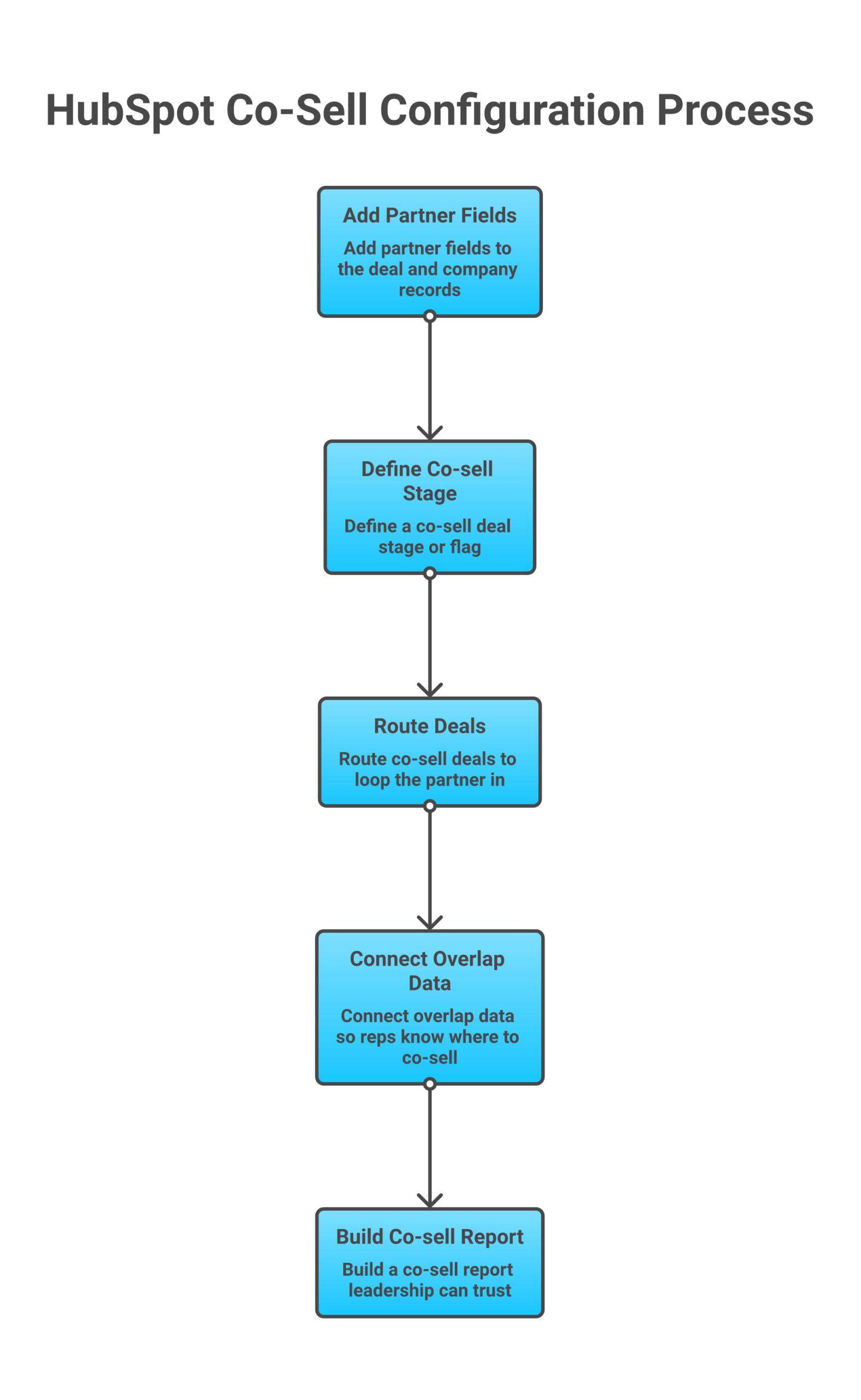
- Add partner fields to the deal and company records: Create properties that capture the partner on a deal, the partner role (sourced, influenced, co-selling), and the partner contact, so every deal carries who is involved and how. Without these fields, partner involvement lives only in someone’s memory.
- Define a co-sell deal stage or flag: Add a way to mark a deal as a co-sell opportunity, either a stage or a property, so co-sell deals can be filtered, reported, and managed as a group. A motion you cannot segment in the pipeline is a motion you cannot manage.
- Route co-sell deals to loop the partner in: Build a workflow that triggers when a deal is flagged for co-sell, notifying the partner manager and creating the task to engage the partner, so involvement happens at the right moment rather than too late. Routing is where most co-sell motions quietly fall apart.
- Connect overlap data so reps know where to co-sell: Feed account-overlap signals into HubSpot, whether through a tool such as Crossbeam or an imported list, so a rep can see which open deals a partner already knows. Co-sell works best when reps act on real overlap, not guesses.
- Build a co-sell report leadership can trust: Create a dashboard that shows partner-sourced and partner-influenced pipeline and closed revenue, drawn from the partner fields, so the motion is measured the same way the rest of the funnel is. A motion without a report does not survive the next planning cycle.
You have set up HubSpot for co-sell well when a rep can see the partner on a deal, a co-sell opportunity routes itself to the right people, and leadership can pull a partner-revenue report without asking the partnerships team to assemble it by hand.
Common pitfalls when you set up HubSpot for co-sell
- Running co-sell outside the CRM: Spreadsheets and chat threads keep the partner motion invisible to the system that runs the rest of the funnel. Partner deals that never touch HubSpot cannot be forecast, attributed, or managed, which defeats the point of running co-sell at all.
- Adding fields no one is required to fill: Partner properties that reps can skip stay empty, and empty fields produce no reporting. Make the partner fields part of the deal process where co-sell applies, so the data exists when you need to report on it.
- Flagging co-sell deals but never routing them: A co-sell stage with no workflow behind it is just a label. The value is in the routing that loops the partner in at the right moment; without it, the flag records that co-sell should have happened after it did not.
- Co-selling on guesses instead of overlap: Asking reps to co-sell without overlap data means they pitch partners on accounts the partner has no relationship with. Feed real overlap into HubSpot so reps act on where a partner can actually help.
- Building the config but not the report: A perfectly instrumented co-sell motion that produces no leadership-facing dashboard still loses the resourcing argument. The report is what proves the program’s contribution, so build it as part of the setup, not as an afterthought.
What this looks like in practice
A team had a real co-sell relationship with a platform partner and nothing in HubSpot to show for it. Reps tracked partner deals in a shared sheet, the partnerships lead chased updates over Slack, and at quarter end no one could say how much pipeline the partner had touched. The RevOps admin and the partner manager rebuilt it inside HubSpot in a week. They added three partner properties to the deal record, created a co-sell flag, and built a workflow that pinged the partner manager and created an engagement task whenever a deal was marked for co-sell. They imported the partner’s overlap list so reps could see which open deals the partner already knew. Last, they built a dashboard showing partner-sourced and influenced pipeline. The motion did not change, but it became visible. Reps started flagging co-sell deals because the routing actually helped them, and the partner manager finally had a report that proved the relationship was producing pipeline rather than just goodwill.
Forecastable’s POV on setting up HubSpot for co-sell
The conviction we hold is that co-sell does not fail for lack of tooling, it fails for lack of visibility, and the cheapest fix is almost always to make the partner a first-class object in the CRM you already run. Teams reach for a new platform when the real problem is that partner involvement lives nowhere their reps work. Configure HubSpot so the partner shows up on the deal, and most of the motion’s problems become tractable.
The second conviction is that adoption follows the path of least resistance. A co-sell motion that asks reps to leave HubSpot to maintain a separate system is a motion that will not get used, no matter how elegant the separate system is. The whole reason to set up HubSpot for co-sell is that reps already live there, so the motion has to live there too.
The candid limit is that HubSpot configuration is necessary but not sufficient. The fields, stage, and routing make the motion manageable, but they do not create the partner relationship or the reps’ willingness to co-sell. If the underlying motion is not real, instrumenting it in HubSpot just gives you a precise view of nothing happening. Build the motion and the configuration together.
Forecastable is a partnerships operating platform; any third-party tools or platforms referenced here are independent third-party products, and naming them is not an endorsement of one deployment over another. Evaluate each against your own motion.
Frequently asked questions
What is the minimum setup to run co-sell in HubSpot?
Partner fields on the deal record, a way to flag a deal as co-sell, and a workflow that loops the partner in when a deal is flagged. Those three turn HubSpot from a place co-sell is invisible into a place it can be managed.
Do I need a separate tool to set up HubSpot for co-sell?
Not to start. Most of the motion can run on native HubSpot properties, stages, and workflows. An overlap tool such as Crossbeam adds value by showing reps where a partner can help, but the core configuration is achievable with what HubSpot already gives you.
How do I attribute revenue to partners in HubSpot?
Capture the partner and the partner role on the deal record, then report on partner-sourced and partner-influenced pipeline and closed revenue from those fields. Attribution depends on the fields being filled consistently, so make them part of the deal process where co-sell applies.
How do I get reps to actually use the co-sell setup?
Make the motion live inside their normal workflow and make the routing genuinely useful to them. Reps adopt a co-sell flag when flagging a deal brings them help, like a partner introduction, rather than just creating a reporting obligation.
What is the most common mistake when setting up HubSpot for co-sell?
Flagging co-sell deals without routing them. A co-sell stage with no workflow is just a label that records co-sell should have happened. The routing that loops the partner in at the right moment is where the value actually is.
Can I set up HubSpot for co-sell with more than one partner?
Yes. Capture the specific partner on each deal rather than a generic co-sell flag, so the same configuration reports across every partner. The fields and routing stay the same; the partner value on the record is what keeps each relationship measurable on its own.
Next step
If your co-sell motion lives in spreadsheets and chat threads, the move this quarter is to bring it into HubSpot, add the partner fields, define a co-sell flag, route the deals, and build the report, so partner pipeline becomes as visible as the rest of your funnel.
Start your growth journey now to make your co-sell motion visible and forecastable, or see the orientation on co-sell for how the configuration fits the broader motion.
Uncover Your Growth Potential
Schedule a Discovery Call