Sales Close Plan: What It Is and How to Use It

What is a sales close plan?
Short answer: A sales close plan is the rep-owned, dated map of every step a deal has to clear to get from the current stage to a signed contract, used inside the sales cycle to keep the deal moving and to make the forecasted close date hold. It is how a rep turns a verbal close date into a sequence of scheduled, owned steps rather than a hope.
The emphasis is on use, not just structure. A sales close plan is not a document a rep fills in for the CRM and forgets; it is the working surface a rep runs the deal from, updating it as steps complete and reworking it when one slips.
Why a sales close plan matters in 2026
A sales close plan matters because the steps that slip deals live mostly inside the buyer’s organization, and a rep who has not mapped them is forecasting on optimism. When a procurement gate or a security review surfaces late, the rep loses the quarter on a step that was always going to be required. The plan is how the rep surfaces it early enough to work.
In 2026 it matters more because buying committees are larger and reps are held to tighter forecast accuracy. A manager reviewing a rep’s pipeline can tell the deals with a real sales close plan from the ones running on hope, because the plan shows the steps and dates behind the forecasted close. Reps who run deals from a plan forecast more accurately, which is increasingly what the role is measured on.
How a sales close plan actually works
A rep builds a sales close plan by agreeing a target date with the buyer and mapping the steps backward, then runs the deal from it as a living checklist. The plan is the artifact; using it in every deal review and buyer conversation is what makes it work.
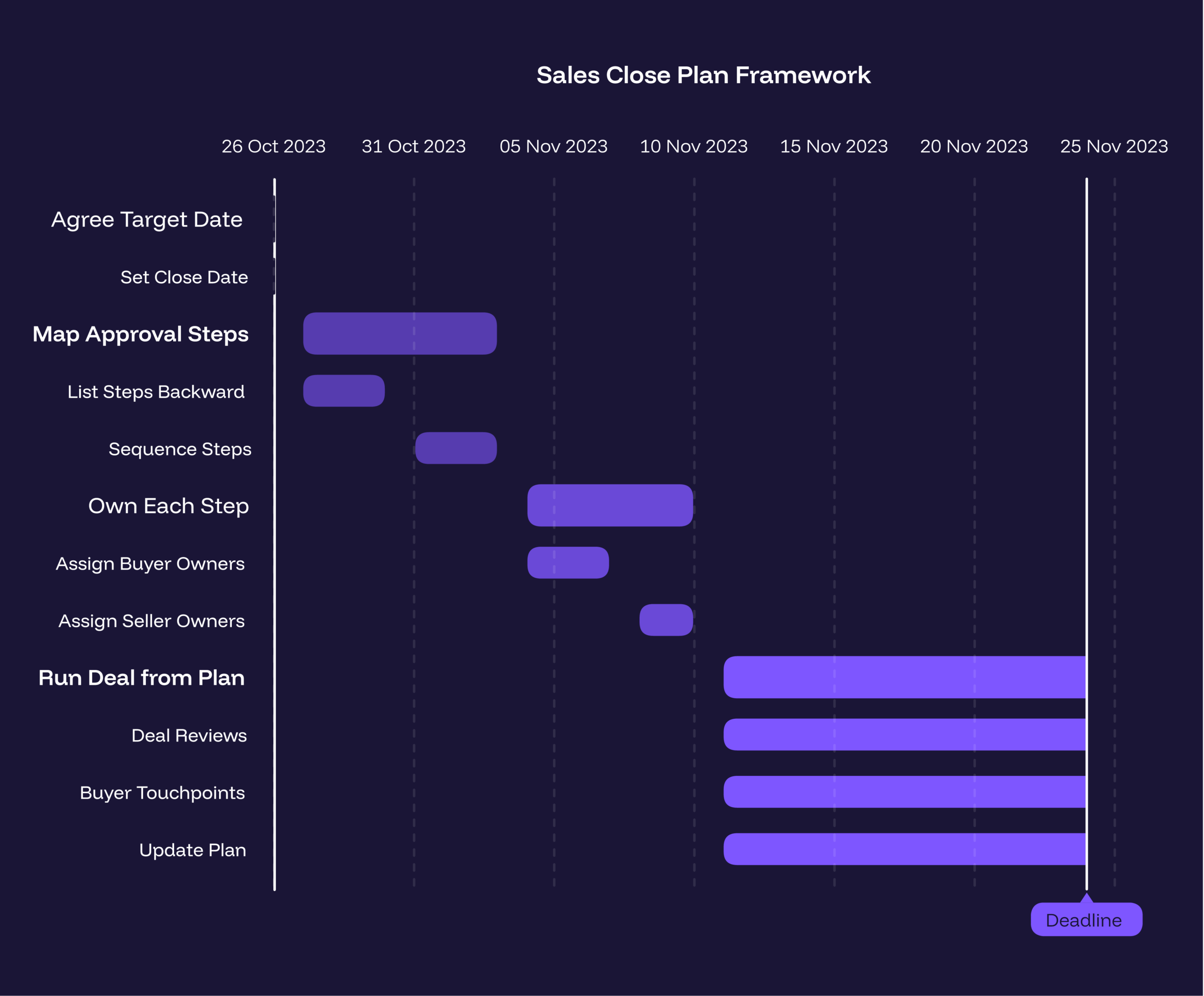
- Agree the target date with the buyer: Set the close date with the buyer rather than imposing it, so the plan is anchored on a date the buyer also believes and will work toward.
- Map the approval steps backward: List every step between now and signature, technical validation, security, legal, budget, procurement, and sequence them from the close date back to today.
- Own each step on both sides: Put a named owner and a due date on every step, including the buyer-side approvals, so the plan shows who is moving what by when.
- Run the deal from the plan: Bring the plan to every deal review and buyer touch, update it as steps complete or slip, and reschedule dependent steps so the forecast moves honestly instead of silently.
A sales close plan is working when the rep and the buyer track the same steps and a slip visibly moves the close date, and failing when it is filled in once for the pipeline review and never used to actually run the deal.
Common pitfalls with a sales close plan
- Filling it in for the CRM, not the deal: A plan a rep completes to satisfy a pipeline review and never opens again is overhead, not selling. The value is in running the deal from it.
- Skipping the buyer’s approvals: A plan that maps only the rep’s actions misses where deals actually stall, inside the buyer’s procurement and security gates. Map the buyer-side steps explicitly.
- No buyer agreement on the date: A close date the rep sets alone is a guess. Agreeing it with the buyer turns it into a shared commitment both sides work toward.
- Letting it go stale: A sales close plan that is not updated as steps move drifts out of date within a week and stops reflecting the deal. Update it as part of running the deal, not as a separate chore.
What this looks like in practice
A rep carried a deal at 90 percent for two quarters because the champion kept saying it would close soon. A manager asked to see the sales close plan and there was not one, just a date. They built one with the buyer: target date, every approval mapped, owners named on both sides. The plan immediately exposed that the budget had not actually been approved and the security review had not started. With the steps visible, the rep worked them in sequence and the deal closed the following quarter on a date the plan made real. The deal had not been at 90 percent; it had been at a date with no plan behind it.
Forecastable’s POV on the sales close plan
Our position is that a sales close plan is a forecasting instrument as much as a selling one. The reason a rep builds it is to make the forecasted close date defensible, and a date with a plan behind it is evidence while a date without one is optimism. When a manager can see the steps and owners behind a close date, the forecast stops being a number the rep asserts and becomes one the plan supports.
The second conviction is that the buyer has to own their half of the plan or it is fiction. Most of what slips a deal happens inside the buyer’s organization, so a plan the rep fills in alone maps the controllable half and ignores the half that actually decides the date. The move that makes a sales close plan work is getting the buyer to agree the steps and dates, because that agreement is both a map of the deal and a commitment to it.
Forecastable is a partnerships operating platform; any third-party tools or methods referenced here are independent and naming them is not an endorsement of one approach over another. Build the sales close plan around your own deal, buying committee, and forecast.
Frequently asked questions
What is a sales close plan?
The rep-owned, dated map of every step a deal has to clear to reach signature, used inside the sales cycle to keep the deal moving and make the forecasted close date hold.
How do reps use a sales close plan?
They build it with the buyer, run the deal from it in every review and touch, update it as steps complete or slip, and reschedule dependent steps so the forecast moves honestly.
What is the difference between a sales close plan and a close plan?
They describe the same artifact; the sales close plan emphasizes the rep’s use of it inside the sales cycle to run the deal and defend the forecast.
Why include the buyer’s steps in the plan?
Because most of what stalls a deal, procurement, security, budget, legal, happens inside the buyer’s organization, so a plan that maps only the rep’s steps misses where deals slip.
How does a sales close plan improve forecast accuracy?
By replacing an asserted close date with a sequence of scheduled, owned steps, so the forecasted date is grounded in evidence a manager can inspect rather than optimism.
Next step
If your forecasted deals slip on steps you did not map, a sales close plan is how you run them to a date that holds. Forecastable helps revenue and partnerships teams keep the steps to signature visible, so a rep’s forecast is grounded in a plan rather than hope. Start your growth journey now to make your close dates defensible. The co-sell hub frames how joint deals reach signature, and the related close plan covers how to build the artifact step by step.
Uncover Your Growth Potential
Schedule a Discovery Call