Skip to content
Logo — It’s All AboutThe Team
  • Home
  • Who We Serve
    • By Category
      • SaaS
      • Professional Services
      • Platforms (Large Ecosystems)
      • Private Equity
    • By Role
      • Chief Revenue Officers (CRO)
      • Chief Financial Officers (CFO)
      • Chief Marketing Officers (CMO)
      • Chief Executive Officers (CEO)
      • Sales Leaders
      • Partnership Professionals
  • Solutions
    • By Partner Program Maturity
      • Partnerships Foundation
      • Partnerships Acceleration
      • Ecosystem-Wide Orchestration
    • Specialized Solutions
      • Net-New Named Account Development
      • Large Ecosystems
      • M&A: Post-Acquisition Internal Cross-Selling
  • Education
  • Company
    • Our History
    • Security
  • Login
Logo — It’s All AboutThe Team
  • Home
  • Who We Serve
    • By Category
      • SaaS
      • Professional Services
      • Platforms (Large Ecosystems)
      • Private Equity
    • By Role
      • Chief Revenue Officers (CRO)
      • Chief Financial Officers (CFO)
      • Chief Marketing Officers (CMO)
      • Chief Executive Officers (CEO)
      • Sales Leaders
      • Partnership Professionals
  • Solutions
    • By Partner Program Maturity
      • Partnerships Foundation
      • Partnerships Acceleration
      • Ecosystem-Wide Orchestration
    • Specialized Solutions
      • Net-New Named Account Development
      • Large Ecosystems
      • M&A: Post-Acquisition Internal Cross-Selling
  • Education
  • Company
    • Our History
    • Security
  • Login
  • Home
  • Who We Serve
    • By Category
      • SaaS
      • Professional Services
      • Platforms (Large Ecosystems)
      • Private Equity
    • By Role
      • Chief Revenue Officers (CRO)
      • Chief Financial Officers (CFO)
      • Chief Marketing Officers (CMO)
      • Chief Executive Officers (CEO)
      • Sales Leaders
      • Partnership Professionals
  • Solutions
    • By Partner Program Maturity
      • Partnerships Foundation
      • Partnerships Acceleration
      • Ecosystem-Wide Orchestration
    • Specialized Solutions
      • Net-New Named Account Development
      • Large Ecosystems
      • M&A: Post-Acquisition Internal Cross-Selling
  • Education
  • Company
    • Our History
    • Security
  • Login
Back to all blogs
  • B2B Sales Foundations
Alex Buckles

What Is a Sales Channel? A Clear Definition

A revenue leader and a sales operations manager mapping direct and partner sales channels on a glass whiteboard in a bright office, a printed channel mix chart on the desk, deep navy and warm amber palette

What is a sales channel?

Short answer: A sales channel is the route a product takes to reach buyers, whether that is a direct sales team, a reseller, a marketplace, or a technology partner who brings you into deals. It describes who does the selling and how the product gets from vendor to customer. Every company has at least one, and most healthy ones deliberately run more than one.

The word channel points to the path. A direct channel goes straight from the vendor’s own team to the buyer. An indirect channel routes through a partner who already has the buyer’s trust or attention.

Why the sales channel mix matters in 2026

The sales channel mix matters because no single route reaches every buyer efficiently, and leaning on one leaves growth on the table. A direct team is precise but expensive and capped by headcount. A partner channel extends reach into accounts and segments a direct team would never touch, at a cost that scales differently.

In 2026, with acquisition costs high and buyers starting from trusted recommendations, the indirect channel is doing more of the work. Prospects ask their agency, their existing vendors, or a peer which tool to use long before they meet a salesperson. A vendor with no partner channel is invisible to that conversation, and the mix that wins is usually a deliberate blend rather than direct alone.

How a sales channel actually works

A sales channel works by defining who sells, how they are compensated, and how the deal is tracked. The components below are what separates a real channel from an ad-hoc referral.
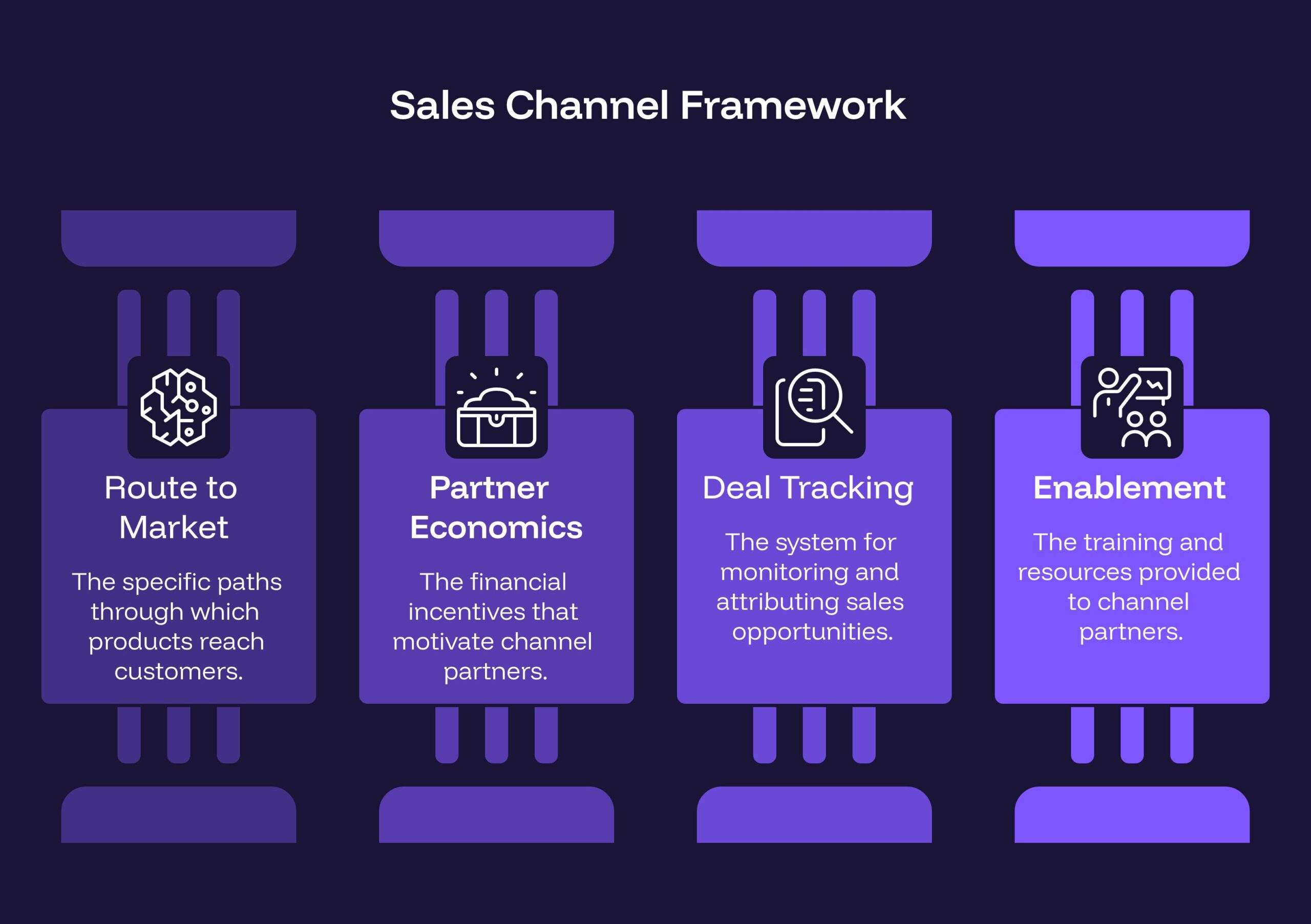
Sales channel framework diagram showing route to market, partner economics, deal tracking, and enablement components

  1. Route to market: The specific path, whether direct sellers, resellers who resell your product, a marketplace, or referral and technology partners who bring you into their deals.
  2. Partner economics: The margin, referral fee, or co-sell arrangement that makes the channel worth a partner’s effort, since a channel with no economics is a wish.
  3. Deal tracking and registration: The record of who sourced or influenced each opportunity, which prevents conflict and creates the attribution that proves the channel’s contribution.
  4. Enablement: The training and materials a channel needs to sell your product accurately, because a partner who cannot explain your offer will not carry it.

Common pitfalls with sales channels

  • Running channels that conflict: A direct team and a reseller chasing the same account with no rules of engagement creates conflict that poisons the partnership. Define who owns what before it happens.
  • Adding a channel with no economics: Signing resellers without a margin worth their time produces a logo list, not a channel. The incentive has to justify the effort.
  • No attribution: If you cannot say which channel sourced a deal, you cannot manage the mix or defend the partner budget. The tracking is not optional.
  • Treating every channel the same: A reseller, a marketplace, and a referral partner sell in different ways. One playbook applied to all of them fits none well.

What this looks like in practice

A worked example: a software vendor sold direct only and stalled once its team had picked the obvious accounts. It added two channels, a reseller motion for a vertical its direct team did not understand and a technology-partner co-sell motion into an adjacent product’s customer base. Each got its own economics, rules of engagement to prevent conflict with direct, and deal registration wired to CRM. A year later the two indirect channels sourced a third of new pipeline, in accounts the direct team would never have reached. The lesson was not that partners are better than direct; it was that a deliberate mix beats a single route.

Forecastable’s POV on sales channels

Our position is that a sales channel only counts when its contribution is measured. It is easy to sign resellers and technology partners and call it a channel; it is harder to prove which deals they sourced or influenced, and that proof is the difference between a channel and a hopeful arrangement. A partner channel with no attribution is a story, not a number.

We also think the channel mix should feed one forecast. When partner-sourced pipeline lives in a separate report, leadership discounts it, and a discounted channel loses its budget. When registered and influenced deals flow into the same CRM forecast as direct, the indirect channel earns a seat in the plan. The discipline that makes partner-led growth forecastable is what turns a sales channel from an experiment into infrastructure.

Forecastable is a partnerships operating platform. Any tools or approaches named here are independent third-party products, and naming them is not an endorsement. Decide which sales channels fit your own product, buyers, and economics.

Frequently asked questions

What is a sales channel in simple terms?
It is the route a product takes to reach buyers, whether through a direct team or through partners such as resellers, marketplaces, and referral or technology partners.

What are the main types of sales channel?
Broadly, direct (your own team), reseller or distributor, marketplace, and referral or technology-partner channels. Most companies run a mix rather than one.

What is the difference between a direct and an indirect sales channel?
A direct channel sells straight from the vendor to the buyer. An indirect channel routes through a partner who resells, refers, or co-sells the product.

Why do companies use more than one sales channel?
Because no single route reaches every buyer efficiently. A mix balances the precision of direct with the reach and trust of partner channels.

How do you measure a sales channel?
By attribution: tracking which channel sourced or influenced each deal, then measuring pipeline and revenue by channel so the mix can be managed.

Next step

If you run partner channels but cannot say which deals they produced, you cannot manage the mix or defend the budget behind it. The fix is attribution that ties channel activity to CRM pipeline. Forecastable helps partnerships teams measure what each channel sources and influences, so the indirect motion earns its place in the forecast. Start your growth journey now to make your channel mix something you can plan around. The partner program hub frames how a partner sales channel fits co-sell and enablement.

Uncover Your Growth Potential

Whether starting with a single sales team or a single partner, any co-sell motion can be live within 30 days.

Schedule a Discovery Call
Latest Insights
A channel sales manager and a reseller's account executive reviewing a joint deal pipeline on a laptop in a bright office, a printed partner tier sheet on the desk, deep navy and warm amber palette
  • B2B Sales Foundations
Alex Buckles

Channel Sales: What It Is and How It Works

What is channel sales? Short answer: Channel sales is the model where you sell through third-party partners, resellers, distributors, agencies, or technology firms, instead of relying only on your own direct sales team. The partner owns or influences the customer relationship, and you gain reach you could not build alone. It trades some margin and […]

Read Article
A channel manager explaining the partner sales motion on a glass whiteboard to a colleague in a bright office, a printed deal registration flow on the desk, deep navy and warm amber palette
  • B2B Sales Foundations
Alex Buckles

What Is Channel Sales? Definition and How It Works

What is channel sales? Short answer: Channel sales is a model where you sell through third-party partners, resellers, distributors, agencies, or technology firms, instead of relying only on your own direct sales team. The partner owns or influences the customer relationship, giving you reach and trust in exchange for some margin and control. It is […]

Read Article
Two professionals review charts in a modern conference room with a large screen displaying sales graphs and a city skyline outside the window.
  • B2B Sales Foundations
Alex Buckles

Sales Channel: What It Is and How to Choose One

What is a sales channel? Short answer: A sales channel is the route a company uses to reach and sell to its buyers, whether that is a direct sales team, a network of partners, a self-serve website, or a marketplace. Most companies use more than one, and the mix determines their reach, their margins, and […]

Read Article
An account executive and a sales manager building a close plan on a whiteboard, a dated list of steps to signature with owners named beside each, a printed deal timeline on the table, deep navy and warm amber palette
  • B2B Sales Foundations
Alex Buckles

Close Plan: What It Is and How to Build One

What is a close plan? Short answer: A close plan is the dated, step-by-step sequence that a seller and a buyer agree to follow to get from the current stage of a deal to a signed contract, naming each step, who owns it, and when it is due. It replaces the vague hope that a […]

Read Article
Logo — It’s All AboutThe Team

Quick Links

  • Who We Serve
  • Solutions
  • Resources
  • Pricing
  • Our History

Social Media

  • Linkedin

Legal

  • Privacy Policy
  • Terms of Service
Quick Links
  • Who We Serve
  • Solutions
  • Resources
  • Pricing
  • Our History
Social Media
  • Linkedin
Legal
  • Privacy Policy
  • Terms of Service

Stay ahead on ecosystem-led growth

Logo — It’s All AboutThe Team
© 2025 Forecastable. All rights reserved.
Book Your Strategy Call
Request Enrollment Details

[contact-form-7 id=”dfbeed3″ title=”Request Enrollment Details”]

Mollie Bodensteiner

Revops Advisory
  Mollie Bodensteiner is an experienced operations professional with a demonstrated track record of utilizing technology to support operational processes that drive performance and innovation. She currently is the Vice President of Operations at Sound and owns go-to-market agency, MB Solutions. Mollie has previously held operations leadership roles at Deel, Syncari, Corteva and Marketo. She has over 14 years of experience in both B2C and B2B operations and technology. When she is not working, Mollie enjoys spending time with her husband, three small children, and two large dogs. Childhood Career/Dream: Growing up in the age of Disney and Nick@Nite I always wanted to be a child actor (good thing that never was actually pursued 🙂 Favorite Win: I am not sure I have a specific “win” but I think I get the most joy and excitement from coaching others and watching them hit major milestones in their career. The first time you get to promote someone on your team or watch them lead a major project – are always career highlights! Personal Fun Facts: Favorite Song: If it’s love, Train Favorite Movie: Good Will Hunting Favorite Meme: Disaster Girl
Forecastable resources: Co-Sell Orchestration Platform · All Use Cases · Live in 30 Days · Co-Sell Playbook

Kelsey Buckles

Director of Operations


My journey from Education to Operations has equipped me with a unique perspective and skill set that perfectly aligns with Forecastable’s mission to help businesses improve sales collaboration through partner co-selling strategies.

At Forecastable, I am passionate about empowering teams and organizations to unlock the full potential of strategic partnerships. By leveraging my expertise in communication, leadership, and operational efficiency, I contribute to creating seamless co-selling processes that align with business goals and deliver exceptional results.

The intersection of my educational foundation and operational experience fuels my dedication to fostering alignment, building trust, and enhancing collaboration between partners. I am driven by the opportunity to contribute to a platform that not only optimizes sales strategies but also strengthens relationships that lead to long-term growth.

Paul Jonhson

Chief Technology Officer (Co-founder)


Paul Johnson has 20+ years of software development and consulting experience for a variety of organizations, ranging from startups to large-enterprise organization with highly-complex needs.

Mr. Johnson has a long track record of successful technology deployments.
This, combined with his deep passion for machine learning and exceptional user experience design, allows him to lead our technical direction from the front with confidence.

Alex Buckles

Product, Partnerships, and Value Engineering (Co-founder)


After serving in The United States Marine Corps, Alex Buckles spent the next two decades as a student of revenue production and an advocate for innovation.

Along the way, he has helped numerous companies achieve double and triple-digit growth by crafting and executing high-performing go-to-market strategies, with co-selling at the center of each.

As a once-advanced technical marketer, an expert sales & partner professional, and a strong customer success advocate, Mr. Buckles understands the impact of these functions aligning not only on revenue production, but on the day-to-day execution of the go-to-market strategy. This concept of revenue-team alignment is what quickly became the foundation of Forecastable back in January of 2018.

In his free time, you’ll find him spending quality time with his children, one of whom is on the autism spectrum. 1 in 36 children in the U.S. are on the spectrum and boys are four times more likely to be diagnosed than girls.

With that in mind, Mr. Buckles plans on dedicating the rest of his life serving those living with autism, through his organization Pathways for Autism. From his perspective, there must be a scalable and financially self-sustaining infrastructure established to put as many individuals with autism as possible on a path towards complete independence as adults.