Skip to content
  • Home
  • Who We Serve
    • By Category
      • SaaS
      • Professional Services
      • Platforms (Large Ecosystems)
      • Private Equity
    • By Role
      • Chief Revenue Officers (CRO)
      • Chief Financial Officers (CFO)
      • Chief Marketing Officers (CMO)
      • Chief Executive Officers (CEO)
      • Sales Leaders
      • Partnership Professionals
  • Solutions
    • By Partner Program Maturity
      • Partnerships Foundation
      • Partnerships Acceleration
      • Ecosystem-Wide Orchestration
    • Specialized Solutions
      • Net-New Named Account Development
      • Large Ecosystems
      • M&A: Post-Acquisition Internal Cross-Selling
  • Pricing
  • Education
  • Company
    • Our History
    • Security
  • Home
  • Who We Serve
    • By Category
      • SaaS
      • Professional Services
      • Platforms (Large Ecosystems)
      • Private Equity
    • By Role
      • Chief Revenue Officers (CRO)
      • Chief Financial Officers (CFO)
      • Chief Marketing Officers (CMO)
      • Chief Executive Officers (CEO)
      • Sales Leaders
      • Partnership Professionals
  • Solutions
    • By Partner Program Maturity
      • Partnerships Foundation
      • Partnerships Acceleration
      • Ecosystem-Wide Orchestration
    • Specialized Solutions
      • Net-New Named Account Development
      • Large Ecosystems
      • M&A: Post-Acquisition Internal Cross-Selling
  • Pricing
  • Education
  • Company
    • Our History
    • Security
  • Home
  • Who We Serve
    • By Category
      • SaaS
      • Professional Services
      • Platforms (Large Ecosystems)
      • Private Equity
    • By Role
      • Chief Revenue Officers (CRO)
      • Chief Financial Officers (CFO)
      • Chief Marketing Officers (CMO)
      • Chief Executive Officers (CEO)
      • Sales Leaders
      • Partnership Professionals
  • Solutions
    • By Partner Program Maturity
      • Partnerships Foundation
      • Partnerships Acceleration
      • Ecosystem-Wide Orchestration
    • Specialized Solutions
      • Net-New Named Account Development
      • Large Ecosystems
      • M&A: Post-Acquisition Internal Cross-Selling
  • Pricing
  • Education
  • Company
    • Our History
    • Security
Back to all blogs
  • Partner Co-Selling
  • Sales Management
  • Sales Reps
B2B Sales Rep Co-Sell
Alex Buckles

*How and When to Leverage a Mutual Action Plan,* Close Plan, or Evaluation Plan

Napkin with a handwritten quote: 'A goal without a plan is just a wish,' beside a pen and a green coffee mug on a wooden table.

One of the biggest problems sales reps have to consistently face is forecasting an accurate close date and making sure that the deal actually closes on or around that exact date. Itโ€™s not easy and requires in-depth planning and project management skills to consistently deliver closed/won opportunities on time. When you break it down into a process though, itโ€™s a combination of art and science (mostly science) and anyone can do it.

The Science (90%)

Closing deals on time is nothing more than sales project management, in my opinion. So, I did some research about what foundational skills a project manager should have and came across another post that I think accurately describes the 15 skills that project managers need. They are as follows:

  1. Leadership
  2. Negotiation
  3. Scheduling
  4. Cost Control
  5. Risk Management
  6. Contract Management
  7. Critical Thinking
  8. Communication
  9. Project Recovery
  10. Coaching
  11. Task Management
  12. Quality Management
  13. Meetings Management
  14. Business Case Writing
  15. Sense of Humor

When you have the time, you should read the post above and think about how it applies to every single sales situation, consistently. The only skill that I didnโ€™t find an equal match for was โ€œCost Controlโ€ as thatโ€™s not traditionally a factor in most sales cycles. As I go through the strategy around crafting a close plan, Iโ€™ll try to call out the skills above that are leveraged throughout the process.

Whatโ€™s the Purpose of a Close Plan?

Let me start out by saying that at Forecastable, we like to call these โ€œEvaluation Plansโ€ as opposed to โ€œClose Plansโ€. Itโ€™s an accurate description of the purpose of the exercise and is a label that is safe to share with a prospect (nobody likes being โ€œclosedโ€). However, Iโ€™ve seen some people call them โ€œMutual Action Plansโ€ or โ€œMutual Success Plansโ€, etc. I donโ€™t see anything wrong with those labels, but still prefer โ€œEvaluation Planโ€.

The purpose of the evaluation plan is to clearly collaborate on and define what steps need to happen between now (today) and the kick-off of a project (assuming I win).

THESE ARE CALLED โ€œCO-SELL PLANSโ€ IN THE PARTNERSHIPS WORLD

Learn More

How and When Should I Introduce an Evaluation Plan?

When I meet with a prospective customer, one of the questions I always ask is, โ€œIdeally, when would you like to have the solution up and running?โ€ย 

Letโ€™s say they come back with November 30th. I then start working backwards from that date on the fly with the prospect. In my case, I know itโ€™ll take one month to get someone up and running with the Forecastable platform, from the time we kick off the project, so weโ€™ll need to kick off by October 31st.

โ€œI then know that once someone signs a contract with us, itโ€™ll take 7-10 days to get a kick-off call scheduled, so let me go ahead and bake in ten days for that, which means we will need to have contracts executed by September 21st.โ€

***note that I used โ€œweโ€ in the above statement. Try to act as a true partner. You want them to feel like theyโ€™re truly a part of this and that youโ€™re in this together.***

Iโ€™ll run that timeline by my prospect in the call and speak aloud while I do all of that basic timing math. Iโ€™ll then say something like, โ€œBased on your timing requirements, it looks like weโ€™ll need to have agreements executed by September 21st. Is that achievable from your perspective?โ€ย  (Project Mgmt. Skills: Scheduling & Critical Thinking)

Seven times out of ten, a prospect agrees that itโ€™s achievable. Voila! You now have your first timing buy-in and can begin forecasting a close date of September 21st. For those customers that donโ€™t think the date is achievable, you need to dig deeper by asking them why and asking them what date they think โ€œisโ€ achievable and go from there.

Once you receive that first date commitment, thatโ€™s when the real work begins. Before you hang up the phone on that first call, you should always set the expectation that a much deeper plan is coming their way. By doing this, youโ€™re also subtly letting them know that you expect them to participate in this process.

I usually say something along the lines of, โ€œNow that I know the timeline youโ€™re looking to achieve, Iโ€™ll go ahead and draft a list of milestones weโ€™ll need to accomplish, between now and the project kick-off, as part of your evaluation plan. Iโ€™ll then schedule time with you for feedback just to make sure weโ€™re all on the same page. Does that seem reasonable?โ€

Again, Iโ€™d say that seven times out of ten, the prospect agrees that this is a reasonable approach. A common objection though is, โ€œI havenโ€™t selected you as a vendor. Why would I go through this with YOU at this stage?โ€ Response: โ€œThis plan isnโ€™t for ME. Itโ€™s YOUR plan and anything we build together, Iโ€™ll make sure itโ€™s something youโ€™re able to share with the other vendors as well so itโ€™s fair all around. Weโ€™ve found that 74% of prospects that donโ€™t have a plan, never end up making a purchase, which is costly on both sides. Thatโ€™s why my leadership wonโ€™t let me move forward with any prospects that arenโ€™t willing to put together SOME semblance of an evaluation plan. Iโ€™ll do most of the work and make it easy on you, so no worries there, but does that answer help at all and are you okay with me drafting that plan for you?โ€ (Project Mgmt. Skills: Leadership & Coaching)

Two thirds of the time, they then agree to it and youโ€™re now back in the driverโ€™s seat of the deal. For the person that refuses…just walk away and never look back. Itโ€™s the hardest thing to do, but I promise you that your time will be better spent on other deals where the prospects are more serious. Now itโ€™s time to build the first draft of your evaluation plan.ย 

What Data Should be Captured in an Evaluation Plan?

Everything you capture should serve a purpose. We recommend the following data as a best practice:

  1. Milestone
  2. Objective
  3. Customer Owner
  4. Vendor Owner
  5. Target Date
  6. Actual Date

Hereโ€™s a screenshot of our platform and how it looks partially filled in:
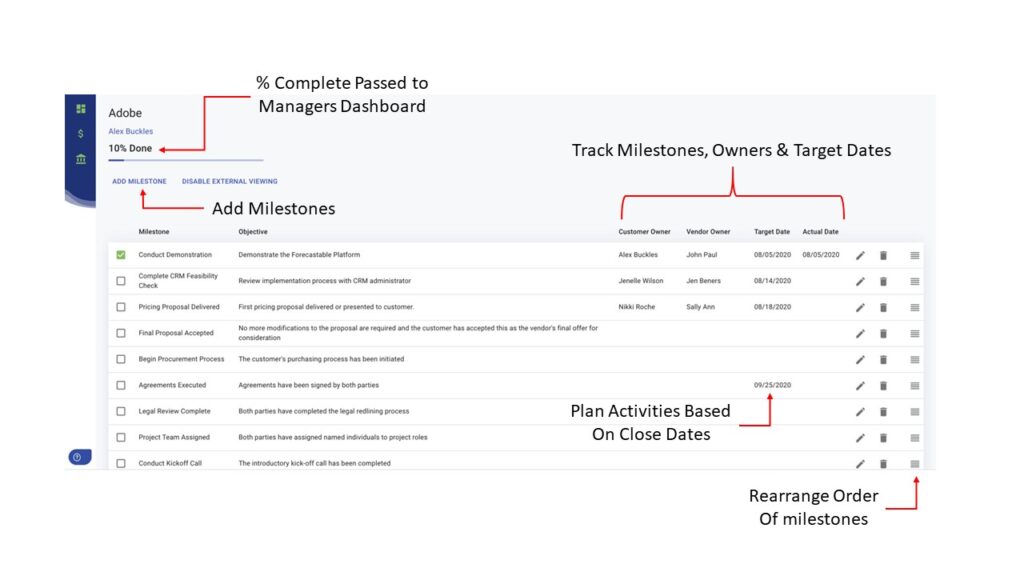
Itโ€™s important to give this all true thought. Think through how long you think these tasks will take based on what you know about your own internal processes as well as how easy/difficult you think the prospect will be throughout the process. Once youโ€™ve drafted the plan for the prospect, book 30 minutes with him/her to review.ย 

In the meeting, do a screenshare, show the plan, and make adjustments on the spot based on their feedback. Once youโ€™ve agreed on the timeline, tell them, โ€œIโ€™m going to send to you for acceptance. Once accepted, we can move forward with the evaluation and Iโ€™ll let you know as time goes on if I identify anything that puts โ€œourโ€ timeline at risk.โ€ย 

In the Forecastable platform, I click on โ€œSend for Acceptanceโ€ (while still sharing my screen), enter their information, and click send. Iโ€™ll then say, โ€œIโ€™ll go ahead and stay on to make sure you receive it and are able to accept everything.โ€ This forces them to look at the email NOW, as opposed to getting distracted with other things while I sit around wondering why they havenโ€™t accepted yet. Hereโ€™s what they see:

If the prospect doesnโ€™t feel comfortable accepting. Itโ€™s not a โ€œwalk awayโ€ type of situation. While this could be a red flag, situationally, Itโ€™s understandable and often times acceptable. The more important thing is that you have a mutually agreed upon timeline of activities.ย (Project Mgmt. Skills: Task Management & Communication)

From here on out, itโ€™s important to continuously check in on all of your evaluation plans to make sure dates havenโ€™t slipped. If someone is starting to fall out of communication, I tend to use the evaluation plan as a reference by writing them with an email subject line of โ€œTimeline Risk Identifiedโ€. I then say something along the lines of, โ€œWeโ€™re now 10 days past due on our โ€œVendor of Choiceโ€ milestone. Do you feel like we can make up lost time by moving faster on some of the other future milestones or should we think about adjusting our project kick-off date? This conversation can go in a lot of different directions, which is way outside of the scope of this post, but will encompass additional project management skills such as meetings management, contract management, negotiation, humor, and project recovery (recovering from a fumble of some sort).ย 

The Art (10%)

We just went through the science of closing a deal (It works…I promise). The art is much harder to describe, but is primarily centered on relationship management. Youโ€™ll have to spend time getting to know people, understanding what landmines not to step on, figuring out internal social influence, and just simply being good on your feet when something goes wrong, because you will absolutely be judged on how you handle mishaps.ย 

THESE ARE CALLED โ€œCO-SELL PLANSโ€ IN THE PARTNERSHIPS WORLD

Learn More

Uncover Your Growth Potential

Whether starting with a single sales team or a single partner, any co-sell motion can be live within 30 days.

Schedule a Discovery Call

Latest Insights
Two colleagues in a modern office review a blue laptop together at a conference table, smiling.
  • Partner Co-Selling
Alex Buckles

Partner Account Planning and Always-On Partner Comms

Short answer: Always-on partner communications keep partners aware of you. On their own, they do not generate pipeline. The pipeline comes from partner account planning: dedicated, recurring account-planning sessions built on completed account mapping. Always-on comms are the wiring between those sessions, not a substitute for them. Crossbeam network data puts the average win-rate lift […]

Read Article
A partner manager and an account executive working a shared co-sell deal together over a laptop and a tablet
  • Partner Co-Selling
Alex Buckles

Co-Sell: The 2026 Definition, Motion, and Playbook

Co-sell is a B2B sales motion where two companies plan and execute against shared accounts together, with both AE teams working the deal and both sides…

Read Article
Two revenue professionals in a co-sell playbook interview, one taking notes while the other talks, a single page on the table between them
  • Partner Co-Selling
Alex Buckles

Joint Value Proposition: Extract It From the Interview

A joint value proposition is the customer-facing statement two partner companies use to explain why their combined offering produces a better outcome than…

Read Article
Two parallel amber arcs converging at a common horizon point on deep navy, illustrating the co-selling motion
  • Partner Co-Selling
Alex Buckles

Co-Selling: Definition, Models, and How It Works

Co-selling is the joint sales motion in which two companies pursue and close the same prospect or customer together, sharing context, sequencing, and accountability for the deal. The motion runs on shared deal mechanics, same logo, same buyer, same forecast date, same next step, not on shared friendly relationships. Companies that confuse the two get […]

Read Article

Quick Links

  • Who We Serve
  • Solutions
  • Resources
  • Pricing
  • Our History

Social Media

  • Linkedin

Legal

  • Privacy Policy
  • Terms of Service
Quick Links
  • Who We Serve
  • Solutions
  • Resources
  • Pricing
  • Our History
Social Media
  • Linkedin
Legal
  • Privacy Policy
  • Terms of Service

Stay ahead on ecosystem-led growth

ยฉ 2025 Forecastable. All rights reserved.
Book Your Strategy Call
Request Enrollment Details

[contact-form-7 id=”dfbeed3″ title=”Request Enrollment Details”]

Mollie Bodensteiner

Revops Advisory
  Mollie Bodensteiner is an experienced operations professional with a demonstrated track record of utilizing technology to support operational processes that drive performance and innovation. She currently is the Vice President of Operations at Sound and owns go-to-market agency, MB Solutions. Mollie has previously held operations leadership roles at Deel, Syncari, Corteva and Marketo. She has over 14 years of experience in both B2C and B2B operations and technology. When she is not working, Mollie enjoys spending time with her husband, three small children, and two large dogs. Childhood Career/Dream: Growing up in the age of Disney and Nick@Nite I always wanted to be a child actor (good thing that never was actually pursued ๐Ÿ™‚ Favorite Win: I am not sure I have a specific โ€œwinโ€ but I think I get the most joy and excitement from coaching others and watching them hit major milestones in their career. The first time you get to promote someone on your team or watch them lead a major project – are always career highlights! Personal Fun Facts: Favorite Song: If itโ€™s love, Train Favorite Movie: Good Will Hunting Favorite Meme: Disaster Girl
Forecastable resources: Co-Sell Orchestration Platform · All Use Cases · Live in 30 Days · Co-Sell Playbook

Kelsey Buckles

Director of Operations


My journey from Education to Operations has equipped me with a unique perspective and skill set that perfectly aligns with Forecastable’s mission to help businesses improve sales collaboration through partner co-selling strategies.

At Forecastable, I am passionate about empowering teams and organizations to unlock the full potential of strategic partnerships. By leveraging my expertise in communication, leadership, and operational efficiency, I contribute to creating seamless co-selling processes that align with business goals and deliver exceptional results.

The intersection of my educational foundation and operational experience fuels my dedication to fostering alignment, building trust, and enhancing collaboration between partners. I am driven by the opportunity to contribute to a platform that not only optimizes sales strategies but also strengthens relationships that lead to long-term growth.

Paul Jonhson

Chief Technology Officer (Co-founder)


Paul Johnson has 20+ years of software development and consulting experience for a variety of organizations, ranging from startups to large-enterprise organization with highly-complex needs.

Mr. Johnson has a long track record of successful technology deployments.
This, combined with his deep passion for machine learning and exceptional user experience design, allows him to lead our technical direction from the front with confidence.

Alex Buckles

Product, Partnerships, and Value Engineering (Co-founder)


After serving in The United States Marine Corps, Alex Buckles spent the next two decades as a student of revenue production and an advocate for innovation.

Along the way, he has helped numerous companies achieve double and triple-digit growth by crafting and executing high-performing go-to-market strategies, with co-selling at the center of each.

As a once-advanced technical marketer, an expert sales & partner professional, and a strong customer success advocate, Mr. Buckles understands the impact of these functions aligning not only on revenue production, but on the day-to-day execution of the go-to-market strategy. This concept of revenue-team alignment is what quickly became the foundation of Forecastable back in January of 2018.

In his free time, youโ€™ll find him spending quality time with his children, one of whom is on the autism spectrum. 1 in 36 children in the U.S. are on the spectrum and boys are four times more likely to be diagnosed than girls.

With that in mind, Mr. Buckles plans on dedicating the rest of his life serving those living with autism, through his organization Pathways for Autism. From his perspective, there must be a scalable and financially self-sustaining infrastructure established to put as many individuals with autism as possible on a path towards complete independence as adults.