Co-Sell Software: What to Look For in 2026

What is co-sell software?
Short answer: Co-sell software is tooling that supports a joint-selling motion, surfacing account overlap with partners, capturing partner-sourced revenue, and coordinating deals between your reps and theirs. It is the infrastructure a co-sell motion runs on, not the motion itself.
The category covers several overlapping tools, ecosystem data platforms, marketplace co-sell tooling, and partner coordination layers. They solve different parts of the same problem.
The thing to understand up front is what co-sell software does and does not do. It makes a motion easier to run; it does not create one. A tool bought without a motion sits idle, which is the most common and most expensive co-sell software mistake.
Why co-sell software matters in 2026
Co-sell has become a planned growth motion, and in 2026 co-sell software matters because a motion run on spreadsheets cannot scale past a handful of deals. Once a company is co-selling with multiple partners across many accounts, the overlap analysis, the attribution, and the coordination overwhelm manual tracking, and the right tooling is what keeps the motion from collapsing under its own volume.
The second reason is attribution. Proving partner-sourced and influenced revenue is what defends a co-sell program at budget time, and capturing it reliably at scale is hard to do by hand. Co-sell software that instruments attribution into the existing funnel gives the program the evidence it needs to keep its resources.
The third reason is the rise of marketplace co-sell. Selling through hyperscaler marketplaces has its own tooling requirements, and companies leaning into that motion need software built for it. As marketplace transactions grow, the software question becomes unavoidable for programs that want to participate.
How co-sell software actually works
Co-sell software works by automating the parts of the joint-selling motion that do not scale by hand, so the motion can run across many partners and accounts.
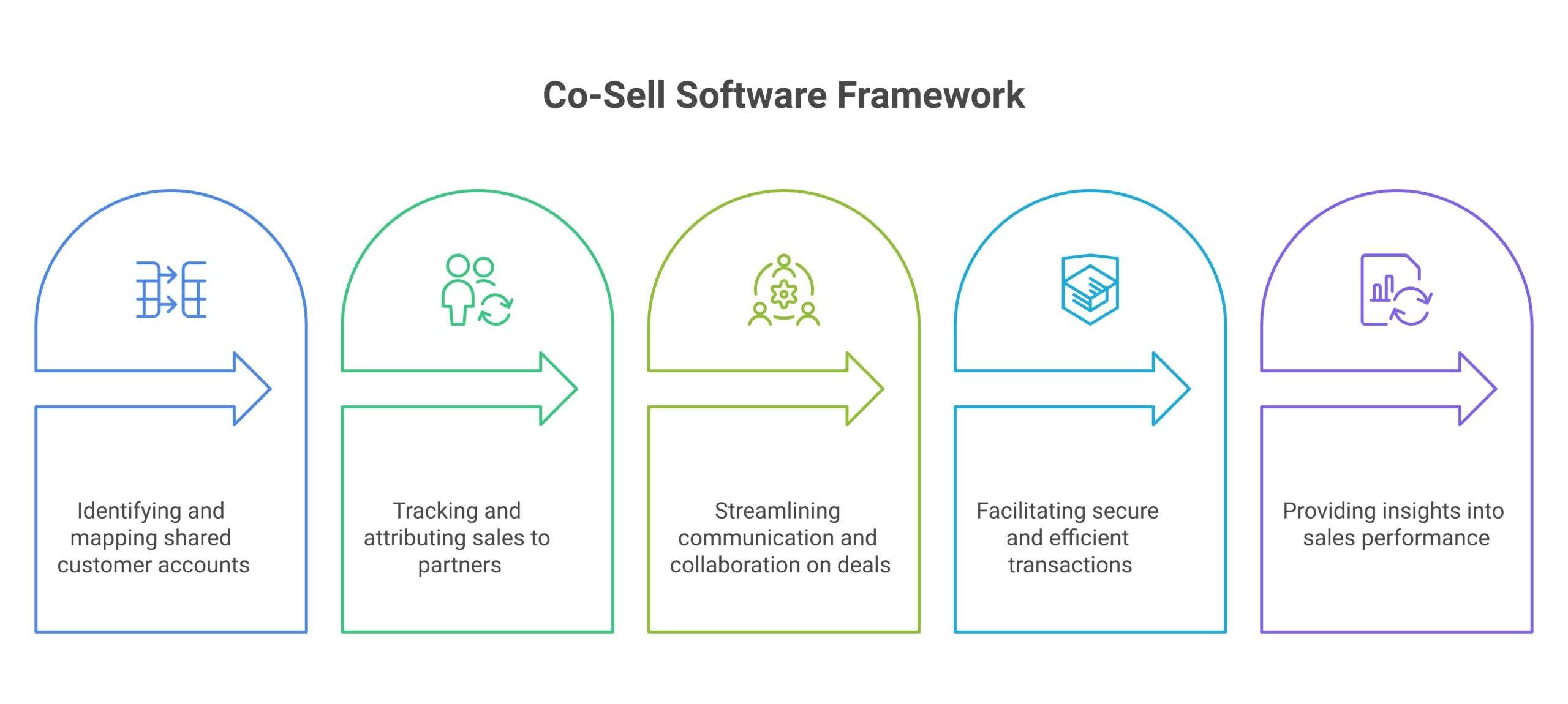
- Account overlap and mapping: The software compares your accounts against a partner’s to surface shared customers and shared prospects, which is where co-sell opportunities live. Overlap data is the entry point, because a motion needs to know where you and the partner can sell together.
- Partner-sourced attribution: The software captures partner involvement in deals and ties it to the pipeline, so the program can prove what it produced. Reliable attribution at scale is something manual tracking cannot sustain past a few deals.
- Deal coordination: The software gives both companies a shared view of joint deals, so the partner and the rep are working from the same picture rather than separate spreadsheets. Coordination tooling is what keeps two-company deals from drifting on misaligned information.
- Marketplace transaction support: For programs selling through cloud marketplaces, the software handles the listing, the private offers, and the committed-spend mechanics. Marketplace tooling is its own category because the motion and the economics differ from direct co-sell.
- Reporting and forecasting: The software rolls the joint pipeline into reporting leadership can plan against, turning the motion into a forecastable number. Reporting is what makes co-sell legible to the rest of the revenue organization.
Co-sell software is working when it makes a real motion faster and more provable across many partners and accounts, and it is failing when it was bought before the motion existed and now sits populated with no process, no adoption, and no deals flowing through it.
Tools and examples
The co-sell software space spans a few categories, and the right tool depends on which part of the motion you are trying to support. The table below sketches the main categories and what each is best suited to; evaluate any specific tool against your own motion rather than the label.
| Tool | Category | Best for |
|---|---|---|
| Crossbeam | Ecosystem data and account overlap | Finding shared customers and prospects across many partners |
| Pocus | Signal and overlap intelligence | Surfacing partner and product signals into the sales workflow |
| Common Room | Community and ecosystem signal | Capturing partner and customer signal from many channels |
| Tackle | Marketplace co-sell | Running hyperscaler marketplace transactions and private offers |
| Labra | Marketplace and co-sell automation | Automating cloud marketplace listings and co-sell workflows |
| Suger | Marketplace operations | Managing marketplace listings and metering across clouds |
| Clazar | Cloud marketplace co-sell | Listing and co-selling through cloud provider marketplaces |
| WorkSpan | Co-sell and ecosystem business management | Coordinating large partner co-sell programs and joint pipeline |
A worked example shows how the categories combine. A company co-selling with both an ISV partner and a hyperscaler used overlap tooling to find shared accounts with the ISV, then ran the deals that transacted through the cloud marketplace via marketplace co-sell software, and rolled both motions into a single joint-pipeline report. No single tool did everything; the overlap layer found the opportunity and the marketplace layer transacted it. The lesson is that co-sell software is usually a small stack matched to the motion, not one platform, and the stack should follow the motion you are running rather than dictate it.
Common pitfalls in buying co-sell software
- Buying the tool before the motion: The most expensive mistake is purchasing co-sell software expecting it to create a motion. Software supports a motion; it cannot build one, and a tool bought without a defined play sits idle and populated by nothing.
- Confusing overlap data with co-sell: Finding shared accounts is the entry point, not the motion. A company that buys overlap tooling and assumes the co-sell follows has bought a map with no journey, and the deals do not appear on their own.
- Ignoring marketplace requirements: Programs leaning into hyperscaler marketplaces need tooling built for that motion, and trying to force a direct-co-sell tool to handle marketplace mechanics produces gaps. The marketplace motion has its own software category for a reason.
- Underinvesting in attribution setup: Buying software with attribution features and never wiring the process to feed it leaves the tracking empty. Attribution is a process the software supports, not a result it produces automatically.
- Buying one platform to do everything: Expecting a single tool to cover overlap, coordination, marketplace, and reporting usually means it does none of them well. The motion is better served by a small stack matched to its parts than by one platform stretched across all of them.
Forecastable’s POV on co-sell software
The position we hold is that co-sell software is infrastructure, and the order of operations matters more than the tool choice. Build the motion first, the play, the ownership, the attribution process, the incentives, then buy software to scale it. Companies that reverse that order, buying a tool to fix a motion they never built, end up with expensive shelfware and a conclusion that co-sell does not work, when what failed was the sequencing.
The second conviction is that the category is a stack, not a platform. The useful tools each do one part of the motion well, overlap, marketplace, coordination, and the smart buyer assembles a small stack matched to the motion rather than chasing a single system that claims to do everything. The right question is not which platform, but which parts of my motion need tooling and which tool fits each part.
The honest caveat is that some motions barely need software at all. A company co-selling with one or two partners on a handful of deals can run the motion on a shared spreadsheet and a standing meeting, and buying a platform for that volume is overhead with no payoff. Co-sell software earns its cost at scale, when the overlap, attribution, and coordination genuinely overwhelm manual tracking; below that, the motion and the discipline matter far more than the tool.
Forecastable is a partnerships operating platform; any third-party tools or platforms referenced here are independent third-party products, and naming them is not an endorsement of one deployment over another. Evaluate each against your own motion.
Frequently asked questions
What does co-sell software do?
It supports a joint-selling motion by surfacing account overlap with partners, capturing partner-sourced revenue, coordinating joint deals, and, for some programs, handling marketplace transactions. Co-sell software is the infrastructure a motion runs on; it makes the motion faster and more provable but does not create it.
Does co-sell software include marketplace tooling?
Marketplace co-sell is its own category within the space, because selling through cloud provider marketplaces has different mechanics and economics than direct co-sell. Programs leaning into hyperscaler marketplaces need tooling built for that motion alongside or instead of direct-co-sell tools.
Should you buy co-sell software before building the motion?
No. Build the motion first, the play, the ownership, the attribution process, then buy software to scale it. A tool bought before the motion exists sits idle, which is the most common and most expensive co-sell software mistake.
Is one co-sell platform enough, or do you need a stack?
Usually a small stack. The useful tools each do one part of the motion well, overlap, marketplace, coordination, and a single platform stretched across all of them tends to do none well. Match a small stack to the parts of your motion that need tooling.
How does co-sell software help with attribution?
It captures partner involvement in deals and ties it to the pipeline so the program can prove what it produced. The software supports attribution, but it is a process you have to wire and feed; the tool does not generate the tracking automatically if no process populates it.
When is co-sell software worth the cost?
At scale, when the overlap analysis, attribution, and coordination across many partners and accounts overwhelm manual tracking. A company co-selling on a handful of deals with one or two partners can run the motion on a spreadsheet and a standing meeting; the software earns its cost as the volume grows.
Next step
If you are evaluating co-sell software, the move is to define the motion first and let it drive the tool choice, decide which parts of your motion need tooling, then match a small stack to those parts rather than buying a platform and hoping the motion follows.
Start your growth journey now to build the motion before you buy the stack, or see the orientation on co-sell for how software fits the broader motion.
Uncover Your Growth Potential
Schedule a Discovery Call