Co-Sell Sales Cycle Time: Why It Shrinks Deals

What is co-sell sales cycle time?
Short answer: Co-sell sales cycle time is how long a deal takes to close when a partner is selling alongside your rep, measured from first opportunity to closed-won. It usually runs shorter than a comparable solo deal because the partner’s trust and access compress the early, slow stages of the sale.
Sales cycle time is the most underrated argument for co-sell. Teams sell partner programs on reach and new logos and forget the velocity story.
A co-sell deal often closes faster not because the later stages move quicker, but because the partner shortcuts the part of the sale that usually takes longest, getting in the door and earning enough trust to have a real conversation.
Why co-sell sales cycle time matters in 2026
Deal velocity has become a core efficiency metric, and in 2026 co-sell sales cycle time matters because a motion that closes deals faster is a motion that does more with the same sales capacity. When budgets are tight and quotas are not, the speed advantage of partner-assisted deals is a direct efficiency gain that leadership cares about as much as new pipeline.
The second reason is that cycle time is a measurable, defensible benefit of co-sell. Reach and goodwill are hard to put a number on; cycle time is not. A program that can show its co-sell deals close meaningfully faster than solo deals has a concrete case for its existence that survives a budget review.
The third reason is forecasting. Shorter, more predictable cycle times make the partner pipeline easier to model, because deals move through the stages on a tighter and more consistent clock. A motion with reliable velocity is a motion you can plan revenue around.
How co-sell sales cycle time actually works
Co-sell compresses cycle time by removing or shortening the specific stages that usually slow a solo deal, so the velocity gain is concentrated in the early phases.
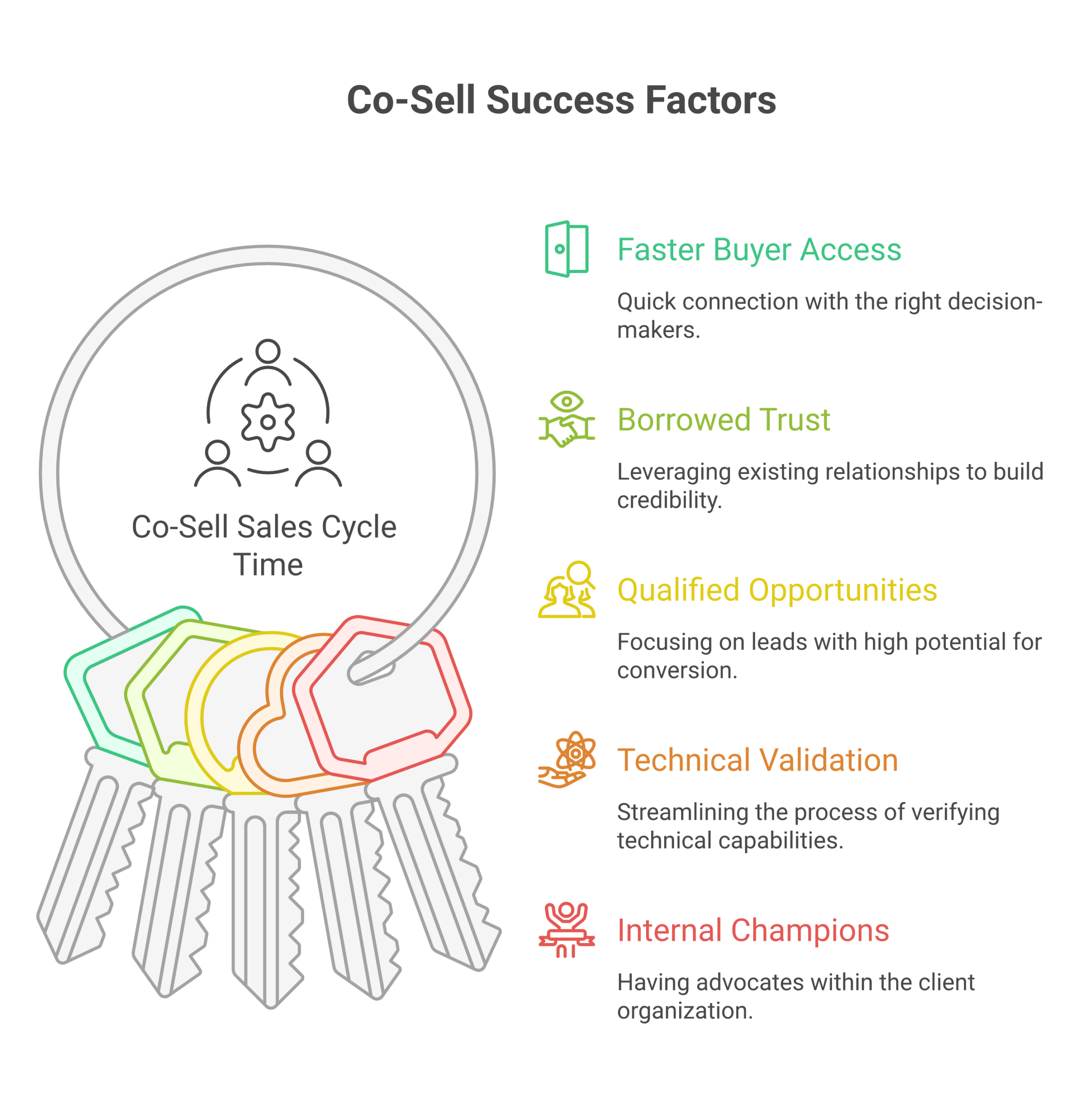
- Faster access to the right buyer: A partner with an existing relationship gets your rep in front of the actual decision-maker quickly, skipping the prospecting and gatekeeper stages that consume the front of a solo cycle. Access is where the biggest time savings live.
- Borrowed trust shortens evaluation: A buyer who trusts the partner extends some of that trust to the partner’s recommendation, so the early skepticism stage runs shorter. Borrowed credibility moves a deal past the proving-you-are-legitimate phase faster.
- Better-qualified opportunities: A partner who knows the customer brings deals that are already a fit, so fewer cycles are spent discovering the opportunity is wrong. Higher-quality entry means less time lost on deals that were never going to close.
- Smoother technical validation: When the partner already understands the customer’s environment, the technical evaluation, often a slow stage, runs faster because context does not have to be rebuilt. Shared context compresses the proof-of-value phase.
- Internal champions already in place: A partner relationship often comes with an internal advocate, so the deal has a champion from the start rather than spending weeks building one. An existing champion shortens the consensus-building stage that stalls many solo deals.
Co-sell sales cycle time is working as an advantage when partner-assisted deals measurably close faster than comparable solo deals, and the benefit disappears when the partner sources the deal but disengages, leaving your rep to run the full cycle alone with none of the access or trust that creates the speed.
Common pitfalls in measuring co-sell sales cycle time
- Not measuring it at all: Most programs never compare co-sell cycle time to solo cycle time, so the velocity advantage stays invisible and the program loses its strongest efficiency argument. What you do not measure you cannot defend.
- Comparing unlike deals: Measuring co-sell cycle time against an unmatched set of solo deals, different segments, sizes, or products, produces a misleading number. The comparison has to control for deal type or the velocity claim does not hold up.
- Crediting speed the partner did not create: Counting a deal as a fast co-sell win when the partner only made an introduction and then vanished overstates the motion’s effect. The speed advantage comes from sustained partner involvement, not a one-time intro.
- Ignoring where the time is actually saved: Treating the cycle as uniformly faster misses that co-sell compresses specific early stages. Teams that do not see where the savings come from cannot reproduce them across deals.
- Assuming faster always means better: A shorter cycle that closes smaller or worse-fit deals is not automatically a win. Cycle time has to be read alongside deal size and quality, not as a standalone metric to maximize.
What this looks like in practice
A company believed in co-sell on instinct but could not defend it in a budget review, because every argument it made, reach, goodwill, ecosystem, was unmeasurable. A sales operations analyst pulled the data and compared closed co-sell deals against matched solo deals in the same segments. The co-sell deals closed in roughly two-thirds the time. Digging into the stages showed why: the partner-assisted deals skipped most of the prospecting and early-trust phases, because the partner walked the rep straight to a decision-maker who already trusted the partner’s recommendation. The later stages took about the same time, but the front of the funnel was dramatically shorter. The program walked into the next budget review with a velocity number it could defend, and co-sell stopped being a matter of faith and became a measurable efficiency gain the sales leader could point to.
Forecastable’s POV on co-sell sales cycle time
The position we hold is that velocity is the most underused argument for co-sell, and teams that only sell the motion on reach are leaving its strongest case unmade. New logos and expanded reach are real benefits, but they are slow to prove and easy to discount. Cycle time is immediate, measurable, and lands with a CFO in a way that ecosystem ambition never will. A co-sell program that measures and reports its velocity advantage has a much stronger seat at the budget table.
The second conviction is that the speed comes from a specific place, the early stages, and understanding that is what makes it reproducible. The partner’s value is access and borrowed trust, which compress the front of the funnel where solo deals lose the most time. A program that knows this can design for it, prioritizing partners and motions that maximize early-stage compression rather than expecting uniform speedup.
The honest caveat is that the velocity advantage depends on sustained partner involvement, and it vanishes when co-sell degrades into sourcing-and-disappearing. If the partner makes an introduction and then disengages, your rep runs the full cycle alone and the speed benefit is gone. The cycle-time gain is a property of real joint selling, not of partner-sourced leads, and measuring it should not flatter a motion that is really just referrals.
Forecastable is a partnerships operating platform; any third-party tools or platforms referenced here are independent third-party products, and naming them is not an endorsement of one deployment over another. Evaluate each against your own motion.
Frequently asked questions
Why is co-sell sales cycle time usually shorter than solo deals?
Because the partner’s existing trust and access compress the early stages of the sale. A partner walks the rep to the right buyer, lends credibility that shortens evaluation, and often brings an internal champion already in place, so the slow front of the funnel runs faster.
How do you measure co-sell sales cycle time?
Compare closed co-sell deals to matched solo deals in the same segments and sizes, measuring from first opportunity to closed-won. The comparison has to control for deal type, or differences in segment and size will distort the velocity claim.
Where in the sales cycle does co-sell save the most time?
In the early stages, access, trust-building, and qualification. The partner gets the rep in front of the decision-maker quickly and lends credibility, so the prospecting and early-skepticism phases that slow solo deals are compressed or skipped.
Does co-sell always shorten the sales cycle?
No. The speed advantage depends on sustained partner involvement. If the partner only makes an introduction and then disengages, your rep runs the full cycle alone and the velocity benefit disappears. The gain is a property of real joint selling, not partner-sourced leads.
Why does co-sell cycle time matter for budget?
Because it is a measurable efficiency gain that lands with finance. A program that shows its co-sell deals close meaningfully faster than solo deals has a concrete, defensible argument for its existence, where reach and goodwill are hard to quantify and easy to discount.
Can a shorter cycle time be a bad sign?
It can, if the faster deals are smaller or worse-fit. Cycle time should be read alongside deal size and quality rather than maximized on its own. A short cycle that closes the wrong deals is not the efficiency win it appears to be.
Next step
If you believe in co-sell but cannot defend it, the move is to measure the velocity, pull matched co-sell and solo deals, compare cycle time by stage, and bring the number to your next planning conversation rather than the instinct.
Start your growth journey now to measure and improve your co-sell velocity, or see the orientation on co-sell for how cycle time fits the motion.
Uncover Your Growth Potential
Schedule a Discovery Call