Co-Sell Program: Structure That Produces Revenue

What is a co-sell program?
Short answer: A co-sell program is the structure that makes joint selling with partners repeatable across many deals and many reps, the defined motion, the ownership, the attribution, and the incentives. It is what turns occasional co-sell wins into a producing, forecastable motion.
A co-sell program is broader than a single co-sell plan for one partner. The program is the operating system; a plan is one application running on it.
The point of a co-sell program is repeatability. Any company can close a joint deal once when the right rep and the right partner happen to align. A program is what makes that happen on purpose, again and again, without relying on luck.
Why a co-sell program matters in 2026
Co-sell has become a core growth motion, and in 2026 a co-sell program matters because the companies treating co-sell as a structured program rather than a series of one-off deals are the ones producing predictable partner revenue. Ad hoc joint selling produces sporadic wins that depend on individual initiative. A program produces a pipeline you can plan around, because the motion, the ownership, and the attribution are built to run at scale.
The second reason is that a program defends itself. A co-sell motion run as a program captures its own attribution and can show what it produced, which is what keeps its budget and headcount through a tight planning cycle. Ad hoc co-sell produces wins nobody can credit, and uncredited contribution gets cut.
The third reason is that a program scales the motion past its champion. A co-sell effort that lives in one enthusiastic partnerships leader’s head collapses when that person leaves. Built as a program, with documented motion and named ownership, the motion survives turnover and grows beyond its founder.
How a co-sell program actually works
A co-sell program works by assembling the structural components that make joint selling repeatable, so the motion produces across reps and partners rather than depending on individuals.
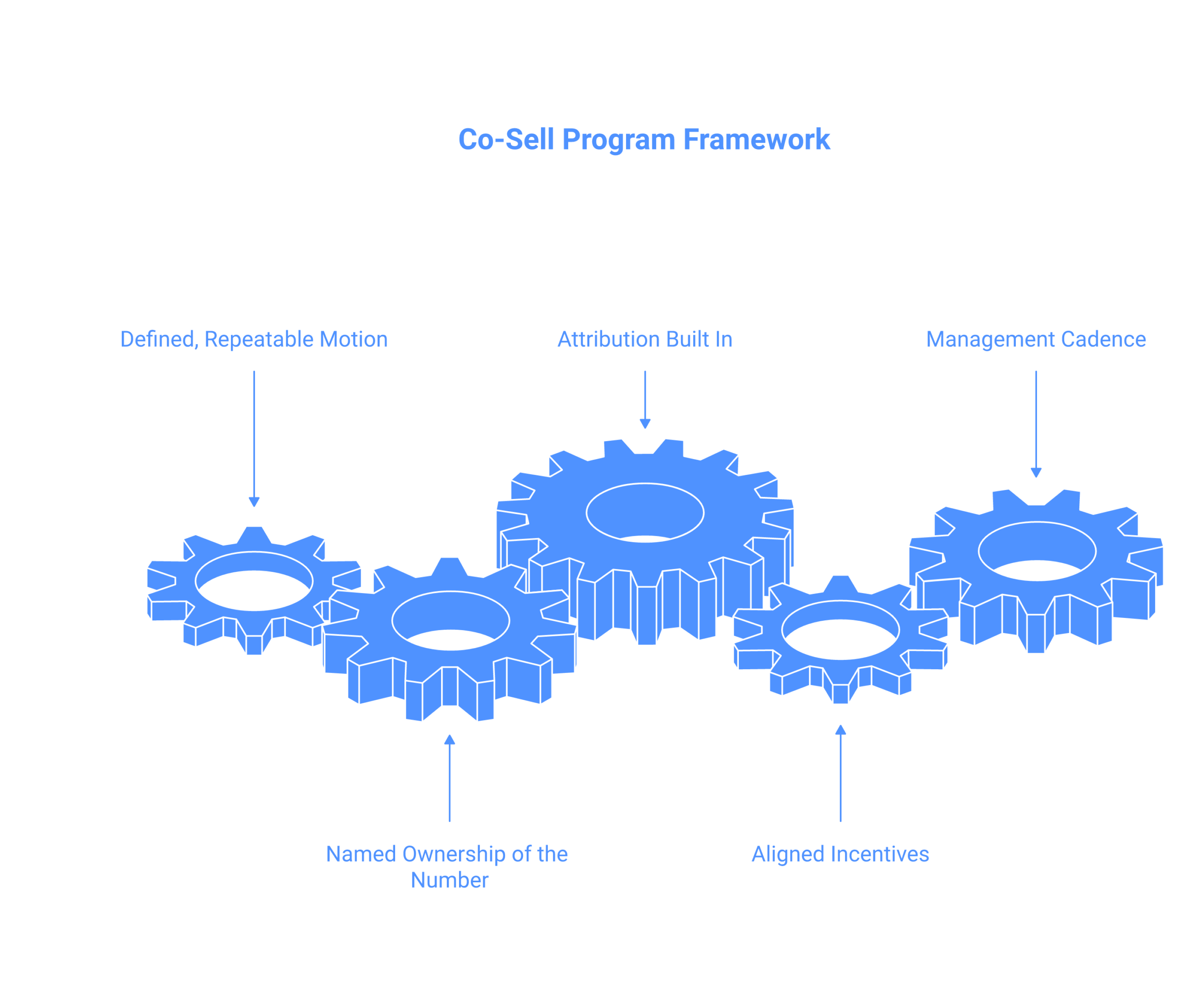
- A defined, repeatable motion: The program documents how a joint deal runs so any rep can execute it, not just the ones who invented it. A repeatable motion is the foundation, because a co-sell effort that improvises each deal cannot scale.
- Named ownership of the number: The program assigns clear ownership of partner-sourced revenue, so the motion is someone’s accountable job rather than a shared good intention. Ownership is what makes the program run under pressure.
- Attribution built in: The program captures partner-sourced and influenced revenue from the start, so it can always prove its contribution. Built-in attribution is what lets the program defend its resources and forecast its pipeline.
- Aligned incentives: The program makes co-sell deals pay reps at least as well as solo deals, so engaging a partner is not a tax on the rep’s number. Aligned incentives are what get the motion run rather than avoided.
- A management cadence: The program runs standing reviews of the joint pipeline, catching stalls and coordinating partners, so the motion keeps producing rather than drifting. The cadence is what turns the structure into ongoing output.
A co-sell program is working when partner revenue is repeatable, owned, and attributable across the team, and it is failing when joint deals still depend on which reps happen to like partnering and nobody can prove what the effort produced.
Common pitfalls in building a co-sell program
- Running deals instead of building a program: Closing one-off joint deals without building the repeatable structure leaves the company dependent on individual initiative. Without a program, the next co-sell win is luck, not output.
- No named ownership: A program where partner revenue is everyone’s job and no one’s quota loses every contest for attention. Unowned co-sell is the most common reason a program produces activity and no number.
- Attribution as an afterthought: A program built without attribution from the start cannot prove its contribution and cannot defend its budget. Bolting on tracking later is harder and usually leaves gaps the program never recovers.
- Ignoring rep incentives: A program that makes co-sell cost reps credit or speed gets routed around no matter how well it is designed. Incentives that punish the partner motion guarantee reps avoid it.
- Building structure without management: A program with a documented motion and no management cadence drifts into an unused document. The structure has to be run, not just built, or the motion reverts to occasional improvisation.
What this looks like in practice
A company had closed a few impressive co-sell deals and assumed it had a co-sell program, but every one of those wins traced back to the same two reps who happened to have partner relationships. When one of those reps left, that share of the partner pipeline vanished overnight, because there had never been a program, only individuals. The company rebuilt it as actual structure. They documented the motion so any rep could run it, named an owner accountable for partner-sourced revenue, wired attribution into the CRM, adjusted comp so co-sell deals paid like solo deals, and put a biweekly review on the calendar. The partner pipeline stopped depending on which reps liked partnering. It became a motion the whole team could run, owned by someone, provable at budget time, and resilient to the next departure, which is what made it a program rather than a streak.
Forecastable’s POV on a co-sell program
The position we hold is that the gap between a co-sell streak and a co-sell program is structure, and most companies mistake the former for the latter. A few good joint deals feel like a program, but if they trace to individual relationships rather than a repeatable motion, owned and attributed, they are luck wearing a program’s clothes. The structure is what makes the revenue survive turnover and scale past its champion.
The second conviction is that attribution and ownership are the load-bearing components, and teams underweight them in favor of the selling mechanics. Companies happily design the joint pitch and skip the parts that determine whether the program lasts, who owns the number and how the revenue is credited. A program without those produces wins it cannot keep or prove.
The honest caveat is that not every company needs a full co-sell program. A company with one or two strategic partners and a handful of joint deals a year may be better served by a tight co-sell plan per partner than by the overhead of a program. The program structure earns its cost when co-sell is a real, repeatable motion across multiple partners and reps; below that scale, a plan may be enough.
Forecastable is a partnerships operating platform; any third-party tools or platforms referenced here are independent third-party products, and naming them is not an endorsement of one deployment over another. Evaluate each against your own motion.
Frequently asked questions
What is the difference between a co-sell program and a co-sell plan?
A program is the repeatable structure, the motion, ownership, attribution, incentives, and cadence, that makes joint selling work across partners and reps. A plan is the operating document for selling with one specific partner. The program is the operating system; a plan runs on it.
What makes a co-sell program repeatable?
A documented motion any rep can run, named ownership of partner revenue, built-in attribution, aligned incentives, and a management cadence. Repeatability comes from structure that does not depend on which individuals happen to have partner relationships.
Why do co-sell programs fail to scale?
Usually because they are actually streaks, joint wins traced to a few individuals rather than a repeatable motion. When those individuals leave, the pipeline vanishes, because there was no program structure to survive them. Scale requires the motion to live in the system, not in people.
How does a co-sell program defend its budget?
Through built-in attribution that proves what it produced. A program that captures partner-sourced and influenced revenue can show its contribution at planning time, while ad hoc co-sell generates wins nobody can credit, and uncredited contribution gets cut.
Does every company need a co-sell program?
No. A company with one or two strategic partners and a few joint deals a year may do better with a tight co-sell plan per partner. The program structure earns its overhead when co-sell is a repeatable motion across multiple partners and reps.
What is the most overlooked part of a co-sell program?
Attribution and ownership. Teams focus on the selling mechanics and skip the components that determine whether the program lasts and can prove itself. A program without named ownership and built-in attribution produces wins it cannot keep or defend.
Next step
If your co-sell wins trace to a few individuals, the move is to build the structure that makes the motion repeatable, document the play, name an owner, wire attribution, align incentives, and run a review cadence, so the next departure does not take the pipeline with it.
Start your growth journey now to build a co-sell program that produces past its champion, or see the orientation on co-sell for how the structure fits together.
Uncover Your Growth Potential
Schedule a Discovery Call