Co-Sell Plan: Building a Motion Reps Execute

What is a co-sell plan?
Short answer: A co-sell plan is the document that defines how a company will sell with a specific partner, the target accounts, the deal motion, the owners, and the credit rules. It turns a vague intention to partner into a concrete operating plan that reps can run against.
A co-sell plan is not a partnership strategy or a slide about ecosystem ambition. It is a working plan tied to named accounts and a defined motion.
The test of a good co-sell plan is whether a rep can read it and know exactly what to do, which accounts to work with the partner, who fronts the customer, and how the deal gets credited. A plan that does not answer those is a statement of intent, not a plan.
Why a co-sell plan matters in 2026
Co-sell has become a planned growth motion, and in 2026 a co-sell plan matters because the difference between partner revenue and partner activity is whether anyone wrote down how the selling actually happens. Without a plan, co-sell defaults to occasional joint meetings that depend on individual reps remembering to involve a partner. With one, the motion has target accounts, owners, and a defined play, which is what turns it into pipeline you can forecast.
The second reason is alignment. A co-sell plan forces the company and the partner to agree on the same accounts, the same motion, and the same credit rules before deals are in flight. That agreement is far cheaper to reach on paper than to discover mid-deal when both sides assumed something different.
The third reason is accountability. A plan names owners, which is what makes the motion someone’s job. A co-sell program with no plan has no owner, and a motion that is everyone’s responsibility gets the attention an unowned goal always gets under pressure.
How a co-sell plan actually works
A co-sell plan works by answering the operating questions a rep needs settled before a joint deal, so the motion runs from a shared document rather than from improvisation.
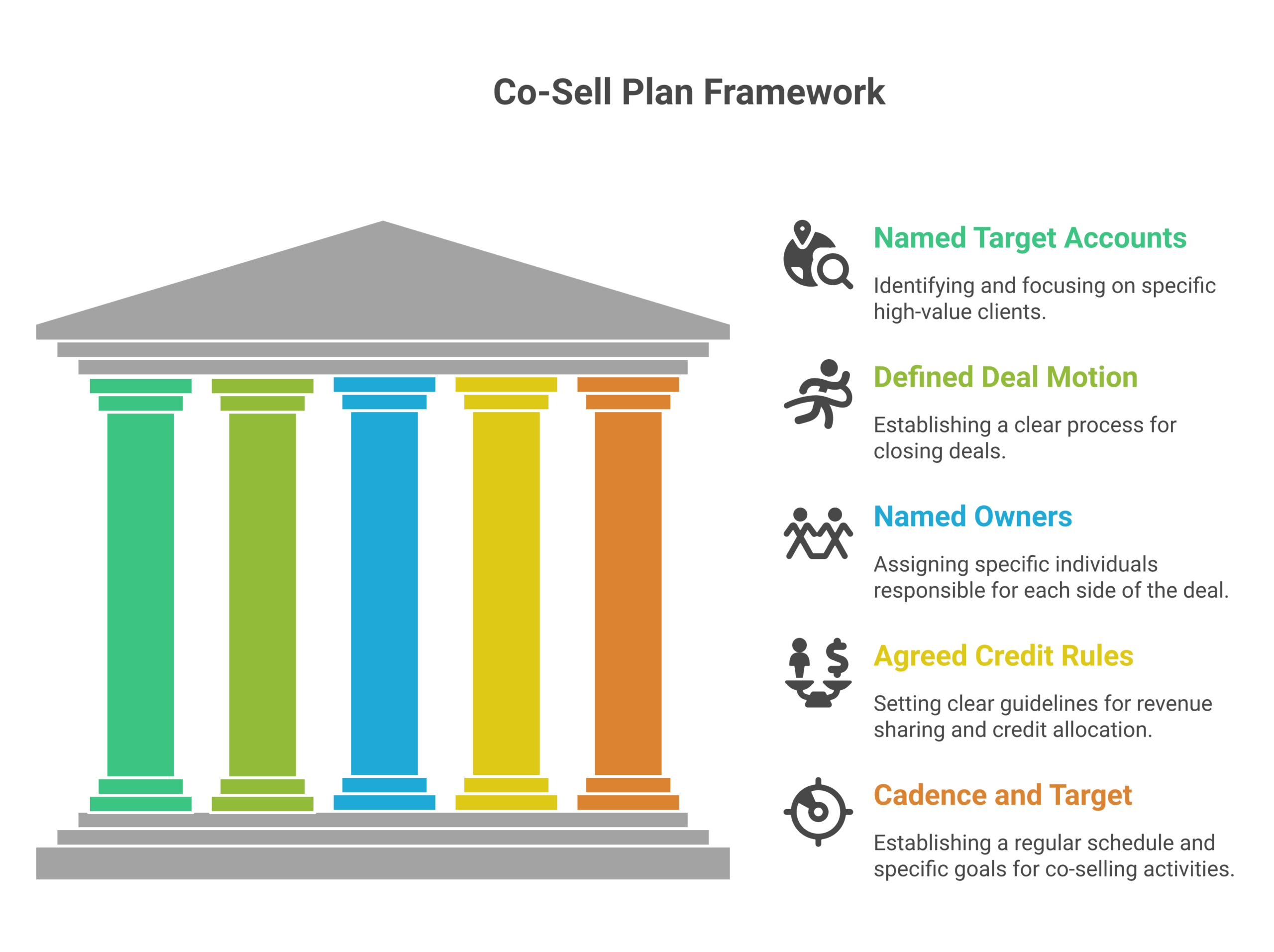
- Named target accounts: The plan starts from the accounts where you and the partner have real overlap, ideally from shared-customer or shared-prospect data. A plan grounded in named accounts gives reps a specific list to work rather than a vague mandate to find partner deals.
- A defined deal motion: The plan states how a joint deal runs, who fronts the customer, how the partner and the rep coordinate, and what each side does. A defined motion is what lets any rep execute without inventing the play each time.
- Named owners on both sides: The plan assigns an owner at the company and a counterpart at the partner who are accountable for the joint pipeline. Named ownership is what keeps the motion from being everyone’s job and therefore no one’s.
- Agreed credit rules: The plan settles how partner-sourced and partner-influenced deals are credited before any deal closes. Pre-agreed credit is what keeps co-sell from turning into an internal dispute reps route around.
- A cadence and a target: The plan sets a review rhythm and a number to hit, so the motion is managed against a goal rather than launched and forgotten. A cadence and a target turn the plan into something you run, not file.
A co-sell plan is working when a rep can open it and know which accounts to work, how the deal runs, and who owns the number, and it is failing when it reads as ambition with no named accounts, owners, or credit rules attached.
Common pitfalls in building a co-sell plan
- A plan with no named accounts: A co-sell plan that talks about ambition without naming the accounts to work gives reps nothing concrete to do. Reps need a list, and a plan grounded in overlap data is what provides it.
- No defined deal motion: A plan that names accounts but never states how a joint deal runs leaves every deal to improvisation. Without a defined play, the plan is a target list with no instructions for hitting it.
- Ownership left blank: A plan with no named owner on each side becomes nobody’s job, and an unowned co-sell motion loses every contest for attention against quota. Named owners are what make the plan operate.
- Credit rules deferred: A plan that skips the credit question saves a hard conversation now and guarantees a worse one mid-deal. Unsettled attribution turns the plan’s first real opportunity into a dispute.
- A plan with no cadence: A co-sell plan written once and never reviewed drifts into a document, not a motion. Without a review rhythm and a target, the plan is filed and the selling reverts to occasional improvisation.
What this looks like in practice
Two companies agreed to co-sell and celebrated the partnership, then did nothing concrete for a quarter because there was no plan, just enthusiasm. Reps on both sides were vaguely told to involve the other when it made sense, which meant almost never. The fix was to write an actual co-sell plan for the partnership. They pulled shared-account data and named thirty target accounts, defined the motion, the company’s rep would front the customer and bring the partner in for the technical evaluation, named an owner on each side accountable for the joint pipeline, agreed that sourced deals would be credited to the partner and closed revenue to the company, and set a biweekly review against a quarterly target. The partnership that had produced nothing for a quarter started producing within a month, because the reps finally had a plan that told them which accounts to work and exactly how.
Forecastable’s POV on a co-sell plan
The position we hold is that the co-sell plan is where partner revenue is won or lost, and most companies skip straight from signing a partnership to expecting deals without writing one. The plan is the unglamorous artifact that converts intention into a motion: named accounts, a defined play, owners, credit rules. A partnership without a co-sell plan is a relationship, not a revenue motion.
The second conviction is that the plan has to be grounded in named accounts, not aspirations. The most common weak plan is full of ambition and empty of specifics, and reps cannot run on ambition. Starting from real overlap data and naming the accounts is what makes the plan executable rather than inspirational.
The honest caveat is that a plan is necessary but not sufficient. A perfect co-sell plan still needs active management to produce, someone running the reviews, coordinating the partners, and unsticking deals. The plan defines the motion; management runs it. Writing the plan and never managing the motion produces a well-documented program that still stalls.
Forecastable is a partnerships operating platform; any third-party tools or platforms referenced here are independent third-party products, and naming them is not an endorsement of one deployment over another. Evaluate each against your own motion.
Frequently asked questions
What goes into a co-sell plan?
Named target accounts from real overlap, a defined deal motion, named owners on both sides, agreed credit rules, and a review cadence with a target. A co-sell plan answers the operating questions a rep needs settled before working a joint deal.
How is a co-sell plan different from a partnership strategy?
A strategy describes ambition and fit; a co-sell plan defines the operating motion for a specific partner, with named accounts, owners, and credit rules. The plan is what reps execute against, while a strategy alone produces no deals.
Where do the target accounts in a co-sell plan come from?
From shared-customer or shared-prospect overlap data with the partner. Grounding the plan in named accounts gives reps a specific list to work, which is what turns the plan from aspiration into something executable.
Why do co-sell plans need named owners?
Because a motion that is everyone’s responsibility becomes no one’s under quota pressure. Naming an owner on each side makes the joint pipeline someone’s accountable job, which is what keeps the plan from drifting into an unowned good intention.
When should credit rules be set in a co-sell plan?
Before any deal is in flight. Settling how sourced and influenced deals are credited up front is far cheaper than discovering the disagreement mid-deal, when it becomes a dispute reps route around rather than a clause they agreed to.
Is a co-sell plan enough to produce revenue?
No. The plan defines the motion, but it still needs active management, reviews, partner coordination, deal unsticking, to produce. A plan written and never managed becomes a document; the plan plus management is what generates pipeline.
Next step
If you have a partnership but no plan, the move this quarter is to write one, pull the overlap data, name the accounts, define the motion, assign owners, and set the credit rules before the next joint deal rather than after the confusion.
Start your growth journey now to build a co-sell plan reps will execute, or see the orientation on co-sell for how the plan fits the motion.
Uncover Your Growth Potential
Schedule a Discovery Call