Co-Sell Management: Running the Motion to Produce

What is co-sell management?
Short answer: Co-sell management is the ongoing operating work that keeps a joint-selling motion producing, running the deal reviews, maintaining attribution, coordinating partners and reps, and unsticking deals. It is the difference between a co-sell program that was launched and one that keeps running.
A co-sell motion is not a thing you build once and walk away from. It is a motion that needs active management the same way a sales team does.
Co-sell management is where most programs quietly fail. They get designed, launched, and then left to run on their own, and a co-sell motion left unmanaged drifts back to nobody doing anything.
Why co-sell management matters in 2026
Co-sell has become a planned growth motion, and in 2026 co-sell management matters because the gap between a designed program and a producing one is almost entirely operating discipline. A company can design a perfect co-sell play and watch it stall within a quarter because no one is running the reviews, chasing the stuck deals, or keeping the partners coordinated. The design is necessary; the management is what makes it produce week after week.
The second reason is that co-sell deals stall in specific ways that only active management catches. A partner goes quiet, a rep deprioritizes a joint deal under quota pressure, a handoff drops, and without someone watching the pipeline, the deal dies silently. Management is the function that notices and intervenes.
The third reason is forecastability. A co-sell program you actively manage produces a pipeline you can model, because the deals move through known stages under someone’s eye. An unmanaged program produces sporadic wins you cannot predict, which makes the whole motion hard to plan around.
How co-sell management actually works
Co-sell management works as a set of recurring operating practices, each keeping a different part of the motion alive, so the program produces rather than drifts.
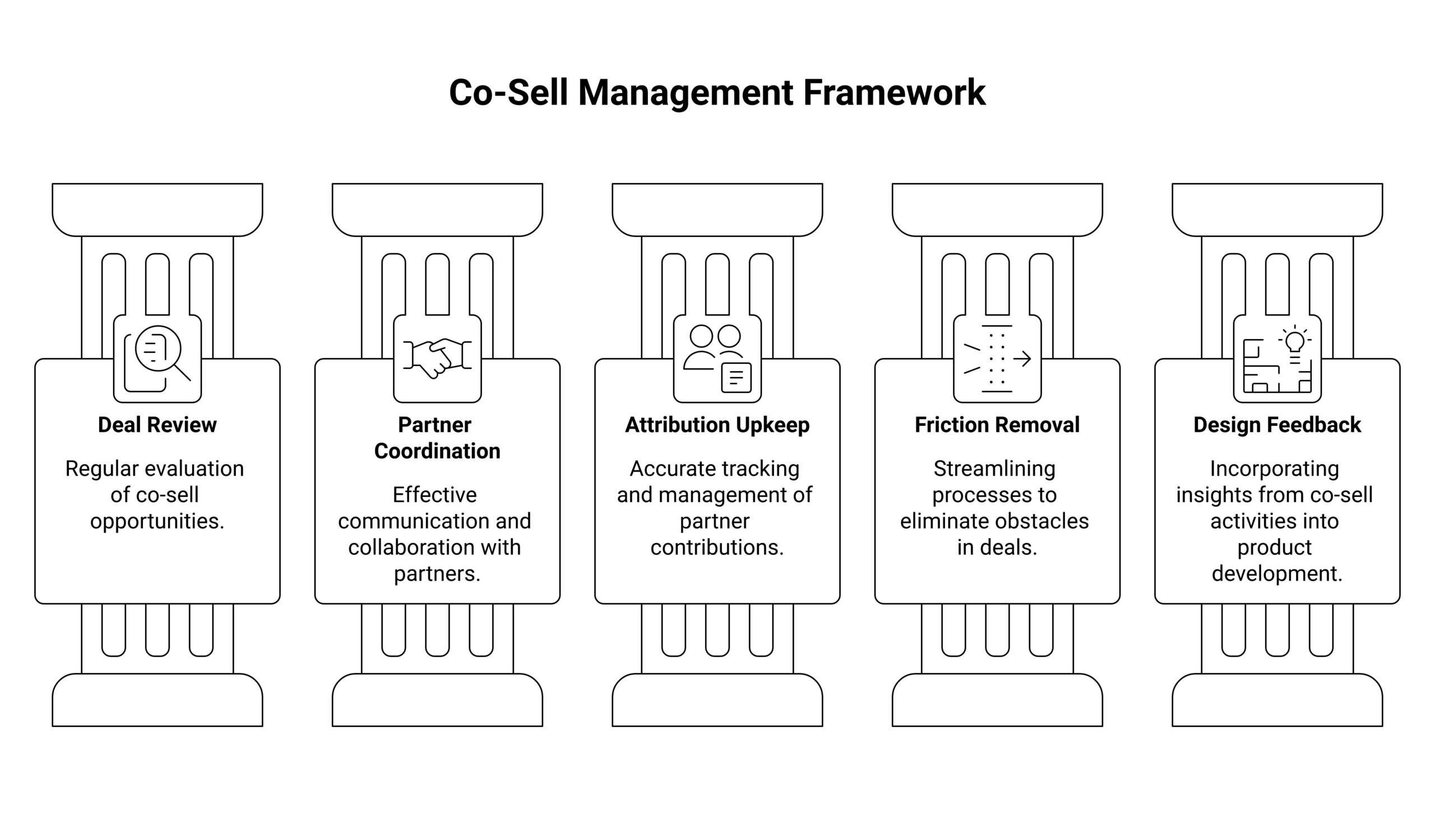
- A standing co-sell deal review: The manager runs a regular review of the joint pipeline, deal by deal, the same way a sales manager reviews quota. The review is where stalled deals surface and get unstuck before they die quietly.
- Active partner coordination: Co-sell deals involve two companies, and someone has to keep both sides moving, chasing the partner when they go quiet and the rep when they deprioritize. Coordination is the work that does not happen on its own.
- Attribution upkeep: The manager keeps partner involvement captured in the CRM so the program can always prove what it produced. Attribution decays without maintenance, and a program that loses its tracking loses its budget defense.
- Removing deal-level friction: When a joint deal hits a snag, a credit dispute, a stalled handoff, a partner resource gap, the manager clears it. Unblocking deals is reactive work that determines whether the pipeline converts.
- Feeding the motion back into design: The manager watches what keeps breaking and feeds it back into the play, tightening the motion over time. Management is not just running the existing motion; it is improving it from what the field reveals.
Co-sell management is working when joint deals move through a reviewed pipeline and stalls get caught early, and it is failing when the program runs on autopilot and the only signal anyone gets is a flat number at quarter end.
Common pitfalls in co-sell management
- Launching and walking away: The most common failure is treating co-sell as a build-once motion and leaving it unmanaged. A co-sell program with no one running it drifts back to nobody doing anything, regardless of how well it was designed.
- No standing deal review: Without a recurring review of the joint pipeline, stalled deals die silently and the manager learns about them at quarter end. The review is the early-warning system, and programs without one fly blind.
- Letting partners coordinate themselves: Assuming the partner and the rep will keep each other moving ignores that both have other priorities. Co-sell deals need active coordination, and the ones that get none stall on the first quiet week.
- Neglecting attribution: A manager who lets tracking decay loses the ability to prove the program’s value, which is the first thing cut when budgets tighten. Attribution upkeep is unglamorous and load-bearing.
- Managing activity, not outcomes: A manager who counts meetings and enablement sessions rather than deals and revenue can report a busy program that produces nothing. Management has to be anchored on the number, not the motion.
What this looks like in practice
A company launched a co-sell program with a clean motion and real partner overlap, and for the first month it looked great, joint meetings, enabled reps, a partner kickoff. Then it went quiet. There was no standing review, so when a key partner-sourced deal stalled on a handoff, nobody noticed for six weeks, and by then the customer had gone cold. Two more deals drifted the same way. The fix was not to redesign the motion; the design was fine. It was to start managing it. A partnerships manager put a weekly co-sell deal review on the calendar, walked the joint pipeline deal by deal, chased the partner and the rep whenever a deal went quiet, and kept attribution current so the program could show its work. The same motion that had stalled started converting, because someone was finally watching the deals move and intervening when they did not.
Forecastable’s POV on co-sell management
The position we hold is that co-sell fails in management far more than in design, and teams overinvest in the launch and underinvest in the operating discipline. A clean motion with active management beats a perfect motion with none, every time. The unglamorous weekly work, the review, the coordination, the attribution upkeep, is what separates programs that produce from programs that were merely launched.
The second conviction is that co-sell deals stall silently, and the whole value of management is catching that. Unlike a solo deal a rep is incentivized to chase, a joint deal can drift because each side assumes the other is driving. Someone has to own watching the pipeline and intervening, and a program without that owner loses deals it never sees die.
The honest caveat is that management cannot rescue a broken motion. If the co-sell play has no defined ownership, no attribution, or no rep incentive, no amount of weekly reviewing will make it produce, because there is nothing sound to manage. Management is what keeps a working motion working; a motion that does not work needs design first, then management.
Forecastable is a partnerships operating platform; any third-party tools or platforms referenced here are independent third-party products, and naming them is not an endorsement of one deployment over another. Evaluate each against your own motion.
Frequently asked questions
What does co-sell management involve day to day?
Running the standing deal review, coordinating partners and reps, keeping attribution current in the CRM, clearing friction on stuck deals, and feeding what breaks back into the motion design. It is the recurring operating work that keeps a joint-selling program producing.
Why do co-sell programs fail after a strong launch?
Because they are left unmanaged. A program with a clean motion still drifts back to nobody doing anything if no one runs the reviews, coordinates the partners, and catches stalled deals. The launch is not the finish line; the management is the ongoing work.
How often should you review the co-sell pipeline?
Weekly or biweekly, the same cadence a sales manager reviews quota. The review is the early-warning system that surfaces stalled joint deals before they die silently, so skipping it removes the program’s main line of defense.
Who should own co-sell management?
A partnerships manager or co-sell manager accountable for the joint pipeline, with enough authority to chase both reps and partners. The role needs to be named, because co-sell deals stall precisely when ownership is diffuse and everyone assumes someone else is driving.
What is the difference between co-sell design and co-sell management?
Design builds the motion, the play, the attribution model, the incentives; management runs it, the reviews, the coordination, the upkeep. Both are required, and a program that invests in design but not management gets launched and then stalls.
Can good management fix a broken co-sell motion?
No. If the motion has no defined ownership, attribution, or rep incentive, management has nothing sound to operate. Fix the design first, then manage it. Management keeps a working motion working; it cannot create a motion that was never built.
Next step
If your co-sell program launched well and went quiet, the move is to start managing it, put a weekly deal review on the calendar, name an owner for the joint pipeline, and keep attribution current so stalls get caught early.
Start your growth journey now to put operating discipline behind your co-sell motion, or see the orientation on co-sell for how management fits the whole motion.
Uncover Your Growth Potential
Schedule a Discovery Call