Co-Sell Email Sequences That Get Partner Replies

What are co-sell email sequences?
Short answer: Co-sell email sequences are the structured, multi-touch email flows that keep a joint selling motion moving between live conversations. They are not marketing nurtures; each touch is tied to a specific deal event and a specific recipient, and the goal of every send is a reply, not an open.
The word sequence is doing real work here. A single co-sell email is easy to ignore. A sequence is a planned series of touches, each one timed off the last and built to advance one thing: getting a partner counterpart, a partner-side AE, or a shared customer to take the next concrete step.
Co-sell sequences come in two kinds, and conflating them is the most common mistake. Internal sequences run between the two selling organizations to keep alignment and deal momentum. Customer-facing sequences run from the joint team to a shared prospect or customer. They share structure but have completely different stakes and tone.
This post is about how to build both: how many touches, how far apart, what triggers each one, and how to keep a sequence from becoming the polite spam that partners learn to ignore.
Why co-sell email sequences matter in 2026
Three forces have made disciplined sequences worth the effort. Co-sell is now a primary pipeline source, so a joint deal that stalls between calls is expensive, not academic. Partner-side sellers carry their own direct quota and treat co-sell email as low priority by default, so a vague touch gets buried. And buying committees have grown past seven stakeholders, which means more handoffs, more waiting, and more moments where a deal goes quiet and needs a structured nudge.
The case for sequencing rather than improvising has three layers. At the strategy layer, a sequence makes co-sell follow-up repeatable instead of dependent on whichever partner manager remembers to chase. At the operating layer, sequences triggered off deal events catch the stalls that a weekly deal review only finds a week late. At the financial layer, the gap between a joint deal that gets a structured nudge at day three and one that drifts for three weeks is real cycle time, and cycle time is pipeline.
The reality most teams live is co-sell follow-up that is entirely manual and entirely forgettable. The partner manager sends a checking in note, gets nothing, and concludes the partner is unresponsive. The partner was not unresponsive. The email gave them nothing to respond to.
How co-sell email sequences actually work
A working sequence has five design decisions. Get all five right and the sequence produces replies; get one wrong and it becomes noise.
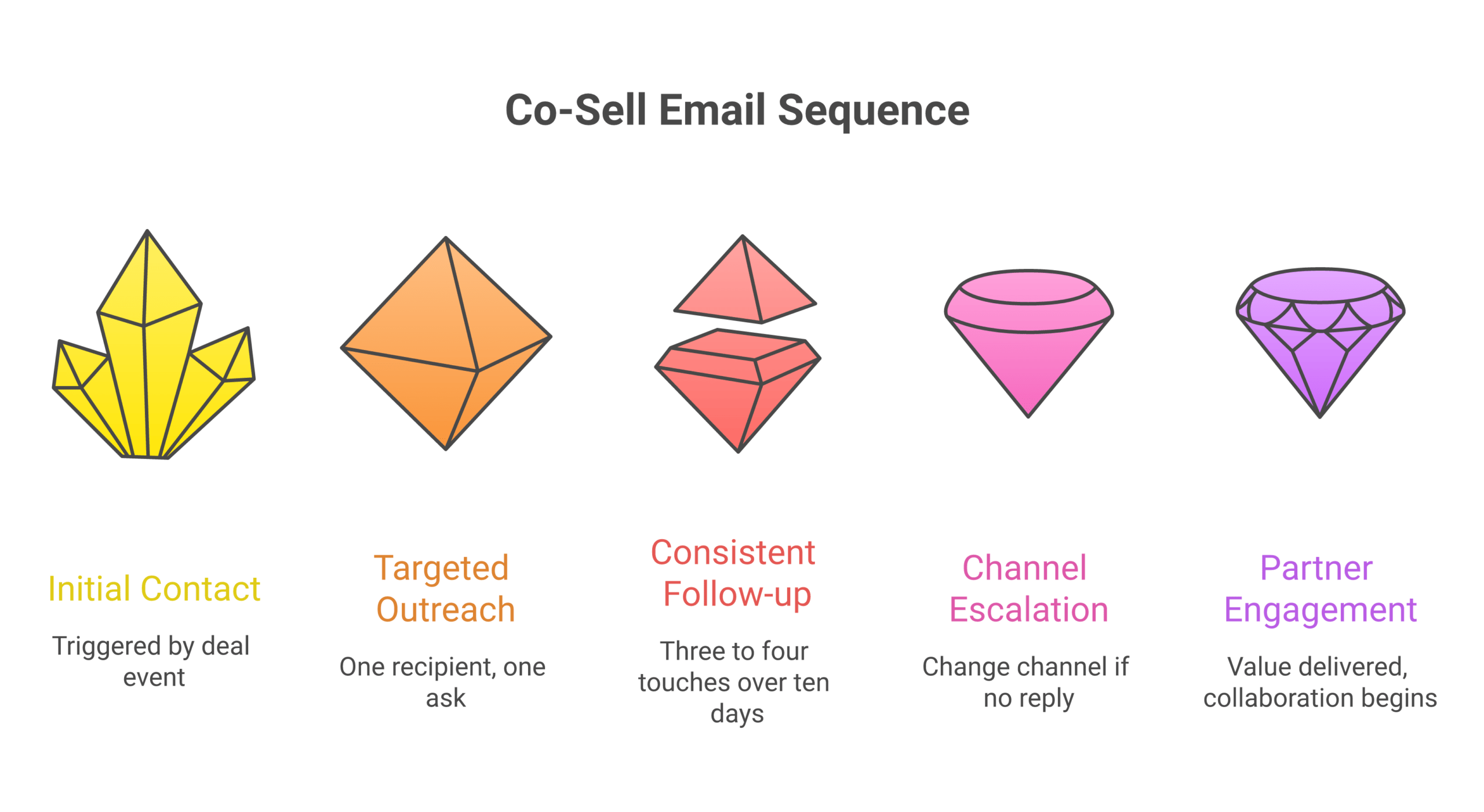
- Trigger off a deal event, not the calendar: Each touch fires because something happened: a partner was account-mapped to an overlap, a joint opportunity was created, a customer call ended, a deal stage changed. Calendar-only sequences ignore reality and read as automated.
- One recipient, one ask per touch: Every email goes to one named person and asks for one concrete thing: a 30-minute deal review, an intro to a named contact, a yes or no on joining a customer call. A touch with two asks gets neither.
- Three to four touches, then stop: An internal co-sell sequence runs three or four touches over roughly ten business days, then stops and converts to a direct ask in the deal review. A sequence that runs eight touches has stopped being outreach and become harassment.
- Escalate the channel, not the volume: If touch one and touch two get no reply, touch three changes the channel: a Slack message in the shared connection, a note to the partner manager, or a raise in the deal review. More emails do not fix an email that is not landing.
- Carry the value the partner needs: Each touch gives the recipient something usable: a specific overlap account, a customer quote, a piece of the joint pursuit plan. A sequence that only asks, and never gives, trains the partner to ignore it.
The closing point is that a co-sell sequence is a deal-advancement tool, not a contact tool. Every touch should leave the recipient with a clear next action and a reason to take it. If a touch does neither, cut it from the sequence.
Common pitfalls
Co-sell sequences fail in consistent ways, and every failure traces to treating the sequence as a nurture instead of a deal motion.
- Calendar-only timing: Touches fire every three days regardless of what is happening on the deal. The partner reads the cadence as automated and stops opening it.
- The vague checking-in touch: An email with no specific account, no specific ask, and no new information. It cannot be replied to because there is nothing to reply to.
- Too many touches: A sequence that runs seven or eight emails. By touch five the partner has filed the sender under ignore.
- Same channel forever: Three unanswered emails followed by a fourth email. Channel escalation is the fix, not repetition.
- All ask, no value: Every touch requests something and offers nothing. The partner learns the sequence costs them and stops engaging.
What this looks like in practice
Co-sell sequences run on a small stack. Sequencing tools send and track, ecosystem data triggers the touches, and partner operations records the outcome.
of an internal co-sell sequence. A partner manager runs an overlap report and finds a shared prospect both companies are pursuing. Touch one, the day of the find, names the account and asks the partner counterpart for a 30-minute deal review on it. No reply by day three. Touch two reframes with a customer detail and offers the vendor’s account notes. No reply by day six. Touch three escalates the channel: a Slack message in the shared connection plus a flag to the partner manager. The partner replies the same day, the deal review happens, and the account moves to active joint pursuit. Three touches, one channel escalation, one outcome.
The contrast is a partner manager who sends three calendar-spaced checking-in emails, gets nothing, and writes the partner off. Same partner, same account. The difference is the first sequence carried a named account and a single ask, and escalated the channel when email did not land.
Forecastable’s POV
Co-sell email gets treated like marketing email, and that is the root error. Marketing email optimizes for opens and scale. A co-sell sequence optimizes for one reply from one named person about one specific deal. The moment a team runs co-sell touches through a marketing mindset, the touches go vague, go high-volume, and stop working.
Across our client base, the sequences that produce share two traits. They are short, three or four touches, and they escalate the channel rather than the volume when email does not land. The sequences that fail are long, calendar-timed, and built entirely of asks. The partner-side seller is not ignoring co-sell because they do not value it. They are ignoring a specific email that gave them no account, no information, and no reason to move.
The contrarian point is that a co-sell sequence should be designed to end. Its job is to get a deal back into a live conversation, the deal review or a customer call, and then stop. A sequence that never ends has become a substitute for the relationship instead of a bridge to it.
If you are running co-sell follow-up by improvisation, the fix is not more discipline from your partner managers. It is three or four event-triggered touches, each with one named account and one ask, and a channel escalation built in.
Forecastable is an independent third-party professional services company. Our evaluations of co-sell practices and tooling are based on publicly-available information as of May 2026 and our own client experience.
Frequently asked questions
How many touches should a co-sell email sequence have?
Three or four over roughly ten business days for internal sequences. Then stop and convert to a direct ask in the deal review.
What is the difference between an internal and a customer-facing sequence?
Internal sequences run between the two selling organizations to hold alignment. Customer-facing sequences run from the joint team to a shared prospect. Same structure, very different tone and stakes.
Should co-sell sequences be automated?
Partially. Automation can time and send the touches, but each touch needs a real account and a real ask written in, so a fully hands-off sequence rarely works.
What triggers a co-sell email touch?
A deal event: an account-mapped overlap, a created joint opportunity, a finished customer call, or a deal-stage change. Calendar-only triggers read as automated and underperform.
Why are partners not replying to co-sell emails?
Almost always because the email is a vague checking-in note with no specific account and no single ask. Partners reply to specific, not to polite.
When should a sequence escalate the channel?
After two unanswered emails. Touch three should move to Slack, a partner-manager flag, or the deal review rather than sending a third email.
Next step
If co-sell follow-up at your company is improvised and forgettable, build two short sequences: one internal, one customer-facing. Trigger each touch off a deal event, carry one named account and one ask per send, and escalate the channel when email goes quiet.
Talk to our team about your co-sell motion →
The co-sell hub holds the broader operating context, and the co-sell email templates write-up gives you the copy blocks to drop into each touch.
Uncover Your Growth Potential
Schedule a Discovery Call