SaaS Channel Partner Strategy: What Works

What is a SaaS channel partner strategy?
Short answer: A SaaS channel partner strategy is a plan for growing recurring revenue through partners whose economics reward retention and expansion, not one-time resale margin. It recognizes that a SaaS deal is the start of a relationship, so partners must be chosen and paid for the whole lifecycle. Copying a hardware channel playbook into SaaS is why many programs stall.
The strategy differs from a traditional resale plan because the money is not in the first sale. It is in renewal and expansion, and the partner motion has to be built for that.
Why a SaaS channel partner strategy matters in 2026
A SaaS channel partner strategy matters because SaaS revenue compounds over years, and a partner who influences retention and expansion is worth far more than one who books a first-year deal and disappears. Getting the partner economics and motion right early determines whether the channel becomes an asset or a churn problem. The wrong partners sell fast and leave you with accounts that do not renew.
In 2026, with net revenue retention driving SaaS valuations, a channel that sources logos but does not support them is a liability. Buyers of SaaS expect ongoing service, and the partner is often the one who provides it. A SaaS channel partner strategy that aligns partners to retention protects the revenue you already have while it grows new pipeline.
The strategy also decides which partner types you build around. In SaaS, services firms, agencies, and platforms that embed your product behave very differently from pure resellers. Choosing the right mix, and paying each for the outcomes SaaS actually rewards, is the difference between a channel that renews and one that leaks.
How a SaaS channel partner strategy actually works
A SaaS channel partner strategy works by aligning partner selection, incentives, and motion to recurring revenue across the lifecycle. The components below are what the strategy contains.
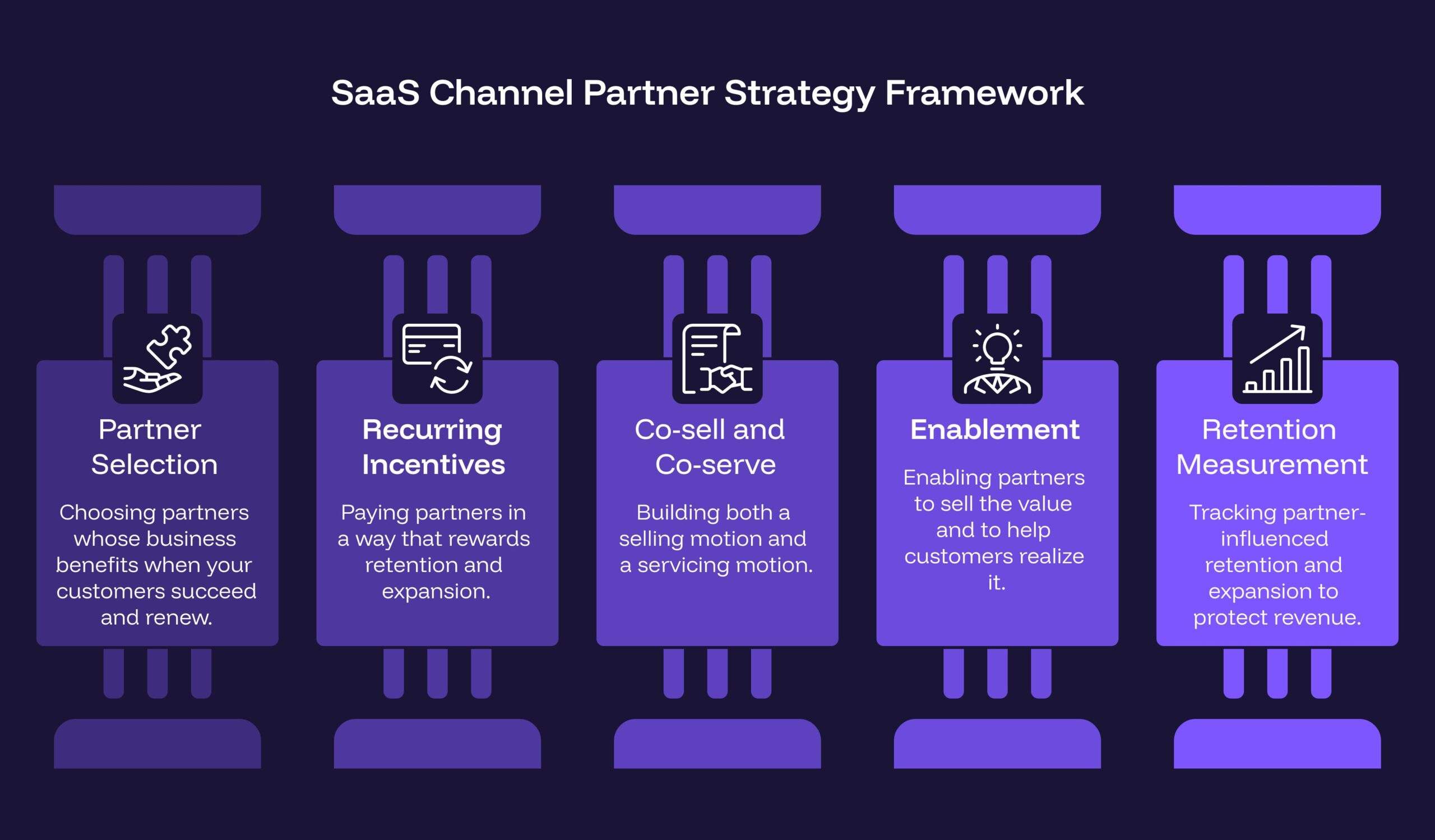
- Lifecycle-aligned partner selection: Choosing partners whose business benefits when your customers succeed and renew, not just partners who can push a first sale.
- Recurring incentives: Paying partners in a way that rewards retention and expansion, so their interest stays aligned with the customer past the initial deal.
- Co-sell and co-serve motion: Building both a selling motion and a servicing motion, because in SaaS the partner often delivers the ongoing value that keeps the account.
- Enablement for the product and the outcome: Enabling partners to sell the value and to help customers realize it, since adoption is what drives renewal.
- Retention measurement: Tracking not just partner-sourced bookings but partner-influenced retention and expansion, so you know which partners actually protect revenue.
Common pitfalls in a SaaS channel partner strategy
- Rewarding the sale, ignoring the renewal: Paying partners only on first-year bookings recruits partners who churn accounts. Tie incentives to retention and expansion.
- Recruiting resale volume over fit: Chasing partners who can move volume without regard for whether their customers succeed fills the funnel with accounts that will not renew.
- No co-serve motion: Treating SaaS partners like resellers who disappear after the sale leaves customers unsupported and revenue at risk. Build the servicing side.
- Enabling on features, not adoption: Teaching partners to sell the product but not to drive its use ignores that adoption, not the signature, is what renews.
- Measuring bookings only: Judging the channel on new logos while ignoring partner-influenced retention hides the partners quietly protecting or destroying revenue.
What this looks like in practice
A worked example: a SaaS company built its channel on a resale model borrowed from its founders’ hardware backgrounds, paying partners a healthy first-year margin and little else. Partners sold hard, logos rolled in, and a year later those cohorts churned well above the direct book. The accounts had been sold, never adopted. The company rebuilt the strategy for SaaS: it recruited services-capable partners whose business grew when customers succeeded, shifted incentives toward multi-year retention and expansion, and enabled partners to drive adoption, not just close. It also started measuring partner-influenced retention alongside bookings. The next cohorts renewed at rates close to direct, and the channel became a source of durable revenue. The lesson was that a SaaS channel partner strategy has to be built for the recurring model, because a resale mindset recruits partners who sell the first year and cost you the rest.
Forecastable’s POV on a SaaS channel partner strategy
Our position is that SaaS punishes channel strategies borrowed from resale, and most struggling SaaS channels are running a hardware playbook without realizing it. The tell is incentives and metrics anchored to first-year bookings. Fix the economics so partners win when customers renew, and the rest of the strategy, selection and motion, tends to follow the money into the right place.
We also believe SaaS channels should measure partner influence on retention, not just on sourcing, and almost none do. The partner who quietly keeps a customer adopting and expanding is protecting more value than the one who sourced a logo that churns, yet the second partner usually gets all the credit. A strategy that sees partner-influenced retention can invest in the partners who actually protect the recurring revenue, which is the whole game in SaaS.
Forecastable is a partnerships operating platform focused on connecting partner conversations and actions to CRM pipeline and revenue. We do not set your incentive model; we make partner-sourced and partner-influenced revenue visible across the lifecycle, so you can see which partners drive retention and expansion, not just first deals. A SaaS strategy aligns partners to recurring revenue; visibility is how you prove which ones deliver it.
Forecastable is a partnerships operating platform and a category authority, not a PRM vendor. Any third-party tools or firms referenced in this space are independent third-party products, and mentioning them is not an endorsement. Evaluate any strategy against your own partner mix, motion, and CRM.
Frequently asked questions
What is a SaaS channel partner strategy?
It is a plan for growing recurring revenue through partners whose economics reward retention and expansion, aligning partner selection, incentives, and motion to the SaaS lifecycle rather than one-time resale margin.
How is a SaaS channel different from a resale channel?
In resale the value is in the first sale; in SaaS it is in renewal and expansion. That changes which partners you recruit, how you pay them, and whether you build a servicing motion.
What partner types work best for SaaS?
Services firms, agencies, and platforms that benefit when your customers succeed and renew tend to fit SaaS better than pure resellers, though the right mix depends on your product.
How should you incentivize SaaS partners?
In a way that rewards retention and expansion, not only first-year bookings, so the partner’s interest stays aligned with the customer over the lifecycle.
How do you measure a SaaS channel?
By partner-sourced bookings plus partner-influenced retention and expansion, so you can see which partners protect recurring revenue, not just source it.
Why do SaaS channels churn accounts?
Usually because the strategy rewards the sale and ignores adoption. Partners who are paid only to close will close accounts that never adopt and therefore never renew.
Next step
If your channel books logos that churn, you are running a resale playbook in a recurring business. Recruit for fit, pay for retention, build a co-serve motion, and measure partner-influenced renewal. Start your growth journey now to make partner-influenced revenue visible across the lifecycle. The partner program hub frames how a SaaS channel partner strategy connects to enablement, roles, and attribution.
Uncover Your Growth Potential
Schedule a Discovery Call