Alliance Manager: Role, Scope, and How to Hire One That Closes

An alliance manager is the person who owns the operating relationship with a strategic partner: the joint motion, the joint pipeline, the executive cadence, and the deal-by-deal field execution. The role is not a single role; it’s a spectrum from co-sell ops to strategic alliance lead. Most alliance manager hires fail in the first 18 months because the JD conflates two or three of those roles into one, and the person hired is mismatched to whichever subset the company actually needs.
The pattern across alliance manager hires that work is different from the pattern across hires that don’t. The hires that work were brought in for a specific operating motion with a named partner and a clear pipeline target. The hires that don’t were brought in to “build the partner program” or “manage strategic alliances” with no specific motion attached.
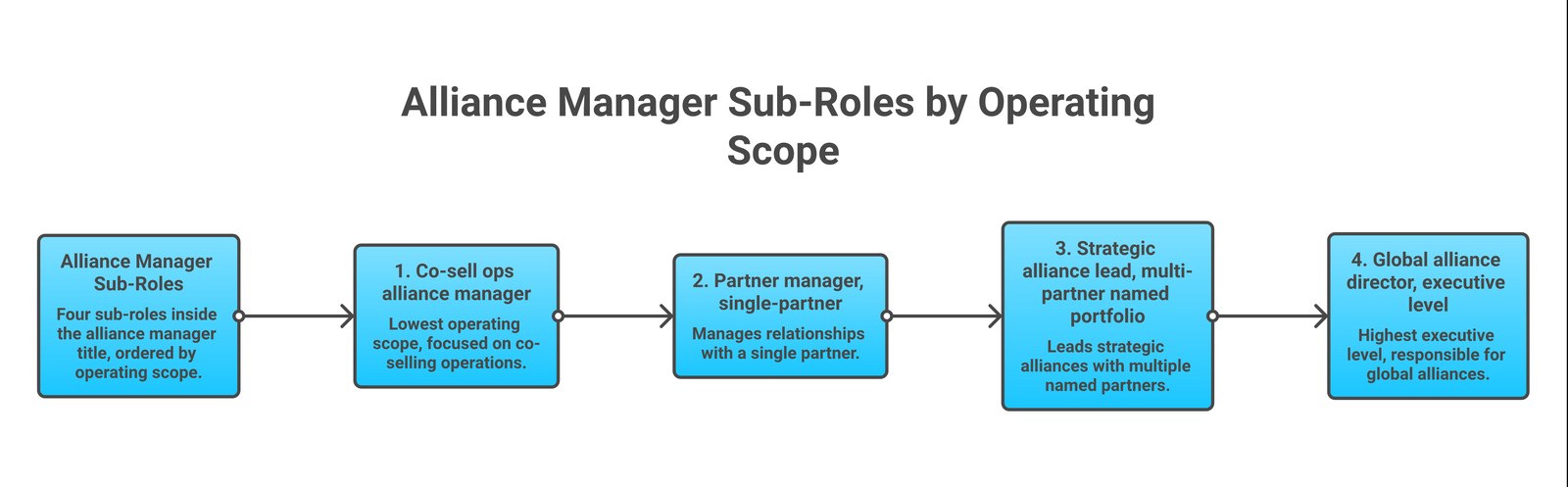
This piece covers what an alliance manager is, the four sub-roles inside the broader title, the operating outcomes the role owns, the failure modes I see most often, and how the alliance manager fits inside the broader partner program.
What is an alliance manager?
An alliance manager owns the day-to-day operating relationship with one or more strategic partners. The accountability is joint pipeline and joint customer outcomes. The role sits between the partner program (which sets the rules) and the field (which closes the deals). A working alliance manager is the operating glue that turns program intent into closed pipeline.
The role title has historical weight. “Alliance manager” emerged in enterprise software in the 1990s for the role that managed strategic technology alliances: Oracle alliances at SAP, IBM alliances at Microsoft, that vintage. The modern usage has expanded to cover any strategic partner motion that requires a named owner: tech alliances, SI alliances, marketplace alliances, channel alliances. The vocabulary varies (alliance manager, partner manager, channel manager, ecosystem manager); the operating responsibility is similar.
The role is distinct from a partner program manager (who runs the program structure across all partners) and a partner marketing manager (who runs co-marketing campaigns). The alliance manager is the operating owner of specific named partner relationships; the program manager owns the underlying rules and the marketing manager owns the demand-generation surface.
Why the alliance manager role matters
Strategic partnerships do not run themselves. The partner contract gets signed, the kickoff happens, and then someone has to do the operating work that turns the relationship into pipeline. The alliance manager is that person. Without one, the partnership defaults to whoever happens to be available, which produces an inconsistent motion that doesn’t compound.
The economic case for the role is straightforward. Strategic partnerships that produce real revenue are operationally expensive: joint pipeline reviews, executive sponsor cadences, deal-by-deal coordination, conflict resolution, attribution arbitration. A named owner with focused capacity does that work consistently; a shared-capacity arrangement does it inconsistently.
The strategic case is that the alliance manager is the partner’s primary internal advocate. The right alliance manager wins the internal political battles to get attention, get pricing exceptions, get co-sell motion, get exec sponsorship, battles the partner cannot fight from outside. Strategic partnerships compound when the alliance manager is good at internal selling; they stagnate when the alliance manager is only good at external relationship management.
The four sub-roles inside the alliance manager title
Four operating profiles sit inside the broader title. Each profile has a different scope, different success metrics, and a different ideal candidate. The most common hiring mistake is writing a JD that mixes two or three profiles, which produces a search that finds nobody and a hire that fits no profile well.
- Co-sell ops alliance manager. Owns deal-by-deal coordination across one or more partner relationships at the field level. Success metric: joint deals closed per quarter. The right candidate has SDR-to-AE field experience and high operating discipline. Common scope: 50-200 named accounts across one or two partners.
- Partner manager (single-partner). Owns the full operating relationship with a single named partner. Success metric: partner-sourced pipeline and joint pipeline retention. The right candidate has deal-stage selling experience and ecosystem fluency. Common scope: one named partner relationship across the partner’s full account base.
- Strategic alliance lead (multi-partner, named portfolio). Owns a portfolio of strategic partner relationships, usually three to seven named partners in a coherent category. Success metric: portfolio-attached pipeline and joint customer outcomes. The right candidate has cross-functional leadership experience and complex-deal navigation.
- Global alliance director (executive-level, strategic). Owns the relationship at the senior level with one or two named flagship partners (Salesforce, ServiceNow, AWS, SAP, Microsoft). Success metric: strategic-partnership health, joint enterprise pipeline, executive cadence.
How the alliance manager works inside the broader program
The alliance manager is downstream of the partner program structure and upstream of the field. Three operating cadences anchor the role: a monthly joint pipeline review with the partner, a quarterly executive sponsor cadence with both leadership teams, and a deal-stage operating tempo at the AE level.
The monthly joint pipeline review is the operating heartbeat. The agenda is named accounts, named opportunities, named blockers, and dispositions. The output is a written joint pipeline document that both teams reference between meetings. Pipeline reviews that don’t produce written disposition decisions are status meetings, not operating meetings.
The quarterly executive sponsor cadence is the escalation lever. The exec sponsors don’t run the partnership; they unblock it when the operating layer hits a structural barrier. The cadence has to be calendared, and the exec sponsors should pre-read a one-page partnership health summary written by the alliance manager.
The deal-stage AE tempo is where pipeline becomes revenue. The alliance manager is the person who pairs the partner AE with the company AE on the right deals at the right stages. Strong alliance managers run weekly or biweekly deal-pairing rituals that scale with portfolio size.
Common pitfalls
The pitfalls are operating pitfalls, not technical pitfalls. The alliance manager role tends to fail for one of three structural reasons.
The first pitfall is hiring for relationship management when the operating motion needs deal coordination. A relationship-only alliance manager produces partner sentiment but not partner pipeline. The role has to combine relationship work with deal-stage operating discipline.
The second pitfall is reporting line. Alliance managers reporting into marketing produce co-marketing output; alliance managers reporting into sales produce co-sell output. The reporting line determines what the role actually does. Most strategic alliance managers should report into sales or directly into the CRO; reporting into marketing is appropriate only when the partnership is fundamentally a co-marketing motion.
The third pitfall is span. An alliance manager covering ten strategic partner relationships cannot run any of them well. The right ratio depends on the sub-role: a co-sell ops manager can cover 50-200 accounts across two partners; a strategic alliance lead can cover three to seven named partners; a global alliance director should own one to two flagship relationships.
Compensation and tooling
| Sub-role | OTE band (US, 2026) | Variable mix | Tooling |
|---|---|---|---|
| Co-sell ops alliance manager | $130K-$170K | 30-40% | CRM, Crossbeam, light PRM |
| Partner manager | $160K-$210K | 35-45% | CRM, Crossbeam, full PRM |
| Strategic alliance lead | $200K-$280K | 35-50% | CRM, Crossbeam, mature PRM, joint planning tools |
| Global alliance director | $280K-$400K+ | 30-50% | Executive partner platform, strategic planning surface, dedicated ops support |
Variable comp is the more important design decision than total OTE. Strategic alliance roles paid on partner-sourced revenue produce sourced-revenue behavior; roles paid on partner-sentiment metrics produce relationship-management behavior. Design the comp plan around the operating outcomes you want.
Forecastable’s POV
The alliance manager hire is one of the highest-leverage hiring decisions in a partnership program. Get the sub-role right and the partnership compounds for years; get it wrong and the partnership burns 18 months and a senior hire. Get the sub-role right by writing the operating outcome before you write the JD.
Two specific calls Forecastable makes consistently. First: the JD should name the partner relationship, the pipeline target, and the operating cadence the role will run. Generic alliance manager JDs (“manage strategic partnerships”) produce generic candidates and predictably miss. Second: the comp plan should pay on partner-sourced or partner-attached revenue, not on partner-sentiment metrics.
The benchmark resources worth borrowing from are AchieveUnite’s “Partner Excellence Framework” and PartnershipLeaders’ role definitions. Crossbeam’s “A Hiring Manager’s Guide to Partnerships Roles and Job Titles” is the most-cited public reference and is generally accurate; treat it as a baseline and adapt the language to your specific motion.
Frequently asked questions
What’s the difference between an alliance manager and a partner manager?
The terms are used interchangeably at most companies. Where there’s a structural distinction, “alliance manager” usually denotes a strategic, multi-stakeholder relationship and “partner manager” denotes a more transactional, single-partner relationship.
What does an alliance manager do day to day?
Joint pipeline review, deal-stage coordination with partner AEs, weekly or biweekly deal-pairing rituals, monthly QBR prep, quarterly executive sponsor cadence, attribution arbitration with finance, and conflict resolution with internal sales.
Who does an alliance manager report to?
Strategic alliance roles should report into sales (CRO or VP Sales) or directly into the CRO. Reporting into marketing is appropriate only when the partnership is fundamentally a co-marketing motion.
How is an alliance manager compensated?
OTE varies by sub-role: $130K-$170K for co-sell ops, $160K-$210K for partner manager, $200K-$280K for strategic alliance lead, $280K-$400K+ for global alliance director. Variable mix typically 30-50%, paid on partner-sourced or partner-attached revenue.
What’s the right ratio of partners to alliance managers?
Depends on the sub-role. A co-sell ops manager can cover 50-200 accounts across two partners; a strategic alliance lead can cover three to seven named partners; a global alliance director should own one to two flagship relationships.
How do I know if my alliance manager is succeeding?
Two leading indicators (joint pipeline created in quarter and joint pipeline retention quarter-over-quarter) and one outcome metric (closed-won partner-attached revenue).
Is alliance manager a senior role?
It depends on the sub-role. A co-sell ops alliance manager is typically a mid-level individual contributor; a strategic alliance lead is senior IC or first-line manager; a global alliance director is senior-leadership IC or second-line manager.
Next step
If you’re hiring an alliance manager, write the operating outcome before you write the JD. The outcome has three lines: which partner the role owns, what pipeline target the role will produce in 12 months, and what cadence the role will run.
Forecastable is an independent third-party professional services company. Our evaluations of other vendors are based on publicly-available information as of May 2026 and our own client experience.
Talk to our team about hiring an alliance manager who produces pipeline →
By Alex Buckles
Uncover Your Growth Potential
Schedule a Discovery Call