Partner Channel Marketing: What It Is and How It Works

Short answer
Short answer: Partner channel marketing is marketing you run with and through your partners to reach their customers, instead of only marketing direct to your own. It covers co-branded campaigns, through-partner demand generation, market development funds, and partner enablement content, and it works when it is tied to a sales motion and to attribution, not when it ships assets into a portal and hopes.
Here is the position. Most partner channel marketing fails for the same reason most partner programs fail: it is run as an activity, not a motion. Assets get made, funds get spent, and no one can say which deal any of it produced.
What is partner channel marketing?
Partner channel marketing is the set of marketing activities a vendor runs jointly with, or on behalf of, the partners who take its product to market. Rather than aiming every campaign at the vendor’s own prospect list, partner channel marketing reaches customers through the partner’s brand, list, and relationships.
It usually takes three shapes. To-partner marketing recruits and educates partners so they know how to sell you. Through-partner marketing arms partners to run demand generation to their own customers under a co-branded or white-labeled banner. With-partner marketing is a joint campaign where both brands show up together to a shared audience. Each shape has a different owner, a different budget line, and a different measure of success, which is the first thing programs get wrong.
Define it plainly the first time it comes up, because “partner marketing” gets used to mean everything from a logo on a webpage to a six-figure event sponsorship. The useful question is not what to call the activity but what it is supposed to produce: partner recruitment, partner mindshare, or sourced pipeline. Those are three different jobs and they do not share a scoreboard.
Why partner channel marketing matters in 2026
Partner channel marketing matters more now because buyers arrive with a partner already in the room. Industry analysts put the share of technology deals that involve a partner at roughly 96 percent, per work widely cited from Jay McBain. If most deals touch a partner, then marketing that only reaches your direct list is marketing to a shrinking slice of the actual buying journey.
The second reason is trust transfer. A campaign that reaches a customer through a partner they already work with carries credibility a cold vendor email never will. Partnership Leaders and others have documented that partner-involved deals tend to close faster and land larger, and channel marketing is how you get your message into that trusted channel at scale rather than one intro at a time.
The catch is that spending on partner marketing is not the same as producing through it. Most programs allocate market development funds, build a content library, and count downloads. A market development dollar produces when it funds a campaign tied to specific accounts and tracked to a deal, and evaporates when it funds a webinar no one attributes.
How partner channel marketing actually works
Partner channel marketing runs on a five-part model. Skip any part and the spend grows while the sourced pipeline does not.
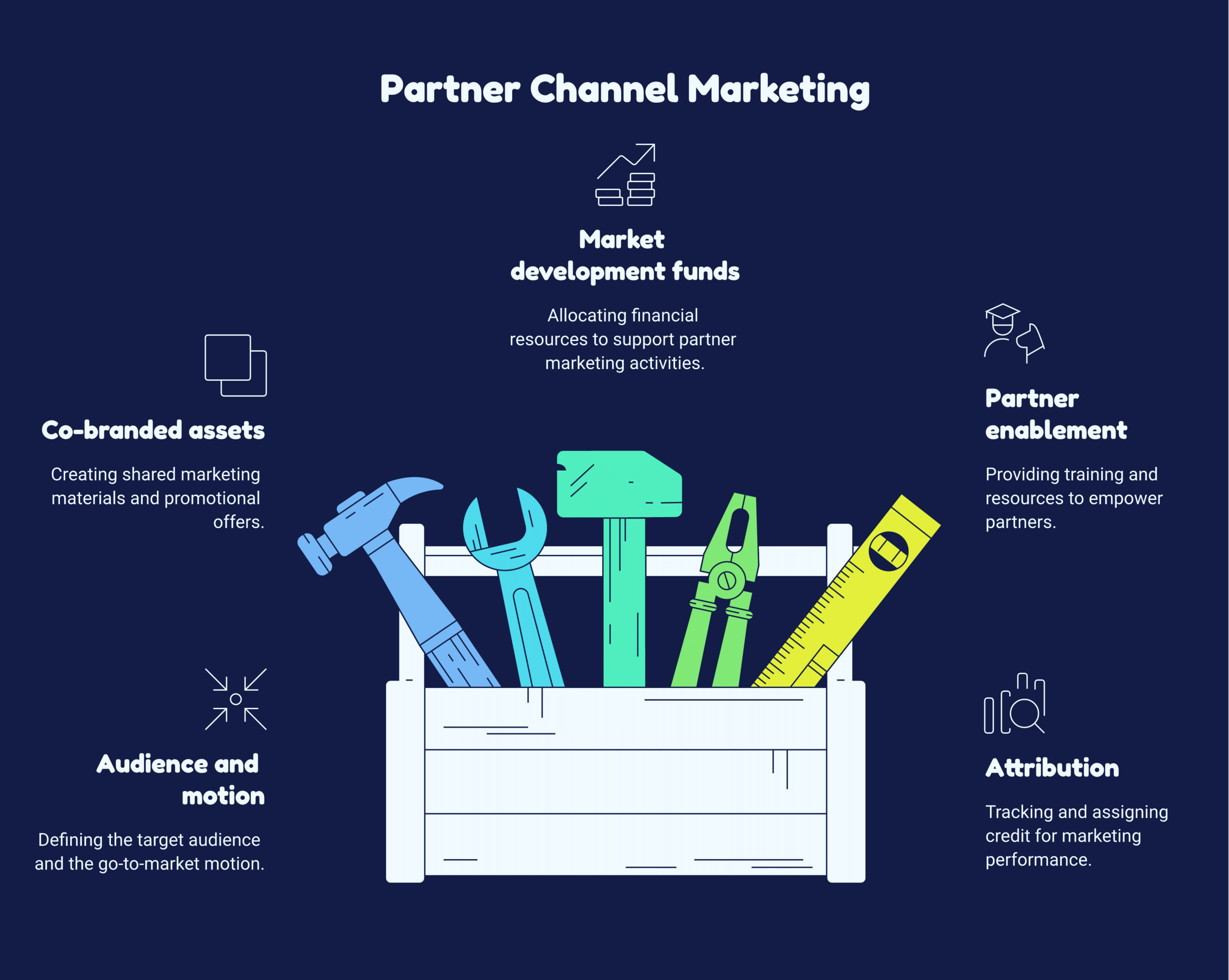
- Audience and motion: decide whose customers you are trying to reach and which partners actually own that audience, then build the campaign around those specific partners rather than broadcasting assets to the whole roster. A campaign aimed at everyone reaches no one’s list.
- Co-branded assets and offers: give partners a concrete offer to put in front of their customers, a workshop, an assessment, a joint webinar, not just a rebranded one-pager. The asset has to be something a partner’s rep would actually send, which means it solves the customer’s problem, not yours.
- Market development funds: fund campaigns against named accounts and require a simple plan and a tracked result for each disbursement, so the money buys pipeline instead of activity. Tie the fund to the motion, not to tier status.
- Partner enablement: make sure the partner’s team can run the play and knows what to do with a responding lead, because a co-branded campaign that generates interest a partner cannot follow up on wastes both brands. Enablement without a live campaign is a certificate no one uses.
- Attribution: track partner-sourced and partner-influenced leads and revenue back to the campaign and the partner, so you can defend the spend and double down on what worked. Without attribution, channel marketing is the first budget cut in a tight quarter.
The through-line is that partner channel marketing is a demand motion, not a content operation. The program that fills a portal with assets and reports downloads is measuring effort. The program that runs a named-account campaign with a specific partner and tracks the deal is measuring production.
Common pitfalls
- Assets over campaigns: building a content library and a portal, then treating that as the program, so partners have material and no reason to run it.
- Spraying MDF: handing out market development funds by tier with no account plan and no tracked outcome, so the money funds activity no one can tie to revenue.
- Marketing without the sales motion: generating co-branded interest with no agreement on who follows up, so leads fall between the vendor and the partner and die.
- One-size assets: shipping the same rebranded one-pager to a reseller, an MSP, and a referral partner, none of whose customers respond to it.
- No attribution: failing to track sourced and influenced pipeline by partner and campaign, so the program cannot be defended and gets cut.
What this looks like in practice
A worked example shows the difference between spend and production. In my work with partnerships teams, the pattern I see most often is a partner marketing budget that funds a content library and a slate of webinars, with success measured in assets shipped and registrations. The pipeline it sources is close to invisible because no one tracks it.
The fix is not more assets. We pick the handful of partners whose customers overlap with the accounts the company actually wants, build one concrete offer those partners would send to their own customers, and run it as a named-account campaign with a clear agreement on who works the responding leads. That is deliberate: the portal does not create demand, a specific campaign with a specific partner against specific accounts does. When the responding leads are tracked back to the partner and the campaign, the program finally has a number it can defend, and that number is what earns the next round of funding.
The lesson is that partner channel marketing is a demand motion you have to run with named partners against named accounts, not a library you stock and a fund you distribute.
Forecastable’s POV
Partner channel marketing fails for a boring reason: it is run as a content and funds operation when it is a demand motion. Assets get made, market development funds get spent, registrations get counted, and no one can point to the pipeline any of it sourced. When the quarter tightens, the budget with no attributable pipeline is the first one cut, and the channel-marketing function spends the next year defending its existence.
The fix is to run it like demand generation and hold it to the same standard: named partners, named accounts, a concrete offer, an agreement on follow-up, and attribution back to the campaign. Prove one co-branded campaign sources real pipeline with a well-fit partner before scaling the content library, not after. Order of operations matters: a producing campaign first, a portal full of assets second.
At Forecastable we operate at that activation layer. We are a partnerships operating platform focused on connecting partner conversations and actions to CRM pipeline and revenue, the flywheel from conversations to actions to pipeline to revenue. Your marketing tools can hold the assets and the fund balances. Our Co-Sell Alignment Specialist is delivered as part of the service and uses the platform to run the joint motion that turns co-branded campaigns into tracked pipeline and to attribute what each partner sources.
My bet: the programs that win treat channel marketing as pipeline with owners and attribution, and the ones that keep stocking portals keep wondering why the spend never shows up in the forecast.
Forecastable is an independent third-party. Any tools, vendors, or third-party figures referenced here are described from public information for the reader’s own evaluation, not as paid placements.
Frequently asked questions
What is partner channel marketing? Partner channel marketing is marketing a vendor runs with and through its partners to reach their customers, instead of only marketing direct. It includes co-branded campaigns, through-partner demand generation, market development funds, and partner enablement content, and it works when it is tied to a sales motion and tracked to pipeline.
What is the difference between to-partner, through-partner, and with-partner marketing? To-partner marketing recruits and educates partners so they know how to sell you. Through-partner marketing arms partners to market to their own customers under a co-branded banner. With-partner marketing is a joint campaign where both brands reach a shared audience together. Each has a different owner and measure of success.
What are market development funds used for? Market development funds are vendor dollars given to partners to run marketing to their customers. Used well, they fund campaigns against named accounts with a plan and a tracked result. Used badly, they are distributed by tier and fund activity no one can tie to revenue.
How do you measure partner channel marketing? Track partner-sourced and partner-influenced leads and revenue back to the specific campaign and partner, not asset downloads or webinar registrations. If the only numbers are activity metrics, the program cannot be defended in a budget review.
Do you need a partner marketing platform to start? Not to start. A platform helps you scale co-branded assets and track funds once you have volume. Production comes from running a named-account campaign with a well-fit partner first; add tooling when the motion is proven and the volume justifies it.
Next step
Look at your partner marketing spend and ask whether you can name the pipeline it sourced last quarter. If the only answer is assets shipped and registrations counted, the problem is not the budget; it is that the spend was never tied to a campaign, a partner, and an account.
If you want the joint motion that turns co-branded marketing into tracked pipeline, that is what we do. Start your growth journey with Forecastable and we will run it on top of your program. Our partner program guide covers how the pieces fit together, and the channel partner guide and referral partner program guide go deeper on the partner types most channel marketing reaches.
Uncover Your Growth Potential
Schedule a Discovery Call