Channel Partner Loyalty Program: What Works in 2026

Short answer
Short answer: A channel partner loyalty program is a structured set of rewards and incentives designed to keep partners engaged, producing, and choosing you over competitors over time, through points, rebates, tiers, recognition, and perks tied to behavior. It works when the rewards reinforce the behaviors that actually drive revenue, and it becomes an expensive giveaway when it rewards activity that does not.
Here is the position. Most channel partner loyalty programs reward the wrong thing. They pay for volume or presence when they should reward the specific behaviors, like registering deals and co-selling, that keep a channel producing.
What is a channel partner loyalty program?
A channel partner loyalty program is a system of incentives a vendor uses to retain and motivate its channel partners beyond the base margin or fee. Where the core program sets the economics of each deal, the loyalty program adds a layer on top: rewards for hitting targets, staying active, completing training, registering deals, or growing year over year. The goal is mindshare, keeping your product top of the partner’s list when a relevant opportunity appears.
It usually combines several mechanisms. Tiers grant better economics and support as partners produce more. Points and rewards give partners something tangible for target behaviors. Rebates return margin for hitting volume or growth goals. Recognition uses status and awards to motivate. Perks offer access, events, or resources reserved for engaged partners. The mix matters less than what each mechanism is tied to.
Define it plainly, because “loyalty program” borrows consumer-marketing language that fits awkwardly here. A partner is not a shopper collecting points; a partner is a business deciding where to spend finite selling capacity. The useful question is not how to make partners feel rewarded but how to make choosing you the obviously better use of their time.
Why a channel partner loyalty program matters in 2026
A channel partner loyalty program matters because partners have limited attention and many vendors competing for it. A partner who works with a dozen vendors will put energy into the two or three that make it worth their while and coast on the rest. A loyalty program, done well, is how you become one of the two or three rather than one of the coasted-on many.
The second reason is retention economics. Recruiting a new productive partner is expensive and slow; keeping an already-producing one engaged is far cheaper. Because partner-involved deals tend to close faster and land larger, per Partnership Leaders, keeping your best partners active is one of the highest-return activities in a channel, and a loyalty program is the structured way to do it.
The catch is that a loyalty program rewards whatever you tie it to, including the wrong things. A program produces when the rewards reinforce revenue-driving behavior, and it drains budget when it pays for logins, certifications no one uses, or volume a partner would have done anyway. Loyalty spend is only as good as the behavior it buys.
How a channel partner loyalty program actually works
A channel partner loyalty program runs on a five-part model. Skip any part and you fund rewards that do not move production.
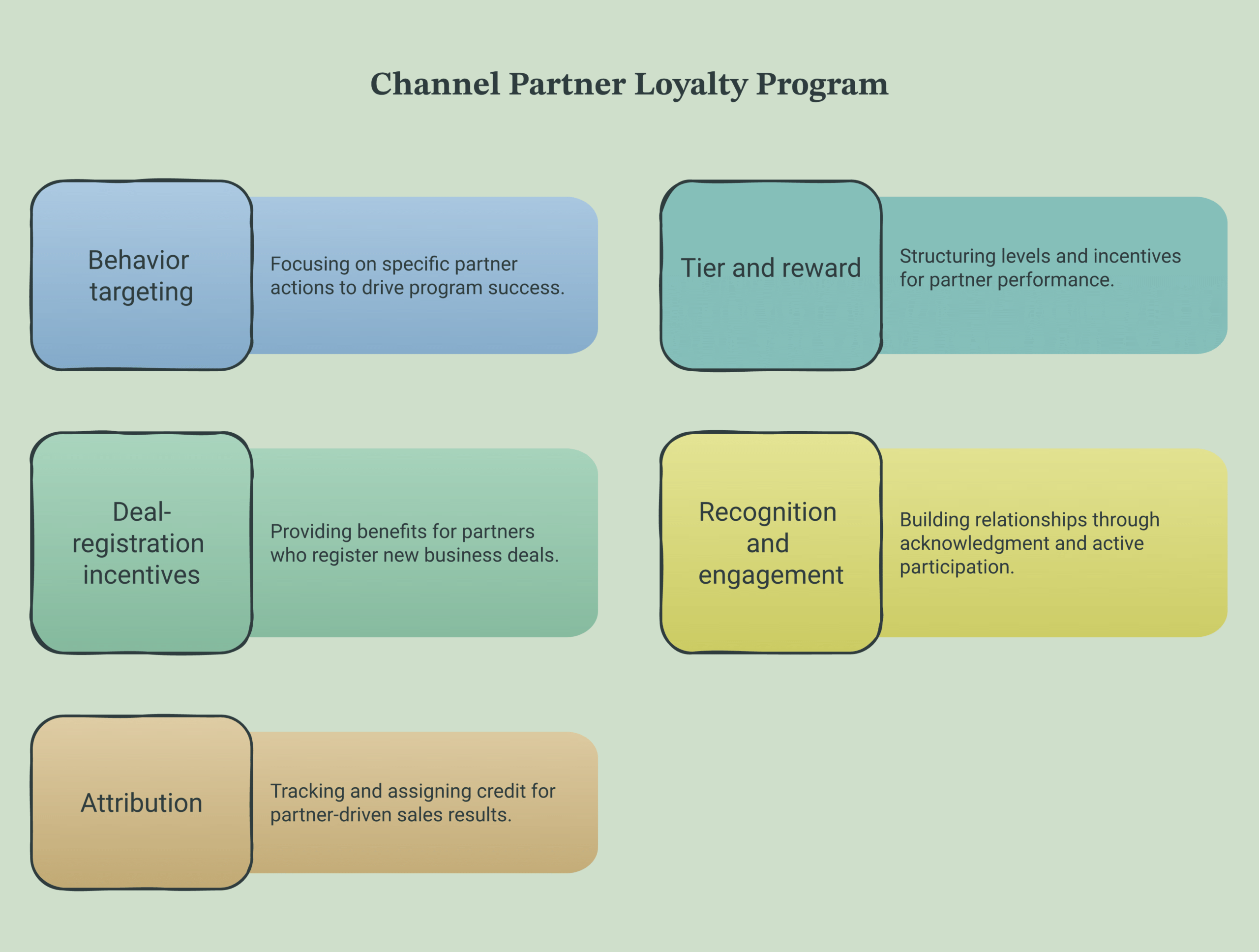
- Behavior targeting: decide which partner behaviors actually drive revenue, registering deals, co-selling, growing an account, and design the program to reward those, rather than presence or generic volume. A reward tied to logins buys logins.
- Tier and reward design: build tiers and rewards that improve as partners produce, so the economics visibly get better the more a partner sells, and the top tier is worth reaching. A flat program gives no reason to grow.
- Deal-registration incentives: reward partners specifically for registering deals early and cleanly, because deal registration is the behavior that protects both partner and vendor and makes attribution possible. Loyalty and clean pipeline data should reinforce each other.
- Recognition and engagement: use status, awards, and access to keep top partners feeling like insiders, because recognition is cheap and mindshare is the real product. The best partners often value status and access over another rebate.
- Attribution: track which rewarded behaviors actually correlate with revenue, so you can cut the incentives that buy nothing and double down on the ones that produce. A loyalty program you cannot measure is a budget line you cannot defend.
The through-line is that a loyalty program is a behavior-shaping tool, not a giveaway. The program that rewards presence and volume indiscriminately funds activity; the program that rewards deal registration, co-sell, and growth funds production. What you reward is what you get.
Common pitfalls
- Rewarding presence, not production: paying for logins, certifications, or attendance that do not correlate with revenue, so the budget buys activity instead of deals.
- Flat, undifferentiated rewards: giving all partners the same perks regardless of production, so top partners feel unrecognized and low performers have no reason to improve.
- Rebates for volume a partner would do anyway: paying rebates on baseline volume rather than incremental growth, which is pure margin giveaway.
- Ignoring deal registration: failing to tie loyalty to clean deal registration, so the program rewards revenue you cannot attribute.
- No measurement: running a loyalty program without tracking which rewards correlate with revenue, so ineffective incentives run indefinitely.
What this looks like in practice
A worked example shows the difference between a loyalty program that shapes behavior and one that just spends. In my work with partnerships teams, the loyalty program that underperforms usually rewards the easy-to-measure things, portal logins, training completions, event attendance, because they are simple to track, not because they drive revenue. The budget flows and the channel does not produce any more than before.
The fix is to reward the behavior that actually precedes revenue. We identify what producing partners do differently, they register deals early, they co-sell, they grow their accounts, and we redesign the rewards to reinforce exactly those behaviors, then track which rewards correlate with real revenue. That is deliberate: the program does not create loyalty by handing out perks; it creates production by paying for the behaviors that lead to deals. The incentives that turn out to correlate with revenue get more budget; the ones that do not get cut.
The lesson is that a channel partner loyalty program buys whatever behavior you reward, so reward the behavior that produces revenue and measure the link, or you are funding activity that would have happened anyway.
Forecastable’s POV
A channel partner loyalty program fails for a boring reason: it rewards what is easy to measure instead of what drives revenue. Logins, certifications, and attendance are simple to track, so they become the reward criteria, and the program ends up paying for activity that has no relationship to production. A year in, leadership sees loyalty spend rising and channel revenue flat and cannot explain the gap.
The fix is to treat the loyalty program as behavior design, not a rewards catalog: figure out what producing partners do differently, reward those behaviors, tie loyalty to clean deal registration, and measure which incentives actually correlate with revenue. Cut what does not produce. Order of operations matters: identify revenue-driving behavior first, design rewards second.
At Forecastable we operate at that activation layer. We are a partnerships operating platform focused on connecting partner conversations and actions to CRM pipeline and revenue, the flywheel from conversations to actions to pipeline to revenue. Your partner tech can hold the tiers, points, and rebates. Our Co-Sell Alignment Specialist is delivered as part of the service and uses the platform to run the motion that produces the behaviors worth rewarding and to attribute which partners actually source revenue.
My bet: the programs that win reward deal registration, co-sell, and growth and measure the link to revenue, and the ones that keep paying for logins and attendance keep wondering why loyalty spend never shows up in the forecast.
Forecastable is an independent third-party. Any tools, vendors, or third-party figures referenced here are described from public information for the reader’s own evaluation, not as paid placements.
Frequently asked questions
What is a channel partner loyalty program? A channel partner loyalty program is a structured set of rewards and incentives, such as tiers, points, rebates, recognition, and perks, that a vendor uses to keep partners engaged, producing, and choosing them over competitors over time. It works when the rewards reinforce revenue-driving behaviors rather than generic activity.
How is a loyalty program different from the base partner program? The base program sets the core economics of each deal, such as margin or fees. A loyalty program adds a layer on top that rewards sustained behavior, hitting targets, registering deals, growing accounts, to build mindshare and retention beyond any single transaction.
What should a channel partner loyalty program reward? The behaviors that precede revenue: early and clean deal registration, co-selling, and account growth. Rewarding presence metrics like logins, certifications, or attendance tends to fund activity that does not correlate with production, which is the most common way loyalty budgets are wasted.
Do channel partner loyalty programs actually work? They work when they reward revenue-driving behavior and the vendor measures which incentives correlate with revenue. They fail when they reward what is easy to measure instead of what drives deals. The program buys whatever behavior it is tied to, so design and measurement decide the outcome.
How do you measure a channel partner loyalty program? Track which rewarded behaviors correlate with actual revenue, then keep the incentives that produce and cut the ones that do not. A loyalty program that cannot show which rewards lead to deals is a budget line that cannot be defended in a tight quarter.
Next step
Look at your loyalty program and ask whether the rewards are tied to deal registration and co-sell or to logins and attendance. If it is the latter, the problem is not partner engagement; it is that the program is buying activity instead of production.
If you want the motion that produces the behaviors worth rewarding and attributes the revenue, that is what we do. Start your growth journey with Forecastable and we will run it on top of your program. Our partner program guide covers how the pieces fit together, and the channel partner guide and channel partner management guide go deeper on running a producing channel.
Uncover Your Growth Potential
Schedule a Discovery Call