Channel Partner Agreement Template: What to Include

Short answer
Short answer: A channel partner agreement template is a reusable contract that defines the terms of the relationship between a vendor and a channel partner, covering scope, economics, deal registration, rules of engagement, obligations, and termination. A good template gets you consistency and speed, but the sections that actually decide whether the partnership produces, deal registration and rules of engagement, are the ones most templates treat as boilerplate.
Here is the position. The agreement is not the partnership; it is the floor under it. A clean template prevents disputes and speeds onboarding, but no contract ever made a partner sell. Get the template right so the relationship has clear rules, then go run the motion.
What is a channel partner agreement template?
A channel partner agreement template is a standardized contract a vendor uses across its partners so every relationship starts from the same terms. Rather than negotiating each deal from scratch, the vendor defines its standard terms once, resellers, referral partners, systems integrators, and MSPs often each get a tailored variant, and applies them consistently. That consistency is the point: it speeds onboarding, keeps the program fair, and prevents the drift that happens when every partner has bespoke terms.
The template sets out what each side agrees to. For the partner, it defines how they can represent and sell the product, what they earn, and what protections they get. For the vendor, it defines what the partner must do, how conflicts are handled, and how the relationship can end. Done well, it is the document both sides point to when something is unclear, which is exactly when it earns its keep.
Define it plainly, because a channel partner agreement is not a one-size document. A referral partner agreement and a reseller agreement cover different economics and obligations, and forcing every partner type onto one template creates terms that fit none of them. The template is a starting frame you adapt by partner type, not a single contract for everyone.
This is general information on what these agreements typically contain, not legal advice. Any channel partner agreement should be reviewed by a qualified attorney before use.
Why a channel partner agreement template matters in 2026
A channel partner agreement template matters because a growing channel cannot run on handshake terms. As soon as you have more than a few partners, inconsistent agreements create conflict, resellers colliding on the same account, partners unsure how they get paid, disputes over who sourced a deal, and every one of those disputes costs trust and time. A clean template prevents most of them before they start.
The second reason is speed. Recruiting is slow enough without every agreement becoming a negotiation. A template lets you onboard a new partner in days instead of weeks, which matters because the gap between a partner saying yes and a partner actually selling is where enthusiasm dies. The faster the paperwork, the faster you can get to the motion that produces.
The catch is that a template can create false confidence. A signed agreement feels like progress, so teams treat the signature as the milestone and stop. An agreement produces nothing on its own; it just sets the rules for a relationship someone still has to run. The template is necessary and nowhere near sufficient.
How to structure a channel partner agreement
A channel partner agreement template runs on a set of core sections. Skip or boilerplate the wrong ones and the agreement fails exactly when you need it.
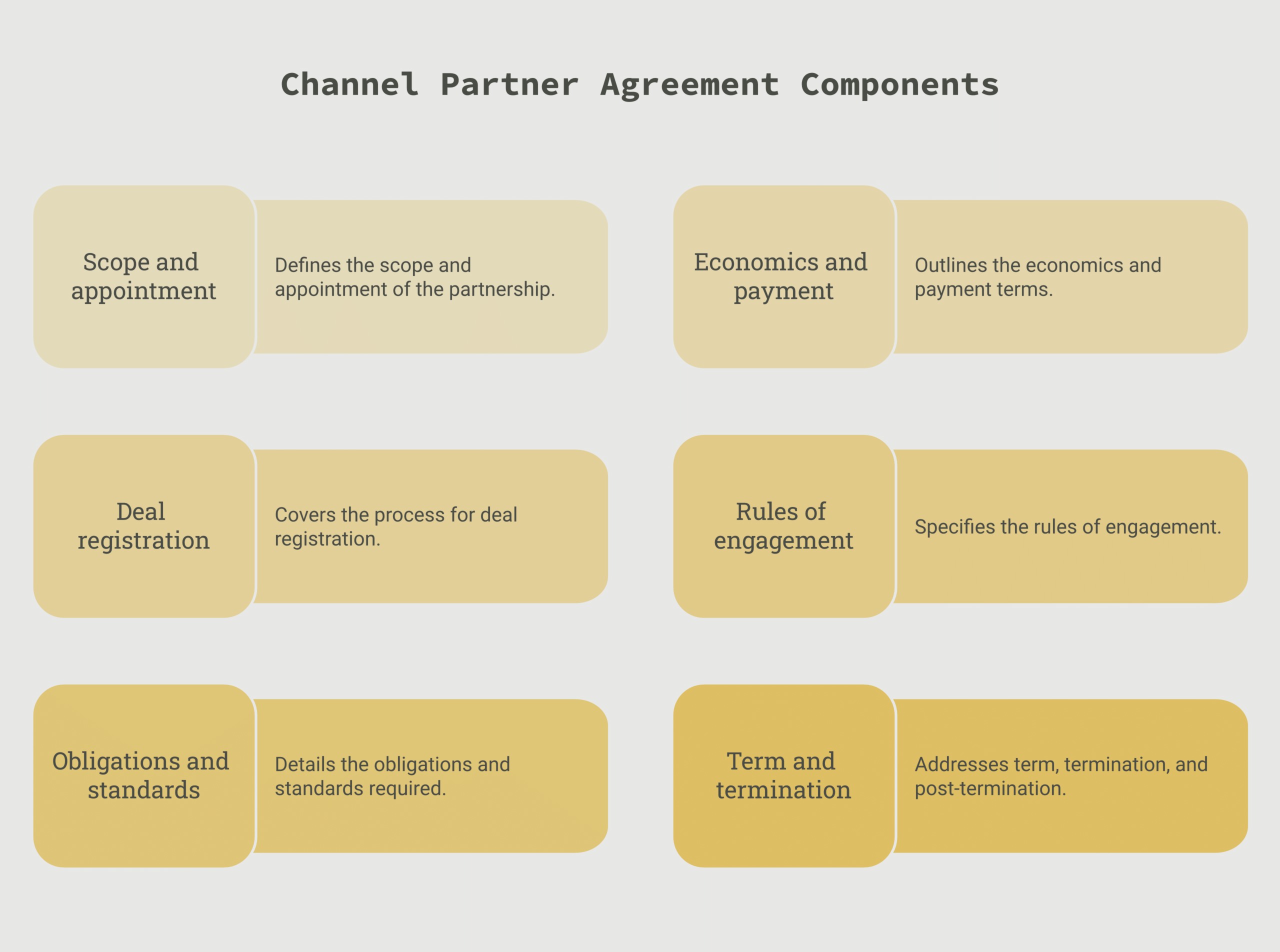
- Scope and appointment: define what the partner is authorized to do, sell, refer, integrate, or deliver, and in what territory or segment, so both sides know the boundaries of the relationship. Vague scope is where channel conflict begins.
- Economics and payment: state the margin, fee, or rebate structure and exactly when and how the partner gets paid, because payment ambiguity is the fastest way to lose a partner’s trust. Spell out the numbers, not just the principle.
- Deal registration: define how a partner registers a deal, what protection registration grants, and how long it lasts, because deal registration is the mechanism that prevents conflict and makes attribution possible. This is the section most templates treat as boilerplate and the one that matters most operationally.
- Rules of engagement: set out how vendor-direct and partner deals are handled, how conflicts between partners are resolved, and who decides, so contested deals are settled on defined rules rather than escalation. Undefined rules of engagement are why partners stop bringing you deals.
- Obligations and standards: specify what each side must do, partner training and certification, vendor support and lead sharing, brand and compliance standards, so expectations are explicit rather than assumed.
- Term, termination, and post-termination: define the length, renewal, how either side can exit, and what happens to in-flight deals and registered pipeline on termination, so an ending relationship does not turn into a dispute.
The through-line is that the agreement’s job is to make the operational rules, especially deal registration and rules of engagement, explicit enough that disputes are rare and quickly settled. The legal boilerplate matters, but the sections that govern day-to-day channel behavior are what separate a template that prevents conflict from one that just sits in a folder.
Common pitfalls
- One template for every partner type: forcing referral partners, resellers, SIs, and MSPs onto identical terms, so the economics and obligations fit none of them.
- Boilerplate deal registration: treating the deal-registration section as legal filler, so the mechanism that prevents conflict and enables attribution is vague or missing.
- Undefined rules of engagement: leaving vendor-direct-versus-partner conflict rules unspecified, so contested deals become escalations and partners stop registering.
- Mistaking the signature for the milestone: treating a signed agreement as progress and stopping there, when the agreement only sets rules for a relationship no one is running.
- Payment ambiguity: stating the principle of how partners earn without the specifics of amount and timing, which erodes trust the first time a payout is unclear.
What this looks like in practice
A worked example shows how the operational sections earn their keep. In my work with partnerships teams, the disputes that consume a channel manager’s time almost always trace back to two vague sections in the agreement: deal registration and rules of engagement. Two partners claim the same account, or a partner and the direct team collide, and because the agreement is quiet on how those are resolved, every case becomes a negotiation.
The fix is to write those two sections as if you expect them to be tested, because they will be. We define exactly how a deal is registered, what protection it grants, how long it holds, and precisely how a conflict between a partner and the direct team, or between two partners, gets decided and by whom. That is deliberate: the template is not there to look complete; it is there to settle the disputes that would otherwise burn trust. Once those rules are explicit, the channel manager stops refereeing and starts running the motion.
The lesson is that a channel partner agreement template earns its value in the operational sections, not the boilerplate. Write deal registration and rules of engagement precisely, adapt the template by partner type, then get to the work the agreement only made possible.
Forecastable’s POV
A channel partner agreement template fails, or rather underdelivers, for a boring reason: teams get the legal boilerplate right and the operational sections wrong, then treat the signature as the finish line. The agreement is clean, everyone signs, and the same account conflicts and attribution disputes happen anyway because deal registration and rules of engagement were left vague. Worse, the signed agreement creates a false sense that the partnership is now underway, when nothing has actually been run.
The fix is two-part. Get the template right where it counts, precise deal registration, explicit rules of engagement, clear economics, adapted by partner type and reviewed by counsel. Then treat the signature as the start, not the milestone, and go run the motion the agreement made possible. Order of operations matters: a clean agreement first, a running partner motion second, and never mistake the first for the second.
At Forecastable we operate at that activation layer, after the agreement is signed. We are a partnerships operating platform focused on connecting partner conversations and actions to CRM pipeline and revenue, the flywheel from conversations to actions to pipeline to revenue. Your legal template sets the rules. Our Co-Sell Alignment Specialist is delivered as part of the service and uses the platform to run the joint motion that turns a signed partner into a producing one and to attribute what they source.
My bet: the programs that win write the operational sections of the agreement as carefully as the legal ones and then actually run the relationship, and the ones that perfect the contract and stop keep wondering why signed partners never produce.
Forecastable is an independent third-party. Any tools, vendors, or third-party figures referenced here are described from public information for the reader’s own evaluation, not as paid placements. This article is general information, not legal advice.
Frequently asked questions
What is a channel partner agreement template? A channel partner agreement template is a reusable contract that defines the terms of a vendor-partner relationship, including scope, economics, deal registration, rules of engagement, obligations, and termination. It gives a program consistency and speeds onboarding, and it is typically adapted by partner type.
What should a channel partner agreement include? Scope and appointment, economics and payment terms, deal registration, rules of engagement, mutual obligations and standards, and term and termination. The deal-registration and rules-of-engagement sections are the most operationally important and the ones most often treated as boilerplate.
Do all partner types use the same agreement? No. Referral partners, resellers, systems integrators, and MSPs have different economics and obligations, so a single template rarely fits all of them well. The usual practice is a common frame adapted into variants by partner type.
Why does deal registration matter in the agreement? Deal registration is the mechanism that prevents partners and the direct team from colliding on the same account and makes partner attribution possible. If the agreement defines it vaguely, account conflicts become negotiations and partners lose the incentive to register, which undermines the whole channel.
Is a channel partner agreement template legal advice? No. A template and any article describing one are general information, not legal advice. Any channel partner agreement should be reviewed and adapted by a qualified attorney before use to fit the specific jurisdiction, partner type, and business terms.
Next step
Look at your channel partner agreement and read the deal-registration and rules-of-engagement sections. If they are vague or copied boilerplate, that is where your channel conflicts are coming from, not from the partners.
If you want the motion that turns a signed agreement into a producing partnership, that is what we do. Start your growth journey with Forecastable and we will run it on top of your program. Our partner program guide covers how the pieces fit together, and the channel partner guide and referral partner program guide go deeper on the partner types your agreement covers.
Uncover Your Growth Potential
Schedule a Discovery Call