Reseller Program: What It Is and How to Build One

Short answer
Short answer: A reseller program is the structure that lets partners buy or sell your product for a margin and take it to their own customers under a defined agreement. It matters because resellers can carry your product into markets and accounts your direct team never reaches, but a reseller program only produces if the margin is designed to drive active selling rather than passive listing.
The mistake is treating margin as the whole design. A discount alone buys shelf space, not effort. The reseller program that works pays for the behavior you want, which is the partner’s reps actively working their base, not waiting for deals to appear.
What is a reseller program?
A reseller program is a formal arrangement in which partners resell your product to their customers for a margin or discount, under terms that define pricing, deal handling, and support. The reseller owns the customer transaction and often the relationship, buying at a discount and selling at your list price, or earning a defined margin on deals they bring.
The model is distinct from its neighbors. A referral partner introduces a prospect and hands the deal to you for a fee, never touching the transaction. A reseller carries the transaction itself, contracts with the customer, and keeps the margin. A technology partner is defined by product fit, not by selling your product at all. A reseller program is specifically about distribution: partners moving your product for economic gain.
The distinction worth holding is reseller versus referral, because companies agonize over it and often frame it as either-or when it is not. A reseller agreement can be cleaner for the customer, one contract, no extra procurement friction, and faster to close, while a referral keeps the partner at arm’s length from the transaction. The right choice depends on the partner and the deal, but the reseller path is frequently simpler for everyone than teams assume.
Why a reseller program matters in 2026
A reseller program matters because resellers extend your reach into accounts, regions, and segments your direct sales cannot cover efficiently. A partner with an established book of business can sell your product into relationships that would take your team years to build, which is why resellers remain a backbone of B2B distribution even as other partner models grow.
The strategic value is a motion that scales without your headcount. Every reseller rep who leads with your product is selling capacity you did not hire. Done well, a reseller program turns a partner’s existing sales force into an extension of yours, and the economics can be compelling because you pay margin only on what actually sells.
The recurring failure is designing the margin to reward passivity. A reseller who earns the same margin whether they proactively sell or passively take inbound will default to passive, and the program produces a trickle. When I have helped design reseller agreements, the question is always whether the incentive is structured to drive the specific behavior we want, which is the partner’s account managers proactively working their customer base, not sitting back and collecting on deals that would have closed anyway.
How a reseller program actually works
A reseller program that produces runs on five components. The margin is central, but how you structure it, and everything around it, decides whether resellers actually sell.
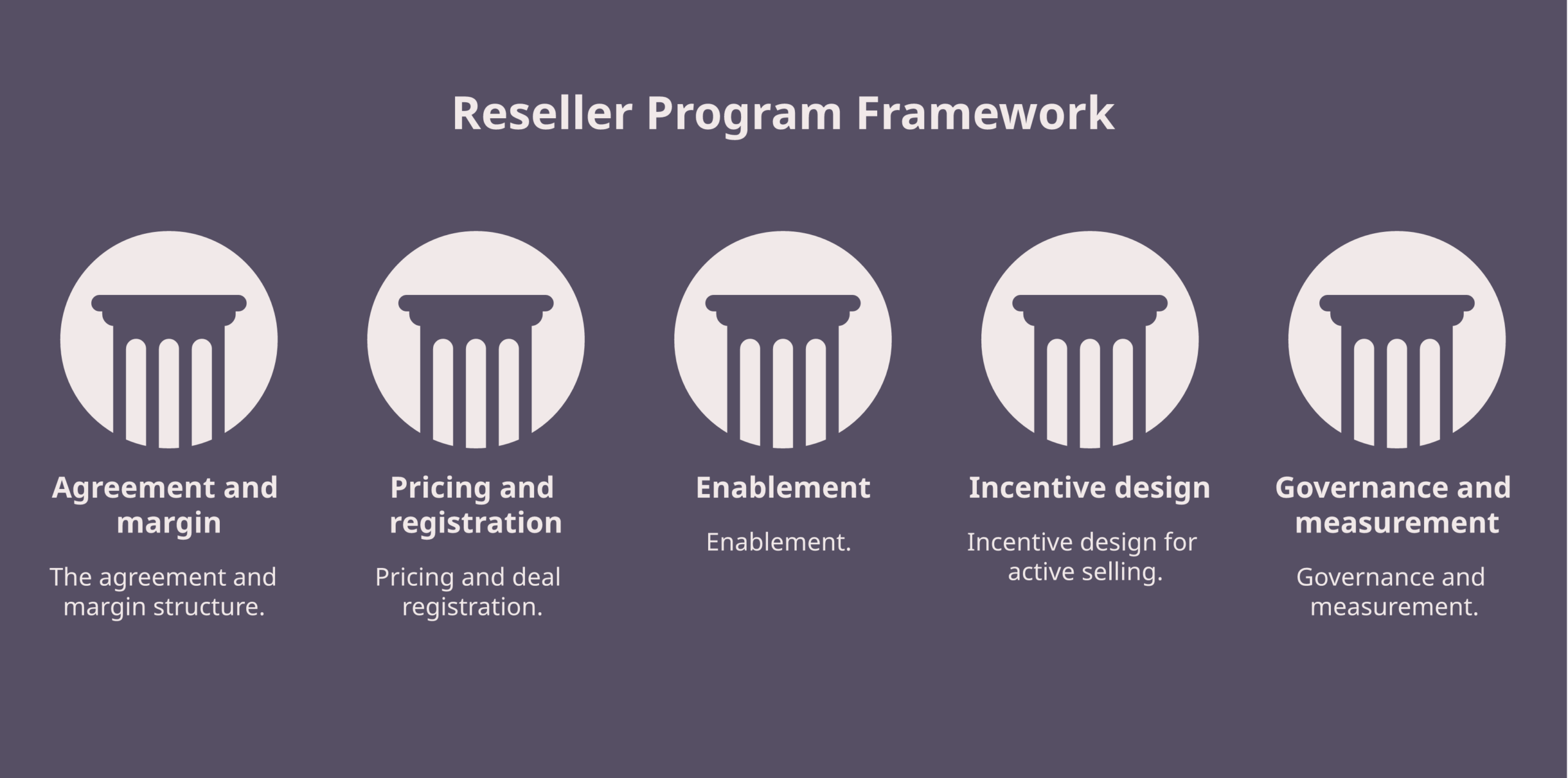
- The agreement and margin structure: define how the reseller earns, the discount or margin, the tiers, and the terms. Set the margin high enough that the partner’s reps have a real reason to lead with you, because a thin margin buys a listing, not a sales effort.
- Pricing and deal registration: protect the reseller’s margin and prevent conflict by registering deals and defining who owns which accounts. Without this, resellers compete with your direct team and each other, and stop trusting the program.
- Enablement: train the reseller’s reps to actually sell your product, not just carry it on a price list. A reseller who cannot articulate your value will not win deals against a vendor whose partners can.
- Incentive design for active selling: structure the economics and any added incentives to reward proactive outreach, the partner’s account managers working their base, rather than passive order-taking. The design should pay for the behavior you want more than the outcome you would have gotten anyway.
- Governance and measurement: assign an owner, run a cadence, and track sourced pipeline per reseller. A reseller program without governance drifts toward the partners who happen to sell and neglects the ones who could.
The through-line is that a reseller program is behavioral economics, not just a discount schedule. The margin is the lever, and how you shape it decides whether the partner’s reps actively sell or passively list. Programs that set a margin and walk away get passive resellers; programs that design the incentive around active selling get a channel.
Common pitfalls
- Margin that rewards passivity: setting a discount the reseller earns whether or not they proactively sell. Paid the same for effort and no effort, most partners choose no effort.
- Framing reseller versus referral as either-or: agonizing over the choice when a reseller agreement is often cleaner for the customer and faster to close. The false choice delays deals that a simple agreement would move.
- No deal registration: letting resellers collide with your direct team and each other over the same accounts. Unmanaged conflict destroys the trust a reseller program runs on.
- Selling on a price list, not enabling: adding a product to a reseller’s catalog without training their reps to sell it. A carried product no one can pitch does not win.
- No governance: signing resellers and never running a cadence, so the program drifts to whoever self-selects into selling. The resellers who could produce with support never get it.
What this looks like in practice
The version that works designs the incentive around behavior. Take a reseller agreement I would model this on: a vendor set the margin at 30% for a mid-sized software partner, deliberately high enough that the partner’s leadership cared about the ARR growth it represented and their account managers had a reason to proactively work their customer base. The design question was never just how big the discount should be, it was whether the structure would drive account-manager outreach rather than passive referrals, and the margin was set to make active selling the obvious choice.
The reseller-versus-referral decision was reframed, not agonized over. Rather than treating it as a hard either-or, the vendor presented the reseller agreement as the simpler path, one contract, less procurement friction for the customer, and a faster cycle, which happened to also be the structure that put the partner closer to the transaction and more motivated to sell. Framing it as simpler and better for the customer, not as a philosophical choice between models, moved the deal.
The contrast is the vendor that signs resellers on a standard discount and lists the product in their catalog. The margin rewards nothing in particular, no one trains the reseller’s reps, and the deals that come through are the ones that would have closed anyway. The vendor calls it a reseller program and it functions as a price list. The lesson repeats: a reseller program is a behavior-design problem, and the teams that win set the economics to make active selling the rational choice.
Forecastable’s POV
A reseller program is where the difference between a discount and an incentive shows up most clearly. Give a partner margin and nothing else and you have bought a spot on a price list. Design that margin to reward the specific behavior you want, proactive selling into their base, and you have built a channel. The number that matters is not the discount, it is whether the reseller’s reps are actually working accounts.
At Forecastable we treat reseller economics as a behavior problem to be operated, not just a contract to be signed. We are a partnerships operating platform focused on connecting partner conversations and actions to CRM pipeline and revenue, the flywheel that runs from conversations to actions to pipeline to revenue. The agreement answers “what margin does the reseller earn.” The work we deliver as part of the service answers “are the reseller’s reps actively selling and producing,” run on the Forecastable platform. A margin starts the relationship. Operating it produces the revenue.
My bet: the programs that win will design reseller margins around active selling and measure resellers by what they source, not by how many they have signed. The vendors treating a reseller program as a discount schedule are funding a price list and calling it a channel.
Forecastable is an independent third-party. Any tools or vendors named here are described from public information for the reader’s own evaluation, not as paid placements, and Forecastable does not resell them.
Frequently asked questions
What is a reseller program? A reseller program is a formal arrangement in which partners resell your product to their customers for a margin, under terms covering pricing, deal handling, and support. The reseller owns the transaction and often the customer relationship, buying at a discount and selling your product as your product.
What is the difference between a reseller and a referral partner? A referral partner introduces a prospect and hands the deal to you for a fee, never touching the transaction. A reseller carries the transaction, contracts with the customer, and keeps the margin. Reselling puts the partner in the deal; referring keeps them beside it.
Should I use a reseller agreement or a referral agreement? It depends on the partner and the deal, but the choice is not always the agonizing either-or teams make it. A reseller agreement is often cleaner for the customer, one contract, less procurement friction, and faster to close, while keeping the partner closer to the transaction and more motivated to sell.
What margin should a reseller program offer? Enough that the partner’s reps have a real reason to lead with you, because a thin margin buys a listing rather than a selling effort. The right level depends on your economics, but the design goal is to make active selling the rational choice for the partner, not just to set a discount.
How do you prevent channel conflict in a reseller program? Register deals and define which accounts belong to the reseller, the direct team, and other partners. Deal registration protects the reseller’s margin and stops partners from competing over the same accounts, which is what erodes trust in a program.
How do you measure a reseller program? Track sourced and influenced pipeline per reseller, tied to your CRM, and watch whether the reseller’s reps are proactively working accounts. Signed reseller count is a vanity metric. The real measure is active resellers producing pipeline.
Next step
Look at your reseller margins and ask a single question of each: does this structure reward the partner for proactively selling, or does it pay the same whether they work the account or not. Any margin that rewards passivity is funding a price list.
If you want reseller economics designed around active selling and measured on sourced pipeline, that is the operating work we do. Start your growth journey with Forecastable and we will make active selling the rational choice for your resellers. Our partner program guide covers how reselling fits alongside your other partner types.
Uncover Your Growth Potential
Schedule a Discovery Call