Business Partner Program: What It Is and How to Build One

Short answer
Short answer: A business partner program is the structured system a company uses to recruit, onboard, enable, incentivize, and measure the partners that help it sell, from resellers to referral and technology partners. It matters because partners produce a large share of modern pipeline, and without a real structure a program becomes a list of signed logos that generate nothing.
The mistake is building the program around recruitment. Signing partners is the easy, visible part. A business partner program lives or dies on activation and measurement, which is the work that happens after the logo goes up.
What is a business partner program?
A business partner program is the framework that governs how a company works with its partners: who it recruits, how it brings them on, how it equips them to sell, what it pays them, and how it measures what they produce. It usually spans several partner types, referral partners, resellers, technology partners, and services firms, each with its own terms and its own motion.
The structure exists because partners are not employees and cannot be run by management fiat. A program gives them a defined path: a way in, a reason to invest, the tools to sell, and a payoff for producing. Without that structure, partnerships happen one ad-hoc handshake at a time and never compound into a channel.
The distinction that matters is between a program and a page. A partner page lists logos and calls itself a program. A real business partner program is an operating system, with tiers, enablement, incentives, and a cadence behind each partner type. The first is marketing collateral; the second is a revenue engine, and companies confuse the two constantly.
Why a business partner program matters in 2026
A business partner program matters because partner-influenced revenue is now too large to run informally. Analyst Jay McBain has estimated that roughly 96% of technology deals are partner-surrounded, and companies that formalize how they work with partners capture more of that surrounding activity than companies improvising it. The structure is what turns scattered partner relationships into a repeatable source of pipeline.
The strategic point is that a program lets you invest unequally on purpose. Tiers, defined benefits, and clear economics mean you can pour resources into the partners who produce and keep the rest on a light touch, rather than treating every partner the same. That deliberate concentration is only possible when the structure exists to support it.
The recurring failure is standing up the shell and skipping the operations. I have seen companies launch a program with a portal, a tier chart, and an application form, then wonder why nothing moves. The visible scaffolding got built and the invisible work, activating partners and running a cadence, never did. A program is not the announcement, it is the operating discipline underneath it.
How a business partner program actually works
A business partner program that produces runs on five components. Recruitment is only the first, and the four that follow decide whether the partners you sign ever sell.
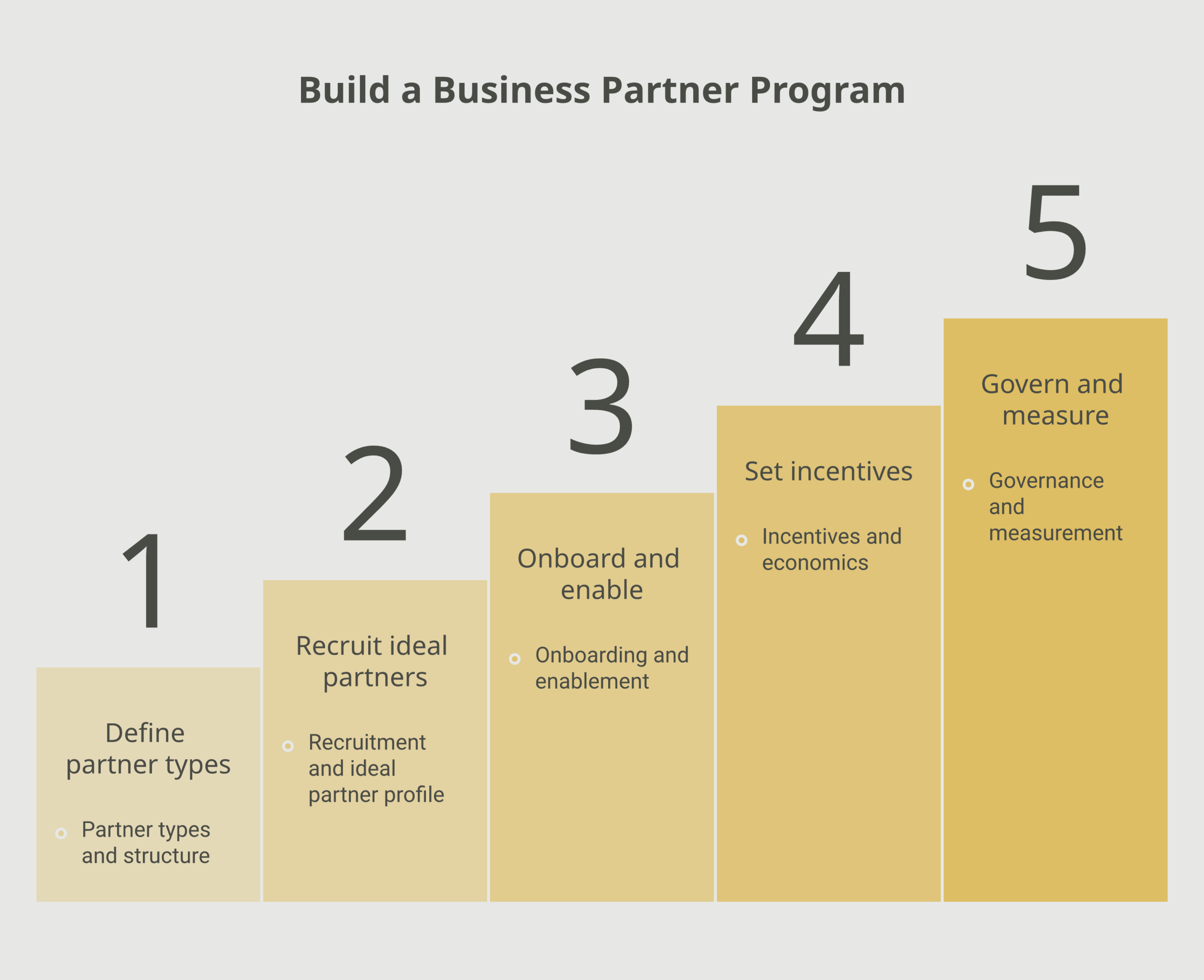
- Partner types and structure: define the kinds of partners you work with, referral, reseller, technology, services, and give each its own terms, motion, and expectations. A single generic track for every partner type fits none of them well.
- Recruitment and ideal partner profile: decide who you actually want before you sign anyone, based on fit and customer overlap rather than willingness. Recruiting on availability fills the program with weak matches that never activate.
- Onboarding and enablement: take a signed partner to a first deal with training, content, and a clear initial play. This is where signatures become sellers, and skipping it is why so many programs stall at the logo.
- Incentives and economics: set the margins, tiers, and funds that make it worth a partner’s time to lead with you. The incentive has to map to the behavior you want, not just exist as a discount.
- Governance and measurement: assign owners, run a cadence, and track sourced pipeline per partner. A program no one governs and no one measures reverts to a list within two quarters.
The through-line is that a business partner program is mostly the four things after recruitment. The application form and the tier chart are the parts everyone builds. The onboarding, incentives, cadence, and measurement are the parts that decide whether the program produces, and they are the parts most often left half-built.
Common pitfalls
- Building a page, not a program: launching a partner page with logos and an application and calling it a program. Structure without operations produces nothing.
- Recruiting on availability: signing any partner willing to join instead of the ones that fit. A program full of weak matches spends its energy on partners that will never activate.
- One generic track: forcing referral, reseller, and technology partners through the same motion. Each type needs its own terms and its own play, or none of them fit.
- Incentives with no behavior: setting margins and funds without mapping them to the partner action you want. An incentive that pays for nothing specific changes nothing.
- No governance: leaving the program to run itself after launch, with no owner and no cadence. Unmanaged programs decay into logo lists no matter how good the launch looked.
What this looks like in practice
The version that works segments before it scales. Take a program I would model this on where the company split its partners into distinct motions rather than running one track: systems integrators and resellers who carry deals went into a co-sell and expansion motion, while technology and marketplace partners went into an integration and warm-access motion. Same program, different plays per type, and a short priority list inside each. The structure let the team invest heavily where deals were and lightly where they were not.
The economics were designed to drive behavior, not just to exist. For a reseller relationship, the margin was set high enough that the partner’s own account managers had a reason to proactively work their customer base rather than passively wait for referrals, because a program that pays for passivity gets passivity. The incentive followed the behavior the company actually wanted, which is the difference between a program that produces and a discount schedule that does not.
The contrast is the company that launches the shell and stops. It has the tiers, the portal, the application, and no one running a cadence with the partners who signed. The program looks complete and produces almost nothing, because the visible parts were built and the operating parts were not. The lesson repeats: a business partner program is the operations under the structure, and the teams that win build those operations, segment by partner type, and measure what each one produces.
Forecastable’s POV
A business partner program is easy to launch and hard to run, which is exactly backwards from how most companies treat it. The launch, the tiers, the portal, the announcement, gets the investment and the attention. The running, activating partners and measuring them week after week, is what produces revenue, and it is the part that quietly goes unbuilt.
At Forecastable we build for the running, not the launch. We are a partnerships operating platform focused on connecting partner conversations and actions to CRM pipeline and revenue, the flywheel that runs from conversations to actions to pipeline to revenue. A program structure answers “what tiers and terms do we offer.” The work we deliver as part of the service answers “which partners are activated and producing,” run on the Forecastable platform. The structure is the container. The operations are the return.
My bet: the programs that win will spend less on the launch and more on the cadence, and will measure themselves by activated, producing partners rather than signed ones. The companies polishing the tier chart while the partners go cold are optimizing the least important part of the system.
Forecastable is an independent third-party. Any tools or vendors named here are described from public information for the reader’s own evaluation, not as paid placements, and Forecastable does not resell them.
Frequently asked questions
What is a business partner program? A business partner program is the structured system a company uses to recruit, onboard, enable, incentivize, and measure its partners. It usually covers several partner types, referral, reseller, technology, and services, each with its own terms and motion, and its purpose is to turn partner relationships into repeatable pipeline.
What is the difference between a business partner program and a partner page? A partner page lists partner logos and often an application form. A business partner program is the operating system behind it: tiers, enablement, incentives, a cadence, and measurement. The page is marketing; the program is the revenue engine underneath.
What partner types belong in a business partner program? Most programs include some mix of referral partners who send leads, resellers who sell for margin, technology partners whose products integrate with yours, and services or implementation firms. Each type needs its own terms and its own selling motion rather than a single generic track.
How do you build a business partner program? Define your partner types, decide who you actually want to recruit based on fit, build onboarding that reaches a first deal, set incentives that map to the behavior you want, and put governance and measurement behind it. The structure matters less than the operations that run it.
How do you measure a business partner program? Track sourced and influenced pipeline per partner and per partner type, tied to your CRM, plus how many signed partners are actually activated. Partner count and application volume are vanity metrics. The real measure is producing partners under active management.
Why do business partner programs fail? Usually because the company builds the visible shell, tiers, portal, application, and skips the operations that make partners produce: onboarding, behavior-mapped incentives, a cadence, and measurement. A program that stops at launch decays into a logo list.
Next step
Audit your program against the five components: partner types, recruitment fit, onboarding, incentives that map to behavior, and governance. The one you have built least is almost certainly where your pipeline is leaking.
If you want the operating layer of a business partner program built and run, activation, cadence, and measurement, that is exactly what we do. Start your growth journey with Forecastable and we will turn the structure into producing partners. Our partner program guide covers how the pieces fit together.
Uncover Your Growth Potential
Schedule a Discovery Call