Strategic Partnership: What It Is and How to Build One

Short answer
Short answer: A strategic partnership is a long-term alliance between two companies that commit resources to a shared goal, whether that is revenue, market access, or a joint product, beyond any single transaction. It matters because the label is easy to claim and rare to earn, and the difference is whether both sides actually put people, budget, and a plan behind it.
Most things announced as strategic partnerships are press releases. They name two logos and a good intention, then nothing is resourced and nothing is measured. A real one looks like an operating commitment with owners and a scoreboard.
What is a strategic partnership?
A strategic partnership is a relationship where two companies align around an outcome important enough that each is willing to change how it operates to reach it. That is the word that does the work in the phrase: strategic means it affects the plan, not just the pipeline. A tactical partnership is a single co-sell or a referral. A strategic partnership is a standing commitment that shapes what each company builds, markets, or sells.
It helps to separate it from the adjacent terms. A channel partnership is about distribution: one company sells another’s product. An integration partnership is about the product connection. A strategic alliance, which is often used as a synonym, usually implies the largest version, where two sizable companies coordinate across product, marketing, and sales at once. The common thread is mutual, resourced commitment to a shared objective.
The honest test is simple. If you removed the press release, would anyone at either company notice the partnership existed next week? If the answer is no, it was an announcement. If the answer is yes, because there are owners, a plan, and a review on the calendar, it is a strategic partnership.
Why strategic partnerships matter in 2026
Strategic partnerships matter because few companies can reach their next stage of growth alone, and the fastest paths into a new market or segment usually run through a company that is already there. A well-built alliance buys access, credibility, and pipeline that would take years to build directly. That is why partner leadership keeps rising: the Chief Partner Officer role has been one of the faster-growing executive titles, a signal that companies are treating partnerships as a strategic function rather than a side project.
The pressure I hear from founders and revenue leaders is that direct acquisition is getting more expensive while boards still expect efficient growth. A strategic partnership, done well, is one of the few motions that can add pipeline without adding proportional cost, because it borrows a partner’s existing relationships and distribution. That is a structurally cheaper form of reach than buying it cold.
The risk is that the word gets used to paper over the absence of a plan. I am regularly brought into companies that have announced strategic partners and have zero systematic way of running them: no shared objective written down, no owner, no cadence, no measurement. The partnership exists in the org chart and nowhere in the actual work.
How strategic partnerships actually work
A strategic partnership that produces runs on five components. The announcement is not on the list, because the announcement is the output of the work, not the work.
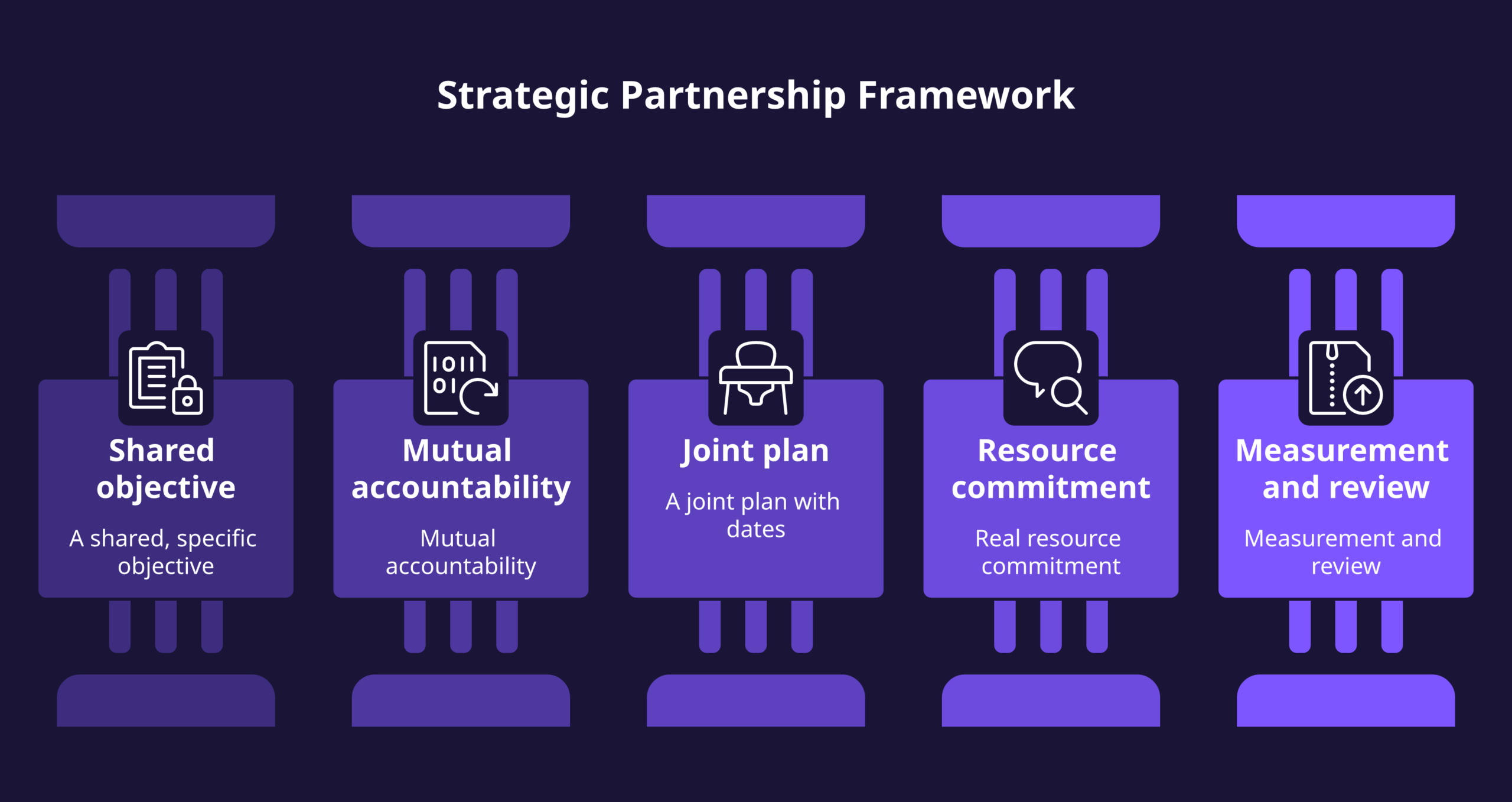
- A shared, specific objective: name the joint outcome in numbers, a revenue target, a market entry, a product capability, not “explore synergies.” If the two companies cannot state the goal in one sentence, there is no partnership to run yet.
- Mutual accountability: each side names who owns the relationship, backed by an executive sponsor who can unblock resources. A partnership with no owner on either side is a partnership no one runs.
- A joint plan with dates: the specific plays, milestones, and owners that move the objective, written down and revisited. Intent without a dated plan drifts within a quarter.
- Real resource commitment: people, budget, or product time actually allocated, not promised in the kickoff. The most common failure is both sides assuming the other will do the work.
- Measurement and review: a monthly or quarterly business review against the objective, where sourced pipeline and progress are on the table. Without a scoreboard, the partnership coasts on goodwill until it quietly ends.
The pattern is that a strategic partnership is an operating system, not an agreement. The contract sets the terms; the five components decide whether anything happens after the signatures.
Common pitfalls
- The press-release partnership: two logos and a quote, then nothing resourced. The announcement is treated as the achievement.
- A vague objective: “explore opportunities” and “drive synergies” are not goals. Without a specific, measurable outcome, no one can tell whether the partnership is working.
- No executive sponsor: partnerships that lack an exec on each side who can move budget and people stall the first time they need a resource decision.
- Unresourced commitment: both sides expect the other to staff the work. Nothing gets done and each blames the other’s lack of effort.
- No review cadence: a partnership with no standing review has no way to catch drift, so it drifts, and by the time anyone looks it is already dead.
What this looks like in practice
The strongest version I have run started as a scoring exercise, not a signing ceremony. Two companies sat down and rated the partnership honestly against a framework: are the right people involved, is there real motivation on both sides, is the internal politics survivable, and is each side moving at a pace the other can match. Those four questions, the underwriting criteria I use, told them where the partnership was strong and where it would break before they committed serious resources.
From there it became an operating rhythm. Each side named an owner. There was a monthly business review where the sponsor from each company showed up and the sourced pipeline was on the screen. The plan had dates. When something slipped, the review caught it that month instead of two quarters later. That is not glamorous, and it is exactly why it worked: the partnership had a scoreboard, so it could not quietly disappear.
The contrast is the announced-and-abandoned version I see far more often. A logo swap, an enthusiastic kickoff, and six months later two teams that each thought the other was driving. Nobody was underwater on it because nobody owned it. The lesson repeats: a strategic partnership lives or dies on whether someone on each side is accountable for a number and shows up to defend it every month.
Forecastable’s POV
A strategic partnership is a resourcing decision disguised as a relationship. The companies that get value from them are the ones that treat the alliance like any other bet on the plan: a named owner, an objective in numbers, a cadence, and a scoreboard. The companies that get burned are the ones that treat the announcement as the deliverable and never build the operating layer underneath it.
At Forecastable this is the work we do. We are a partnerships operating platform focused on connecting partner conversations and actions to CRM pipeline and revenue, the flywheel that runs from conversations to actions to pipeline to revenue. The alliance sets the objective; the work we deliver as part of the service is running the cadence, the plays, and the attribution that prove the partnership against that objective, on the Forecastable platform. The handshake answers “are we partners.” We answer “is the partnership producing, and can you show it to a CFO.”
My bet: as partnerships get held to the same forecasting standard as direct sales, the phrase “strategic partnership” stops being a marketing flourish and becomes a line item defended on sourced pipeline. The programs that survive that shift will be the ones that were operated, not announced.
Forecastable is an independent third-party. Any tools or vendors named here are described from public information for the reader’s own evaluation, not as paid placements, and Forecastable does not resell them.
Frequently asked questions
What is a strategic partnership? It is a long-term alliance where two companies commit resources to a shared goal, such as revenue, market access, or a joint product, beyond a single transaction. The defining feature is mutual, resourced commitment, not the announcement.
What is the difference between a strategic partnership and a strategic alliance? The terms are used interchangeably. When people draw a distinction, “strategic alliance” usually implies the largest version, where two sizable companies coordinate across product, marketing, and sales at once, while “strategic partnership” covers the broader idea of a resourced, long-term commitment.
How is a strategic partnership different from a channel partnership? A channel partnership is about distribution, where one company sells another’s product for margin. A strategic partnership is broader and deeper: it aligns two companies around a shared objective that can span product, marketing, and sales, not only resale.
Why do strategic partnerships fail? Most fail because they are announced but not operated. There is no specific objective, no owner on each side, no resourcing, and no review cadence, so the partnership exists in the org chart and nowhere in the actual work.
Who should own a strategic partnership? Each side needs a named owner backed by an executive sponsor who can move budget and people. The owner runs the plan and the cadence; the sponsor unblocks the resource decisions the partnership depends on.
How do you measure a strategic partnership? Tie it to the objective you set: sourced and influenced pipeline, market entry milestones, or product delivery, reviewed on a monthly or quarterly cadence. A partnership with no scoreboard cannot be defended in a budget review.
Next step
Take your most-cited strategic partnership and write down its objective in one sentence with a number in it. If you cannot, or if two people on your team would write different sentences, you have an announcement, not a partnership, and that is the first thing to fix.
If you want to turn a named alliance into an operating motion with a scoreboard, that is exactly what we do. Start your growth journey with Forecastable and we will build the plan and the review with you. Our partner program guide covers how strategic partnerships fit alongside your other motions.
Uncover Your Growth Potential
Schedule a Discovery Call