MindMatrix vs Salesforce: What to Use for Partners

What is the mindmatrix vs salesforce question really asking?
Short answer: MindMatrix vs Salesforce is not a head-to-head between two products that do the same job, it is a question about two different layers of a partner program. MindMatrix is a partner relationship management and through-channel marketing platform built to recruit, enable, and market through partners, while Salesforce is a CRM built to be the system of record for pipeline and revenue. They overlap at the edges, but choosing between them usually means deciding which layer you need to fix first.
Most teams asking the question already own one of the two. The real decision is whether the tool you have leaves a gap the other one fills.
Why mindmatrix vs salesforce matters in 2026
The reason mindmatrix vs salesforce matters in 2026 is that partner programs are now measured on sourced and influenced pipeline, and that measurement lives in the CRM. A partner marketing platform can run co-branded campaigns and distribute content to hundreds of partners, but if the deals never tie back to CRM opportunities, the program cannot prove revenue. Buyers feel this the moment finance asks what the channel produced.
That tension is why the comparison keeps coming up. Teams buy a PRM and TCMA platform to administer partners at scale, then discover the pipeline story still has to be told in Salesforce. Or they run everything in Salesforce and discover it was never designed to recruit partners, syndicate marketing assets, or manage partner-facing content. Each tool is strong where the other is thin.
The reframe is that the two are complementary far more often than they are competitive. The useful question is which gap is costing you now: partner administration and marketing, or pipeline attribution and reporting.
How mindmatrix and salesforce actually differ
MindMatrix and Salesforce differ across a few layers, and seeing the layers is how you decide. One tool administers and markets to the partner base, the other records and reports the revenue. The parts below map where each is strong so you can match the tool to the gap you feel.
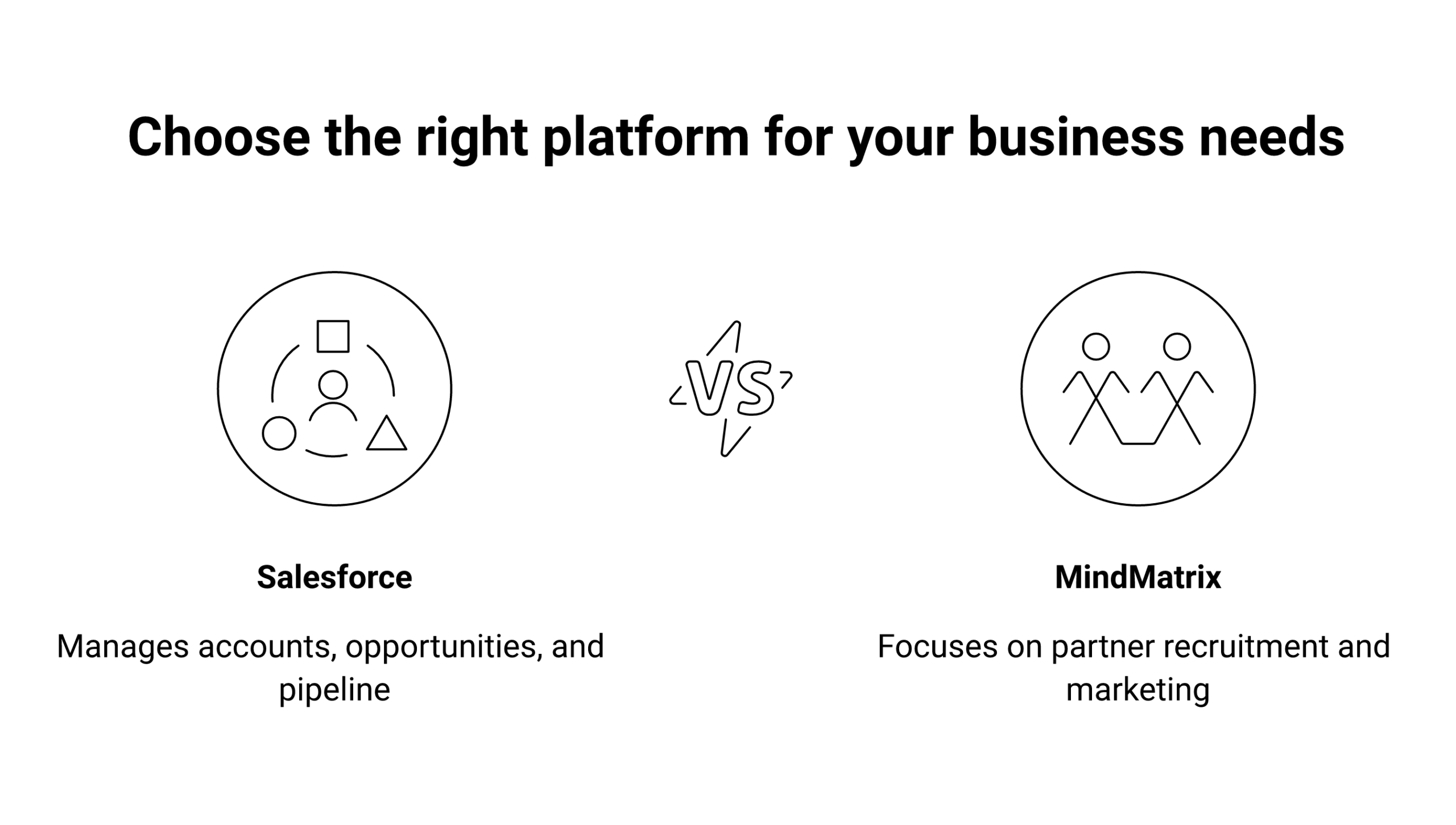
- System of record: Salesforce owns the accounts, opportunities, and pipeline that finance trusts. MindMatrix does not replace that ledger, it feeds and reads from it, so the CRM stays the source of revenue truth.
- Partner recruitment and onboarding: MindMatrix is built to recruit partners, run application and onboarding flows, and manage tiers. A base CRM treats partners as another account type and leaves the program mechanics to you.
- Through-channel marketing: MindMatrix syndicates campaigns, co-branded assets, and content to many partners at once. This through-channel marketing layer is not native to a CRM and is where a partner marketing platform earns its cost.
- Deal registration and partner portal: Both can offer a partner-facing portal and deal registration. Salesforce does it through its PRM add-on on top of Sales Cloud, while MindMatrix ships it as core, so the question is whether you want the portal inside your CRM or beside it.
- Attribution and reporting: Salesforce is where sourced and influenced pipeline gets reported to leadership. Whatever partner activity happens in MindMatrix only counts once it connects back to CRM opportunities.
Common pitfalls when comparing mindmatrix vs salesforce
- Treating it as one tool replacing the other: They sit at different layers. Buying MindMatrix does not retire your CRM, and standing up Salesforce PRM does not give you a through-channel marketing engine. Expecting a full swap leaves you short on one side.
- Skipping the CRM connection: A partner marketing platform that does not write back to CRM opportunities produces activity nobody can attribute. Insist on the integration, because unmeasured channel activity gets cut in the next budget review.
- Buying marketing scale before you have partners to market through: Through-channel syndication only pays off with a partner base large enough to justify it. A ten-partner program does not need mass campaign distribution yet.
- Underestimating the Salesforce PRM lift: Salesforce can run a partner portal and deal registration, but it is a configuration and licensing project, not a switch. Scope the build before assuming the CRM already covers the partner layer.
- Ignoring who administers it: MindMatrix needs a partner marketing owner to run syndication; Salesforce PRM needs admin capacity. A tool with no owner produces the same result either way, which is nothing.
Tools and examples
The two products anchor different layers, and a real stack usually includes more than either alone. The table groups where each fits so you can match tools to the layer you need.
| Layer | What it covers | Representative tools |
|---|---|---|
| CRM and system of record | Accounts, opportunities, pipeline, revenue reporting | Salesforce, HubSpot |
| PRM and partner administration | Recruitment, onboarding, tiers, deal registration, portal | MindMatrix, Impartner, ZINFI, Introw, Euler |
| Through-channel and partner marketing | Campaign syndication, co-branded assets, content distribution | MindMatrix, Channelscaler (formerly Allbound) |
A worked example: a mid-market software company ran its whole channel in Salesforce and could report partner-sourced pipeline cleanly, but recruiting and enabling partners was all manual, and marketing assets reached partners over email. It added a PRM and through-channel layer to recruit and syndicate at scale, then wired every registered deal back to a Salesforce opportunity. Salesforce stayed the revenue ledger, the PRM handled the partner mechanics, and the two together did what neither did alone. The lesson was that the choice was never either-or; it was which layer to add to the one they already trusted.
Forecastable’s POV on mindmatrix vs salesforce
Our position is that mindmatrix vs salesforce is a layering question dressed up as a fight. A CRM is the system of record for pipeline and revenue, and you do not walk away from that ledger. A PRM and through-channel platform administers and markets to partners at a scale a CRM was never built for. The mistake is framing them as substitutes and expecting one purchase to solve both problems.
The way we would run the decision is to name the gap that is actually costing you. If you cannot recruit, onboard, or market through partners at scale, that is the PRM and TCMA layer. If your partner activity never shows up as attributable pipeline, that is the CRM connection. Buy for the gap, insist the two systems talk, and keep the CRM as the place revenue is proven.
Forecastable is a partnerships operating platform that connects partner conversations and actions to CRM pipeline and revenue, the flywheel of Conversations to Actions to Pipeline to Revenue. We are a category authority on running partner-led growth, so we sit complementary to both a PRM like MindMatrix and a CRM like Salesforce, making it visible which partner conversations and actions actually turn into revenue rather than which campaigns were sent.
Any third-party tools or firms referenced here are independent third-party products, and mentioning them is not an endorsement. Evaluate MindMatrix, Salesforce, and any PRM against your own CRM, partner base, and program stage before committing.
Frequently asked questions
Is MindMatrix a replacement for Salesforce? No. MindMatrix is a PRM and through-channel marketing platform for recruiting, enabling, and marketing through partners; Salesforce is the CRM system of record for pipeline and revenue. Most programs run both, with partner activity connecting back to CRM opportunities.
Does Salesforce have its own PRM? Yes. Salesforce offers partner relationship management through a portal and deal registration built on top of its CRM. It covers the partner-facing basics, but standing it up is a configuration and licensing project, and it does not include through-channel marketing syndication.
When should I choose MindMatrix over Salesforce PRM? When your gap is recruiting, onboarding, and marketing through many partners at scale, a dedicated PRM and TCMA platform is built for that. When your gap is pipeline attribution, the answer is tighter CRM connection, not a new marketing platform.
Can MindMatrix and Salesforce work together? Yes, and that is the common setup. The PRM handles partner administration and marketing while the CRM stays the revenue ledger, with registered deals and partner activity written back to CRM opportunities so the program is measurable.
What about other PRM options? Impartner, ZINFI, Introw, and Euler are full-suite PRM options worth weighing alongside MindMatrix, depending on program size and whether through-channel marketing is a priority. Match the tool to the layer and stage, not to a brand.
How do I keep the comparison honest? Score each tool only on the layer you are trying to fix, confirm it connects to your CRM, and check that a real owner will run it. A tool with no owner and no CRM connection produces no measurable channel regardless of which one you pick.
Next step
If you are weighing mindmatrix vs salesforce, the honest move is to name the layer that is costing you, buy for that gap, and keep the CRM as the place revenue is proven. Start your growth journey now to connect partner activity to pipeline so the tools you pick are measured by revenue. The partner tech hub sets the wider context for how these layers fit together.
Uncover Your Growth Potential
Schedule a Discovery Call