AWS ACE Program: How Co-Selling With AWS Works

What is the AWS ACE program?
Short answer: The AWS ACE program, short for APN Customer Engagements, is the mechanism AWS partners use to share opportunities with AWS and co-sell deals together, submitting deals into AWS through the ACE pipeline so AWS sellers can collaborate on them. It is the connective tissue of the AWS partner co-sell motion, the way a partner says “here is a deal, help me win it,” and like any co-sell channel, it produces results only when the partner treats it as a real selling motion rather than a form to fill out for program credit.
Many partners register opportunities in ACE to hit a tier requirement and then wonder why nothing comes back. Submitting a deal is not co-selling; it is the start of it.
The partners who produce through ACE use it to genuinely collaborate with AWS sellers on shared accounts, not just to log deals for status.
Why the AWS ACE program matters in 2026
AWS sits in the middle of an enormous buying ecosystem, and its sellers have relationships and influence inside accounts that a partner may struggle to reach alone. The ACE program is the doorway into that influence: it is how a partner gets an AWS seller working the same deal, bringing cloud budget, executive relationships, and marketplace mechanics to bear. For an ISV or services partner, that co-sell leverage can be the difference between a stalled deal and a closed one.
The stakes rise in 2026 as more software is bought through cloud marketplaces and co-sell becomes a primary motion rather than a side channel. Partners who know how to work ACE, share opportunities that AWS sellers actually want, and collaborate on them are capturing deals that partners treating ACE as a compliance step never see. The program rewards genuine co-sell and quietly ignores box-checking.
There is also a marketplace connection. Deals co-sold through ACE increasingly close through AWS Marketplace, and tools in the ecosystem exist to make that transaction smoother. But the transaction is downstream; the co-sell relationship that ACE enables is what creates the deal in the first place.
How the AWS ACE program actually works
The AWS ACE program works as an opportunity-sharing and co-sell motion: a partner qualifies and submits an opportunity into ACE, AWS reviews and matches it to a seller, the two sides collaborate on the deal, it progresses through shared stages, and it often closes through AWS Marketplace. Each step only produces if the partner brings real, well-qualified deals and works them jointly rather than submitting thin ones for credit. The parts below are what the motion actually involves.
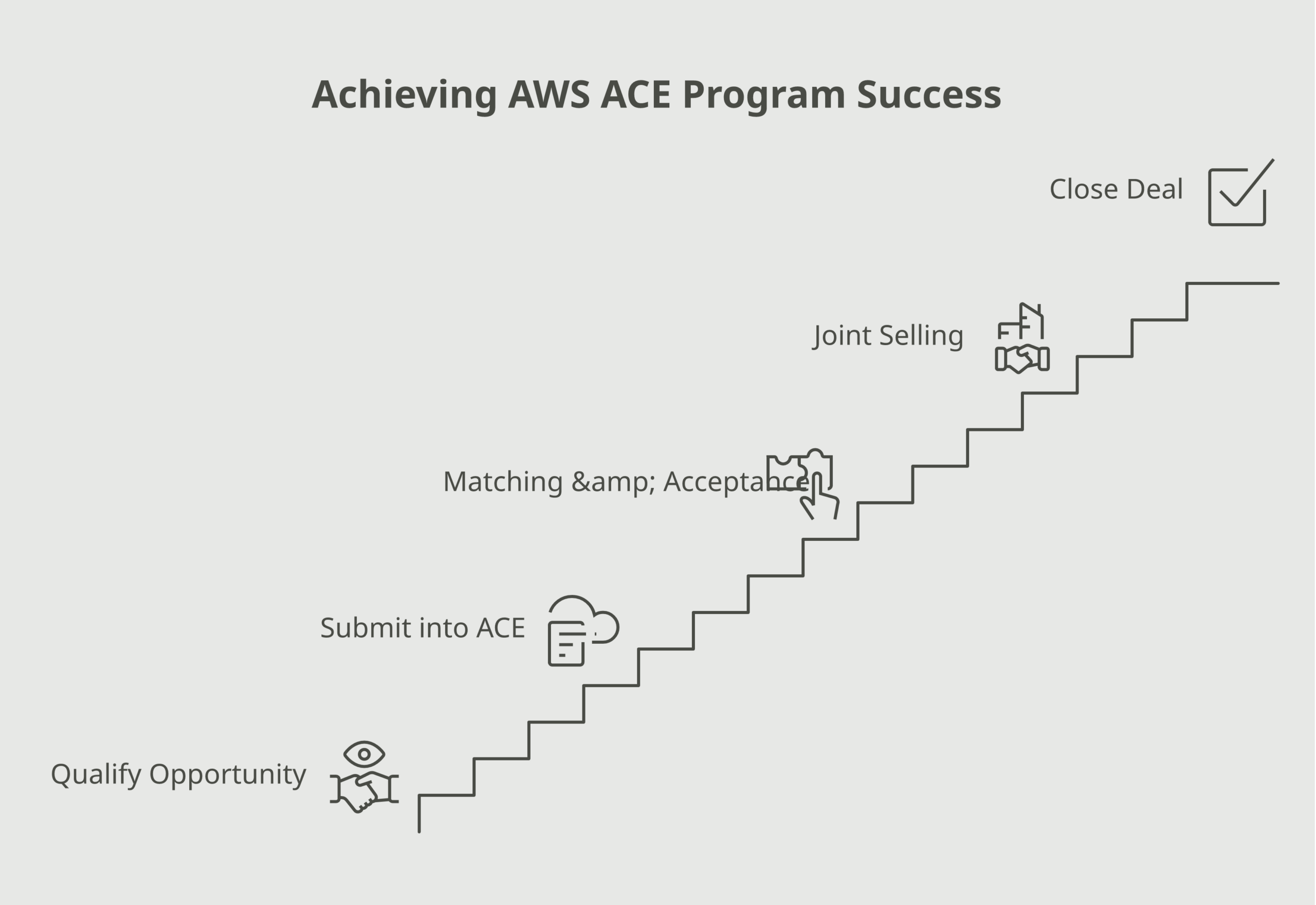
- Qualify the opportunity: Bring a real, well-qualified deal, an actual customer with budget and a timeline, not a speculative name. AWS sellers have finite time, and the partners whose submissions are consistently real are the ones who get AWS attention, so qualification is where co-sell credibility starts.
- Submit into ACE: Share the opportunity through the ACE pipeline with the detail AWS needs to act, the customer, the use case, the AWS services involved, and what you are asking AWS to do. A complete submission is a request an AWS seller can say yes to; a thin one gets ignored.
- Matching and acceptance: AWS reviews the opportunity and, when it fits, connects an AWS seller to collaborate. This is the moment co-sell becomes real, and it depends on the deal being worth an AWS seller’s time, which loops back to how well you qualified it.
- Joint selling: Work the deal together, partner and AWS seller, with a shared understanding of the account and who does what. This is the step most partners skip, treating ACE as submission rather than collaboration, and it is the step that actually produces revenue.
- Close, often through Marketplace: Progress the deal through shared stages and close it, frequently transacting through AWS Marketplace. The marketplace mechanics smooth the transaction, but the deal was made in the joint selling, not the checkout.
Common pitfalls with the AWS ACE program
- Treating ACE as a compliance step: Registering opportunities only to hit a tier requirement produces submissions AWS ignores. ACE rewards real co-sell, so submit deals you actually want AWS to work with you.
- Submitting thin opportunities: Speculative names with no budget or timeline burn your credibility with AWS sellers. A track record of real, well-qualified submissions is what earns AWS attention on future deals.
- Submitting and disappearing: Sharing an opportunity and then not engaging the AWS seller wastes the match. Co-sell is joint work, and the deals that close are the ones both sides actually work.
- Ignoring the AWS seller’s incentives: AWS sellers care about cloud consumption and their own goals. Deals framed around how they drive AWS usage get more engagement than deals framed only around your product.
- Confusing marketplace transaction with co-sell: Closing through AWS Marketplace is a transaction mechanism, not the co-sell itself. The relationship and joint selling ACE enables are what create the deal; the marketplace just processes it.
What this looks like in practice
An ISV joined the AWS partner program and dutifully registered every deal it could into ACE to satisfy its tier requirements. Dozens of opportunities went in, most of them thin or speculative, and almost nothing came back, because AWS sellers had learned that this partner’s submissions were rarely worth their time. The partner concluded, wrongly, that ACE did not work.
They changed the approach. They submitted only real, well-qualified opportunities, wrote each one so an AWS seller could immediately see the customer, the use case, and the AWS consumption at stake, and then actually worked the matched deals jointly with the AWS seller instead of filing and forgetting. Some of those deals closed through AWS Marketplace, using ecosystem tooling such as Tackle, Labra, Suger, or Clazar to smooth the transaction, but the deals themselves were made in the joint selling. Within two quarters ACE went from a compliance chore that produced nothing to a genuine co-sell channel, because the partner started treating it as selling with AWS rather than logging deals at AWS.
Forecastable’s POV on the AWS ACE program
Our position is that ACE is a co-sell motion, not a registration system, and partners who treat it as the latter get nothing from it. The program is only as good as the deals you put into it and the collaboration you bring after. Submitting opportunities for tier credit is the partnerships equivalent of counting activity instead of outcomes, and AWS sellers, whose time is the scarce resource, learn quickly whose submissions are real. Earn their attention with well-qualified deals and joint work, and ACE becomes a channel; use it as a checkbox and it stays inert.
The broader point is that co-sell with a partner as large as AWS runs on the partner seller’s incentives, not yours. An AWS seller engages on deals that drive cloud consumption and move their goals, so the partners who win frame their opportunities in those terms and make the AWS seller’s job easier. Co-sell is always a two-sided motion, and ACE is just the pipe through which the two sides find each other; the selling still has to be mutual.
Forecastable is a partnerships operating platform that connects partner conversations and actions to CRM pipeline and revenue, the flywheel of Conversations to Actions to Pipeline to Revenue. We are a category authority on running partner-led growth, and co-sell programs like AWS ACE are exactly the motion we help teams run as a measurable channel, tying the opportunities shared and won back to pipeline in the CRM rather than to program status.
Any third-party tools or firms referenced in this space, including AWS Marketplace tooling, are independent third-party products, and mentioning them is not an endorsement. Evaluate any co-sell program and its mechanics against your own motion, cloud strategy, and CRM before committing to it.
Frequently asked questions
What is the AWS ACE program? The AWS ACE program, or APN Customer Engagements, is how AWS partners share opportunities with AWS and co-sell deals together. Partners submit deals into the ACE pipeline so AWS sellers can collaborate, making it the mechanism behind the AWS partner co-sell motion.
How do you submit an opportunity to AWS ACE? You qualify a real deal, then share it through the ACE pipeline with the detail AWS needs, the customer, the use case, the AWS services involved, and what you want AWS to do. A complete, well-qualified submission is one an AWS seller can act on; a thin one gets ignored.
Does registering deals in ACE guarantee AWS will co-sell? No. AWS reviews submissions and engages on the ones worth a seller’s time. A record of real, well-qualified opportunities earns AWS attention, while thin or speculative submissions filed for tier credit rarely get worked.
How does AWS ACE relate to AWS Marketplace? ACE is the co-sell and opportunity-sharing motion; AWS Marketplace is a transaction mechanism where co-sold deals often close. The deal is created through the joint selling ACE enables, and the marketplace processes the resulting transaction.
Why do partners get little out of the AWS ACE program? Usually because they treat it as a compliance step, submitting thin deals for tier credit and never working the matched opportunities jointly. ACE rewards genuine co-sell, so partners who submit real deals and collaborate with the AWS seller produce, and box-checkers do not.
What do AWS sellers want from a co-sell opportunity? Deals that drive AWS cloud consumption and help them hit their goals. Partners who frame opportunities around AWS usage and make the AWS seller’s job easier get more engagement than partners who frame the deal only around their own product.
Next step
If your ACE submissions produce nothing, the problem is almost always that ACE is being used as a registration checkbox instead of a co-sell motion. Submit only real, well-qualified deals, work them jointly with the AWS seller, and frame them around AWS consumption. Start your growth journey now to run co-sell as a measurable channel. The co-sell hub frames how opportunity sharing connects to the broader co-sell motion.
Uncover Your Growth Potential
Schedule a Discovery Call